


The Sales Acceleration Formula — Cliff Notes Summary
Quality
Certified

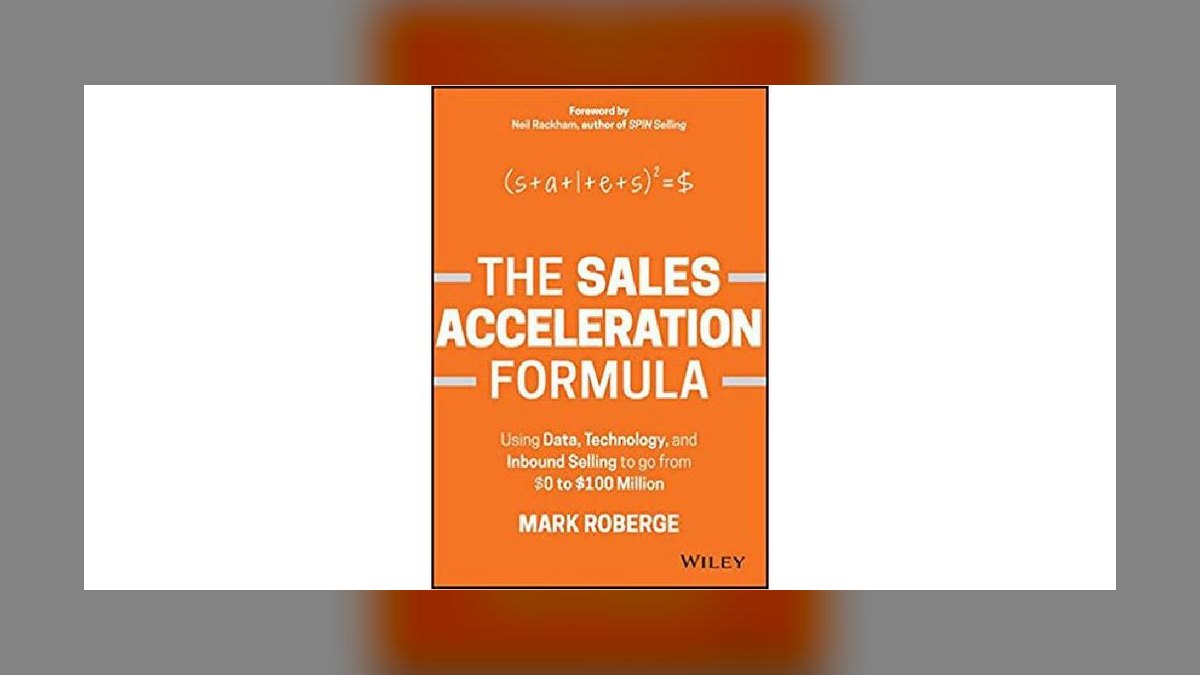
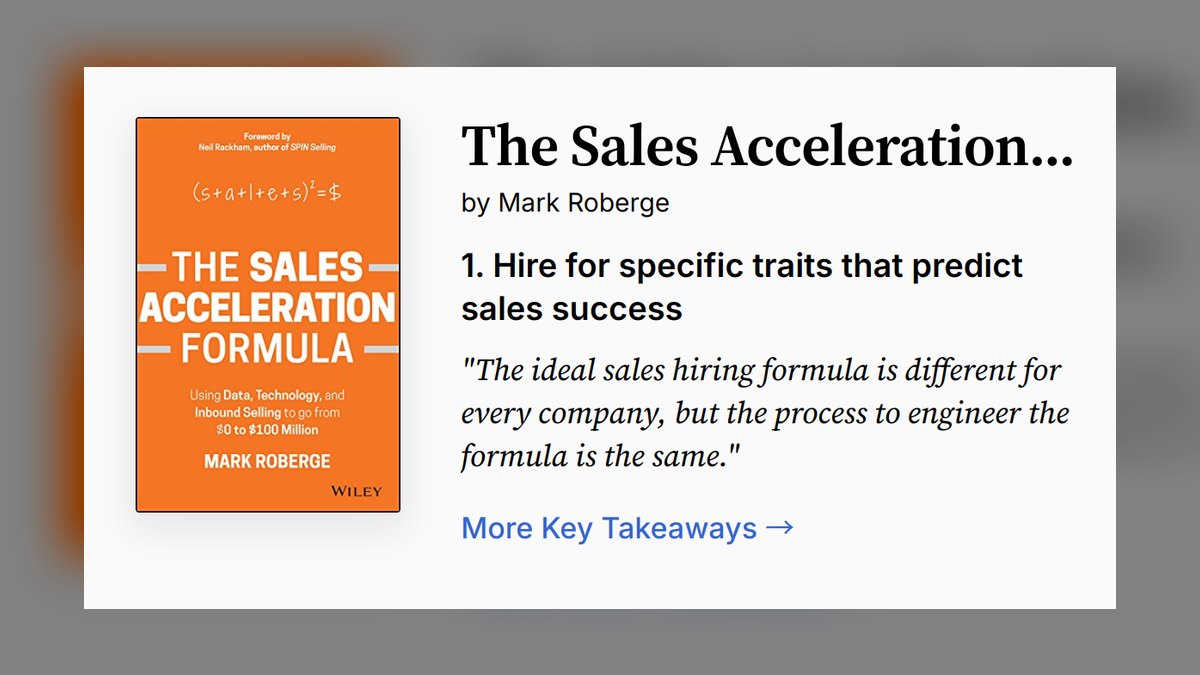
*The Sales Acceleration Formula* by Mark Roberge is HubSpot's $0-to-$100M ARR playbook, and its summary is simple: treat hiring, training, managing, and demand generation as engineering problems solved with metrics, scorecards, and repeatable experiments. Published by Wiley in 2015, it remains the default operating manual for first-time VPs of Sales.
The outcome you should expect
Read the book expecting a system, not a set of tips. The outcome Roberge promises — and the one HubSpot actually delivered — is a sales motion where the variance between reps narrows enough that revenue becomes forecastable. That is the real product of the book. Not more aggressive closers, not a better pitch deck: a smaller standard deviation across your rep population, which is what makes a number predictable a quarter out.
Concretely, teams that implement the four formulas with discipline tend to see three shifts. First, hiring stops being a coin flip. When you score candidates against a written rubric rather than a gut read, your ramped-rep success rate moves from something like half of hires working out to a clear majority — and more importantly, you can explain *why* a hire failed, which lets you fix the rubric. Second, ramp time compresses. Certification-based onboarding replaces shadowing, and new reps hit their first closed-won faster because they are not waiting for a senior rep's calendar to open up. Third, coaching stops being a monthly vent session and becomes a measured intervention with a leading metric attached.
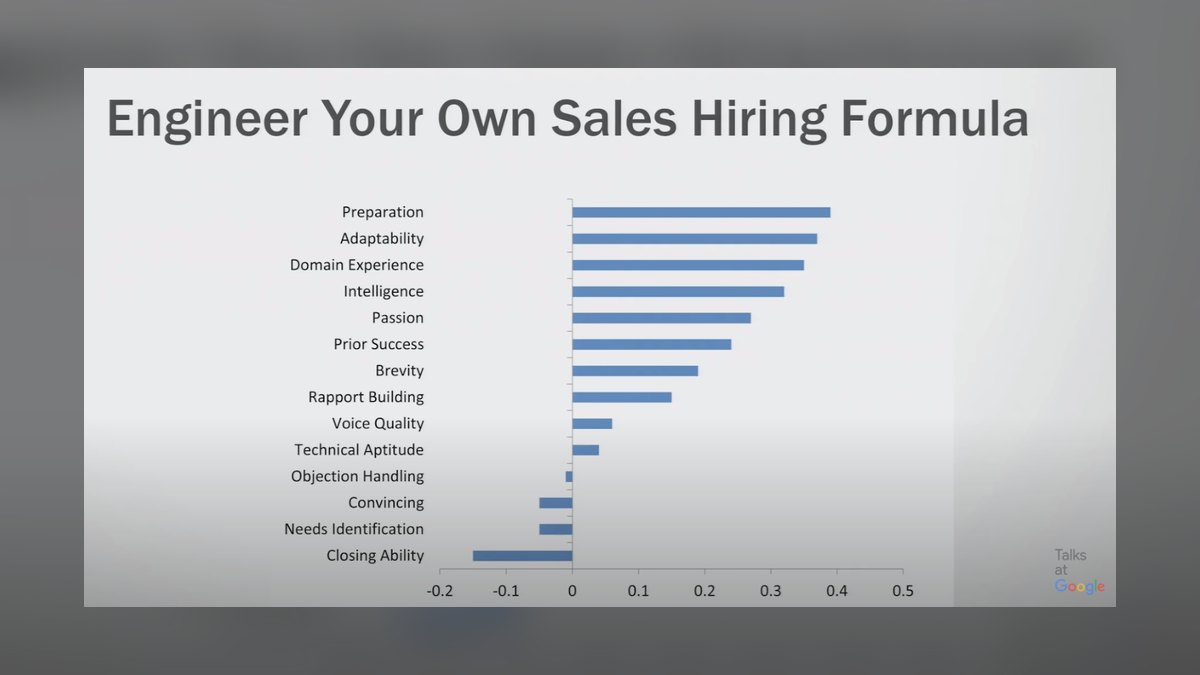
What you should *not* expect is a magic number. Roberge is careful about this and most summaries flatten it. The five traits his regression surfaced at HubSpot — coachability, curiosity, prior success, intelligence, work ethic — were true *for HubSpot's buyer and product in that era*. The transferable asset is the regression method itself: hire twenty reps, score them on a dozen dimensions at intake, wait four quarters, then run the correlation and keep only the dimensions that predicted quota attainment. If you copy the trait list without running your own regression, you have copied the answer to somebody else's exam.
The adjacent outcome, and one worth naming, is organizational. Once sales has a scorecard, marketing gets pulled into the same discipline, and so does customer success. The Marketing-Sales SLA in the demand-generation chapters is the seam where this happens: marketing commits to a monthly MQL volume at a defined lead score, sales commits to working each lead within a stated time window with a documented outcome, and both bonuses reference the same number. That single artifact is arguably the origin story of the modern RevOps charter. Teams that adopt only the hiring chapter get a better recruiting process; teams that adopt the SLA get a different company.
What drives that outcome
The engine underneath every chapter is the same three-step loop: instrument a behavior, tie it to a leading metric, then run a bounded experiment against that metric. Roberge applies it to hiring, to onboarding, to coaching, to comp design, and to tooling. Understanding the loop matters more than memorizing the chapter order, because the loop is what you actually port into your own company.
Start with hiring. The mechanism is that a written, anchored rubric removes interviewer variance. Every trait gets a 1-to-10 scale with defined anchors and a specific question designed to elicit evidence. Coachability is the sharpest example: run a live roleplay, give real feedback, then ask the candidate to redo the roleplay applying that feedback inside the same call. A candidate who nods politely and repeats the original performance scores in the bottom third. A candidate who visibly adjusts scores high. Every interviewer submits scores in the ATS *before* the debrief, which kills the anchoring effect where the most senior voice in the room sets the tone and everyone else nods along.
Training works because certification creates a hard gate. New reps at HubSpot could not touch a live lead until they passed scored exams in product, persona, and the qualifying matrix. Failing meant retaking the module, not graduating with a warning. The curriculum itself rests on three artifacts every methodology needs: the buyer journey (what the customer does), the sales process (what the rep does in response), and the qualifying matrix (the data the rep must collect). The famous flourish is "sell like a marketer" — Roberge had new reps start a blog and publish three posts a week for thirty days during onboarding, then study the analytics. The point was not content marketing. It was that a rep who has personally tried to earn a stranger's attention stops pitching features and starts diagnosing problems. The 2020s version is rep-led LinkedIn posting or a personal newsletter; same mechanism, different pipe.
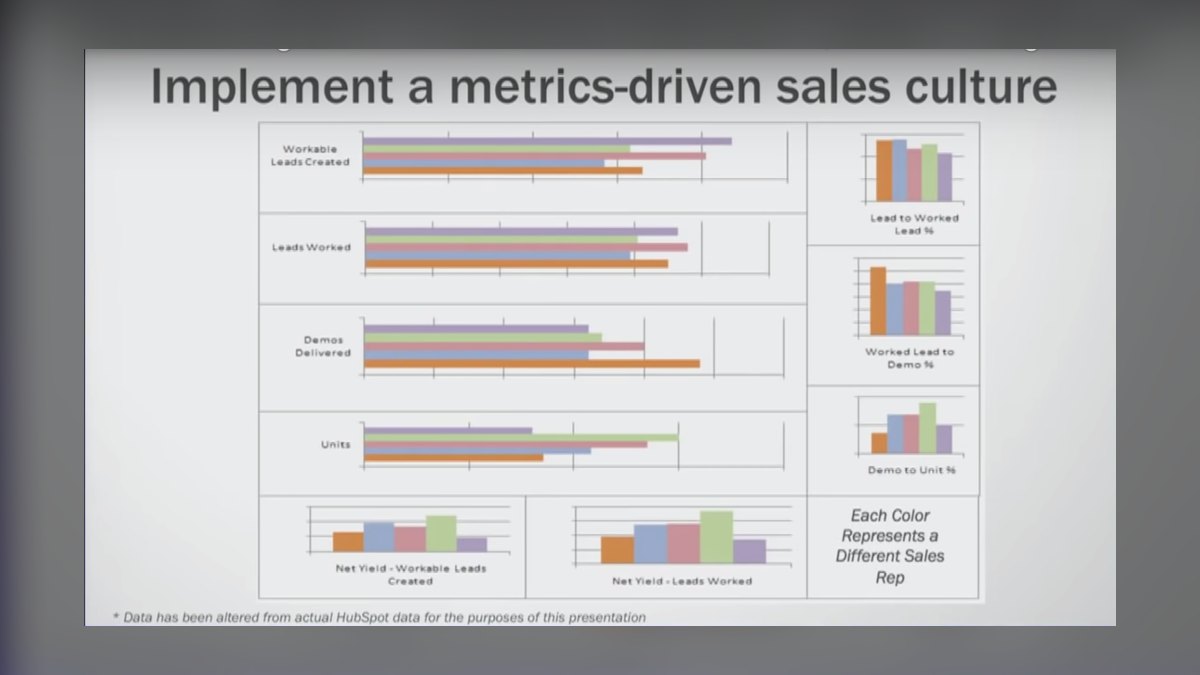
Management works because the unit of coaching is one skill, not fifteen. Each month, rep and manager co-author a one-page plan: the skill name, why it matters, a leading metric that will prove improvement, and the tactic the rep will run. A rep might work discovery questioning in January, multi-threading in February, closing technique in March. The metric is deliberately upstream of quota — for discovery, something like "percentage of deals with documented pain inside fourteen days," never "January bookings." That distinction is what lets the month-end review be a blameless retro against a number both parties agreed to in advance, rather than an argument about effort.

Compensation is treated as a teaching instrument rather than a payout schedule. HubSpot ran three distinct plans over its scaling years — one weighted toward customer success outcomes, one toward hunting new logos, one toward customer acquisition volume — each engineered to shift a specific behavior. Sales contests get the same framing: a two-week contest is a hypothesis that a particular incentive will move a particular behavior, and if the contest fails you have bought a cheap lesson. Chapter nine adds the staffing counterpart, noting HubSpot promoted the overwhelming majority of its sales managers internally, trading slower early performance for longer tenure and intact culture.
The technology chapter supplies the discipline that keeps the rest honest. Roberge insists every sales motion reduces to one underlying number — deals per rep per month — and that every tool purchase must be judged against whether it moves that number inside ninety days. Rollouts at HubSpot ran as four-week experiments on a single team, followed by a scorecard review and a kill-or-scale decision. No tool was bought on the strength of a vendor demo. That gate is more useful now than when it was written, because the tooling landscape has multiplied: conversation intelligence, forecasting platforms, sequencers, data enrichment, AI roleplay tools. Each one deserves the same four-week trial and the same brutal scorecard.
Benchmarks and realistic ranges
Be careful with benchmarks here, because the book's headline numbers describe one company in one era. HubSpot's $0-to-$100M ARR in roughly seven years is the outcome, not a target you should hold yourself to. Treat the following as ranges to plan against, and replace each with your own measured figure as soon as you have twenty data points of your own.

Hiring sample size. Roberge's regression method needs a population before it produces signal. Twenty ramped hires with four quarters of attainment data is the practical floor; below that you are reading noise. If you are pre-twenty, run the rubric anyway and record the scores — you are building the dataset that will let you run the regression later. Small teams often skip this and then wonder why year three feels like guesswork.
Ramp time. Certification-based onboarding typically pulls first-deal ramp forward, but the size of the gain depends on deal complexity. A transactional SMB motion with a two-to-four-week sales cycle may see full productivity in one to two months. A mid-market motion with a two-to-three-month cycle usually needs three to six months regardless of how good the curriculum is, because the rep cannot close what has not had time to progress. Enterprise ramp of six to nine months is normal and no onboarding program compresses it dramatically. The realistic claim is that certification reduces *variance* in ramp more than it reduces the average.
Coaching cadence. One skill per month means twelve interventions a year per rep, which sounds modest and is exactly the point. Managers who try to coach four skills a month coach none of them. A manager carrying six to eight direct reports can sustain the one-page plan, a mid-month check, and a month-end retro. At ten or more reports, the loop degrades into a form-filling exercise; that ratio is a load-bearing constraint the book does not stress enough.
The SLA numbers. The marketing side of the agreement should specify a monthly MQL count at a defined lead score, and the sales side should specify a response window and a documented outcome. Response windows in the book's era were measured in hours; teams running high-intent inbound now often commit to minutes for demo requests and hours for content-sourced leads. The exact number matters less than the fact that it is written, mutual, and reviewed monthly with both leaders in the room.

Deals per rep per month. This is the book's single metric, and its realistic range varies wildly by ACV. A high-velocity motion at low four-figure ACV might expect several deals per rep per month; a mid-market motion at five-figure ACV might expect one to three; enterprise reps close a handful per year. The benchmark is not the absolute number, it is the trend line after each experiment. If a tool, a comp change, or a coaching focus does not move your own baseline within ninety days, kill it.
Where the book's benchmarks have aged. The demand-generation chapters assume a content landscape with far less competition than exists now. "Publish daily and the MQLs will come" was a genuine arbitrage in HubSpot's scaling years and is table stakes today. The directional claim — buyers research before they talk to a rep, so show up where the research happens — has only become more true; the specific tactic has commoditized. Operators arguing for demand *creation* through podcasts, dark social, and creator partnerships are extending Roberge's logic rather than contradicting it. Similarly, the book pre-dates product-led growth, so a modern reader running a PLG motion needs to layer product-qualified lead scoring on top of the fit-and-interest matrix rather than replacing it.
Risks, edge cases, and failure modes
The most common failure is cherry-picking. Teams adopt the hiring scorecard, ignore the certification curriculum and the coaching loop, and then conclude the rubric does not work. It does not work in isolation because the rubric selects for coachability — and coachability only pays off if there is something structured to be coached into. A high-coachability hire dropped into a shadow-a-senior-rep onboarding produces the same mediocre outcome as anyone else. The four formulas are a chain; a broken link zeroes the product.
The second failure is copying HubSpot's trait list as gospel. If your product requires deep domain expertise — clinical, industrial, regulatory — prior success and intelligence may weight very differently than they did for a marketing SaaS tool sold to SMBs. Run the regression against your own attainment data. The book explicitly says this, and summaries reliably omit it.
Third, the leading-metric discipline is easy to game. If the coaching metric is "percentage of deals with documented pain," reps will document pain. Whether that documentation reflects a real conversation is a separate question, and the manager has to spot-check call recordings or read the notes rather than trusting the dashboard. Any metric that is both the coaching target and the performance measure will drift toward the letter of the definition. Rotate what you inspect.
Fourth, contests-as-experiments can corrode trust if run carelessly. A two-week contest that materially changes take-home pay is not a low-stakes A/B test to the rep living it. Keep the incentive meaningful but bounded, announce the hypothesis openly, and share what you learned when it ends — including when it failed. Treating reps as experimental subjects without telling them is the fastest way to make the whole engineering framing feel cynical.
Fifth, promote-from-within has a real edge case. It scales culture and preserves institutional knowledge, but a team that only ever promotes internally can calcify around one way of selling. If your motion is shifting — moving upmarket, adding a PLG layer, entering a regulated vertical — you need at least some external hires who have run that motion before. The honest version of the trade-off is a mix, weighted internal, with deliberate external hires at inflection points.
Sixth, and most current: the technology gate cuts against the way AI tooling is being sold. Vendors now pitch platform-level transformation with adoption timelines longer than ninety days, which makes the four-week experiment awkward to run. The workaround is to scope the experiment to one measurable behavior rather than the whole platform — test whether AI-drafted follow-ups increase reply rate on one team for four weeks, not whether "AI transforms our sales org." Keep the unit of evidence small enough to actually measure.
Finally, the book is genuinely incomplete at the front end, and Roberge has said so. His later work through Stage 2 Capital frames the original as the playbook for what comes *after* product-market fit, arguing that most teams who tried to install the formula were still hunting for fit and go-to-market fit — stages the 2015 book barely covers. Installing a hiring regression and a certification curriculum before you know who buys and why is expensive theater. Read the front-end material first if you are pre-fit.
A practical rollout plan
You do not need a reorganization to start. The book is modular by design, and the correct move is one formula at a time on a ninety-day clock, with each formula's leading metric baselined before you touch anything.
Week one is measurement only. Pull your current baseline: deals per rep per month, ramp time to first closed-won, ramped-rep attainment distribution, and lead response time. Resist changing anything until these are written down, because every later claim of improvement depends on knowing where you started.
Weeks two through four install the hiring rubric. Pick five to seven traits, write anchored 1-to-10 definitions for each, and attach one interview question per trait that produces evidence rather than opinion. Build the coachability roleplay-feedback-redo sequence into the loop. Enforce independent scoring in the ATS before every debrief. You will not have regression data yet — that is fine, you are creating the dataset.
Weeks five through eight rebuild onboarding into certification. Document the three artifacts first: buyer journey, sales process, qualifying matrix. Then write a scored exam per module and set the gate — no live leads until passed. If you have an existing team, have them take the exam too; the failure pattern in the results will tell you where your process documentation is actually vague.
Weeks nine through twelve start the coaching loop. One skill per rep, one page, one leading metric, one tactic. Run the mid-month check and the month-end retro. Do not add a second skill.
Quarter two belongs to the SLA. Get the marketing leader in a room, agree on a monthly MQL commitment at a defined lead score, agree on the sales-side response window and documented-outcome requirement, and put both on a shared dashboard reviewed monthly. Tie a portion of both leaders' variable comp to the same number. This is the highest-leverage artifact in the book and also the one most likely to stall on politics, which is why it gets its own quarter rather than being squeezed into the first ninety days.
Quarter three is tooling. One experiment per month, four weeks on a single team, a scorecard review, then kill or roll out. Judge everything against deals per rep per month. Say no to anything that cannot be scoped to a measurable four-week test.
The compressed version of this whole strategy fits in a sentence: one rubric, one skill, one SLA, one experiment. That is the Monday-morning summary of the Acceleration Formula, and it is far more likely to survive contact with a real quarter than a twelve-month transformation program.
Related questions
Is the book still worth reading given it was published in 2015?
Yes, for the method rather than the tactics. The hiring regression, certification gate, one-skill coaching loop, and Marketing-Sales SLA all still hold. The inbound demand-generation chapters have aged most, and the book pre-dates product-led growth entirely.
Does it only apply to SaaS?

The examples are SaaS, but the frameworks port to any B2B motion with repeatable deals — professional services, fintech, industrial equipment. What needs adjusting is the trait weighting and the qualifying matrix, since domain expertise matters more in some markets than HubSpot's did.
What should a founder read alongside it?
Roberge's own later work on scaling stages, which covers the product-market-fit and go-to-market-fit stages the 2015 book assumes you have already cleared. Pair it with a methodology text — MEDDIC or a discovery-focused book — for the in-call mechanics the formula does not teach.
When in a company's life is it most useful?
Around rep number five, or the week you take a first VP of Sales title. Earlier than that you are still finding fit; much later and you are retrofitting a system onto habits that have already hardened across dozens of people.
What is the single highest-leverage chapter?
The management chapter on one-skill-per-month coaching. It requires no budget, no headcount, and no cross-functional negotiation, and it changes manager behavior within a single month.
FAQ
What is the main idea of The Sales Acceleration Formula?
Apply engineering discipline — measurement, hypothesis, bounded experiment — to every part of sales rather than treating selling as an art. Roberge argues hiring, training, managing, and demand generation are all systems that can be instrumented and improved predictably, which is how HubSpot scaled from zero to $100M ARR.
What are the five traits in the hiring formula?
Coachability, curiosity, prior success, intelligence, and work ethic. Traits conventionally associated with sales — aggression, slick objection handling — correlated poorly at HubSpot. The important caveat is that these came from HubSpot's own regression; the method transfers, the specific list may not.
How long does implementation actually take?
Expect visible movement on hiring quality and coaching consistency within three to six months, and a full organizational shift across all four formulas in twelve to eighteen months. Rolling out one formula per quarter is more durable than attempting all four at once.
Does the book cover AI tools or product-led growth?
No. It was written before both waves. The four-week experiment gate in the technology chapter is the right framework for evaluating AI tooling, and PLG teams should layer product-qualified lead scoring on top of the fit-and-interest qualifying matrix rather than discarding it.
What is the most common implementation mistake?
Cherry-picking one formula. The hiring rubric selects for coachability, which only pays off if a real coaching and certification system exists to receive it. Teams that install the scorecard without the curriculum and the monthly skill loop typically conclude the scorecard does not work.
Is the "sell like a marketer" blogging exercise still relevant?
The mechanism is, the medium has moved. The goal was empathy — reps who have tried to earn a stranger's attention stop leading with features. Rep-led LinkedIn posting or a personal newsletter accomplishes the same thing with distribution that fits the current landscape.
Sources
- Wiley — The Sales Acceleration Formula publisher page
- O'Reilly — full book table of contents and chapter view
- Amazon — The Sales Acceleration Formula by Mark Roberge
- Stage 2 Capital — Mark Roberge's firm and scaling research
- Harvard Business School — Mark Roberge faculty profile
- Nat Eliason — detailed reader notes on the book
- HubSpot — Service Level Agreement between sales and marketing
- Mark Roberge — LinkedIn profile
Related on PULSE
- The Advantage by Patrick Lencioni — Cliff Notes Summary for Sales Leaders
- Major Account Sales Strategy by Neil Rackham: Summary, Key Lessons, and RevOps Takeaways
- Demand-Side Sales 101 by Bob Moesta: Summary, Key Lessons, and RevOps Takeaways
- Cracking the Sales Management Code by Jason Jordan and Michelle Vazzana: Summary, Key Lessons, and RevOps Takeaways
This page will be disappearing soon. Save it to your device for $1 — or read it free while it is here.
@Kory-White- · if Venmo asks, the last 4 of my number are 2012
This page is gone.
This one is off the shelf now. $1 keeps it on your phone for good — the whole page, pictures and diagrams included.
 pulse-recentSnap Selling by Jill Konrath — Top 10 Key Takeaways for Sales Leaders in 2027
 book-summaryMajor Account Sales Strategy by Neil Rackham: Summary, Key Lessons, and RevOps Takeaways
 pulse-recentWhat is the first concrete step in SPIN Selling by Neil Rackham for structuring a discovery call in 2027?
 pulse-recentThe Greatest Salesman in the World by Og Mandino — Top 10 Key Takeaways for Sales Leaders in 2027
 pulse-recentThe Collaborative Sale by Keith Eades — Top 10 Key Takeaways for Sales Leaders in 2027
 pulse-recentTraction by Gabriel Weinberg and Justin Mares — Top 10 Key Takeaways for Sales Leaders in 2027
 pulse-recentMonetizing Innovation by Madhavan Ramanujam — Top 10 Key Takeaways for Sales Leaders in 2027
 pulse-recentThe Sales Acceleration Formula by Mark Roberge — Top 10 Key Takeaways for Sales Leaders in 2027
 pulse-recentSelling Above and Below the Line by Skip Miller — Top 10 Key Takeaways for Sales Leaders in 2027
 pulse-recentWhat are the concrete steps to implement the Sandler Rules for Sales Leaders by David Mattson in 2027?