


The Greatest Salesman in the World — Cliff Notes Summary
Quality
Certified
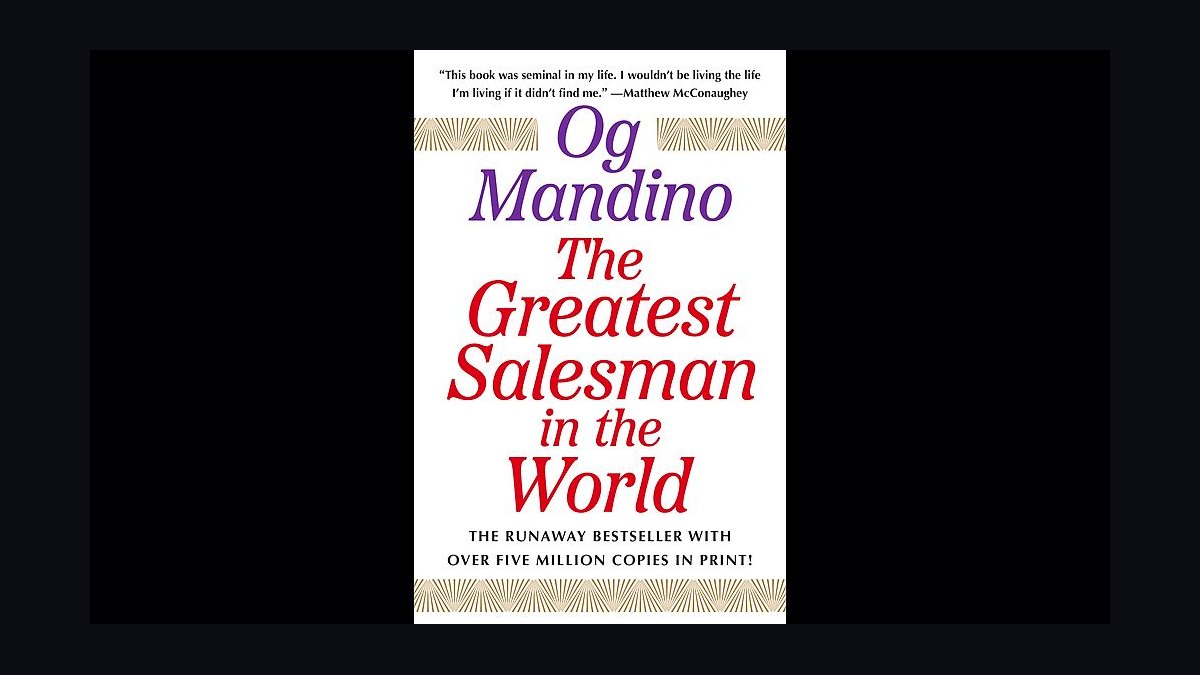
Og Mandino's *The Greatest Salesman in the World* (1968) is a short parable about a camel boy, Hafid, who inherits ten leather scrolls and becomes a legendary merchant. Each scroll is a habit — persistence, self-worth, emotional control, urgency — meant to be read three times daily for thirty days until it becomes reflex.
The outcome you should expect from reading it
Set expectations correctly and the book delivers; set them wrong and it disappoints badly. This is not a sales-methodology text. There is no discovery framework in it, no qualification checklist, no objection-handling taxonomy, no pricing guidance, no account-planning motion. A rep who finishes the book will not know how to run a multi-threaded enterprise cycle, build a mutual action plan, or navigate a procurement gauntlet. What they will have is a rehearsed internal script for the parts of selling that grind people down — rejection, monotony, the slow attrition of self-belief that turns a promising first-year rep into a churned statistic before month nine.
The realistic outcome is behavioral consistency, not skill acquisition. If you already know what a good discovery call sounds like but you only make eleven dials on a Tuesday when you meant to make sixty, Mandino attacks exactly that gap. If you make ninety dials and every one of them goes nowhere because your questions are bad, this book will make you louder and no more effective. That distinction is the single most useful thing to understand before buying it, and it is the thing most reviews skip past.
The reading time is genuinely short — the core text runs roughly 110 to 130 pages depending on edition, most of which is the Hafid novella. A focused reader finishes in two to three hours. The scrolls themselves are each about 400 to 700 words, deliberately written in incantatory, repetitive prose so they can be spoken aloud without stumbling. The prose style is a feature, not a flaw: Mandino wrote them to be recited, and they read strangely on a silent skim.

The secondary outcome, less discussed, is a vocabulary shift. Teams that pass this book around tend to develop shorthand for internal states — "I'm having a Scroll VII morning" is a compact way for a rep to tell a manager they got worked over on a call and need ten minutes. That kind of shared language is a real managerial asset, and it is why sales floors have kept the book in circulation for nearly six decades despite everything about the job changing around it.
What drives that outcome
The mechanism is repetition under emotional load, and it is worth being precise about how Mandino thought it worked. His claim is that a person is always the servant of habits; the only variable is whether those habits compound upward or downward. He treats the scrolls as an installation procedure rather than a reading list. Read one three times a day — morning silently, midday silently, evening aloud — for thirty consecutive days, then advance to the next. Ten scrolls at thirty days each is a ten-month program. The evening reading aloud is the part most people drop, and it is arguably the load-bearing one, since speaking a sentence engages more retrieval than scanning it.
The content of the ten is straightforward once stripped of the archaic phrasing. Scroll I commits the reader to forming good habits deliberately. Scroll II instructs the reader to greet everyone — prospect, gatekeeper, competitor — with warmth held internally, which is a state-control device dressed as a moral instruction. Scroll III is persistence: the famous "I will persist until I succeed," built on the arithmetic that each rejection moves you nearer the acceptance. Scroll IV asserts individual uniqueness and worth, aimed squarely at reps who apologize for existing on a cold call. Scroll V compresses the time horizon to a single day. Scroll VI is emotional mastery — the line about forcing your actions to control your thoughts, rather than the reverse. Scroll VII is perspective and laughter as recovery tools. Scroll VIII is compounding value through goals set at day, month, year, and lifetime tiers. Scroll IX is the anti-procrastination scroll, repeated as "I will act now." Scroll X asks for guidance, framed religiously, though secular readers commonly reinterpret it as a structured end-of-day reflection.
Notice what the diagram implies: results sit at the far end of a long chain, and every link before them is internal. That is the entire argument of the book compressed into one sentence. Mandino's bet is that behavior is upstream of outcome and belief is upstream of behavior, so the highest-leverage intervention is the one furthest from the scoreboard. This is also precisely why the book frustrates analytically minded readers — the causal chain is long, the feedback is slow, and nothing in it is measurable at the point of intervention.
The adjacent workflow worth noting is onboarding design. Ramp programs generally front-load product knowledge and CRM mechanics because those are teachable and testable in week one. Almost nothing in a standard ramp addresses rejection tolerance, which is the actual attrition driver for outbound roles. Mandino occupies that gap cheaply. A paperback costs less than lunch, and the ten-month cadence happens to overlay neatly onto a first-year ramp calendar — which is likely why enablement leaders keep reaching for it despite having far more sophisticated tools available.
Benchmarks and realistic ranges
Treat every number here as a planning range, not a measurement, because the book itself contains no data whatsoever — no studies, no control groups, no cited research. Mandino argued from parable and personal biography. He had been a failed insurance salesman before he wrote it, and that failure is the credential the book leans on. Anyone claiming the ten-scroll protocol has measured efficacy is inventing it.
What can be stated honestly is the shape of the commitment. Full protocol: ten scrolls × thirty days × three readings per day = 900 readings across roughly ten months. At two to four minutes per scroll, that's about thirty to fifty hours of total reading, or six to twelve minutes per day. The daily cost is trivial; the completion rate is not. In practice, most readers who start the protocol abandon it somewhere in the first scroll's thirty days, usually within the first week or two, because three readings a day requires three separate calendar anchors and most people only build one.
The common compressed adaptations, and their honest trade-offs:
One scroll per week, read once daily, ten weeks. Cuts the commitment to about two hours total. You get the content and lose most of the conditioning effect. Reasonable if your goal is comprehension rather than behavior change, which for many readers it honestly is.
One scroll per week, read twice daily, ten weeks. The most common workable middle. Roughly seventy readings, four hours, and enough repetition that a few lines actually stick. This is what most people who report "the book worked for me" are actually describing.
Full protocol, thirty days, Scroll I only. A useful experiment. Run the real cadence on one scroll, see whether the mechanism does anything for you, and decide from there whether the remaining nine months are worth it. Far better than starting all ten and quitting in week two, which teaches you nothing except that you quit.
Audio on commute, scrolls only. The novella is skippable on a re-read. Audio recitation matches Mandino's intent better than silent reading, and a commute is a natural three-times-weekly anchor. The weakness is that passive listening while driving engages far less than deliberate recitation.
On the folk-wisdom question: the "thirty days makes a habit" figure Mandino uses is not supported by habit-formation research, which finds a wide individual spread with medians well beyond thirty days and long tails for complex behaviors. Thirty days is a schedule, not a guarantee. Reading a scroll for thirty days reliably makes the scroll familiar; whether it makes the underlying behavior automatic depends on the behavior and the person. Take the cadence as structure and drop the promise.
One more calibration on cost. Used paperbacks trade for a few dollars, new copies for roughly the price of any mass-market paperback, and the audiobook runs about two to three hours. Against the cost of a single lost first-year rep — recruiting, ramp, opportunity cost on a territory left cold — the economics of handing every new hire a copy are not close, even at a low hit rate. That asymmetry, not any measured effect, is the honest case for the book as an enablement purchase.
Risks, edge cases, and failure modes
The most common failure is misdiagnosis. A manager watches a rep miss quota, assumes a motivation problem, and hands over Mandino. If the real problem is a broken territory, a product-market mismatch, a comp plan that pays nothing until 80 percent attainment, or a discovery process the rep never learned, the book does active harm. It relocates a structural failure into the rep's character, and the rep now believes their personal inadequacy explains a systems problem. That is a demoralizing outcome dressed as encouragement, and it is the single most damaging way this book gets deployed.
The second risk is the genre trap. Motivational literature produces a reliable short-term lift that feels like progress and decays within days. Reading about persistence engages some of the same reward circuitry as practicing it, minus the results. A rep can spend a month feeling transformed while their dial count stays flat. The only defense is pairing the reading with a countable behavior — dials, first meetings, follow-ups sent same-day — so the effect is visible or absent rather than merely felt.
Third, the book is a product of 1968 and reads like it. The language is relentlessly male, and modern readers frequently find the framing dated or alienating. Scroll X is explicitly a prayer scroll, which some readers skip entirely; Mandino, by every account, considered it essential and would not have removed it. Neither issue is disqualifying, but a manager distributing the book to a whole team should say plainly up front what is in it rather than let people discover the framing on their own and quietly disengage.
Fourth, and most important for anyone selling complex deals: the book has zero model of the buyer. There is no committee, no economic buyer, no champion, no procurement, no competitive displacement, no security review, no legal redline. Every dynamic that determines whether a large deal closes is absent, because in 1968 the archetype was a merchant selling robes to individuals. An enterprise seller working a long cycle across many stakeholders needs a qualification framework and a stakeholder map, and Mandino supplies neither. Handing it to a senior AE as their primary training material is a category error.
Fifth, an edge case worth naming: reps who are already over-indexed on grit. Some people do not need permission to persist — they need permission to disqualify. For a rep who cannot let a dead deal die, "I will persist until I succeed" is fuel on exactly the wrong fire, and the honest prescription is a qualification framework that gives them language for walking away, not a scroll that valorizes the not-walking-away.
Sixth, applying it as a team mandate rather than an individual choice. Recitation practices work when someone opts in and fall apart when they are enforced, and a mandatory morning scroll reading generates eye-rolling and quiet contempt far more reliably than it generates persistence. Offer it, model it, do not require it.
A practical rollout plan
If you want to actually run this rather than shelve it, the sequence matters more than the enthusiasm. Below is a realistic version calibrated to a working seller's week rather than an idealized one.
The three decision points in that flow carry all the weight. First, choose the countable behavior before you start reading, not after — dials placed, first meetings booked, follow-ups sent within four hours of a call, whatever is genuinely your bottleneck. Baseline it for two weeks so you have an honest before-number. Without that, you will evaluate the book on how it made you feel, which is exactly the failure mode described above.
Second, the thirty-day Scroll I checkpoint is a real gate, not a formality. If four weeks of twice-daily reading moved nothing measurable, the diagnosis was wrong and the remaining nine months will not fix it. Walk away without guilt and go find the actual gap — usually it lives in discovery quality, qualification discipline, or a targeting list that was never going to work.
Third, if it does work, the finishing move is not completion. It is selecting the two or three scrolls that hit hardest for you personally and keeping them in permanent rotation. Almost nobody reruns all ten annually. Most long-term readers report keeping a small set — commonly Scroll III on persistence and Scroll IX on acting immediately — and treating the rest as read-once material. That is a sane end state and worth planning for from the start rather than treating as a failure to complete the program.
On sequencing against other reading: use Mandino as the internal layer and put an external layer next to it. Consultative-selling texts supply the question structure the parable omits; qualification frameworks supply the buyer model it lacks entirely; process and operations books supply the pipeline mechanics. The natural pairing is one motivational text and one methodology text running concurrently, because the failure modes are complementary — methodology without discipline produces a rep who knows what to do and does not do it, and discipline without methodology produces a rep who works hard at the wrong things. Reading only one side of that pair is how teams end up with either paralyzed analysts or busy non-closers.
A final note on the broader strategy of using books this way at all. Distributing a paperback is one of the cheapest interventions available to a sales leader, and it is also one of the least accountable, since nobody tracks whether it worked. The discipline that makes it worth doing is the same discipline the book preaches: pick the behavior, measure the before, run the protocol, measure the after. Do that once and you will know whether *The Greatest Salesman in the World* belongs in your onboarding kit or on the shelf where good intentions go to age quietly.
Related questions
Is this book still worth reading in the 2020s?
Yes, with a narrow use case. The internal content — persistence, composure, urgency, self-worth — has not aged. The absent content, buyer-side dynamics and committee selling, was never there. Read it for discipline, pair it with something modern for method.
Should I read the parable or skip straight to the scrolls?
Read the parable once; it takes about two hours and frames why the scrolls are treated as inherited rather than instructional. On any re-read, skip it. The scrolls carry all the operational content and stand alone once you know the story.
What should a sales manager pair it with?
A qualification framework and a consultative-questioning text. Mandino covers the seller's internal state; those cover the buyer's decision process. Together they address both failure modes — the disciplined rep asking bad questions and the skilled rep who does not show up consistently.
Does the religious content make it unusable for secular teams?

Rarely. Nine scrolls are essentially stoic self-discipline. Scroll X is explicitly a prayer, and secular readers commonly reinterpret it as a structured end-of-day reflection. Say so up front when distributing the book rather than letting people find it unannounced.
How does it compare to modern sales podcasts and newsletters?
Podcasts deliver tactics with a short half-life; Mandino delivers one durable idea with a long one. The book's advantage is that a single rehearsed sentence beats fifty half-remembered tips when you are sitting in front of a dial pad at 4 p.m.
FAQ
Is this book actually about sales techniques?
No. It contains no scripts, no objection handling, no negotiation tactics, and no pricing guidance. The ten scrolls are about personal discipline and character habits — persistence, emotional control, self-worth, urgency. Mandino's argument is that mindset is the real lever and technique is downstream of it. If you want technique, this is the wrong book and no amount of rereading will change that.
Do I need to follow the thirty-day reading plan exactly?
Most readers do not, and the book still delivers something. The prescribed cadence is three readings a day for thirty days per scroll, which requires three separate daily anchors and defeats most people within the first two weeks. A common workable adaptation is one scroll per week read once or twice daily over ten weeks. You lose most of the conditioning effect and keep the content — an honest trade for a lot of people.
Will the book feel outdated or religious?
Somewhat, on both counts. It was written in 1968, set in biblical times, and the language is consistently male throughout. Nine of the ten scrolls are secular self-discipline material with clear stoic ancestry; Scroll X is explicitly a prayer for guidance. Readers who dislike the framing typically skip Scroll X and lose little of the practical content.
Can it help someone who already has strong sales training?
Yes, if the gap is consistency rather than capability. Experienced reps often know exactly what to do and do it inconsistently after enough rejection, and that is the precise problem this addresses. If the gap is discovery quality, qualification discipline, or handling a complex buying committee, the book has nothing to offer and a methodology text is the right purchase instead.
Is there research or data backing the methods?
None in the book. There are no studies, statistics, control groups, or case studies — it rests entirely on parable and Mandino's own account of turning his life around after failing as an insurance salesman. Habit-formation research has since given partial support to the repetition premise while contradicting the specific thirty-day figure, which is folk wisdom rather than a finding.
How long does the whole thing take?
The core text runs roughly 110 to 130 pages and a focused reader finishes in two to three hours. Each scroll is only a few hundred words. The real investment is the practice: the full protocol is about 900 readings across ten months, or six to twelve minutes a day. The book is short; the program is not.
Sources
- Wikipedia — The Greatest Salesman in the World
- Wikipedia — Og Mandino
- Penguin Random House — The Greatest Salesman in the World
- Goodreads — The Greatest Salesman in the World
- Britannica — Stoicism
- Harvard Business Review — The Right Way to Form New Habits
- Audible — The Greatest Salesman in the World audiobook
- Simon & Schuster — Og Mandino author page
Related on PULSE
- The 12 Week Year by Brian Moran and Michael Lennington — Cliff Notes Summary for Sellers
- Contagious by Jonah Berger — Cliff Notes Summary for Sellers
- How to Win Friends and Influence People — Cliff Notes Summary for Sellers
- Building a rejection-resilient SDR onboarding program
- Sales methodology vs. sales motivation — which gap are you actually fixing?
This page will be disappearing soon. Save it to your device for $1 — or read it free while it is here.
@Kory-White- · if Venmo asks, the last 4 of my number are 2012
This page is gone.
This one is off the shelf now. $1 keeps it on your phone for good — the whole page, pictures and diagrams included.
 pulse-recentHow I Raised Myself from Failure to Success in Selling by Frank Bettger — Top 10 Key Takeaways for Sales Leaders in 2027
 pulse-recentProActive Selling by Skip Miller — Top 10 Key Takeaways for Sales Leaders in 2027
 pulse-recentSPIN Selling by Neil Rackham — Top 10 Key Takeaways for Sales Leaders in 2027
 pulse-recentThe Sales Manager’s Guide to Greatness by Kevin Davis — Top 10 Key Takeaways for Sales Leaders in 2027
 pulse-recentWhat is the most actionable step in The Sandler Rules for Sales Leaders by David Mattson to improve discovery in 2027?
 pulse-recentWhat is the second concrete step in Strategic Selling by Miller Heiman for identifying a sales coach in 2027?
 pulse-recentNever Lose a Customer Again by Joey Coleman — Top 10 Key Takeaways for Sales Leaders in 2027
 pulse-recentHow does *The New Strategic Selling* define the first step in qualifying an opportunity in 2027?
 pulse-recentWhat is the first concrete step in Sandler Rule #4 for a sales leader to implement in 2027?
 pulse-recentSales EQ by Jeb Blount — Top 10 Key Takeaways for Sales Leaders in 2027