


Buyer-Centered Selling — Cliff Notes Summary
Quality
Certified
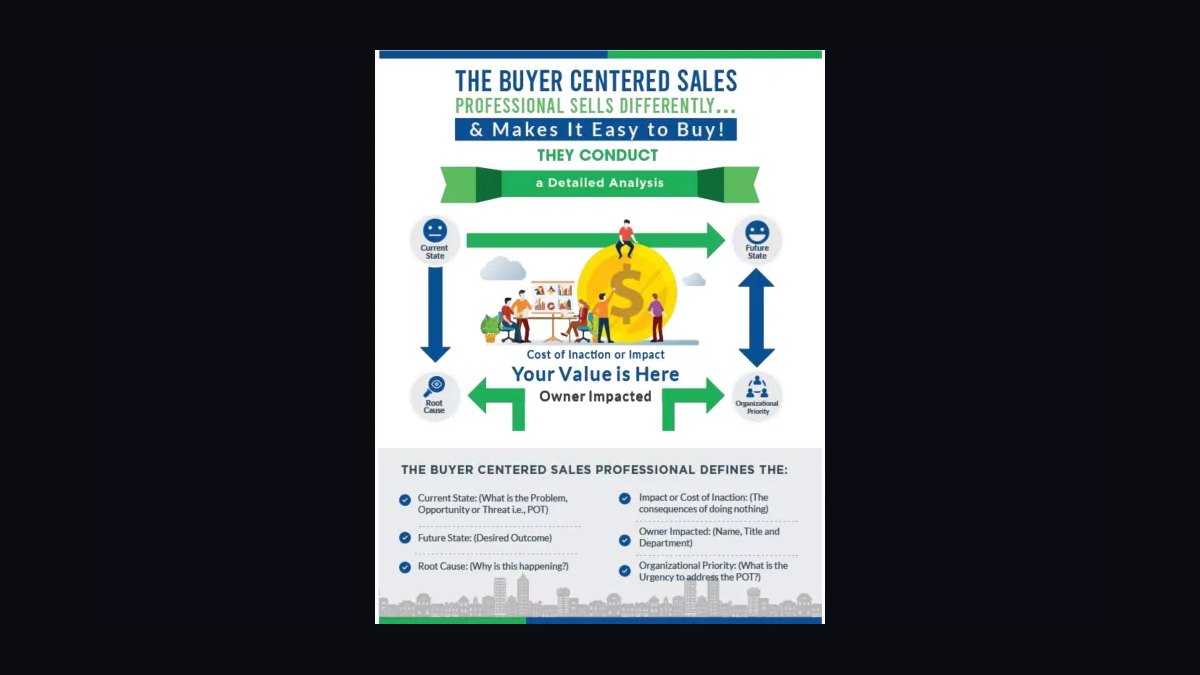
In short: Buyer-Centered Selling by Thomas Williams & Thomas Saine — Cliff Notes Summary hinges on a clear operating definition, an owner, a review cadence, and one measurable outcome the team can track each week without debate.
Buyer-Centered Selling by Thomas Williams and Thomas Saine (Strategic Dynamics Publishing, 2018) re-engineers the B2B sales motion around eleven buyer dilemmas that quietly kill deals — fear, risk, internal politics, no consensus, no time — and gives reps a playbook of research, socialize, solve, collaborate, guide to move buyers through them. It is the book to pick up when your pipeline looks healthy but conversion is rotten, when CRM shows activity but deals stall in legal, procurement, or "we decided to pause." The 2027 reader gets a framework that predates Gartner's 61% rep-free preference stat and still maps cleanly onto Mutual Action Plans, deal rooms, and modern buyer enablement.
1The Setup — Why Selling Broke
The Buyer-Seller Mismatch
Chapter 1 opens with a blunt audit of B2B sales as practiced. Sellers run discovery to fill MEDDIC fields or BANT checkboxes; buyers are running an entirely different process — researching internally, building consensus, calculating personal risk. Williams and Saine quote CEB / Gartner data showing buyers complete 57-70% of their journey before contacting a seller, and argue the response from sales orgs has been to push harder on the activities buyers already hate: cold outreach, demo-first conversations, premature pricing pressure.
What Buyers Actually Want
The chapter defines "buyer-centered" not as a soft mindset shift but as a discipline. Buyers want to be understood, educated without being sold to, de-risked, and made to look good internally. Every chapter that follows is a tactical answer to one of those wants. This is where the book differentiates from Sandler or MEDDIC — those frame around the seller's job; this frames around the buyer's job.

The Eleven Dilemmas Preview
The authors name eleven recurring buyer dilemmas that stall deals: no recognized pain, competing priorities, no consensus, status quo bias, risk aversion, stalled momentum, dormant interest, wrong stakeholder, budget conflict, decision avoidance, and post-purchase regret. Each gets its own playbook.
2Jobs-To-Be-Done Applied to Selling
Christensen's JTBD, Translated for Reps
Chapter 2 is the chapter James Muir singled out as the book's most original contribution. Williams and Saine take Clayton Christensen's Jobs-To-Be-Done theory — the idea that customers "hire" products to make progress on a specific job — and apply it to sales conversations. The shift: stop asking "what features do you need?" and start asking "what job are you trying to get done, and what's preventing progress today?"

Functional, Emotional, Social Jobs
The framework names three job layers. Functional jobs are the visible work (close the books faster, route leads in under five minutes). Emotional jobs are how the buyer wants to feel (in control, ahead of peers, not embarrassed in front of the CFO). Social jobs are how the buyer wants to be perceived (the person who fixed forecasting, the modernizer). A seller who only solves functional misses two-thirds of why the deal closes.
Forces of Progress
Chapter 2 introduces the Four Forces model — push of the situation, pull of the new solution, anxiety of the new, and habit of the present. A deal closes only when push + pull > anxiety + habit. Most stalled deals are not won by a better feature; they are won by reducing anxiety (proof, references, pilot scope) or disrupting habit (cost of inaction made visible).
3The Five Seller Competencies
Researching, Socializing, Solving, Collaborating, Guiding
Chapters 3-4 introduce the Five Cluster Model of seller skills. Researching is account and persona homework before any conversation. Socializing is building a multi-threaded relationship map. Solving is co-developing the answer with the buyer, not pitching a finished product. Collaborating is shared work product — agendas, success criteria, Mutual Action Plans. Guiding is the senior skill: shepherding a buyer through their own internal process.

Behavioral Style Adaptation
Chapter 4 adds the DISC-adjacent behavioral overlay — four buyer styles (Driver, Expressive, Amiable, Analytical) and how the seller should modulate pace, detail density, and proof type for each. An Analytical CFO wants a spreadsheet and a reference customer; an Expressive VP Marketing wants vision and a logo wall. Same deal, two playbooks.
Where Reps Most Often Fail
The authors are blunt that most reps over-index on socializing (relationship-building lunches) and under-invest in researching (real account work) and guiding (helping the buyer navigate their own approval gauntlet). The chapter ends with a self-assessment grid still circulated by sales leaders today.

4Buyer Discovery Done Right
Discovery as Continuous, Not a Stage
Chapter 5 is the book's most reprinted section. Williams and Saine argue discovery is not the second meeting on the MEDDIC stage map — it is every interaction from prospect to renewal. Each touch should surface a new piece of the buyer's strategic initiatives, goals, outcomes, obstacles, decision criteria, or personal stakes.
The Relevant Messaging Framework
The chapter gives a step-by-step messaging method backed by construal-level theory and dual-process cognition research. The short version: lead with near-term, concrete pain (System 1 grabs it), then layer strategic outcome (System 2 justifies it), then close with proof artifact matched to the buyer's behavioral style. Most rep messaging inverts this and dies in the inbox.

Question Architectures
Chapter 5 also catalogs question types — landscape questions (open the field), gap questions (surface dissatisfaction), impact questions (quantify the cost of inaction), and vision questions (paint the future state). It is closer to SPIN Selling in structure but with explicit JTBD anchoring.
5Resuscitating Stalled Deals and Risk-Averse Buyers
The Stall Diagnostic
Chapter 6 confronts the most common reality: roughly 60% of forecasted deals end in "no decision" (a CEB stat the authors lean on). The chapter teaches a stall diagnostic: was the stall caused by lost sponsor, shifted priority, failed business case, fear of change, or competing project? Each cause has a different unstick play. Generic "checking in" emails treat every stall the same way and re-confirm zero.

Risk-Averse Buyer Playbook
Chapter 7 is the selling-to-the-risk-averse-buyer chapter. The core move: stop selling upside and start selling downside protection. Pilot scope, opt-out clauses, phased rollout, third-party references in the buyer's exact vertical, and named-vendor benchmarks. Risk-averse buyers do not buy your ROI; they buy proof that you will not be the reason they get fired.
Reanimating Dormant Accounts
Chapter 8 covers dormant leads and inactive accounts — how to re-enter an account that went cold without restarting from zero. The authors recommend a trigger-event reset: leadership change, funding round, earnings call language shift, regulatory event. Re-open the conversation around the buyer's new context, not your old pitch.

6Upsell, Cross-Sell, and Professional Closing
Expansion as a Buyer-Centered Motion
Chapter 9 treats upsell and cross-sell not as a quota-quarter scramble but as a continuation of the discovery rhythm. The seller who has logged the buyer's strategic initiatives for two years has expansion ammunition the new AE does not. The chapter gives a white-space mapping template and explicit talk tracks for moving from one department to another inside an account.
Closing as Confirming, Not Convincing
Chapter 10 — Closing Professionally — is where the book aligns with James Muir's own Perfect Close research. If the discovery and de-risking work was done, the close is a confirmation question, not a manipulation script. "Would it make sense to..." beats "What would I have to do to earn your business today?" by a wide margin in the cited studies.

The Eleventh Dilemma — Post-Purchase Regret
Chapter 11 closes with the buyer dilemma the industry still under-invests in: post-purchase regret. Gartner's 2026 update found 43% of buyers who use self-service report higher regret. Williams and Saine preview that — five years early — with a seller-led first-90-days protocol: success criteria reconfirmation, executive check-in, early win identification. The deal is not done at signature; it is done at first measurable outcome.
7What Holds Up in 2027 and What Is Dated
The Durable Core
The Five Competencies, the Eleven Dilemmas, the JTBD application, and the Risk-Averse Buyer chapter are the parts modern operators still quote. Mutual Action Plans — a niche idea in 2018 — became table-stakes by 2022 when Clari acquired DealPoint (Tom Williams's company) and shipped them inside the Clari Align product. Dock, Aligned, Recapped, and Mindtickle all sell variants of the buyer-collaboration room Williams and Saine described in chapter 4.
What Aged Less Well
The book predates the generative-AI sales stack. Its researching chapter assumes manual LinkedIn and ZoomInfo lookups; in 2027, Clay, UserGems, Common Room, and Pocus automate 80% of that pre-call work. The socializing chapter under-weights buyer self-service — Gartner's June 2026 update put rep-free preference at 61% of B2B buyers, meaning the seller often does not get to socialize until late. The book's closing chapter is solid but assumes longer rep-led cycles; PLG and product-led sales motions need their own overlay.

Where Modern Operators Cite It
Sangram Vajre (GTM Partners) cites the Five Competencies in his 2026 GTM Operating System content. Kyle Coleman (formerly Clari, now Copy.ai) credits Williams directly for the Mutual Action Plan rigor that survived the Clari Align acquisition. Anita Nielsen (LDK Advisory) teaches the Eleven Dilemmas inside her enablement programs. John Barrows has quoted the risk-averse buyer chapter on the Make It Happen Mondays podcast.
8Who Should Read This Book
Best Fit Readers
Enterprise AEs running 60-180 day cycles. Sales managers rebuilding stage definitions in Salesforce or HubSpot. Enablement leaders who need a coherent skill model instead of stitching together Challenger + SPIN + Sandler. Revenue operations leaders defining what "good discovery" actually means in CRM fields.

Read Order Recommendation
Pair this with Matthew Dixon's Challenger Sale (for commercial-teaching tension), Mike Weinberg's New Sales. Simplified. (for prospecting muscle), and James Muir's Perfect Close (for the close-as-confirmation idea Williams and Saine echo). If you only have time for one chapter, read Chapter 5 on discovery and messaging.
Skip If
You sell PLG self-serve under $5K ACV — the rep-driven motion the book assumes does not fit. You sell pure transactional SMB — the multi-threading and Mutual Action Plan rigor is overkill. The book is built for considered B2B purchases with multiple stakeholders and a real approval gauntlet.
FAQ
How is Buyer-Centered Selling different from traditional sales methodologies like MEDDIC or BANT? Buyer-Centered Selling flips the focus from qualifying a deal to diagnosing and resolving the buyer's internal dilemmas. While MEDDIC and BANT are seller-centric checklists, this framework centers on the buyer's hidden fears, politics, and lack of consensus that cause deals to stall.
Does this book still apply in 2027 with AI and self-serve buying? Yes, because the core buyer dilemmas—fear of making a wrong decision, internal politics, no consensus—are human problems that technology doesn't solve. The "research, socialize, solve, collaborate, guide" playbook works well with modern tools like deal rooms and mutual action plans.
What are the eleven buyer dilemmas mentioned in the book? The book identifies dilemmas such as fear of change, risk of failure, internal politics, lack of consensus, insufficient time, unclear value, no urgency, competing priorities, information overload, distrust of sellers, and fear of making a mistake. These are the hidden reasons deals stall.
How long does it take to implement the Buyer-Centered Selling approach? Adoption typically takes several months to a year, as it requires shifting mindset from product pitching to buyer problem-solving. Teams often see initial improvements in deal progression within a quarter, but full cultural change takes longer.
Is this book only for B2B sales, or can B2C sellers use it too? The book is written specifically for complex B2B sales with multiple stakeholders and long cycles. B2C sellers with high-consideration purchases (e.g., enterprise software, consulting) may find parts useful, but the framework is designed for multi-person buying groups.
What is the single most actionable takeaway from the book? The most actionable takeaway is to replace your discovery questions with ones that uncover the buyer's personal and organizational dilemmas—not just their needs. For example, ask "What's the personal risk to you if this project fails?" rather than "What's your budget?"
Bottom Line
Buyer-Centered Selling is the operator's manual for the buyer-enablement era — eight years old, written before the term "buyer enablement" caught on, and still the cleanest articulation of the five-competency model and the eleven dilemmas that kill complex B2B deals. Pick it up when your pipeline looks fat but your win rate is anemic, when your reps are busy but your stages are stalling, or when you are rebuilding stage definitions and need a framework that maps cleanly onto Clari Align, Dock, Aligned, or whatever Mutual Action Plan tool you run. Skip it if you sell pure PLG under $5K. Read it twice if you sell anything over $50K with a procurement gauntlet attached.
Related on PULSE
- Selling the Invisible by Harry Beckwith — Cliff Notes Summary
- Secrets of Question-Based Selling by Thomas Freese: Summary, Key Lessons, and RevOps Takeaways
- SPIN Selling by Neil Rackham: Summary, Key Lessons, and RevOps Takeaways
- Gap Selling by Keenan: Summary, Key Lessons, and RevOps Takeaways
- The SPIN Selling Fieldbook — Cliff Notes Summary
- High-Profit Selling — Cliff Notes Summary
Sources
- Buyer-Centered Selling on Amazon (publisher listing, ISBN 9781948974059)
- Strategic Dynamics Firm — official book page (Tom Williams's publishing arm)
- James Muir review at PureMuir.com — chapter-by-chapter breakdown
- Gunnar Habitz review on Medium — practitioner perspective on Five Competencies
- Listen Innovate Grow book review — buyer enablement framing
- Sales Talent Agency interview with Tom Williams — DealPoint origin and method
- Demand Gen Report — Clari acquires DealPoint, ships Mutual Action Plans as Clari Align
- Gartner — 67% of B2B Buyers Prefer a Rep-Free Experience (March 2026 release)
- Apollo — What's Changed in the B2B Buyer Journey in 2026
- Dock — Mutual Action Plans 101: Tips, Tools, and Templates
This page will be disappearing soon. Save it to your device for $1 — or read it free while it is here.
@Kory-White- · if Venmo asks, the last 4 of my number are 2012
This page is gone.
This one is off the shelf now. $1 keeps it on your phone for good — the whole page, pictures and diagrams included.
 pulse-recentHigh-Profit Prospecting by Mark Hunter — Top 10 Key Takeaways for Sales Leaders in 2027
 pulse-recentThe Customer Success Professional’s Handbook by Ashvin Vaidyanathan — Top 10 Key Takeaways for Sales Leaders in 2027
 pulse-recentStrategic Selling by Robert Miller and Stephen Heiman — Top 10 Key Takeaways for Sales Leaders in 2027
 pulse-booksTop 10 practical takeaways from Atomic Habits for building a new routine in 2027.
 pulse-recentHyper Sales Growth by Jack Daly — Top 10 Key Takeaways for Sales Leaders in 2027
 pulse-recentBlueprints for a SaaS Sales Organization by Jacco van der Kooij — Top 10 Key Takeaways for Sales Leaders in 2027
 pulse-recentThe Sandler Rules by David Sandler — Top 10 Key Takeaways for Sales Leaders in 2027
 pulse-booksWhat are the most common mistakes in Book Summaries in 2027?
 pulse-recentHow do you implement the Sandler Rules by David Mattson in your first 30 days as a new sales manager in 2027?
 pulse-recentWhat is the first concrete step in SPIN Selling by Neil Rackham for structuring a discovery call in 2027?