


Founding Sales by Pete Kazanjy: Summary, Key Lessons, and RevOps Takeaways
Quality
Certified
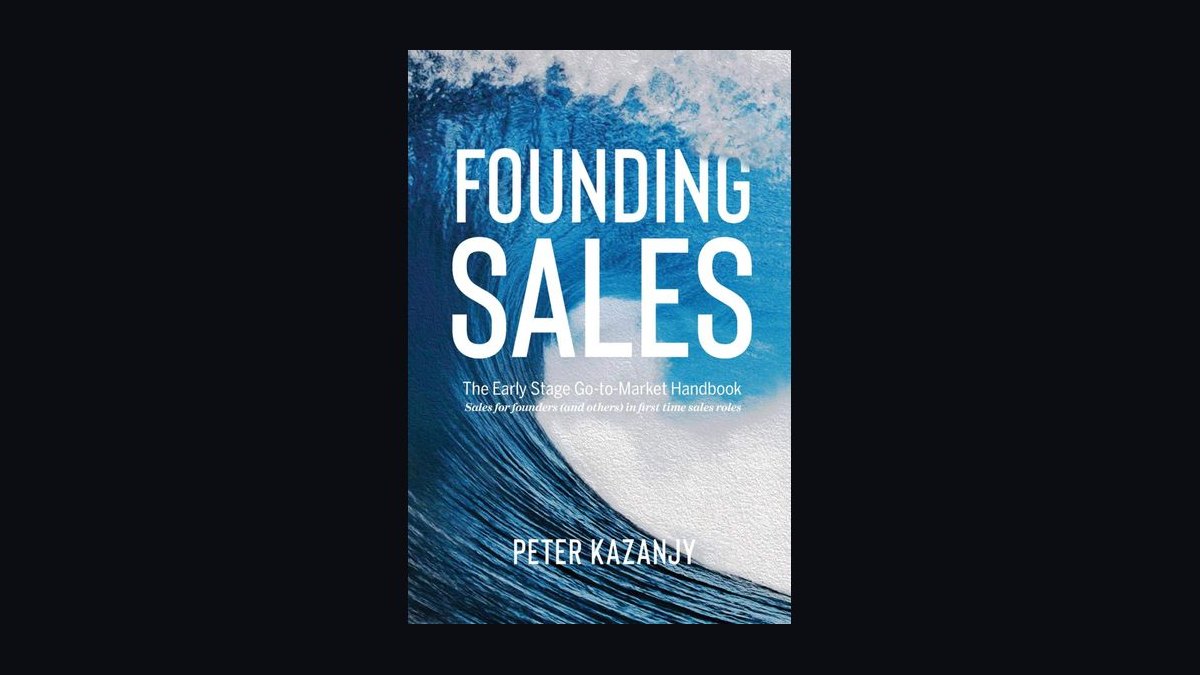
*Founding Sales* by Pete Kazanjy argues that founders must sell the first deals themselves, because only founder-led selling discovers the repeatable motion. Sales is a learnable, methodical craft — not a personality trait. Document what works into a playbook, then hire reps to run it. You cannot hire your way out of not knowing how to sell.
The moment a founder realizes the hire didn't fix anything
Picture a two-person B2B software company eleven months past incorporation. The technical co-founder has shipped a genuinely useful product. Twelve customers signed, all of them sourced from the founders' personal network, a Show HN thread, and one lucky conference hallway conversation. Revenue is real but lumpy. The founders are exhausted by the part of the job neither of them wanted, so they do the obvious thing: they hire a salesperson. Someone with eight years of experience, a good logo on the résumé, a warm handshake, and a quota they hit three years running at a company with 400 employees and a marketing department that fed them leads.
Ninety days later that rep has closed nothing. Not one deal. The founders review the pipeline and find a graveyard of stalled opportunities with no clear next step. The rep is frustrated; the founders are quietly furious; and the story they tell each other is "we made a bad hire."
This is the scenario Kazanjy wrote the book to prevent, and his diagnosis is unsentimental: the hire was not the failure. The failure happened months earlier, when the founders decided that selling was something to be delegated rather than something to be learned. That rep walked into a company with no defined ideal customer profile, no documented discovery questions, no demo structure, no objection library, no pricing logic anyone could articulate under pressure, and no CRM discipline beyond a spreadsheet. They were handed a product and a laptop and asked to invent a go-to-market function from nothing — a job that is materially harder than closing deals inside an established machine, and one that almost nobody is trained to do.
The adjacent version of this failure shows up everywhere in early-stage companies, not just in sales. It's the same shape as hiring a "head of marketing" before anyone has written a message that converts, or a "head of customer success" before anyone knows why customers actually churn. In every case the founder is trying to buy a solved problem, and the problem is not yet solved. The organization has outsourced the discovery step, and discovery is the only step that cannot be outsourced.

What makes the sales version particularly costly is the feedback lag. A bad engineering hire is visible in three weeks. A bad early sales hire takes two to three quarters to fully reveal itself, because sales cycles are long, pipeline looks like progress, and everyone involved has an incentive to believe the deals in stage three are real. By the time the truth lands, the company has burned six figures of salary and commission plus, more painfully, nine months of learning that the founder should have been doing personally.
The rest of the book is essentially the counterfactual: what those founders should have done in month three instead of month eleven.
How founder-led selling actually converts conversations into a repeatable motion
The mechanism at the center of *Founding Sales* is not "founders are better closers." Often they aren't — founders are frequently awkward on price, terrible at qualifying out, and prone to talking about architecture when the buyer asked about implementation timelines. The mechanism is that founders are the only people in the building who can hold the full loop: hear an objection, understand whether it's a messaging problem or a product problem, and change either one by Friday.
A hired rep hears "your reporting is too thin" and logs it as a lost deal. A founder hears the same sentence three times in a week and either ships reporting, changes the ICP to companies that don't care about reporting, or builds a rebuttal that reframes the gap. That closed loop — sell, learn, adjust, sell again — is what compounds into a motion. It cannot be delegated because the person doing the selling and the person authorized to change the product and the message have to be the same person, or at minimum sit at the same table with no translation layer between them.

Kazanjy breaks the founder's selling work into recognizable stages, each of which he treats as a learnable skill with concrete tactics rather than an innate gift.
Sourcing. Early pipeline comes from proactive outbound, not inbound. That means building a target list from a sharply defined ICP — industry, company size, role, and a triggering condition that suggests the pain is live right now — and reaching those people directly. Founders have an unfair advantage here that they systematically underuse: a founder's outreach gets opened and answered at rates a mid-level SDR will never see, because "I built this thing and I'd like fifteen minutes to learn whether it's useful to you" is a fundamentally different email than a templated sequence.
Discovery. The single highest-leverage skill in the book. Discovery is not a rapport-building preamble to the demo; it is the conversation where you find out whether a deal exists at all. The founder's job is to surface the actual pain, its business cost, who feels it, who pays to fix it, and what happens if nobody does anything. Kazanjy pushes founders toward ruthless qualification — the discipline of ending a call by saying "I don't think we're the right fit" is more valuable early than any closing technique, because founder time is the scarcest resource in the company and a bloated fake pipeline is worse than an empty one.
Demo. The demo is a response to discovery, not a feature tour. The failure mode for technical founders is showing everything they built because they're proud of it. The correct demo shows the two or three things that address the specific pain the prospect just described, in the order that maps to their workflow, and stops.
Objection handling and close. Objections repeat. Within twenty conversations a founder has heard essentially the entire objection set for their category, and the work is to write down each one alongside the response that actually moved the deal forward. Closing is then mostly the mechanical discipline of clear next steps, named decision-makers, dates, and pricing that the founder can state out loud without flinching.

Documentation. This is the step that turns activity into an asset, and the step founders skip. Kazanjy is emphatic that the playbook must be tactical rather than philosophical. "Understand their pain" is useless. "Ask these three questions, in this order, and if you don't get a specific dollar figure or a named internal deadline by question three, this is not a qualified opportunity" is a playbook.
Notice that the loop feeds itself. Losses and disqualifications are not waste; they are the cheapest data in the company, and the founder is the only person positioned to act on them immediately. This is also where the discipline connects directly to RevOps: the fields you decide to capture during founder-led selling — loss reason, source, competitor, deal stage definitions — become the schema your entire revenue reporting stack inherits for years. Sloppy definitions written in month four are still generating arguments in year four.
The numbers: how much selling is enough before you hire
Founders always want a date. The honest answer in *Founding Sales* is that the trigger is evidence, not calendar time, but there are practical benchmarks worth stating plainly — with the caveat that any specific figure depends enormously on deal size, category maturity, and whether you sell to five thousand companies or fifty.
Volume of closed business. The commonly cited threshold is roughly ten to twenty closed-won deals before handing the motion to someone else. Below ten you cannot distinguish a pattern from a run of luck. The number matters less than what it buys you: enough repetitions that you can predict, before a call happens, roughly how it will go.
Consistency, not just count. Ten deals that each took a wildly different path prove nothing. What you're looking for is convergence — sales cycle length clustering in a recognizable band, deal sizes within a range rather than scattered across an order of magnitude, and the same two or three objections showing up in most conversations. If your cycles run 21 days, 140 days, 45 days, and 200 days, you do not have a motion; you have four unrelated sales.

Concentration risk. Kazanjy warns explicitly against reading one enormous deal as validation. A single whale masks a broken process, distorts your average deal size, and often came through a personal relationship that no rep will ever be able to reproduce. Strip your outlier deal out of the dataset and ask whether the remainder still tells a coherent story.
The metrics worth instrumenting from day one. Average deal size or contract value. Sales cycle length from first meeting to closed-won. Conversion rate at each stage — meeting to demo, demo to proposal, proposal to close. Win rate against the qualified pipeline. Deal velocity, which combines the others and is the earliest warning sign of unclear messaging: cycles that stretch usually mean you're selling to people who don't feel the pain acutely, not that your closing needs work.
Elapsed time. In practice founders sell for something like three to twelve months before the first hire, and the wide range is the point. A company selling a $6,000 annual tool to small businesses may reach twenty closed deals in a quarter. A company selling a six-figure platform to enterprise buyers may take eighteen months to reach the same evidentiary standard, and should expect a longer founder-led phase accordingly.
Compensating the first rep. Kazanjy's guidance is a base salary plus uncapped commission with a ramp period — typically 60 to 90 days of guaranteed commission or a draw while the rep builds pipeline that hasn't had time to close yet. Cited ranges in the book land around $60,000 to $90,000 base with on-target earnings of roughly $120,000 to $160,000, with the obvious caveat that geography, market, and the years since publication all move these materially. The structural point survives the specific numbers: the plan must reward pipeline generation *and* closed revenue, because your first hire has to do both. A pure closing comp plan on a rep who has no lead flow is a comp plan that pays nothing and produces a resignation.

Onboarding investment. Plan on two to four weeks of intensive onboarding — the founder on every call, reviewing every email, handing over accounts one at a time rather than in a batch. Then plan on the founder continuing to sell alongside the rep for three to six months. Not to compete for deals, but to keep modeling the behavior, coaching against the playbook, and updating the playbook with what the rep discovers. The rep's early feedback is the first external test of whether the document is actually teachable or merely a transcription of founder intuition.
Stack. Keep it thin: a CRM, a way to send sequenced email, a way to make calls. The temptation to buy a mature revenue stack at ten customers produces noise instead of insight and creates data-hygiene debt that a future RevOps hire will spend a quarter unwinding. Add tooling when a specific manual process becomes the bottleneck, not in anticipation of scale you don't have.
Trade-offs: when founder-led selling is the wrong default
The book is a strong argument, and strong arguments deserve honest boundaries. Founder-led sales is the right default for early-stage B2B with meaningful deal sizes and a discoverable buyer. It is not a universal law, and a RevOps leader evaluating the strategy should know where the model strains.
The founder-time trade-off is real. Every hour a technical founder spends on discovery calls is an hour not spent on the product. In a category where the product is the entire wedge and the buying process is short and self-serve, that trade can be genuinely negative. Product-led motions with low ACVs and thousands of small customers do not reward a founder personally running discovery on a $40/month subscription; they reward instrumentation, onboarding funnels, and pricing experiments. Kazanjy's frame still applies in spirit — the founder must personally understand why users convert — but the mechanism shifts from calls to usage data and user interviews.

Founder charisma can be a false positive. Some founders close deals that no rep could ever close, because the buyer is purchasing the founder's conviction, availability, and implied promise of custom work. If your closed-won deals all involved the founder promising a feature, a discount, or a direct line to their cell phone, the motion is not transferable and the playbook you write will fail on contact with the first hire. The test is whether you can articulate why a deal closed in terms a stranger could reproduce.
Sales-first founding teams exist. A team where one co-founder has genuinely built and run a pipeline before is running founder-led sales by definition, and can compress the timeline substantially. The warning in the book is aimed at first-time and technical founders, not at everyone.
Hiring a sales leader versus a sales rep. A common alternative strategy is bringing in an experienced VP of Sales early to build the function. This usually fails at the pre-repeatability stage for a specific reason: senior sales leaders are optimized for scaling an existing motion, hiring teams, and managing forecasts. Asked to personally cold-call forty prospects and discover an ICP, most will not, and the ones who will are rare enough that you probably can't afford them. The sequencing that generally works is founder → first reps → sales leader once there are enough reps to actually manage.
Fractional and agency alternatives. Outsourced SDR agencies and fractional sales leaders are increasingly common substitutes. They can help with the mechanical top of funnel once a message is proven. Before the message is proven, they systematically fail, because they are being asked to do discovery work with no authority to change the product or the positioning — the exact structural gap that makes early rep hires fail.
The right-hand side of that diagram is where the book's thinking connects to everything a RevOps function does later. Territories, forecast categories, comp plans, and stage definitions are all downstream artifacts of the motion the founder discovered. Companies that skip the discovery phase end up designing those artifacts around assumptions rather than evidence, and then spend years relitigating them.
Pitfalls that kill the transition, and how to avoid each one

Hiring on frustration rather than evidence. The most common trigger for a premature sales hire is founder exhaustion, not motion readiness. The fix is a written trip-wire agreed on in advance: we hire when we have N closed deals with cycle length within a defined band and a playbook a stranger could read. Deciding the criteria while calm prevents deciding them while tired.
Writing the playbook as philosophy. A document full of principles is not a playbook. Specificity is the whole value. Name the exact questions, the exact order, the exact disqualification criteria, the exact objection responses with the language that worked. A useful test: hand it to someone outside the company and ask them to run a mock discovery call from it. If they can't, it isn't done.
Letting the playbook go stale. The playbook is a living document, and its worst failure mode is being written once during a burst of discipline and never touched again. Assign an owner and a cadence — a monthly pass where recent wins and losses update the objection library and the ICP definition.
Hiring the wrong profile. The first hire needs to prospect and close — hunter and farmer in one person. Someone from a large company with brand recognition and inbound lead flow has never built pipeline from zero and will struggle without the infrastructure they're used to. Prefer candidates who have worked at a similarly early stage and understand operating without support functions. Screen for it directly: ask a candidate to describe, in detail, how they sourced their own pipeline at their last job. Vague answers are the answer.
Handing over everything at once. Transferring the entire book of accounts on the rep's first day guarantees a bad outcome. Hand over one account, review every call, then two, then five. The gradual handoff is also the mechanism by which the founder discovers which parts of the playbook are wrong.

Mistaking a rep problem for a playbook problem, or vice versa. When the first rep misses, the default founder conclusion is "bad hire." Sometimes true. But if the rep is executing the documented process faithfully and still losing, the playbook or the ICP is wrong, and firing the rep resets your learning to zero. The diagnostic is call review: listen to actual recordings against the documented motion before drawing a conclusion.
Under-instrumenting, then over-instrumenting. Founders typically track nothing for a year, then panic-buy a full revenue stack. Both are mistakes. From the first deal, log the fields that matter — source, ICP fit, loss reason, cycle length, stage transitions — in whatever CRM you're already using. That discipline costs almost nothing at ten customers and is nearly impossible to backfill at two hundred.
Assuming the channels transfer unchanged. The book's principles hold up well; some of its tactical specifics around outbound email norms and prospecting tools predate the current environment of AI-assisted sequencing, signal-based selling, and deliverability regimes that punish volume. Treat the channel-level advice as illustrative and the sequencing logic — sell, document, hire, instrument — as the durable part.
Stopping selling the day the rep starts. The founder who disappears from sales the moment a rep is hired removes the coaching, the fast product feedback loop, and the credibility that closes the hardest deals. Step back when the rep is consistently hitting quota, and even then stay involved in the largest opportunities.
Related questions
Should a non-technical founder also sell first?
Yes. The argument isn't about technical background — it's that the person who can change the product, price, and positioning must be the one hearing objections. A non-technical founder still owns the message and the ICP, and still needs the repetitions before writing a playbook.
What if the founder genuinely hates selling?
Kazanjy's answer is reframing: selling a product that solves a real problem is helping, and refusing to sell withholds a solution from people who need it. Practically, hating it is survivable — the founder-led phase is finite, and the goal is a documented motion, not a career in sales.
How does this apply to a second product line at an established company?

Closely. A new product with a new buyer is an early-stage motion inside a mature company, and handing it to the existing sales team usually fails because the ICP, objections, and discovery questions are different. Someone with product authority should sell the first deals.
Does the playbook replace sales training?
No. The playbook defines what to do; training builds the skill to do it. New reps need both — the documented motion plus call reviews, role-play, and coaching against real recordings. A playbook alone assumes execution ability that new hires rarely have on day one.
When should a company hire its first RevOps person?
Typically once there are enough reps that forecast accuracy, territory conflicts, and comp administration consume real management time — often around the third to fifth rep. Before that, the founder and sales leader can maintain the instrumentation the founder-led phase established.
FAQ
Why is founder-led sales so important for early-stage startups?
Because only the founder holds the complete loop: hearing an objection, diagnosing whether it's a message problem or a product problem, and having the authority to fix either one immediately. A hired rep can report the objection but cannot resolve it. That closed feedback loop is what turns scattered conversations into a discoverable, repeatable motion, and it's the reason the discovery phase can't be delegated to someone without product authority.
What's the biggest mistake first-time founders make about sales?

Hiring too early — trying to delegate a problem that hasn't been solved. The rep arrives with no ICP, no proven message, no discovery script, and no objection library, and is asked to invent the go-to-market function while also hitting quota. When they fail, the company misdiagnoses it as a bad hire and repeats the mistake with a more expensive candidate.
How long should a founder sell before hiring a sales rep?
Commonly three to twelve months, though the trigger is evidence rather than time. The practical benchmark is roughly ten to twenty closed-won deals with cycle length and deal size clustering in recognizable bands, plus a documented playbook a stranger could run. Enterprise deal sizes push the timeline longer; small-business ACVs compress it considerably.
Do I need a sales background to succeed at founder-led sales?
No — the book is written specifically for technical and first-time founders who find selling intimidating. Kazanjy's core claim is that B2B sales is a methodical, learnable discipline built from repeatable components: list building, discovery questions, demo structure, objection responses, and clear closing steps. Each improves with deliberate repetition, and none requires a particular personality type.
What's the most useful takeaway for a RevOps leader from this book?
That every artifact RevOps later owns — stage definitions, forecast categories, loss-reason taxonomies, territory logic, comp design — is downstream of the motion the founder discovered. If the founder-led phase was skipped or undocumented, those artifacts get built on assumptions instead of evidence, and the resulting reporting layer produces arguments rather than answers.
Is the advice still relevant given AI-assisted prospecting and modern outbound?
The sequencing logic holds: sell, document, hire to the playbook, instrument the funnel. What has shifted is the channel layer — outbound tooling, email norms, and signal-based targeting have changed substantially since publication. Treat the specific tactical prescriptions as illustrative and the structural argument about founder-led discovery preceding the hire as the durable part.
Sources
- https://www.foundingsales.com/
- https://www.saastr.com/founder-led-sales/
- https://review.firstround.com/
- https://openviewpartners.com/blog/
- https://www.bvp.com/atlas
- https://blog.bridgegroupinc.com/
- https://hbr.org/topic/subject/sales
- https://www.ycombinator.com/library
Related on PULSE
- Major Account Sales Strategy by Neil Rackham: Summary, Key Lessons, and RevOps Takeaways
- Demand-Side Sales 101 by Bob Moesta: Summary, Key Lessons, and RevOps Takeaways
- Cracking the Sales Management Code by Jason Jordan and Michelle Vazzana: Summary, Key Lessons, and RevOps Takeaways
- Hope Is Not a Strategy by Rick Page: Summary, Key Lessons, and RevOps Takeaways
- Start with No by Jim Camp: Summary, Key Lessons, and RevOps Takeaways
- $100M Leads by Alex Hormozi: Summary, Key Lessons, and RevOps Takeaways
This page will be disappearing soon. Save it to your device for $1 — or read it free while it is here.
@Kory-White- · if Venmo asks, the last 4 of my number are 2012
This page is gone.
This one is off the shelf now. $1 keeps it on your phone for good — the whole page, pictures and diagrams included.
 pulse-recentPredictable Revenue by Aaron Ross — Top 10 Key Takeaways for Sales Leaders in 2027
 pulse-recentDelivering Happiness by Tony Hsieh — Top 10 Key Takeaways for Sales Leaders in 2027
 pulse-recentHow does Strategic Selling by Miller Heiman define a Champion and how do you qualify one in 2027?
 pulse-recentWhat is the first concrete step in The Sandler Rules by David Mattson for building a sales plan in 2027?
 pulse-recentThe Challenger Customer by Brent Adamson — Top 10 Key Takeaways for Sales Leaders in 2027
 pulse-recentHigh-Profit Prospecting by Mark Hunter — Top 10 Key Takeaways for Sales Leaders in 2027
 pulse-recentFanatical Prospecting by Jeb Blount — Top 10 Key Takeaways for Sales Leaders in 2027
 pulse-recentThe 22 Immutable Laws of Marketing by Al Ries and Jack Trout — Top 10 Key Takeaways for Sales Leaders in 2027
 pulse-recentThe Greatest Salesman in the World by Og Mandino — Top 10 Key Takeaways for Sales Leaders in 2027
 pulse-recentThe Collaborative Sale by Keith Eades — Top 10 Key Takeaways for Sales Leaders in 2027