


The Transparency Sale by Todd Caponi — Top 10 Key Takeaways for Sales Leaders in 2027
Quality
Certified
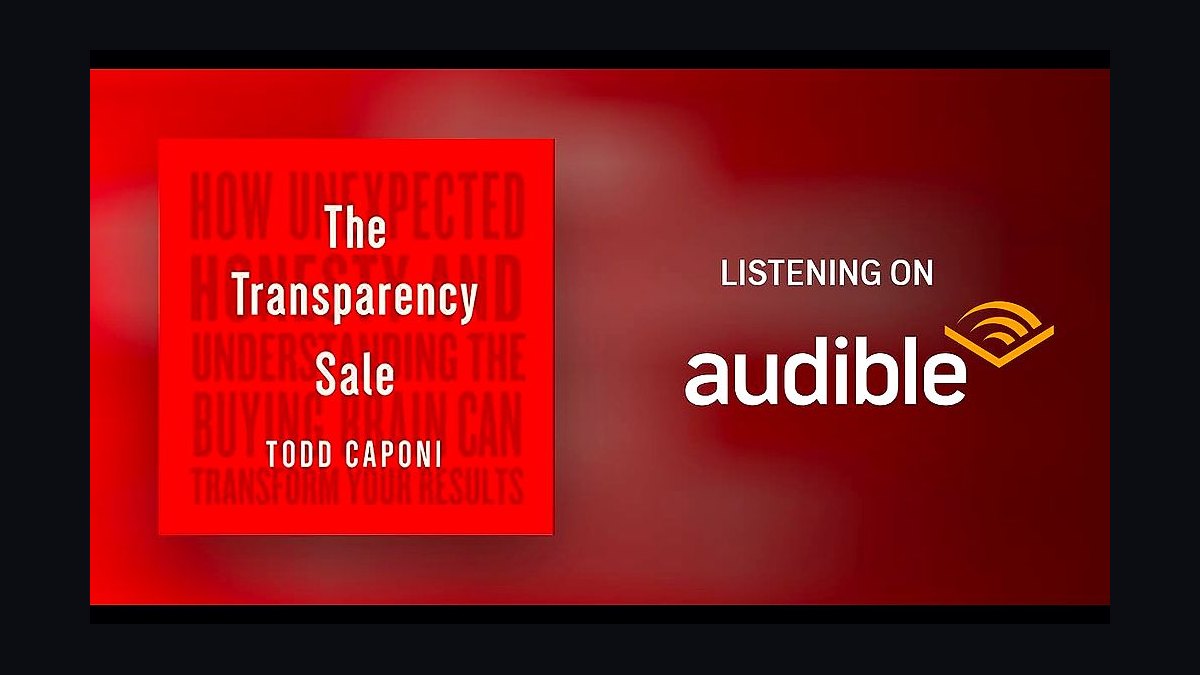
The Transparency Sale by Todd Caponi argues that sales leaders win more deals by proactively disclosing pricing, limitations, and negative information instead of hiding them, because the buyer's brain trusts certainty and honesty more than polish. The top takeaways for 2027: lead with weaknesses, publish pricing early, replace charisma with credibility, and build a decision-simplicity strategy that makes buying easy, not just selling persuasive.
A sales team that hides the truth and loses the deal anyway
Picture a mid-market SaaS rep three calls into a deal. The prospect asks a pointed question about a known product gap — maybe the reporting module lags competitors, or implementation takes six weeks instead of two. The rep deflects, pivots to a roadmap promise, and moves the conversation along. It feels like standard sales technique. Caponi's research says it is the single most reliable way to lose the deal to research the buyer will do anyway.
Today's buyer has already read the G2 reviews, the Reddit thread, the Gartner Peer Insights page, and three competitor comparison blogs before the rep is ever looped in. Caponi's central claim in The Transparency Sale is that the internet has already told the buyer about the weakness — the only open question is whether the seller admits it too. When the rep dodges, the buyer's brain doesn't hear "confident salesperson." It hears "this person is hiding something I already suspected," and confirmation bias kicks in against the deal. Caponi walks through this exact scenario in the book's opening chapters, using it to set up the core thesis: sales leaders in 2027 are not competing against other vendors as much as they are competing against the buyer's own skepticism, built up over a decade of being burned by oversold software. The rep who says "yes, our reporting is behind Vendor X's right now, and here's how our customers work around it while we ship the fix in Q2" doesn't lose credibility — they gain it, because they're the first person in the sales cycle who sounded like a peer instead of a pitch. That single reframe is the throughline for every other takeaway in the book: strategy built on withholding information is a strategy built on borrowed time, because the information gets found regardless.
How the transparency mechanism actually works in the buyer's brain
Caponi builds his framework on decision science, not sales folklore, and the mechanism is worth walking through step by step because it explains why transparency outperforms traditional persuasion tactics like urgency and scarcity.
First, the buyer arrives with existing beliefs shaped by online research — reviews, forums, analyst notes. Second, every claim the seller makes gets run through a filter: does this confirm or contradict what I already believe? Claims that feel too good ("we have zero downtime, ever") trigger suspicion because they contradict lived experience with every other vendor who has ever said that. Third — and this is the pivot point Caponi returns to again and again — when a seller volunteers a limitation before being asked, the buyer's brain reclassifies that seller from "salesperson trying to close me" to "credible source trying to help me decide." That reclassification is what unlocks trust, and trust is what shortens the sales cycle, because a buyer who trusts the seller stops re-verifying every claim independently and starts moving toward a decision.

Caponi ties this to what CEB (now part of Gartner) called "decision simplicity" in its buyer research: the deals that close fastest and with the least remorse are not the ones where the seller was most persuasive, but the ones where the buyer felt the information they needed was easy to find, easy to trust, and easy to compare. Sales leaders reading this in 2027 should treat decision simplicity as a strategy input, not a soft metric — it directly predicts win rate and deal velocity, and it is something a sales team can deliberately engineer by choosing what to disclose and when.
The research and numbers behind the argument
Caponi doesn't ask sales leaders to take transparency on faith — he leans on published research, and the specific figures matter for anyone building a 2027 enablement plan around this book.
The clearest data point comes from the Spiegel Research Center at Northwestern University's Medill School, which Caponi cites extensively: as a product's star rating moves from a perfect 5.0 toward the 4.2–4.7 range, purchase likelihood actually increases, because a flawless rating reads as suspicious or unrepresentative to buyers who have learned to distrust anything that looks curated. The same research found that displaying reviews — including negative ones — can lift conversion by double- and triple-digit percentages for higher-consideration purchases, precisely because the negative reviews make the positive ones believable. Caponi's application to B2B selling is direct: a case study page or reference call that only shows flawless outcomes reads the same way to a buyer's brain as a suspiciously perfect star rating, and sales leaders who scrub every hint of friction from their proof points are quietly undermining their own credibility.

On the pricing side, Caponi points to the buyer behavior shift that happened once B2C commerce trained every buyer to expect visible pricing before talking to a human. His argument for 2027 sales leaders: teams that publish pricing ranges or packaging tiers publicly spend less rep time on unqualified leads and see shorter time-to-first-meeting, because the buyer self-selects before engaging a rep, rather than the rep spending two discovery calls just extracting budget information the buyer was never going to volunteer honestly anyway. He also introduces the "Say/Do" ratio as a trackable leadership metric — the percentage of commitments a rep or company actually delivers on relative to what was promised in the sales cycle. Leaders who start measuring Say/Do ratio at the team level, not just the individual deal level, get an early warning system for the exact behavior — overpromising to hit quota — that erodes long-term win rates and renewal rates even when it closes short-term deals.
Trade-offs: transparency versus traditional persuasion tactics
Adopting this strategy is not free, and Caponi is direct about the trade-offs sales leaders need to manage rather than pretend away.

Traditional tactics — artificial urgency, discount countdowns, information gatekeeping until a demo is booked — still produce short-term lift for some segments, particularly low-consideration or first-time buyers with little ability to research independently. Transparency-based selling trades some of that short-term pop for a longer-term asset: buyers who trust the company enough to expand, renew, and refer. Caponi frames this as a build-versus-borrow choice. Scarcity tactics borrow urgency from the buyer's fear of missing out; transparency tactics build durable trust that compounds across the account's lifetime. The trade-off sales leaders have to manage is patience — transparency-based deals sometimes take a beat longer to open (a well-informed buyer asks harder early questions) but close with a shorter total cycle and a much lower rate of post-sale buyer's remorse and churn.
The other trade-off is organizational, not just tactical: transparency only works if it's true. A team can't fake proactive disclosure — the moment a rep's "honest" admission turns out to be a scripted talk track designed to manufacture trust rather than earn it, the tactic backfires harder than the deception it replaced, because now the buyer has caught the seller performing sincerity. That means sales leaders adopting this strategy in 2027 need product, support, and sales aligned on what's actually true about the product's weaknesses, not just a new slide in the onboarding deck.
Common pitfalls sales leaders hit when adopting this strategy
The most common mistake Caponi warns against is treating transparency as a script rather than a leadership discipline. Reps who are handed a list of "approved" weaknesses to disclose, without understanding why disclosure builds trust, tend to deliver them in a flat, defensive tone that reads as an apology instead of confidence — which reintroduces the exact suspicion the tactic was meant to remove. Leaders should coach the delivery, not just the content: the goal is a rep who sounds like they'd tell you the same thing whether or not you were about to sign a contract.

A second pitfall is disclosing the wrong things. Not every limitation deserves airtime — Caponi's framework is about surfacing information the buyer will find anyway or genuinely needs to make a good decision, not manufacturing false modesty about irrelevant details. Leaders who let reps freelance on what to disclose risk reps oversharing in ways that create new objections rather than defusing existing ones.
A third pitfall is measuring the wrong thing during rollout. Because transparency-based selling can lengthen the top of the funnel slightly (better-informed buyers ask more questions before engaging), leaders who only track first-call-to-close velocity in the first quarter may see a dip and panic. Caponi's guidance is to track full-cycle win rate, expansion revenue, and churn alongside cycle length — the metrics where transparency pays off are downstream of the first meeting, not at it. Sales leaders who cut the strategy after one quarter of flat top-of-funnel numbers usually miss the compounding return that shows up in renewal and referral data two to three quarters later.
Related questions
Is The Transparency Sale still relevant for 2027 sales teams?
Yes — its foundation is buyer psychology and decision science, not tactics tied to a specific era of tools, so the core argument about disclosure and trust holds as buyers keep gaining more independent research power each year.
Does price transparency actually shorten B2B sales cycles?

In most cases yes, because it removes an early qualification step and lets unqualified buyers self-select out before consuming rep time, though highly custom or enterprise deals still need a scoped quote.
How is this different from "solution selling" or "challenger sale" methodologies?
Those methodologies focus on how a rep frames value or challenges buyer assumptions; Caponi's book focuses specifically on what information gets disclosed and when, making it complementary rather than competing.
Can a company be too transparent with buyers?
Yes — disclosing irrelevant or confusing details can create objections that weren't there before, so leaders should coach reps to disclose what buyers need and will find anyway, not everything.
FAQ
Who is Todd Caponi and why does his perspective carry weight? Todd Caponi is a former sales VP and CRO who built and sold enterprise software teams before turning to research-backed sales training; The Transparency Sale draws on decision science and behavioral economics research rather than personal anecdote alone.
What is the single biggest takeaway sales leaders should act on first?

Start disclosing one known product limitation proactively in every demo or discovery call, and track how it affects objection-handling time and deal velocity before expanding the practice further.
Does this book apply outside of software sales? Yes — the underlying psychology (confirmation bias, decision simplicity, trust from disclosure) applies to any high-consideration purchase, including services, hardware, and complex B2B contracts, not just SaaS.
How does this connect to online review research? Caponi uses Spiegel Research Center findings on star ratings and reviews as a proof point: buyers trust near-perfect but not flawless signals, and the same psychology governs how they judge a sales conversation.
What is the "Say/Do" ratio and how should leaders use it? It's the percentage of commitments a rep or team actually fulfills relative to what they promised during the sales process; tracking it at the team level surfaces overpromising trends before they show up in churn data.
Should reps disclose pricing before qualifying the buyer? Caponi's recommendation is to publish pricing ranges or packaging structure openly so buyers can self-qualify, reserving live pricing conversations for scoping specifics rather than gatekeeping the number itself.
Sources
- https://www.toddcaponi.com/
- https://www.amazon.com/Transparency-Sale-Unexpected-Understanding-Transform/dp/1732755109
- https://spiegel.medill.northwestern.edu/online-reviews/
- https://www.gartner.com/en/sales
- https://hbr.org/2016/03/why-your-customers-dont-want-to-talk-to-you
- https://www.linkedin.com/in/toddcaponi/
- https://www.goodreads.com/book/show/49212314-the-transparency-sale
Related on PULSE
- How does the Challenger Sale methodology compare to consultative selling?
- What is decision simplicity and why do B2B buyers reward it?
- Should sales teams publish pricing on their website in 2027?
- How does the Say/Do ratio predict churn before it happens?
- What does Spiegel Research Center's review data mean for B2B case studies?
This page will be disappearing soon. Save it to your device for $1 — or read it free while it is here.
@Kory-White- · if Venmo asks, the last 4 of my number are 2012
This page is gone.
This one is off the shelf now. $1 keeps it on your phone for good — the whole page, pictures and diagrams included.
 pulse-recentWhat is the Blue Sheet from Strategic Selling by Miller Heiman and how do you fill it out in 2027?
 pulse-recent$100M Offers by Alex Hormozi — Top 10 Key Takeaways for Sales Leaders in 2027
 pulse-recentWhat is the first concrete step in The Sandler Rules by David Mattson for building a sales plan in 2027?
 pulse-recentConceptual Selling by Robert Miller and Stephen Heiman — Top 10 Key Takeaways for Sales Leaders in 2027
 pulse-recentHow I Raised Myself from Failure to Success in Selling by Frank Bettger — Top 10 Key Takeaways for Sales Leaders in 2027
 pulse-recentObviously Awesome by April Dunford — Top 10 Key Takeaways for Sales Leaders in 2027
 pulse-recentMonetizing Innovation by Madhavan Ramanujam — Top 10 Key Takeaways for Sales Leaders in 2027
 pulse-recentProActive Selling by Skip Miller — Top 10 Key Takeaways for Sales Leaders in 2027
 pulse-recentSPIN Selling by Neil Rackham — Top 10 Key Takeaways for Sales Leaders in 2027
 pulse-recentNever Lose a Customer Again by Joey Coleman — Top 10 Key Takeaways for Sales Leaders in 2027