


Fine-Tuning Platform Selling to the ML Platform Lead — 60-Min Training
Quality
Certified
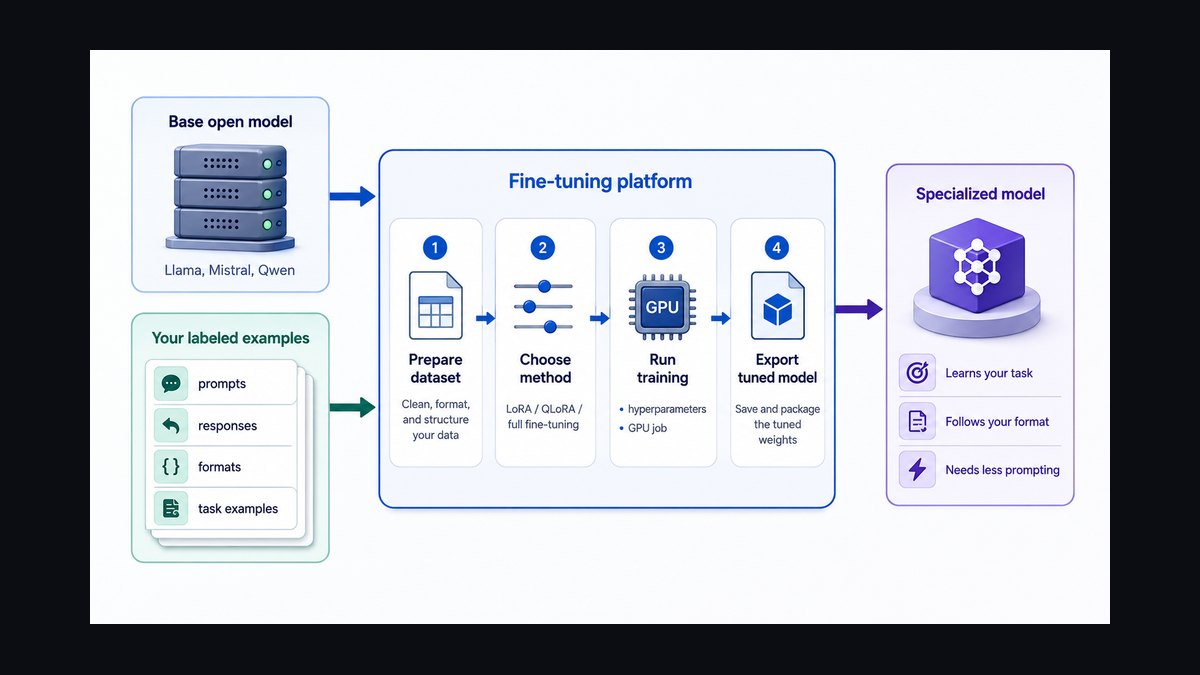
Fine-tuning platform selling to the ML Platform Lead is a consultative motion: prove specialization gains and inference-cost reduction on the buyer's own data inside a one-week proof of concept, price per-token and per-job together with finance, and lock renewal at kickoff through adoption thresholds rather than year-end negotiation.
What fine-tuning platform selling is and why the motion differs
Most infrastructure sales training teaches you to find pain, quantify it, and map a feature to it. Fine-tuning breaks that pattern in one specific way: the buyer is not in pain. The ML Platform Lead already has a working system. Base models answer their prompts. Retrieval-augmented generation covers most of the knowledge gap. The org ships. What they have instead is a slow leak — inference bills that scale linearly with usage, output style that drifts from the brand or the domain vocabulary, latency that a smaller specialized model would halve, and a long tail of tasks where prompt engineering has stopped improving.
That means the discovery conversation is not "what hurts" but "what would you stop paying for." A large frontier model called on every request is expensive per token and generous in capability the customer does not use. Fine-tuning a smaller open-weight model on ten thousand well-labeled examples can match or beat the large model on that one narrow task at a fraction of the per-token rate. The pitch is arbitrage, not rescue. Reps who lead with capability lose to the incumbent frontier API, because the frontier API is more capable. Reps who lead with cost-per-task and behavioral control win, because that is the axis where a specialized model genuinely dominates.
The second structural difference is who signs. The ML Platform Lead owns the tooling budget and the evaluation, but the renewal veto sits one level up — a VP of AI Engineering, a CTO, or increasingly a finance partner who now watches AI spend as a discrete line item because it grew fast enough to become visible. A single-threaded deal with the platform lead can win year one and quietly die at renewal when the sponsor above them asks what the line item bought. Treat the economic buyer as a discovery participant, not a closing formality.

Third, the competitive set is unusually wide and unusually cheap to try. Managed fine-tuning services from the major model providers, dedicated inference-and-training platforms, the hyperscaler ML suites, serverless GPU runtimes, and open-source training stacks that a competent engineer can run themselves all address the same job. Your buyer can spin up an alternative over a weekend. That collapses the value of a polished demo and raises the value of a real proof on real data, because the only durable advantage is what happens when their messy dataset meets your pipeline.
The adjacent motions rhyme. Selling a vector database, an embeddings API, an eval platform, or a serving runtime to the same persona follows the same arc: the buyer can build a worse version themselves, the differentiator is operational rather than functional, and the champion is an engineer who will personally use the thing. If you carry more than one of these products, the discovery skeleton transfers almost unchanged — only the metrics move.
Why does this matter for a 60-minute Training session? Because the reps who walk into a platform lead's calendar without this framing default to the generic infrastructure script — capability, benchmarks, roadmap — and get politely dismissed. The session's job is to overwrite that default with a cost-and-control narrative the buyer has not heard from three competitors that same week. Selling in this category is less about persuasion and more about proving a specific delta on a specific task with the customer's own numbers attached.
The step-by-step process from first call to signed contract

Run the cycle as five stages with hard exit criteria. Skipping a criterion to keep momentum is the most common way these deals stall at legal.
Stage one — qualification, one call, thirty minutes. You are testing three things: is there a task with enough repeatable volume to justify specialization, does labeled data exist or can it be derived from production logs, and is there a named person who owns the outcome. Volume is the fastest disqualifier. A task that runs a few thousand times a month rarely justifies the operational overhead of maintaining a tuned model; the same engineering hours spent on prompt caching or a better retrieval index pay back faster. Say so out loud. Disqualifying honestly at stage one is what buys you credibility when you push hard at stage four.
Stage two — technical discovery, sixty to ninety minutes, joint attendance. Get the platform lead and the economic buyer in the same call. Work through base model preference and license constraints, training data volume and labeling provenance, whether they intend to self-host inference or attach yours, burst GPU access during training, current per-token spend on the task, and any existing contract that would need to be displaced. Ask what evaluation harness they trust — if they cannot describe how they will judge the tuned model against the baseline, that is your first deliverable, not theirs.

Stage three — proof of concept, seven days, customer data. The customer's platform engineer installs, not you. Your job is to remove blockers within the hour and to run a mid-week scorecard before anyone has time to form a private opinion. Ship a side-by-side evaluation: baseline model versus tuned model on a held-out slice, scored on their metric, with per-request cost and latency next to quality. A proof that shows quality alone is half a proof.
Stage four — commercial, one joint session. Present per-job training economics and per-token or per-hour inference economics together, because separating them is how customers get surprised in month three. Bring a modeled twelve-month spend curve at their stated volume, and a second curve at three times that volume so the finance participant can see what growth costs.
Stage five — kickoff, week one of the contract. Set the adoption instrumentation, the scorecard cadence, and the expansion path before anyone is busy. Renewal is decided here.
Each stage has a disqualifier that should stop the deal cold. Stage one: no repeatable volume. Stage two: no named evaluation owner and no path to one. Stage three: the customer refuses to put real data in. Stage four: procurement insists on negotiating without the platform lead present. Stage five: no instrumentation agreed, which means no way to prove value at renewal. Reps who honor these gates close fewer deals and keep more of them.
Costs, timelines, and the ranges you should be able to quote cold
You do not need memorized price sheets, and you should never quote a competitor's number you have not verified that week — these prices move often and a wrong figure in front of an engineer costs you the room. What you do need is command of the shape of the economics.

Fine-tuning cost splits into three buckets. Training is usually billed per million tokens processed or per GPU-hour, and it is a one-time cost per model version. Hosting a tuned model may carry a standing charge on some platforms — a dedicated deployment reserved for you — or may be folded into inference on others. Inference is billed per million input and output tokens, and on most platforms a tuned smaller model carries a higher per-token rate than the same base model untuned, but a dramatically lower rate than the frontier model it replaces. That last point is the one reps get wrong: the comparison is not tuned-versus-untuned-small, it is tuned-small-versus-untuned-large.
Verify current numbers on the vendor's public pricing page before every pricing call, and put the retrieval date on the slide. Engineers respect a dated figure and distrust a round one.
Timelines are more stable than prices. Parameter-efficient tuning with LoRA or QLoRA on a dataset in the ten-thousand-example range typically completes in hours, not days — often within a single working session on a modern GPU allocation. Full-parameter tuning of a mid-size model takes materially longer and costs multiples more, which is why the honest recommendation for most first projects is LoRA. The real timeline risk is upstream: dataset assembly, deduplication, PII scrubbing, and the split into train, validation, and held-out evaluation sets routinely consume two to six weeks of customer effort. If the customer has not started, your seven-day POC starts in week four, and your forecast should say so.
Budget-wise, these deals cluster around a few shapes. A team experimenting on one task with modest volume looks like a low five-figure annual commitment and often does not need a contract at all — self-serve is the right answer, and saying that wins you the second, larger conversation. A platform team standardizing three to eight tuned models across product lines is a mid-six-figure conversation where the value is the pipeline, the versioning, and the eval tooling rather than any single model. A company routing large sustained production traffic through tuned models is buying capacity and reliability, and the negotiation shifts to committed-use discounts and latency guarantees.

Multi-year structure is worth pursuing where the customer's volume trajectory is credible. Standard practice across enterprise infrastructure is escalating discount tiers in exchange for term commitment, sometimes paired with reference or case-study rights. Do not invent the percentage — bring what your desk actually approves. The one commercial rule that holds regardless of vendor: never negotiate with procurement alone. Procurement's job is to compress price in the absence of technical context, and without the platform lead in the room there is no one to say what the discount would cost in capability.
A worked example keeps reps honest. Suppose the customer runs 40 million input tokens and 8 million output tokens per month on a frontier model. If the tuned small model cuts the effective blended rate by roughly an order of magnitude on that task, the annual saving is the entire commercial argument — and the Training session should have reps compute it live from the customer's own numbers rather than recite a canned multiple. The arithmetic, not the adjective, closes these deals.
Where teams get it wrong
Selling capability instead of specialization. The frontier model is smarter than the tuned model. Arguing otherwise in front of an ML platform lead ends the meeting. Argue instead that on this one task, with this data, the tuned model matches quality at a fraction of the cost and a third of the latency — and then prove it.

Running the POC on synthetic or demo data. Every fine-tuning platform looks identical on a clean public dataset. The differentiation appears when the customer's data has inconsistent labels, duplicated examples, mixed formats, and a class imbalance nobody documented. If your platform's tooling surfaces those problems during preparation, that is your feature — but only a real-data proof reveals it.
Letting the AE run the installation. When the rep configures the environment, the customer learns nothing about their own operational fit, and the champion has no personal stake in the outcome. Have their engineer drive with you on the call. The friction they experience is data you both need.
Skipping the evaluation harness. Deals die at month two when the customer cannot demonstrate to their own leadership that the tuned model is better. Insist on a held-out set and a scoring method agreed in writing before training starts. If the customer has no harness, build the first one with them — it becomes switching cost and a genuine contribution.
Ignoring data governance. Training data provenance, retention, whether the vendor trains on customer data, regional processing requirements, and open-weight license terms for derivative models all surface in security review. An AE who raises these unprompted in discovery shortens legal by weeks. An AE who is surprised by them in week six loses the quarter.
Treating drift as someone else's problem. A tuned model is a snapshot. Input distributions shift, the base model gets deprecated, and quality degrades quietly. Customers who are not told this feel misled at renewal. Customers who are told at kickoff — and given a re-tuning cadence and a versioning plan — renew, because you predicted their year.
Single-threading to the champion. The platform lead is your advocate, not your buyer of record. Map at least three relationships: the champion who runs the eval, the leader who owns the AI budget, and one downstream consumer of the model's output — a product manager or applied engineer whose feature quality improves. That third voice is what survives a champion's departure.
Quoting a competitor's price from memory. Prices in this category change monthly and vary by commitment tier. A stale figure delivered confidently in front of an engineer who checked the page that morning destroys the credibility you spent three calls building. Cite only what you verified today.
Decision framework: when to choose what
The most valuable thing an AE in this category can do is disqualify accurately, out loud, in front of the buyer. Fine-tuning is the wrong answer more often than it is the right one, and a rep who says so becomes the person the platform lead calls next quarter.
Walk the decision in order. First, is the problem knowledge or behavior? If the model lacks facts — company documents, current data, private records — retrieval solves it and tuning does not. Tuning teaches style, format, and task-specific reasoning patterns; it is a poor and expensive way to install facts. Second, has prompt engineering plateaued? If the team has not yet tried structured output constraints, few-shot examples, and a decent system prompt, they will get most of the gain for none of the operational cost. Third, is there volume? Specialization pays back through repetition; a low-volume task cannot amortize the pipeline. Fourth, does labeled data exist, and is it good? Ten thousand mediocre examples produce a confidently mediocre model. A thousand excellent, consistent examples often beat them.

Only when knowledge is handled, prompting has plateaued, volume is real, and data is clean does tuning become the right recommendation. Then the sub-decision is method and hosting. Parameter-efficient tuning suits nearly every first project: cheap, fast, reversible, and easy to version. Full-parameter tuning earns its cost when the domain vocabulary is genuinely alien to the base model or when the task demands behavior a low-rank adapter cannot express. On hosting, managed inference wins until volume is large and steady enough that reserved capacity or self-hosting beats the per-token rate — at which point the conversation shifts from tuning to serving, which is a different and usually larger deal.
The framework also tells you what to do when the answer is "not yet." A customer who fails the data-quality gate is a data-preparation opportunity, not a lost deal. A customer who fails the volume gate is a self-serve user today and a platform account in two quarters. A customer who fails the prompting gate needs a solutions engineer, not a contract. Selling well here means being the rep who routes the buyer to the right next step even when that step is not a purchase.
Related questions
How is this different from selling an eval platform to the same buyer?
Eval sells against risk and release confidence; fine-tuning sells against cost and behavioral control. Eval deals close faster because the pain is acute after a bad launch, but they are smaller. The two attach naturally — an eval harness is a prerequisite for any credible tuning proof.
What if the customer wants to self-host everything?
Take it seriously rather than defending. Self-hosting wins on sustained high volume and strict data residency. Position managed training with self-hosted serving as the middle path, and model the engineering headcount cost of the fully self-hosted option honestly.
How do you handle an incumbent already in place?

Compete on the specific metric their team reviews weekly, and prove the delta on their data in a week. Displacement rarely happens on features; it happens when migration effort is visibly smaller than the annual saving.
Should the AE bring a solutions engineer to discovery?
Yes, from the technical discovery call onward. The platform lead will ask about tokenization, adapter merging, and checkpoint handling within twenty minutes. An AE who answers approximately loses technical credibility that is difficult to recover.
When should the deal be handed to customer success?
Keep the AE on the adoption scorecard through month three, then transition operational cadence while the AE retains the expansion conversation. A clean handoff that drops the joint dashboard is the most common post-sale failure.
FAQ
How long should the proof of concept run?
Seven days of active evaluation, preceded by however long data preparation takes. Longer POCs do not produce better decisions — they produce forgotten ones. Set a fixed end date with a scheduled scorecard call, and hold it even if results are mixed, because a documented mixed result is a follow-up and an abandoned POC is a loss.
What do you do when the tuned model does not beat the baseline?

Say so first, before they find it. Then diagnose: usually the dataset is too small, inconsistently labeled, or the evaluation metric does not capture what the team actually values. Any of those is a genuine follow-on project. Reps who hide a failed proof do not get the second attempt.
How do you price when the customer's volume is unknown?
Model three scenarios — current, three times current, ten times current — and show cost at each. Structure the agreement so the customer commits to a floor with rate improvements at higher tiers. Never let a finance participant leave a pricing call without seeing what growth costs.
Who should own the relationship after signature?
The AE stays on the adoption scorecard through month three, then hands operational cadence to customer success while retaining the expansion conversation. The most common post-sale failure is a clean handoff that drops the joint dashboard, after which nobody notices declining usage until renewal.
Is fine-tuning training for reps worth sixty minutes?
Sixty minutes covers the motion — the qualification gates, the discovery skeleton, the POC structure, and the pricing rule. It does not cover the technical depth reps need to hold a room alone, which is why the session should end with a standing SE pairing rule rather than the illusion of self-sufficiency.
What is the single highest-leverage habit for reps in this category?
Insisting on an agreed evaluation harness before any training run. It converts a subjective conversation into an arithmetic one, and arithmetic is the only argument that survives a procurement review and a skeptical CFO.
Sources
- https://platform.openai.com/docs/guides/fine-tuning
- https://docs.aws.amazon.com/sagemaker/latest/dg/whatis.html
- https://cloud.google.com/vertex-ai/generative-ai/docs/models/tune-models
- https://huggingface.co/docs/peft/index
- https://huggingface.co/docs/transformers/training
- https://arxiv.org/abs/2106.09685
- https://arxiv.org/abs/2305.14314
- https://docs.together.ai/docs/fine-tuning-overview
- https://pytorch.org/torchtune/stable/index.html
Related on PULSE
- Computer Vision API Selling to the ML Platform Lead — 60-Min Training
- Vector Database Selling to the ML Platform CTO — 60-Min Training
- Embeddings API Selling to the ML Engineer — 60-Min Training
- Speech-to-Text API Selling to the Voice Platform Lead — 60-Min Training
- AI Eval Platform Selling to the AI Engineering Lead — 60-Min Training
- AI Code Review Selling to the Director of Platform Engineering — 60-Min Training
This page will be disappearing soon. Save it to your device for $1 — or read it free while it is here.
@Kory-White- · if Venmo asks, the last 4 of my number are 2012
This page is gone.
This one is off the shelf now. $1 keeps it on your phone for good — the whole page, pictures and diagrams included.
 sales-trainingAI Eval Platform Selling to the AI Engineering Lead — 60-Min Training
 sales-trainingThe Time-Blocking Workflow — 60-Min Training in 2027
 sales-trainingFirst Sales Training Session: What to Cover in Your Opening 60 Minutes in 2027
 sales-trainingHow do you train a sales team in Security & Fire Systems in 2027?
 sales-trainingWhat does a sales training program for a new B2B sales team cost in 2027?
 sales-training60-Min Sales Training: Using Social Proof in the Late Stage
 sales-trainingHow do you train a sales team in Medical Devices & Supplies in 2027?
 sales-trainingHow do you train a sales team in Battery & Energy Storage in 2027?
 sales-trainingHow do you train a sales team in Hardware & Devices in 2027?
 sales-trainingTop 10 ways to calculate ROI on sales training spend in 2027