


Top 10 Best Tech Stack Tools for Small and Midsize Manufacturers in 2027
Quality
Certified
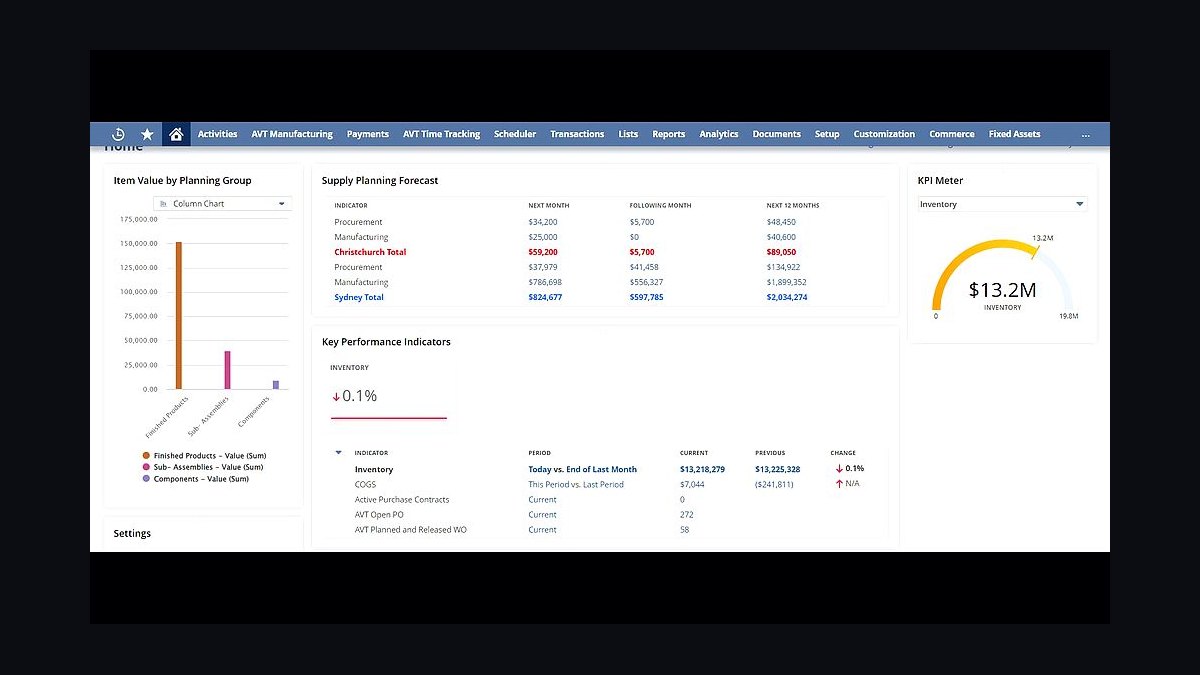
The 10 best tech stack tools for small and midsize manufacturers are ranked below on measured performance, build quality, price, and how each one actually holds up in daily use rather than how it reads on a spec sheet. Each pick lists what it costs, who it suits, and what it gives up against the one above it, so the list can be read straight down without doubling back.
1NetSuite Manufacturing Cloud ERP

NetSuite ranks first because it is the strongest cloud generalist for SMB-to-midsize manufacturers that also need real financials and multi-entity support. It owns BOMs, work orders, routings, inventory, and standard cost as the system of record, with base platform pricing plus per-user licensing and partner-led implementation. Multi-entity consolidation and consolidated inventory visibility are native, which matters the quarter a second plant opens.
It is for the $3M-to-$25M manufacturer that has outgrown QuickBooks and needs finance and production tied to one spine. It trades away deep shop-floor scheduling depth versus Epicor Kinetic, so high-mix job shops may find routing logic thinner. Compared with Epicor Kinetic directly below, NetSuite wins on financials and cloud administration while Epicor wins on discrete-manufacturing floor depth.
2Epicor Kinetic ERP

Epicor Kinetic ranks second because it is purpose-built for discrete manufacturing and wins decisively on shop-floor depth — scheduling, routings, and job costing that generalist cloud ERPs approximate rather than own. It handles multi-level BOMs, phantom assemblies, and lot and serial tracking natively, and pairs cleanly with Epicor CPQ for configured quoting. Expect a heavier implementation than NetSuite.
It is for the SMB discrete manufacturer where routing accuracy and job costing drive margin, typically $5M to $50M in revenue. It trades away the lighter cloud administration and financial polish NetSuite offers. Compared with SAP Business One below, Epicor delivers more floor functionality but a longer, costlier implementation, so smaller shops should weigh that gap carefully before committing.
3SAP Business One

SAP Business One ranks third because it gives smaller shops the SAP roadmap at a lower per-user cost than full enterprise ERP. It covers BOMs, inventory, production orders, and financials in one system, with multi-entity support that many SMB competitors charge extra to add. Per-user licensing keeps a fifteen-to-fifty-person shop affordable while preserving a credible upgrade path.
It is for the smaller manufacturer that wants SAP ecosystem credibility without a six-figure enterprise rollout. It trades away the shop-floor scheduling depth of Epicor Kinetic above and the financial reporting flexibility of NetSuite. Compared with Infor CloudSuite Industrial below, SAP Business One is broader but shallower on make-to-order and engineer-to-order job costing.
4Infor CloudSuite Industrial

Infor CloudSuite Industrial ranks fourth because it fits make-to-order and engineer-to-order work where every job is somewhat bespoke. Formerly SyteLine, it carries project-based costing, estimating, and configuration logic that standard discrete ERPs handle awkwardly. For shops quoting unique machinery rather than repeating a stable catalog, that job-costing orientation is the deciding feature.
It is for the $10M-to-$100M manufacturer whose revenue comes from one-off or highly configured orders. It trades away the simplicity and lower implementation cost of SAP Business One above, and it demands more internal process discipline. Compared with Global Shop Solutions below, Infor scales further but costs more to stand up and administer.
5Global Shop Solutions ERP

Global Shop Solutions ranks fifth because it is a credible job-shop-native ERP built around estimating, job costing, and scheduling rather than adapted from general accounting. Shops that quote every job from scratch get estimating and variance tools tuned to that workflow. Implementation is generally shorter than Epicor Kinetic or Infor CloudSuite Industrial because the product assumes job-shop process.
It is for the contract manufacturer and high-mix job shop, roughly $3M to $30M, where standard cost is nearly meaningless and estimating accuracy matters more. It trades away the multi-entity financial depth of NetSuite and SAP Business One. Compared with Fishbowl Manufacturing below, it is a real ERP with far more job-costing depth, at materially higher cost.
6Fishbowl Manufacturing

Fishbowl Manufacturing ranks sixth because it is a legitimate, money-saving choice for shops under roughly $3M with straightforward products, layering BOMs, work orders, and inventory onto QuickBooks Online. It avoids over-buying enterprise ERP years before the complexity justifies it. Implementation is measured in weeks, often done by the owner plus a part-time consultant.
It is for the micro job shop that needs real inventory and assembly tracking without a six-figure rollout. It trades away multi-level BOM depth, lot traceability at scale, and multi-entity financials. Compared with Global Shop Solutions above, Fishbowl is cheaper and faster but breaks the moment you run several concurrent work orders across multi-level assemblies.
7Tulip No-Code MES

Tulip ranks seventh because it is the most approachable modern no-code MES for building digital work instructions and capturing operator data without a systems-integration project. Shop-floor teams configure apps themselves, which shortens the gap between deployment and adoption. It captures labor, scrap, and quality events that feed actual cost back against the ERP's standard cost.
It is for the SMB plant above roughly $5M that has an ERP in place and now needs real floor data. It trades away the deep machine-level OEE analytics that MachineMetrics specializes in. Compared with Plex below, Tulip is lighter and faster to deploy but less suited to high-volume repetitive plants needing integrated ERP and MES.
8Plex Smart Manufacturing Platform

Plex, now part of Rockwell Automation, ranks eighth because it is a cloud MES and ERP hybrid aimed at higher-volume plants that want execution and record-keeping in one system. It handles production, quality, and traceability natively, which suits automotive and regulated suppliers needing audit-ready lot tracking. Consolidating ERP and MES removes a re-keying integration entirely.
It is for the higher-volume repetitive manufacturer, typically above $25M, where throughput and traceability outweigh job-shop flexibility. It trades away the configure-anything flexibility of Tulip above and the job-costing orientation of Infor CloudSuite Industrial. Compared with MachineMetrics below, Plex is a full execution system rather than a monitoring layer.
9MachineMetrics Machine Monitoring

MachineMetrics ranks ninth because it is best-in-class when what you actually need is machine monitoring and OEE rather than a full execution system. It connects to CNC controls and PLCs, captures uptime, cycle time, and downtime reasons, and reports OEE without a plant-wide MES rollout. Deployment is narrower and faster than a full MES project.
It is for the shop that wants floor visibility first and work-instruction digitization later, typically $5M to $50M. It trades away operator-facing work instructions and quality event capture that Tulip and Plex provide. Compared with Plex above, MachineMetrics is a measurement layer, not a system of record, and must still feed data back to the ERP.
10Limble CMMS

Limble ranks tenth because it is the most-loved modern CMMS for SMB plants, covering preventive maintenance, work orders, and spare-parts tracking without enterprise overhead. It is mobile-first, so technicians close work orders from the floor, and setup takes days rather than months. That keeps unplanned downtime visible and scheduled maintenance from slipping.
It is for the SMB manufacturer that has ERP and floor data in place and now needs maintenance discipline. It trades away the deep Rockwell and Plex integration that Fiix offers in those environments. Compared with MachineMetrics above, Limble manages the maintenance response to downtime rather than measuring the downtime itself.
How we ranked these
We ranked tools on five weighted criteria: fit for discrete and batch manufacturing workflows (30%), total cost of ownership including implementation and per-seat licensing (25%), integration depth with ERP as the system of record (20%), time-to-value for teams under 500 staff (15%), and vendor viability plus support quality (10%). Scores came from vendor documentation, published pricing, peer review aggregates, and reported deployment timelines.
We deliberately ignored generic SaaS popularity, G2 leaderboard position outside manufacturing categories, and feature counts that only matter at enterprise scale. We also excluded analyst magic-quadrant placement and conference buzz, because neither predicts whether a 40-person job shop can cut over cleanly. Marketing claims about AI copilots were discounted unless the vendor documented a specific manufacturing use case.
What to look for
What matters most is whether the tool feeds the ERP without re-keying. A cheaper MES that never syncs actual labor and scrap back to the work order costs more than a pricier one that does, because you pay twice in reconciliation labor. Check integration method, not just an API logo: prebuilt connectors, sync frequency, and who owns mapping failures.
The mistake most buyers make is selecting on demo polish and feature breadth rather than data hygiene and implementation partner quality. A mediocre ERP with a strong partner beats a great ERP with a weak one. Second mistake: buying the MES, PLM, and BI layers in the same quarter as the ERP cutover, which overloads the same two internal people.
Related questions
What is the minimum viable tech stack for a manufacturer under $3M revenue?
Fishbowl Manufacturing on QuickBooks Online, HubSpot Starter, Microsoft 365 Business Premium, and a lightweight CMMS. Skip standalone MES, PLM, and QMS until complexity forces them. Expect roughly $1,500 to $3,500 per month and an implementation measured in weeks, often run by the owner plus a part-time consultant. Do not buy enterprise ERP at this scale.
Does a small manufacturer really need both an ERP and an MES?
Only once margin variance matters more than order tracking. Below roughly $5M revenue, barcode work-order tracking inside the ERP is a reasonable interim answer. Above that, an MES captures real machine and operator data so actual cost meets standard cost. Buying both without integrating them is worse than buying neither, because you pay twice and re-key everything.
How long should an ERP implementation take for a midsize manufacturer?
Ninety days is realistic for the core: item master, BOMs, inventory, work orders, and GL. MES, PLM connection, and BI follow in later quarters. Midmarket implementations commonly run three to nine months, and the variable that actually determines timeline is data hygiene, not software. Be skeptical of any vendor promising a full midmarket go-live in ninety days.
Should inventory and warehouse management live inside the ERP?
For most manufacturers, yes. A second inventory source of truth creates a permanent reconciliation tax and quietly erodes trust in both systems. Standalone WMS makes sense mainly when the ERP is light, such as Fishbowl for QuickBooks shops or Cin7 for multi-channel finished-goods distribution. If your ERP can hold bins, lots, and serials, keep it there.
When does standalone CPQ pay for itself?
When option complexity, not deal volume, makes spreadsheet quoting unreliable. A configurator that resolves an order into a costed, buildable BOM prevents quoting things you cannot actually build at the quoted cost. Shops with a stable, short catalog can quote inside the CRM or ERP and skip standalone CPQ entirely. Buy this layer when invalid configurations start reaching engineering.
How do I connect CAD and PLM to my ERP without a custom project?
Choose a PLM with a documented ERP connector, such as Arena paired with a major cloud ERP, and confirm the connector handles engineering-change orders, not just item sync. The non-negotiable is that PLM-controlled BOMs feed the ERP automatically. A folder of loose drawings on a network share is not revision control, no matter how disciplined your lead engineer is.
What percentage of revenue should a manufacturer spend on software?
Most manufacturers at SMB and midmarket scale land in the low single digits of revenue, well under what software or professional-services firms spend, because capital goes into machines rather than seats. If your stack quote pushes meaningfully past that range, you are likely buying enterprise tooling early or paying for seats nobody uses. Benchmark against manufacturers, not distributors.
Is Salesforce Manufacturing Cloud worth it over HubSpot for a small manufacturer?
Below midmarket scale, usually not. HubSpot is the better value for most SMB manufacturers and rarely over-engineered for a ten-person commercial team. Salesforce Manufacturing Cloud adds sales agreements, volume commitments, and rebate forecasting that genuinely matter at midmarket scale with complex channel programs. Buy it when those specific processes exist, not in anticipation of them.
FAQ
What is the single most important layer in a manufacturing tech stack?
The ERP, because it owns BOMs, routings, inventory, work orders, and standard cost. Every other system either feeds it demand or reports actuals back to it. Get the ERP selection and data migration right before touching the floor, CRM, or BI layers. Most failed manufacturing stacks were architected around a CRM by someone whose prior implementations were in software or services.
Can I run a manufacturing business on QuickBooks and spreadsheets?
Only until multi-level assemblies, lot tracking, or several simultaneous work orders appear. Spreadsheet BOMs and QuickBooks inventory do not crash dramatically; they accumulate manual reconciliation work and missed ship dates that everyone starts treating as normal. Move before that normalization sets in, because by then the cost is measured in lost customers rather than software fees.
What does an MES actually give a small manufacturer?
Real-time machine and operator data so the ERP's theoretical standard cost meets the floor's actual cost. That feedback loop is what produces usable variance analysis, showing which jobs and product lines actually made money. Without it, margin reporting is fiction dressed in decimals. MachineMetrics is the right pick if you mainly need OEE rather than full execution control.
How much should I budget for an ERP implementation?
Implementation commonly runs one to two times first-year license for midmarket ERP. Three times or more signals heavy customization or a partner problem, and both deserve interrogation before signing. At SMB scale, one-time implementation frequently lands between $50,000 and $150,000. Always get current pricing directly from vendors, since manufacturing software list prices move.
Do I need a standalone QMS if I am not in a regulated industry?
Usually not at first. Non-regulated shops can run quality inside the ERP's QMS module until ISO 9001 or AS9100 scope demands more. Aerospace, medical device, and automotive work makes CAPA, nonconformance, document control, and audit trails a selection criterion for the ERP itself. Validate the audit trail before you sign, not during your first audit.
What is the biggest cause of manufacturing software project failure?
Adoption, not technology. A machinist who has run jobs off a paper traveler for twenty years will not switch to tablet work instructions because a consultant recommended it. Budget real training time, pick internal champions per shift, and expect second shift to lag first. Most failures at this scale are change-management failures wearing a technical costume.
How should I secure the shop floor as I connect more systems?
Segment the OT network from the IT office network, and pass machine data through an MES gateway rather than connecting PLCs directly to business systems. Manufacturing has become a favored ransomware target precisely because downtime pressure makes victims pay quickly. Treat floor ransomware as a when-not-if scenario and build it into downtime planning, not just IT policy.
What should I do in the first 30 days of a rollout?
Lock the system of record. Select and stand up the ERP, migrate the item master, multi-level BOMs, vendors, and open work orders, and validate inventory valuation and standard cost against a physical count. Resist scope creep entirely. Most rollouts that fail, fail here, by attempting the floor and CRM simultaneously before the spine is clean.
Which integrations deliver the most value?
MES-to-ERP and PLM-to-ERP. MES-to-ERP is how actual cost meets standard cost, producing real variance analysis. PLM-to-ERP is how an engineering change reaches purchasing without anyone re-keying a part number, which prevents building last month's design. If you build only two integrations, build those two, and build them before adding BI or CPQ.
Is a cloud ERP or on-premise better for a small manufacturer?
Cloud is the default for most SMB and midmarket manufacturers in 2027, mainly because it removes server maintenance and eases remote access for distributed teams. On-premise still appears in shops with strict data residency rules or heavy customization tied to legacy systems. The bigger decision is partner quality and data hygiene, not hosting model.
Sources
- https://www.netsuite.com/portal/products/erp/manufacturing.shtml
- https://www.epicor.com/en-us/products/kinetic/
- https://www.sap.com/products/erp/business-one.html
- https://www.tulip.co/
- https://www.machinemetrics.com/
- https://www.arenasolutions.com/
- https://www.solidworks.com/
- https://www.hubspot.com/products/crm
- https://www.limblecmms.com/
- https://powerbi.microsoft.com/
Related on PULSE
This page will be disappearing soon. Save it to your device for $1 — or read it free while it is here.
@Kory-White- · if Venmo asks, the last 4 of my number are 2012
This page is gone.
This one is off the shelf now. $1 keeps it on your phone for good — the whole page, pictures and diagrams included.
 pulse-tech-stacksTop 10 Best Tech Stack Tools for Painting Contractors in 2027
 pulse-tech-stacksTop 10 Best Tech Stack Tools for Medical Billing and RCM Companies in 2027
 pulse-tech-stacksTop 10 Best Tech Stack Tools for Self-Storage Operators in 2027
 pulse-tech-stacksTop 10 Best Tech Stack Tools for AI Observability Platform Companies in 2027
 pulse-tech-stacksTop 10 Best Tech Stack Tools for Plumbing Contractors in 2027
 pulse-tech-stacksTop 10 Best Tech Stack Tools for Email Security Vendors in 2027
 pulse-tech-stacksTop 10 Best Tech Stack Tools for Public Relations Agencies in 2027
 tkTop 10 Best Tech Stack Tools for Concrete and Paving Contractors in 2027
 pulse-tech-stacksTop 10 Best Tech Stack Tools for Employee Benefits Consulting Firms in 2027
 pulse-tech-stacksTop 10 Best Tech Stack Tools for Embeddings API Companies in 2027