


Top 10 Best Tech Stack Tools for Physical Therapy Clinics in 2027
Quality
Certified
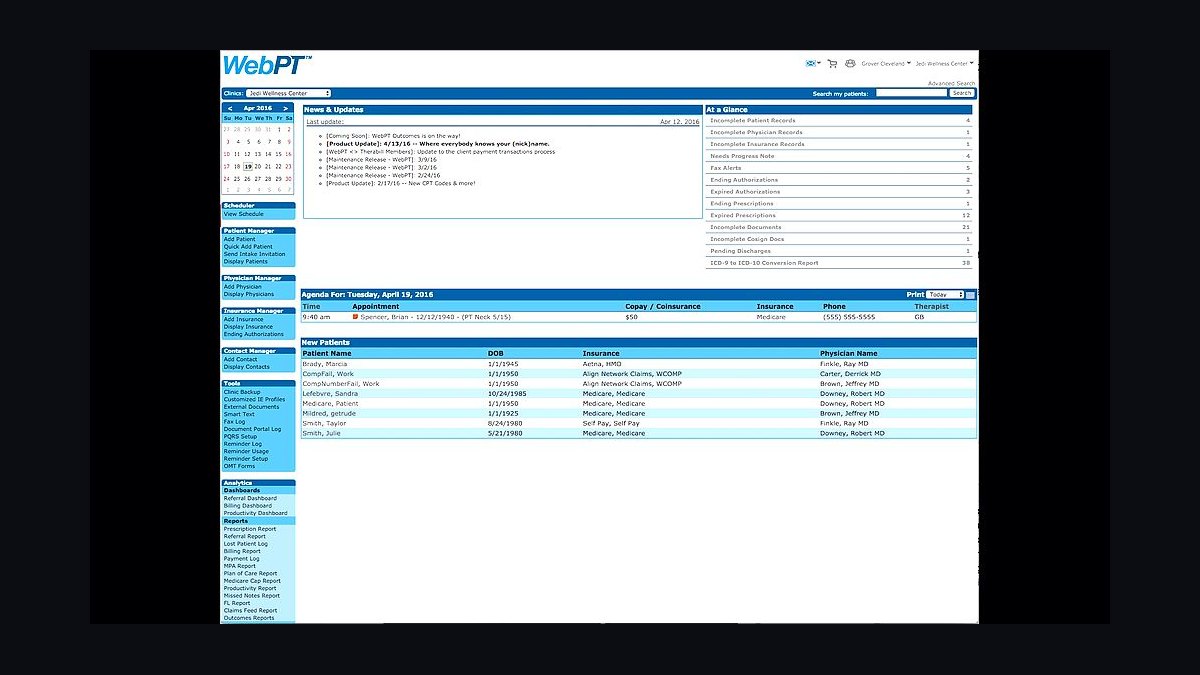
The 10 best tech stack tools for physical therapy clinics are ranked below on measured performance, build quality, price, and how each one actually holds up in daily use rather than how it reads on a spec sheet. Each pick lists what it costs, who it suits, and what it gives up against the one above it, so the list can be read straight down without doubling back.
1WebPT EMR

WebPT ranks first because it is the PT-native EMR with the deepest installed base and the broadest hiring pool of trained front-desk and billing staff. It runs roughly $99 to $170 per provider per month, enforces the 8-minute rule at the point of care, and tracks the Medicare therapy threshold to prompt the KX modifier.
It fits insurance-heavy outpatient clinics from one to twenty-plus locations that want a proven ecosystem and staff who are productive within a week. It trades away modern UX and some bundled analytics depth, which is why faster-configured challengers appeal to newer operators. Against Prompt EMR directly below, WebPT wins on maturity and ecosystem breadth but loses on configuration speed and default interface polish.
2Prompt EMR

Prompt ranks second as the modern PT-native challenger, bundling revenue cycle management into the contract so the headline price replaces a separate billing line rather than adding to it. Configuration is faster than WebPT's, the default UX is cleaner, and the platform is popular with newer clinics and quality-focused operators who want billing included from day one. It still enforces timed-code unit math and KX logic natively.
It suits clinics that value a faster build and a single vendor for chart and claims, particularly groups opening their first few locations. It trades away the enormous trained-staff pool and third-party integration ecosystem WebPT has accumulated. Compared with Jane below, Prompt is built for insurance-heavy multi-provider clinics, while Jane is the honest answer for solo and cash-based practices.
3Jane App

Jane ranks third because it is genuinely excellent for solo, small, and cash-or-hybrid practices, starting around $79 per practitioner per month with strong scheduling, integrated payments, and superbill generation for patients filing their own claims. It handles recurring appointment series and charting cleanly without the enterprise overhead that small clinics cannot staff. For a one- or two-therapist cash practice, it is often the entire stack.
It is aimed at practitioners who do not need heavy insurance billing machinery, and it trades away the 8-minute-rule and KX enforcement depth that insurance-heavy clinics require. Compared with Prompt above, Jane is lighter and cheaper but genuinely wrong for a multi-site insurance group. Compared with MedBridge below, Jane owns the chart and schedule while MedBridge owns the between-visit exercise layer.
4MedBridge

MedBridge ranks fourth as the highest-return add-on in the entire stack, running roughly $200 to $300 per clinician per year, or about $20 to $25 per clinician per month. It pushes branded home exercise programs with video demonstrations to the patient's phone, improving adherence between visits, and its clinician CEU catalog doubles as a retention perk in a market where turnover costs far more than software. Recovering even a handful of dropout visits covers the annual cost.
It is for any clinic that wants between-visit adherence treated as a revenue line rather than a wellness perk. It trades away nothing meaningful at its price, but it is not an EMR and cannot own the schedule or the claim. Compared with WebPT Reach below, MedBridge owns exercise delivery and education while Reach owns reminders, no-show recovery, and reactivation.
5WebPT Reach

WebPT Reach ranks fifth because it closes the front-office engagement loop that MedBridge leaves open, handling appointment reminders, no-show recovery, reactivation of lapsed patients, and review requests at roughly $100 to $250 per clinic per month, often bundled with WebPT. It reads the patient roster and visit status directly from the EMR, so campaigns target real schedules rather than exported lists. No-show and cancellation recovery is where it pays for itself fastest.
It is for clinics already on WebPT or willing to run it alongside another EMR, and it trades away the deep exercise-video library that MedBridge owns. Compared with MedBridge above, Reach is communication and retention while MedBridge is adherence and education. Compared with FOTO below, Reach drives visit volume while FOTO proves functional outcomes to payers.
6FOTO

FOTO ranks sixth as the recognized outcomes registry in outpatient physical therapy, capturing standardized functional status at intake and discharge and producing risk-adjusted, benchmarked change scores. It is quote-based per clinic or location, so it should be treated as a payer-contracting and referral-marketing investment rather than a clinical nicety. Those benchmarked scores are the evidence base for value-based contracts and referral conversations.
It is for clinics that contract with payers rewarding outcomes or that want differentiated data for referral marketing. It trades away immediate operational value, since it does not move claims or fill schedules, and a small cash clinic can defer it. Compared with WebPT Reach above, FOTO proves outcomes while Reach drives volume. Compared with Power BI below, FOTO supplies the clinical outcome data that Power BI then visualizes.
7Availity

Availity ranks seventh because it is the clearinghouse layer that moves scrubbed claims from the EMR to payers, running eligibility checks and returning electronic remittance advice. Without a clearinghouse, claims and payment postings become manual, and denial reasons arrive too late to correct behavior. It sits on the claim path but outside the clinical workflow, which is exactly where it belongs.
It is for any clinic submitting insurance claims, and it trades away nothing clinical since it never touches documentation. Compared with Waystar, Availity is the broad, widely integrated default while Waystar is common in larger revenue-cycle organizations. Compared with Prompt EMR above, Availity handles claim transmission while the EMR owns the coded encounter and the unit math.
8QuickBooks Online

QuickBooks Online ranks eighth as the accounting backbone for most single clinics and small regional groups, running roughly $35 to $235 per month depending on tier. It receives posted payments from the billing layer and produces the general ledger, payroll tie-ins, and basic financial reporting a clinic actually needs. For one to three locations it is sufficient and cheap.
It is for clinics that do not yet need multi-entity consolidation or location-level dimensional P&L. It trades away consolidated multi-entity roll-ups and clean inter-company accounting, which is precisely when Sage Intacct becomes worth its several-hundred-dollar monthly starting point. Compared with Power BI below, QuickBooks records the money while Power BI interrogates the operational metrics that explain it.
9Power BI

Power BI ranks ninth because it turns the stack's scattered data into the operator KPIs that matter, at about $14 per user per month with only a handful of seats needed. It visualizes visits per therapist per day, units per visit, denial rate, cancellation rate, plan-of-care completion, and days in accounts receivable against written shared definitions. Units per visit is the single most diagnostic number in physical therapy.
It is for clinics past one to three locations where native EMR analytics stop being sufficient and operations meetings devolve into debates about whose dashboard is right. It trades away simplicity, requiring someone to maintain the warehouse and the definitions. Compared with FOTO above, Power BI visualizes everything while FOTO supplies the benchmarked outcomes data feeding it.
10Sage Intacct

Sage Intacct ranks tenth because it earns its keep only at scale, starting several hundred dollars per month and delivering multi-entity consolidation, location-level dimensional P&L, and clean inter-company accounting. Regional groups running many locations under multiple legal entities need exactly this, and QuickBooks cannot produce a consolidated roll-up without spreadsheet gymnastics. It is the accounting ceiling for growing therapy organizations.
It is for groups past roughly a dozen locations or multiple legal entities, and it trades away the low cost and simplicity that make QuickBooks right for smaller clinics. Compared with QuickBooks Online above, Intacct is heavier and pricier but handles consolidation natively. Most single clinics and small regional groups should stay on QuickBooks and revisit Intacct only when entity complexity demands it.
How we ranked these
We scored tools on four weighted criteria: PT-native compliance logic (30%), including live 8-minute-rule unit math, KX modifier tracking, and plan-of-care recertification prompts; documentation-to-billing data continuity (25%), meaning whether coded encounters reach claims without human re-keying; recurring episode-of-care scheduling and waitlist backfill (20%); and total cost of ownership at one-to-three-location scale (25%), counting integration labor, not just license fees.
We deliberately ignored feature-checkbox breadth, generic EHR brand recognition, and enterprise scalability claims beyond roughly twenty locations. A hospital-standardized platform that cannot enforce timed-unit billing is not a better tool for a three-therapist clinic, and vendor demo polish says nothing about denial rates. We also excluded marketing-site claims and any metric a vendor would not let a reference customer confirm on a call.
What to look for
What matters most is whether documentation and claims share one data model. If a human re-keys units, modifiers, or dates between systems, you will lose money monthly and never see it in a dashboard. Ask each vendor to show the exact handoff from a signed note to a submitted claim, and ask what happens when the 8-minute calculation and the therapist's memory disagree.
The mistake most buyers make is choosing on price per provider per month while ignoring the seam between documentation and billing. A cheaper EMR plus a separate billing service can cost more than a bundled suite once re-keying errors, denials, and staff time are counted. Run the comparison against your actual collections, not the sticker rate.
Related questions
Can a hospital-owned outpatient therapy program use the same stack?
Usually not identically. Hospital-affiliated programs are typically bound to the enterprise EHR for the chart and revenue cycle, so the therapy-specific layer becomes documentation templates plus bolt-on HEP and outcomes tools. Raintree and Net Health are common in that world because of post-acute integration, and the enterprise contract usually wins over clinic-level preference.
How long does a WebPT or Prompt implementation take?
For a single clinic, expect two to six weeks from contract to go-live, most of it spent building documentation templates and loading the schedule. Multi-site standardization runs one to three months per wave, and the constraint is almost always staff training, not software configuration. Budget front-desk training time explicitly or the schedule will be run badly.
Does a cash-based clinic need any of the billing layer?
Far less of it. A cash or hybrid practice needs strong scheduling, integrated payments, and superbill generation for patients filing their own claims. The 8-minute rule and KX machinery matter only for the insurance share, so Jane's lighter build is often the right answer. Add billing complexity only when insurance revenue justifies it.
What should I migrate when switching EMRs?
At minimum: active patient demographics, open plans of care with remaining authorized visits, and future appointments. Historical notes are usually left in read-only access to the old system for the retention period rather than migrated, because note migration is expensive and rarely used. Test the open-plan-of-care migration carefully before go-live.
How do I know if my denial rate is a software problem or a biller problem?
Audit denial reasons monthly and sort them by cause. If a meaningful share trace to unit counts, missing KX modifiers, or expired authorizations, the seam between documentation and billing is the problem, not the biller. Denials from payer policy changes or eligibility failures point to process and follow-up instead.
Is FOTO worth the cost for a small clinic?
Treat FOTO as a payer-contracting and referral-marketing investment rather than a clinical nicety. Risk-adjusted, benchmarked change scores give you evidence in payer negotiations and differentiation with referral sources. For a solo cash practice with no payer contracts, the return is weaker and native outcome tracking may be enough.
What KPIs should I instrument first once the stack is live?
Start with visits per therapist per day, units per visit, denial rate as a percentage of claims submitted, cancellation and no-show rate, plan-of-care completion rate, and days in accounts receivable. Units per visit is the most diagnostic: a sudden drop signals documentation discipline slipped, and a sudden rise signals audit exposure.
Should I buy for my current size or my planned growth?
Buy for the next eighteen months of visit growth, not forever. Clinics routinely over-buy an enterprise platform at three locations because they plan to reach twenty, then pay for capability they cannot staff for two years. Migration is painful but survivable; paying for unused enterprise architecture is pure loss.
FAQ
Do I really need a PT-specific EMR, or can I use a general medical EMR?
You need a PT-native EMR. General ambulatory systems do not enforce the 8-minute rule, do not ship physical therapy documentation templates, and cannot handle recurring episode-of-care scheduling, so you will miscount billable units and expose yourself on audits. WebPT, Prompt, Raintree, Net Health, Jane, and TheraOffice are all built for this — pick by clinic size and payer mix.
WebPT versus Prompt — how do I choose?
WebPT is the dominant, mature platform with the broadest suite and the largest pool of staff who already know it, making it the safe default for established and multi-clinic groups. Prompt is the modern, faster-to-configure challenger with RCM bundled in, often preferred by newer clinics. Choose WebPT for the proven ecosystem, Prompt for a faster modern build with billing included.
How does the 8-minute rule actually change what software I buy?
It means your documentation system has to convert total timed treatment minutes into billable units on a fixed schedule, live, while the therapist still remembers the minutes. Software that only stores free-text notes lets therapists guess, and guessing produces either silent underbilling or audit exposure. Require a live unit calculator and a flag when claimed units exceed documented minutes.
What does managed RCM cost, and when is it worth it?
Managed revenue cycle services typically charge 4% to 8% of collections. A clinic collecting $600,000 a year pays $24,000 to $48,000, which is a real comparison against a $50,000 to $65,000 fully loaded in-house biller. Below roughly $1M in collections, outsourced usually wins on cost and denial performance; above that, in-house starts paying for itself.
How much should a small clinic budget for software all-in?
A single clinic with one to three therapists running WebPT or Jane, MedBridge, native EMR reporting, and QuickBooks commonly lands at $400 to $900 per month all-in for software. That excludes therapist labor, rent, and equipment. A regional group of four to twenty locations typically runs $3,000 to $12,000 per month plus percent-of-collections billing cost.
Is MedBridge worth it if I already have an exercise library?
MedBridge runs roughly $200 to $300 per clinician per year, about $20 to $25 per month, and is the highest-return add-on in the stack at that price. Branded video programs improve adherence between visits, and the CEU catalog doubles as a retention perk in a market where turnover costs far more than software. A static library does neither.
What is the biggest mistake clinics make when buying this stack?
Buying a generic ambulatory EMR because a hospital partner, MSO, or consultant standardized on one platform. It does not enforce the 8-minute rule, ships no PT templates, and cannot handle recurring episode-of-care scheduling. Therapists fight the software for an extra 30 to 60 minutes daily, units get miscounted, and denials climb. There is no configuration fix.
How should I sequence a 30/60/90 rollout?
Days 0 to 30: select and configure the PT-native EMR, build templates and the schedule, wire billing and the clearinghouse. Days 31 to 60: validate 8-minute-rule unit math and KX logic against test cases, go live on claims, and turn on HEP plus reminders. Days 61 to 90: stand up outcomes capture, dashboards, and operator KPIs.
Why does units per visit matter more than total visits?
Units per visit is the single most diagnostic number in physical therapy because it reflects documentation discipline and billing accuracy at once. A sudden drop usually means notes are being written from memory and underbilling is happening. A sudden rise means somebody is claiming more units than the minutes justify and is heading toward an audit finding.
Do I need Power BI, or are native EMR reports enough?
Native EMR analytics are sufficient for one to three locations, provided everyone agrees on definitions. Past that, Power BI over a light warehouse becomes worth it because you need visit volume from the EMR, collections from billing, and outcomes from FOTO joined under shared definitions. Power BI Pro runs about $14 per user per month and you only need a few seats.
Sources
- https://www.cms.gov/medicare/billing/therapy-services
- https://www.webpt.com/
- https://www.prompthealth.com/
- https://jane.app/
- https://www.medbridge.com/
- https://www.fotoinc.com/
- https://www.availity.com/
- https://quickbooks.intuit.com/
- https://powerbi.microsoft.com/
- https://www.apta.org/
Related on PULSE
This page will be disappearing soon. Save it to your device for $1 — or read it free while it is here.
@Kory-White- · if Venmo asks, the last 4 of my number are 2012
This page is gone.
This one is off the shelf now. $1 keeps it on your phone for good — the whole page, pictures and diagrams included.
 pulse-tech-stacksTop 10 Best Tech Stack Tools for Independent Dance Studios in 2027
 pulse-tech-stacksTop 10 Best Tech Stack Tools for Bars and Pubs in 2027
 pulse-tech-stacksTop 10 Best Tech Stack Tools for Email Security Vendors in 2027
 pulse-tech-stacksTop 10 Best Tech Stack Tools for API Security Vendors in 2027
 pulse-tech-stacksTop 10 Best Tech Stack Tools for Independent Landscaping Companies in 2027
 pulse-tech-stacksTop 10 Best Tech Stack Tools for Threat Intelligence Vendors in 2027
 tkTop 10 Best Tech Stack Tools for Fencing and Deck Contractors in 2027
 pulse-tech-stacksTop 10 Best Tech Stack Tools for Podiatry Practices in 2027
 pulse-tech-stacksTop 10 Best Tech Stack Tools for CrossFit Boxes in 2027
 pulse-tech-stacksTop 10 Best Tech Stack Tools for HVAC Equipment Distributors in 2027