


Top 10 Best Tech Stack Tools for Post-Quantum Cryptography Vendors in 2027
Quality
Certified
The 10 best tech stack tools for post-quantum cryptography vendors are ranked below on measured performance, build quality, price, and how each one actually holds up in daily use rather than how it reads on a spec sheet. Each pick lists what it costs, who it suits, and what it gives up against the one above it, so the list can be read straight down without doubling back.
1Salesforce Sales Cloud Enterprise

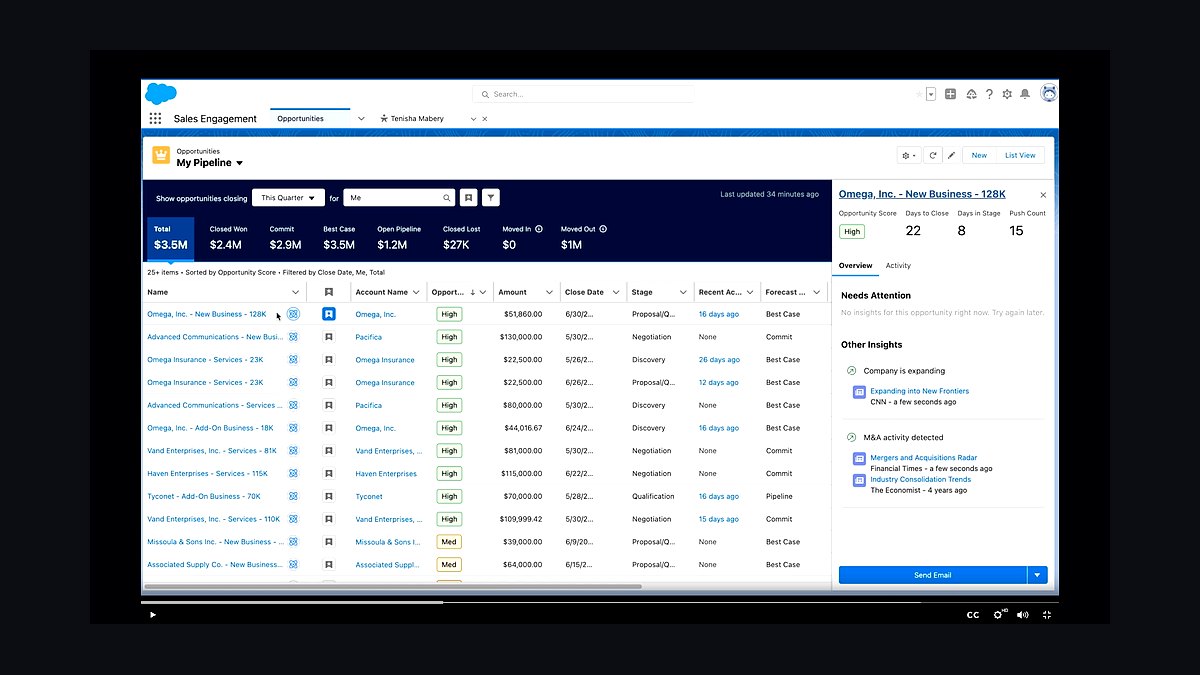
Salesforce Sales Cloud Enterprise ranks first because the PQC deal object model is the hardest thing to retrofit, and Salesforce custom objects carry the regulatory driver, discovery-scan status, estate size in certificates, and incumbent HSM vendor. Enterprise editions price per user per month, landing in the mid-hundreds annually depending on edition and contract length. Six-to-eighteen-month cycles with a sixty-to-ninety-day discovery pilot demand stage definitions tied to observable artifacts.
It suits vendors past roughly $20M ARR with a four-person buying committee spanning CISO, cryptography lead, compliance owner, and application-platform owner. The trade-off is administrative overhead and cost: HubSpot Enterprise is defensible below that threshold and far cheaper to run. Compared with Zuora at rank two, Salesforce owns the relationship and pipeline record while billing owns the money.
2Zuora Billing

Zuora Billing ranks second because PQC pricing blends per-certificate subscription, milestone services, and occasional perpetual OEM licensing, a mix naive SaaS billing cannot represent. It handles subscription plus professional services plus perpetual in one contract, priced as a six-figure annual commitment at enterprise scale. ASC 606 allocation across term license, discovery engagement, migration milestones, and support is genuinely hard and surfaces during diligence.
It fits vendors above roughly $50M ARR whose contracts bundle software and services. The trade-off is cost and implementation time; Stripe Billing plus a competent revenue-operations hire covers smaller volumes. Against Salesforce CPQ, which manages quote complexity, Zuora owns recurring revenue and recognition while Salesforce owns the pipeline.
3Gong Revenue Intelligence

Gong ranks third because PQC technical objections repeat verbatim across deals — signature size, FIPS validation status, side-channel posture, hybrid interoperability — and recorded calls let new account executives absorb how cryptographers answer them. Priced per seat, it earns its keep in a category where sellers must be credible on five recurring objections without holding cryptographic credentials. Every deal still needs a solutions architect for hostile internal reviewers.
It suits growth-stage vendors onboarding sellers faster than they can hire cryptographic literacy. The trade-off is per-seat cost that scales with headcount while value scales with deal quality, and outbound sequencing converts poorly here versus inbound driven by regulatory news. Against Clari at rank four, Gong develops sellers while Clari inspects the forecast.
4Clari Revenue Platform

Clari ranks fourth because a six-to-eighteen-month cycle with a technical pilot in the middle cannot be forecast on seller optimism, and pipeline inspection tied to observable artifacts — scan complete, roadmap accepted, pilot passed — is the discipline the category needs. Priced per seat, it pairs with Gong and covers forecasting, pipeline inspection, and revenue cadence. Cryptographic engineering teams tend to build brilliant products on chaotic revenue operations.
It suits growth-stage vendors with enough deal volume to make statistical forecasting meaningful. The trade-off is that below a few dozen active opportunities the signal is thin and spreadsheet discipline works. Against Gong at rank three, Clari reads the pipeline while Gong develops the people who fill it.
5Vanta Compliance Automation

Vanta ranks fifth because SOC 2 Type II and ISO 27001 are table stakes for selling into regulated buyers, and automation lands annual costs in the low five figures for a growing company. It continuously monitors controls rather than snapshotting them, which matters when the same engineering team is also chasing FIPS 140-3 module validation through an accredited laboratory over twelve to eighteen months. FedRAMP remains a separate multi-year program.
It suits seed through growth-stage vendors who need commercial-framework evidence fast and cannot spare headcount. The trade-off is that Vanta does not cover FIPS 140-3, Common Criteria, or FedRAMP, which are the actual PQC purchasing gates. Against Hyperproof at rank six, Vanta is lighter and cheaper while Hyperproof handles several frameworks at once.
6Hyperproof GRC Platform

Hyperproof ranks sixth because once a vendor is managing SOC 2, ISO 27001, FIPS 140-3 evidence, Common Criteria artifacts, and FedRAMP simultaneously, a single-framework tool stops working. It maps overlapping controls across frameworks so one piece of evidence satisfies several auditors, which is the actual cost driver in a compliance-heavy category where validation, not compute, consumes the budget. AuditBoard is the comparable alternative at larger scale.
It suits growth-stage vendors past roughly $15M ARR pursuing European and defense buyers alongside commercial ones. The trade-off is more configuration and administrative weight than Vanta, and it still does not perform the laboratory work. Against Vanta at rank five, Hyperproof trades simplicity for multi-framework coverage.
7Gainsight Customer Success

Gainsight ranks seventh because the renewal argument in PQC is a monitored loop, not a one-way migration, and the health metrics are unusual: percentage of inventoried estate migrated, percentage under agility policy, algorithm swaps executed, and days until the customer's binding regulatory deadline. Standard seat-based health scores mislead here. The staffing reality is that customer success managers need genuine cryptographic literacy.
It suits growth-stage vendors whose renewal depends on demonstrating continuous re-scanning and drift detection rather than initial deployment. The trade-off is that Gainsight assumes a generalist CSM motion, and hiring generalist CSMs into a solutions-architect-shaped role is a reliably expensive mistake. Against Pendo at rank eight, Gainsight tracks the relationship while Pendo tracks console usage.
8Pendo Product Analytics

Pendo ranks eighth because the agility layer and discovery console are where adoption either compounds or stalls, and product analytics shows which parts of the migration workflow customers actually use. It instruments console adoption, feature depth, and drop-off without requiring engineering to build telemetry, which matters when cryptographic engineers are consumed by side-channel hardening and validation queues. Standard SaaS adoption curves apply less than expected.
It suits growth-stage vendors with a self-serve or low-touch console component alongside enterprise deals. The trade-off is that Pendo measures interaction, not cryptographic outcomes, so it complements rather than replaces Gainsight health scoring. Against Gainsight at rank seven, Pendo reads the product while Gainsight reads the account.
9Datadog Observability Platform

Datadog ranks ninth because the control plane for a PQC vendor runs across AWS or Azure with Terraform, GitHub Enterprise, and Argo CD or Flux, and observability across that surface is standard rather than exotic. It covers infrastructure, application traces, and logs in one place, priced per host and per ingested volume, and integrates with PagerDuty for on-call. Nothing about the category changes the observability requirement.
It suits vendors at any stage running a cloud control plane with real uptime commitments to regulated customers. The trade-off is cost at volume, since per-host and per-gigabyte pricing compounds as scan data grows. Against Gainsight and Pendo above it, Datadog watches the platform while those watch the customer.
10Thales Hardware Security Modules

Thales ranks tenth because it is not a tool the vendor buys but the incumbent platform the vendor must integrate with, and a Thales shop and an Entrust shop have different integration paths and competitive dynamics. Discovery output must enumerate HSM-backed keys, and the agility layer must resolve policy to primitives the customer's HSM already supports. Entrust and Utimaco occupy the same position.
It suits vendors selling into enterprises and government where HSM integration is a gating requirement, not a nice-to-have. The trade-off is dependency: the incumbent does not need to win on post-quantum, only to be adequate while winning on everything else. Against Datadog at rank nine, Thales is the customer's infrastructure rather than the vendor's.
How we ranked these
We ranked tools by how directly they support the five-stage PQC migration arc: discovery scanning across source, network, certificate, and embedded surfaces; roadmap prioritization by confidentiality lifetime; crypto-agility policy abstraction; hybrid TLS/IKE/X.509 deployment; and steady-state drift detection. Weighting favored validated modules, hybrid support, and FIPS 140-3 readiness over raw throughput benchmarks.
We deliberately ignored algorithm speed comparisons, marketing feature counts, and seat-based pricing optics. Pure performance is commoditized by liboqs and PQClean, and benchmark wins do not close enterprise deals. We also excluded vendor lock-in scores and analyst quadrant placement, because in a category where standards are still settling, interoperability and auditability matter far more than short-term competitive positioning.
What to look for
What matters most is whether the tool spans the full migration arc rather than solving one stage. A scanner without a policy engine produces paralysis; an agility layer without discovery has nothing to govern. Buyers should verify hybrid mode support, FIPS validation status, HSM vendor integrations, and whether the vendor can show a real estate-sized deployment, not a lab benchmark.
The mistake most buyers make is treating this as a software purchase when it is a multi-year program purchase. They evaluate on feature checklists and per-seat cost, then discover the integration burden lands on an application-platform owner who was never in the room. Insist on a discovery pilot as the first milestone, price services separately, and confirm the vendor's roadmap is pinned to CA and cloud provider deadlines, not just regulator dates.
Related questions
What is crypto-agility and why does it matter more than the algorithm itself?
Crypto-agility is the ability to swap cryptographic primitives without rewriting applications. It matters because algorithm implementations commoditize quickly, while the inventory, policy engine, and abstraction layer above them persist across standard revisions. Enterprises will still pay for agility in 2033 when the current algorithm set has been amended at least once.
Why is hybrid mode non-negotiable for post-quantum deployments?
Hybrid key exchange combines a classical primitive with a post-quantum one so the session survives if either is broken. Security teams will not bet everything on relatively young lattice mathematics, and they are right not to. A single cryptanalysis result against a pure PQC deployment would be catastrophic; hybrid absorbs that risk.
How long does FIPS 140-3 validation actually take?
Budget twelve to eighteen months from submission through an accredited laboratory, longer if the lab queue is congested. It is the single longest pole in the tent for federal and defense deals. Start the process earlier than feels comfortable, because federal procurement will not close without a validated module.
What should a first discovery scan actually cover?
Four surfaces: source code for hardcoded algorithm identifiers, network traffic for negotiated TLS and IKE suites, certificates by signature algorithm and expiry, and embedded or OT firmware where crypto is burned into silicon. The embedded findings are usually the honest bad news and the most trust-building output.
Why do PQC deal cycles run six to eighteen months?
The buying committee spans a CISO sponsor, a cryptography lead, a compliance owner, and an application-platform owner who absorbs integration. The proof of concept is almost always a discovery scan rather than an algorithm benchmark, which adds sixty to ninety days before technical validation even begins.
When does per-seat pricing stop making sense for PQC vendors?
Immediately. Value correlates with certificates under management, applications under policy, and protected endpoints, not headcount. Per-seat pricing misaligns the commercial model with the migration program and makes the software attach invisible to the board during diligence.
What is the biggest competitive threat to standalone PQC vendors?
Hardware security module incumbents like Thales, Entrust, and Utimaco, plus hyperscalers folding post-quantum key exchange into managed services. The incumbent does not need to win on post-quantum, only to be adequate while winning on everything else in the cryptographic infrastructure stack.
How should services revenue be structured in a PQC migration sale?
Price and deliver as distinct milestones: discovery, roadmap, pilot migration, production rollout. This keeps gross margin legible, makes the software attach visible, and prevents consulting revenue from quietly converting the company's valuation multiple from software to services before a fundraise.
FAQ
What is the recommended 2027 stack for a PQC vendor?
Pair NIST-standardized algorithms ML-KEM, ML-DSA, SLH-DSA, and Falcon with discovery scanners, a crypto-agility policy layer, and hybrid TLS, IKE, and X.509 implementations. Run sales on Salesforce, Clari, and Gong; billing on Zuora and NetSuite; compliance on Vanta and Hyperproof.
Which NIST standards should procurement cite?
FIPS 203 for ML-KEM, FIPS 204 for ML-DSA, and FIPS 205 for SLH-DSA. These give procurement a citable object instead of a research paper, which is what converts a hypothetical quantum threat into an approved budget line inside a security organization.
What is harvest now, decrypt later and why does it carry deals?
An adversary captures encrypted traffic today, stores it, and decrypts it when a cryptographically relevant quantum computer arrives. Any data with a confidentiality lifetime longer than the migration window is already exposed, which turns a hypothetical into a funded program for health, legal, defense, and financial data.
How does CNSA 2.0 affect the buying timeline?
NSA's Commercial National Security Algorithm Suite 2.0 attached phased dates ending around the early 2030s, with software and firmware signing moving first. That gives national security system buyers a binding deadline, which is materially different from internal risk committee curiosity in a CRM pipeline.
Why is discovery the first technical win rather than a benchmark?
Nobody knows where their cryptography lives. The first scan produces an inventory that becomes the roadmap, and surfacing uncomfortable findings like unpatched firmware builds more trust than hiding them. Vendors who make discovery legible convert; vendors who make it exhaustive do not.
What is the two-axis heuristic for migration prioritization?
Sort by how long the data must stay secret and how hard the system is to change. Long-lived secrets in easy-to-change systems go first because they are pure win. Long-lived secrets in impossible systems get compensating controls and a hardware refresh line item.
Why are ML-DSA signature sizes a real integration problem?
ML-DSA signatures and public keys are substantially larger than elliptic-curve equivalents. That is fine for a web server and painful for constrained devices, firmware updates over low-bandwidth links, or certificate chains that no longer fit in a handshake. Test against real targets early.
What is the renewal argument for a PQC agility platform?
Standards will change, parameter sets will be deprecated, and at least one implementation panic will occur. Continuous re-scanning, drift detection against policy, and a demonstrated ability to swap a primitive in weeks rather than years is what converts a one-way migration project into a monitored subscription.
How long does a large enterprise migration actually take?
Five to seven years for a large enterprise, which is why 2027 planning matters. Organizations doing discovery now are the ones that finish before their binding deadlines. Individual vendor deal cycles run six to eighteen months with the discovery pilot consuming the first sixty to ninety days.
What staffing reality should PQC vendors plan for in customer success?
Customer success managers need genuine cryptographic literacy. This is a solutions-architect-shaped role wearing a CSM title, and hiring generalist CSMs into it is a reliably expensive mistake. Health metrics should track estate migrated, policy coverage, and days to regulatory deadline.
Sources
- https://csrc.nist.gov/pubs/fips/203/final
- https://csrc.nist.gov/pubs/fips/204/final
- https://csrc.nist.gov/pubs/fips/205/final
- https://www.nsa.gov/Cybersecurity/Post-Quantum-Cybersecurity/
- https://openquantumsafe.org/
- https://www.bsi.bund.de/EN/Themen/Unternehmen-und-Organisationen/Informationen-und-Empfehlungen/Kryptografie/kryptografie_node.html
- https://www.ncsc.gov.uk/guidance/post-quantum-cryptography
- https://www.cyber.gc.ca/en/guidance/post-quantum-cryptography-guidance
- https://csrc.nist.gov/projects/cryptographic-module-validation-program
- https://www.iso.org/standard/27001
Related on PULSE
This page will be disappearing soon. Save it to your device for $1 — or read it free while it is here.
@Kory-White- · if Venmo asks, the last 4 of my number are 2012
This page is gone.
This one is off the shelf now. $1 keeps it on your phone for good — the whole page, pictures and diagrams included.
 pulse-tech-stacksTop 10 Best Tech Stack Tools for Tire Shops in 2027
 tkTop 10 Best Tech Stack Tools for Fencing and Deck Contractors in 2027
 pulse-tech-stacksTop 10 Best Tech Stack Tools for Appliance Repair Services in 2027
 pulse-tech-stacksTop 10 Best Tech Stack Tools for Window Cleaning Services in 2027
 pulse-tech-stacksTop 10 Best Tech Stack Tools for Self-Storage Operators in 2027
 pulse-tech-stacksTop 10 Best Tech Stack Tools for Bot Mitigation Vendors in 2027
 pulse-tech-stacksTop 10 Best Tech Stack Tools for Bars and Pubs in 2027
 pulse-tech-stacksTop 10 Best Tech Stack Tools for Vulnerability Management Software Vendors in 2027
 pulse-tech-stacksTop 10 Best Tech Stack Tools for Pressure Washing Companies in 2027
 pulse-tech-stacksTop 10 Best Tech Stack Tools for Small Pest Control Companies in 2027