


Top 10 Best Tech Stack Tools for AI Sales Coaching and Conversation Intelligence Companies in 2027
Quality
Certified
The 10 best tech stack tools for ai sales coaching and conversation intelligence companies are ranked below on measured performance, build quality, price, and how each one actually holds up in daily use rather than how it reads on a spec sheet. Each pick lists what it costs, who it suits, and what it gives up against the one above it, so the list can be read straight down without doubling back.
1Gong Revenue Intelligence
Gong ranks first because it defined the conversation intelligence category and reached roughly $300M ARR at a $7B valuation by 2024, the largest pure-play in the space. Its platform pairs proprietary call analysis with deal-execution scoring, forecast attribution, and deep bidirectional Salesforce and HubSpot sync. For an AI sales coaching vendor, Gong is both the benchmark competitor and the reference architecture for what full-stack conversation depth looks like.
Gong is built for enterprise revenue organizations with 200+ reps and dedicated RevOps staff who can absorb six-figure annual contracts. It trades away cheap SMB pricing and lightweight self-serve onboarding, so smaller teams often choose Avoma or Fathom instead. Compared with Clari directly below, Gong wins on conversation depth and coaching workflows, while Clari wins on forecast roll-up and revenue-platform breadth.
2Clari Revenue Platform
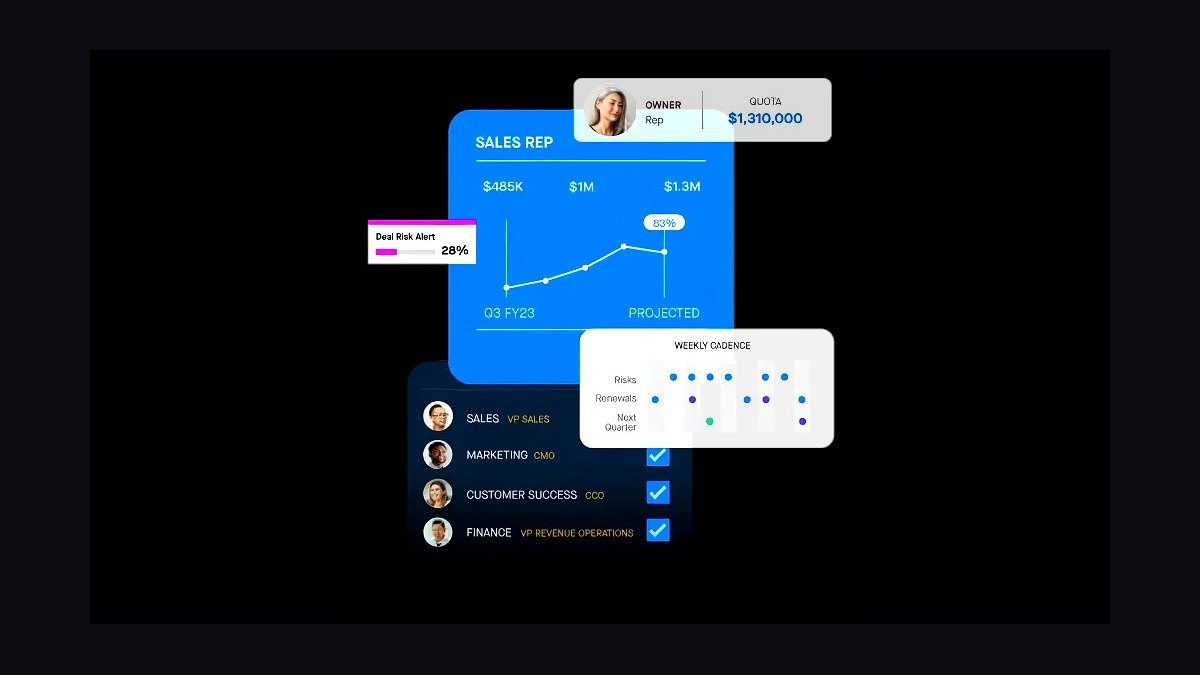
Clari ranks second on the strength of its $2.6B valuation and its forecast-intelligence core, which pairs a conversation intelligence component with pipeline inspection and deal execution. Where Gong leads on call analysis, Clari leads on revenue forecasting accuracy and executive roll-up, the layer VP Sales and CRO buyers actually renew on. Its platform consolidates forecast, pipeline, and coaching into one system of record.
Clari fits large enterprises where forecast accuracy is the primary buying criterion and conversation intelligence is a supporting module. It trades away some call-level coaching depth versus Gong, so enablement-led buyers may prefer the pick above. Against Salesloft and Outreach below, Clari is the analytics and forecasting layer rather than the engagement and sequencing layer reps touch daily.
3Salesloft Sales Engagement
Salesloft ranks third because it owns the rep-facing engagement surface — sequences, cadences, dialer, and email — with conversation intelligence embedded as a feature rather than a standalone product. Owning the daily workflow means Salesloft captures call data natively without relying on third-party recording integrations. It competes directly with Outreach for the same enterprise sales engagement budget line.
Salesloft is for sales organizations that want coaching and conversation insights delivered inside the tool reps already live in. It trades away the deep revenue-intelligence analytics that Gong and Clari provide, so forecasting teams often pair it with one of them. Compared with Outreach directly below, Salesloft is typically rated stronger on coaching workflow and weaker on extensibility and API depth.
4Outreach Sales Engagement
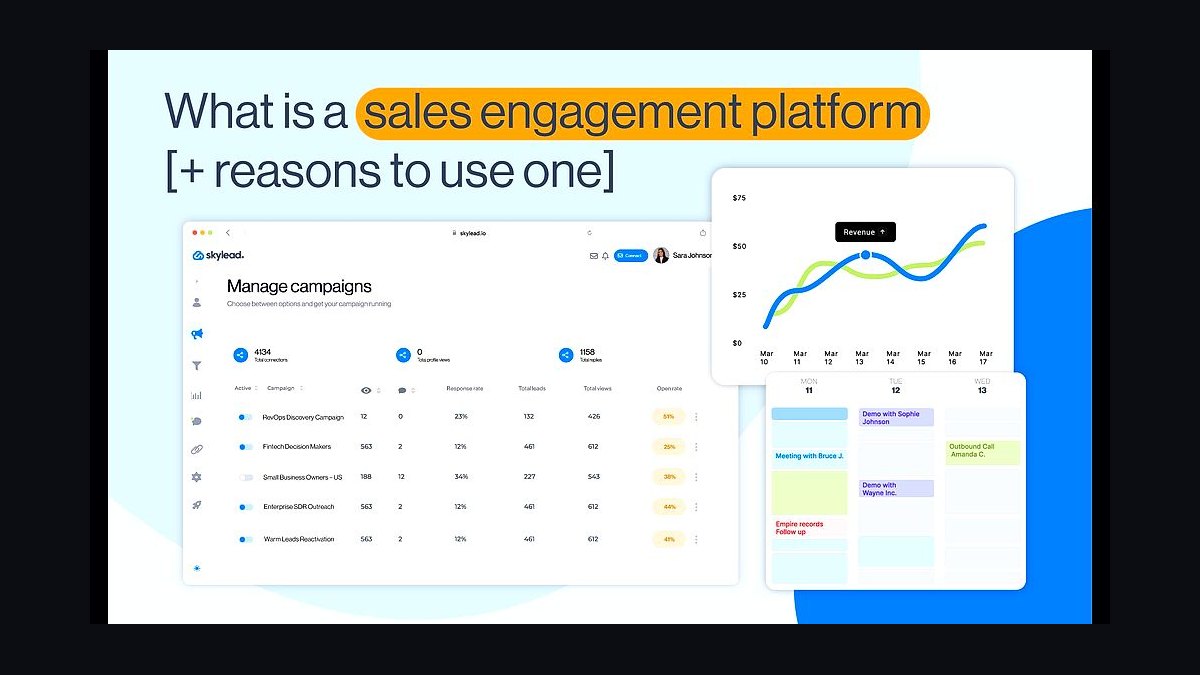
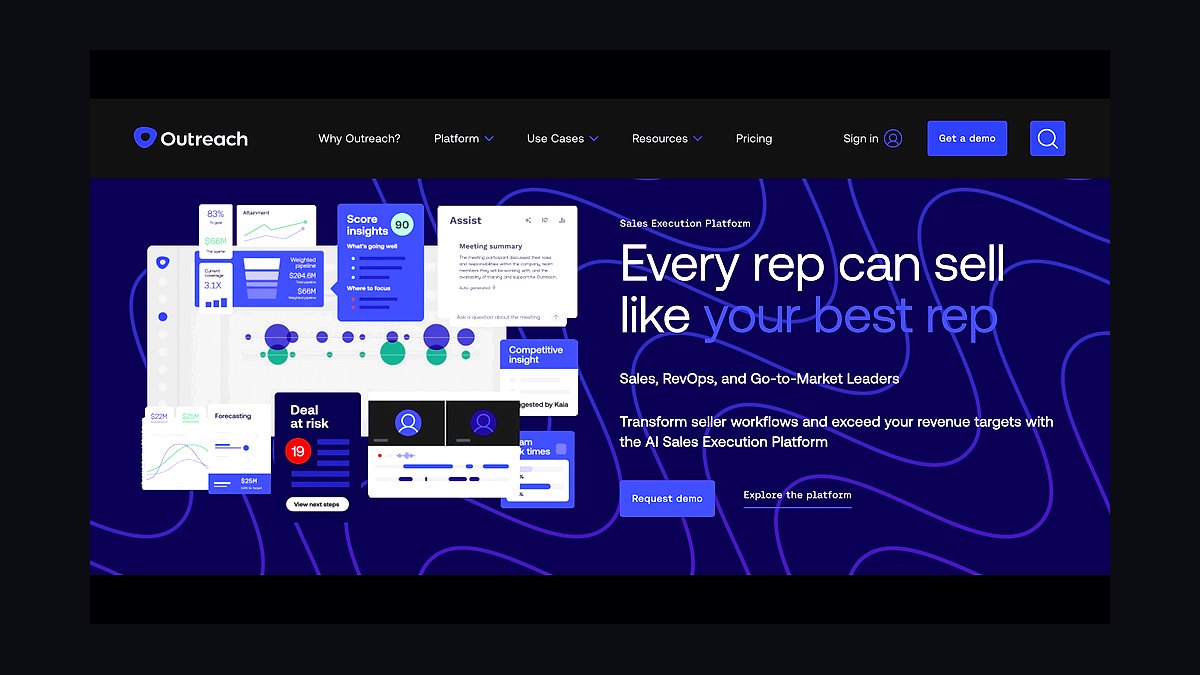
Outreach ranks fourth as the other dominant sales engagement platform, with conversation intelligence, deal management, and forecasting bundled into a single revenue execution suite. Its strength is extensibility: a mature API, a large integration marketplace, and deep CRM sync make it a common backbone for revenue operations teams. Outreach competes head-to-head with Salesloft for the same enterprise seat count.
Outreach suits revenue operations teams that prioritize customization and integration breadth over out-of-box coaching workflows. It trades away some of the polished coaching UX that Salesloft offers, so enablement-first buyers may lean the other way. Against Chorus.ai below, Outreach is the engagement and execution layer, while Chorus is the dedicated conversation intelligence and data-enrichment play.
5Chorus.ai by ZoomInfo
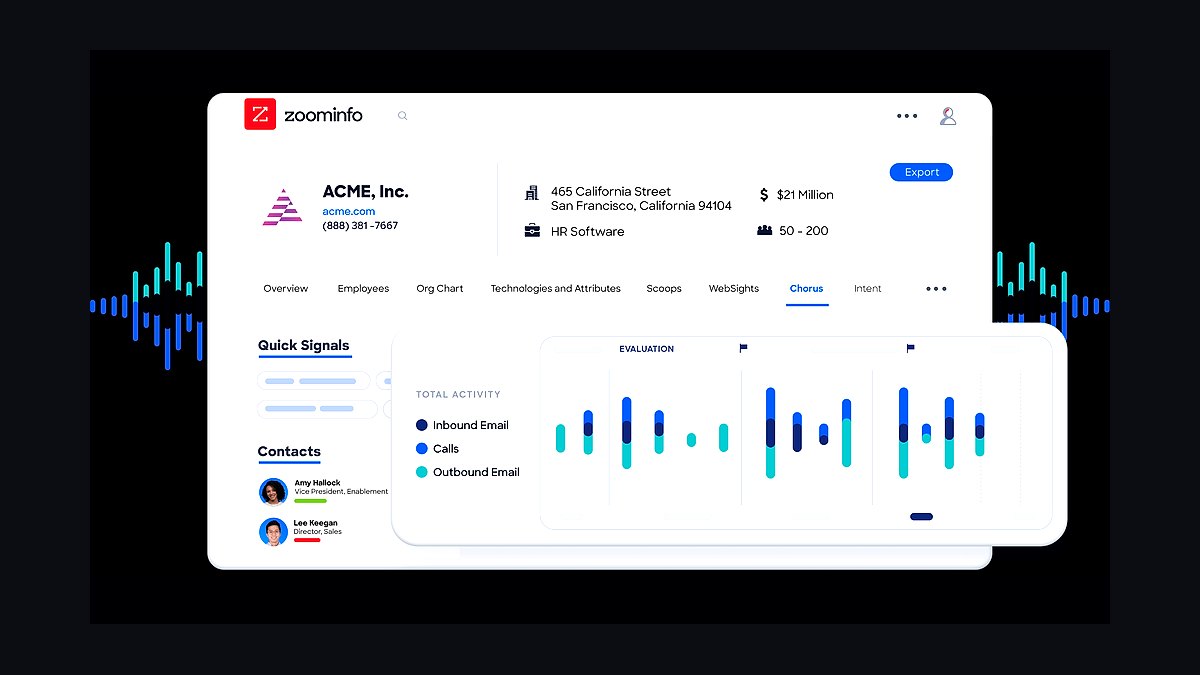
Chorus.ai ranks fifth because ZoomInfo acquired it and bundled conversation intelligence with its B2B contact and intent data, creating a combined data-plus-conversation offering. That bundling gives buyers prospect context alongside call analysis in one contract, a real procurement advantage. Chorus competes on price-per-seat value rather than best-in-class call scoring.
Chorus fits mid-market teams already standardized on ZoomInfo for prospecting data who want conversation intelligence without a separate vendor relationship. It trades away some analysis depth and coaching workflow sophistication versus Gong, so enterprise enablement teams often still pick the leader. Compared with Avoma below, Chorus leans on bundled data while Avoma leans on transparent SMB pricing and self-serve setup.
6Avoma Conversation Intelligence
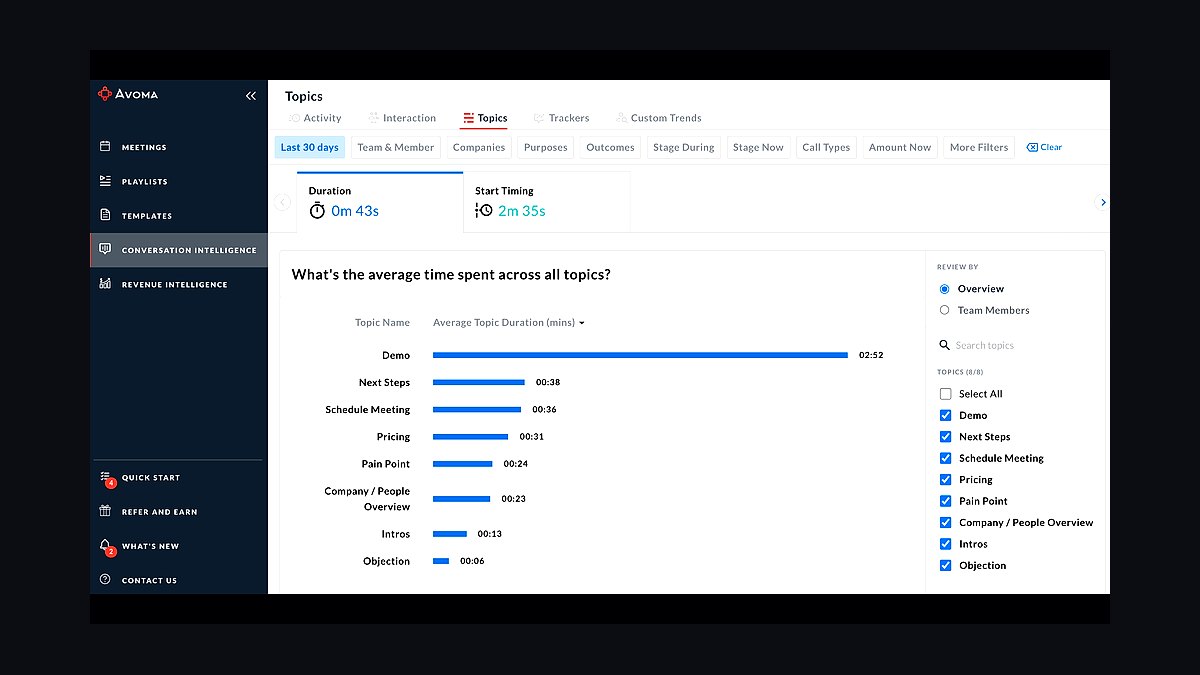
Avoma ranks sixth as the strongest mid-market challenger, combining meeting recording, transcription, conversation intelligence, and revenue intelligence at pricing well below Gong and Clari. It targets teams that want core coaching and deal-risk signals without enterprise contract overhead. Avoma's self-serve onboarding and per-seat transparency make it a common first purchase for scaling sales orgs.
Avoma is for 20-to-200-rep companies that need conversation intelligence now and cannot justify a six-figure platform commitment. It trades away the deep forecasting, graph analytics, and enterprise compliance certifications that Gong and Clari ship. Against Wingman below, Avoma is broader across meeting and revenue intelligence, while Wingman leans on real-time in-call coaching as its differentiator.
7Wingman by Clari
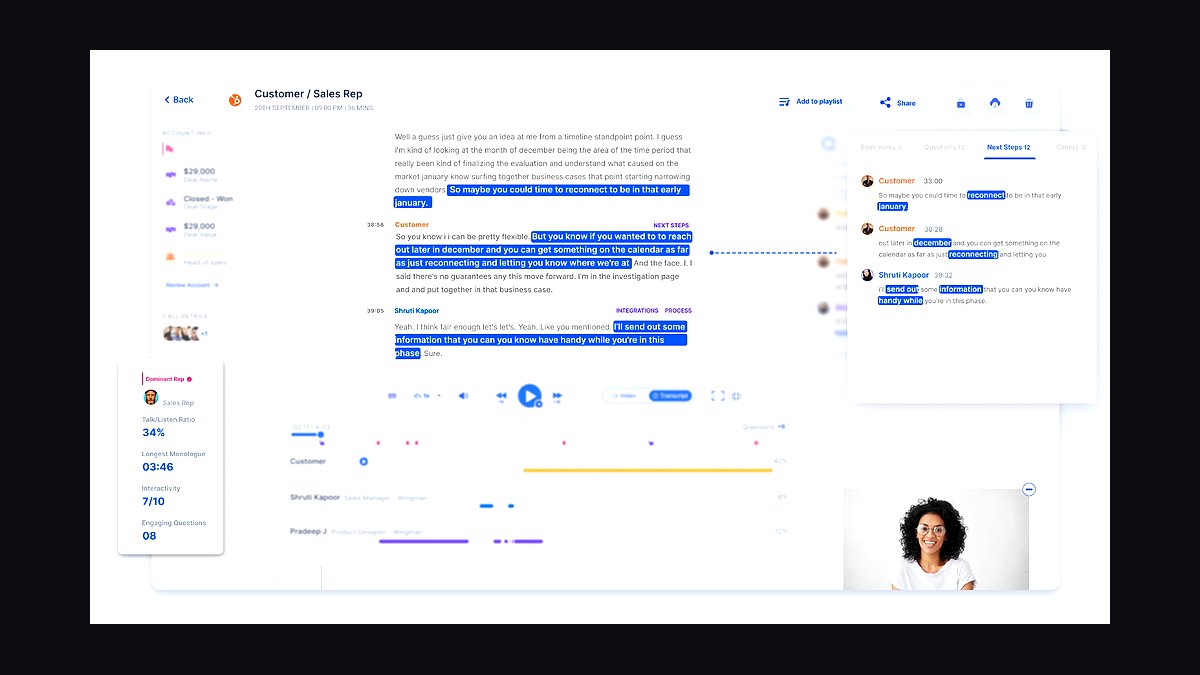
Wingman ranks seventh because Clari acquired it and folded real-time in-call coaching into the Clari revenue platform. Wingman's differentiator is live guidance during calls — talk-track prompts, objection handling, and next-best-action nudges — rather than only post-call analysis. That real-time angle is genuinely distinct from the post-call scoring most competitors lead with.
Wingman fits teams already on Clari that want coaching surfaced inside the same platform, plus SMB buyers wanting live call assistance. It trades away standalone breadth, since it is now a Clari module rather than an independent product with its own roadmap. Compared with Fathom below, Wingman emphasizes live coaching while Fathom emphasizes free-tier meeting capture and fast post-call summaries.
8Fathom AI Notetaker
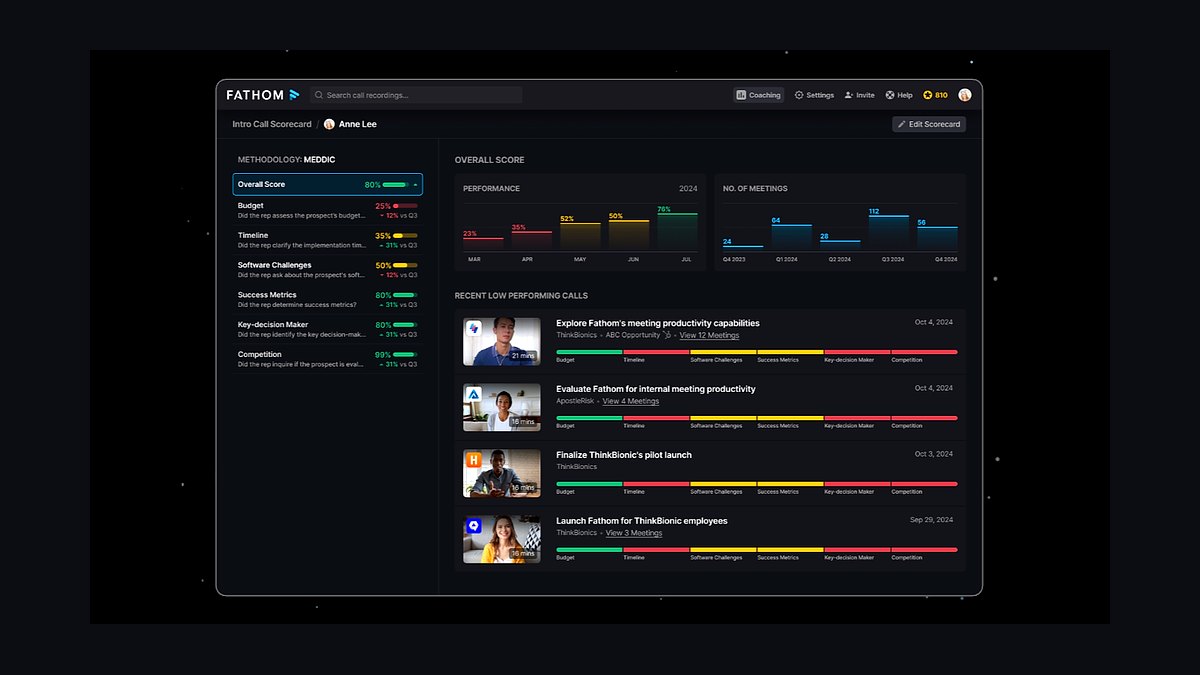
Fathom ranks eighth on the strength of its generous free tier and fast, accurate meeting summaries, which made it a default notetaker for individual reps and small teams. It records, transcribes, and summarizes Zoom, Teams, and Meet calls, then pushes notes and next steps into the CRM. Its zero-friction adoption is why it spreads bottom-up inside sales orgs.
Fathom is for individual reps, founders, and small teams that want meeting capture and summaries without a procurement cycle. It trades away enterprise-grade coaching analytics, MEDDPICC scoring, and forecast attribution that Gong and Clari provide. Compared with tl;dv below, Fathom leans on summary quality and CRM push, while tl;dv leans on multilingual support and timestamped clip sharing.
9tl;dv Meeting Recorder
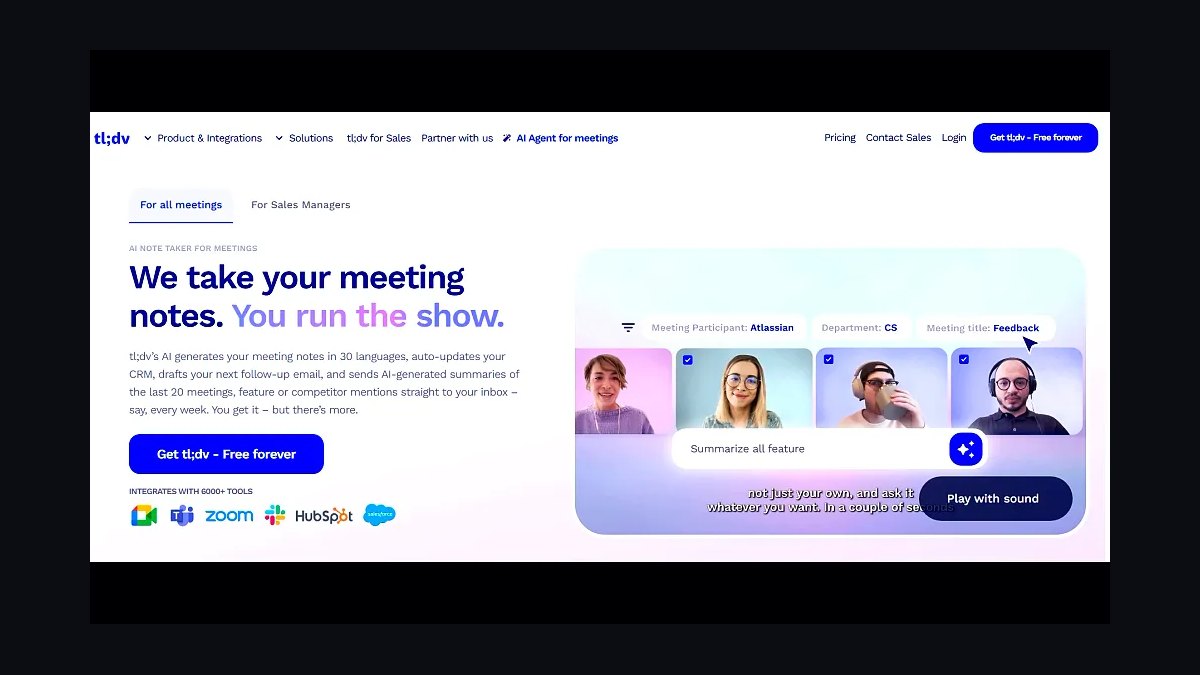
tl;dv ranks ninth as a meeting recorder and conversation intelligence tool known for multilingual transcription, timestamped highlight clips, and shareable snippets that make coaching feedback concrete. It integrates with Zoom, Teams, and Meet and pushes summaries to CRM, targeting teams that want lightweight capture with strong clip-sharing. Its free tier and per-seat pricing keep it accessible.
tl;dv is for teams that coach through shared call clips rather than dashboards, and for multilingual sales orgs needing accurate non-English transcription. It trades away the deep deal-scoring, graph analytics, and forecast attribution that enterprise platforms ship. Compared with Fathom above, tl;dv is stronger on clip sharing and language coverage, while Fathom is stronger on summary polish and default CRM push.
10Salesforce Einstein Conversation Insights
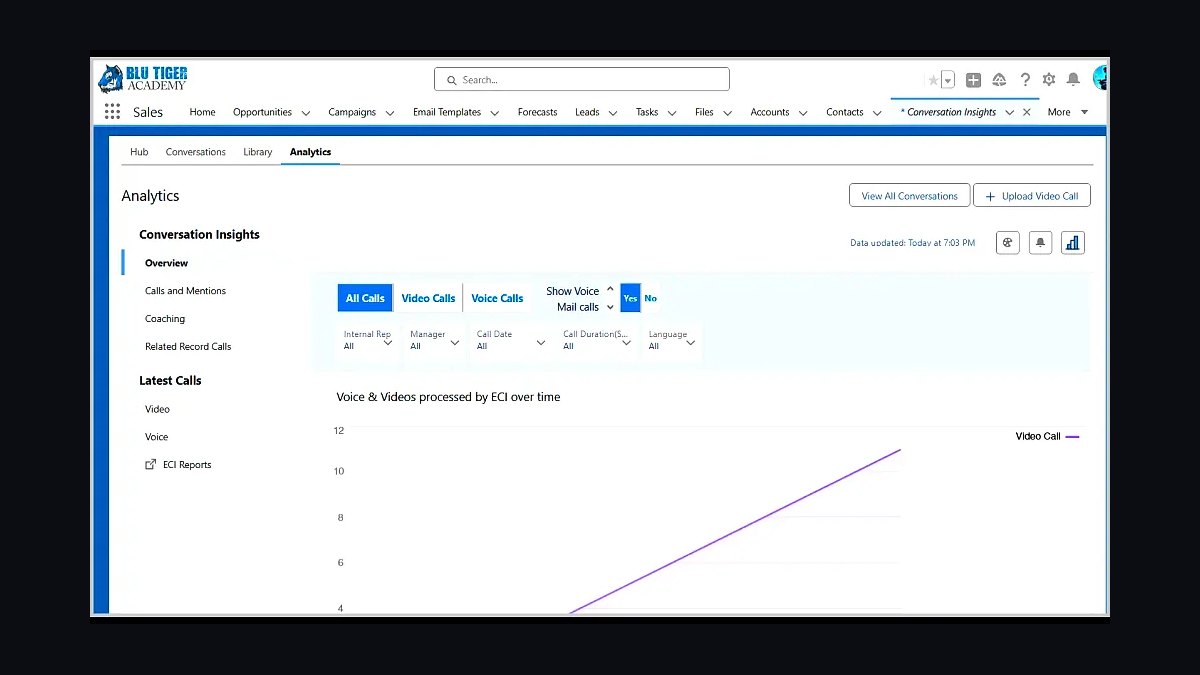
Salesforce Einstein Conversation Insights ranks tenth because it is the native CRM option, bundling call transcription, keyword tracking, and coaching insights directly into Sales Cloud without a third-party vendor. For organizations already standardized on Salesforce, the zero-integration path and single-contract procurement are real advantages. It is the default answer when IT blocks new vendors.
Einstein Conversation Insights is for Salesforce-centric enterprises that value native data residency and consolidated billing over best-in-class analysis. It trades away cross-CRM support, multi-platform recording breadth, and the deeper revenue intelligence that Gong and Clari deliver. Compared with Microsoft Sales Copilot, which is not ranked here, Einstein is the Salesforce-native counterpart to Microsoft's Teams and Dynamics-native offering.
How we ranked these
We ranked tools by weighting five factors: depth of native telephony and video-conferencing capture (Zoom, Teams, Meet, Webex, Dialpad), bidirectional CRM sync reliability with Salesforce and HubSpot, LLM-based scoring accuracy for MEDDPICC and deal-risk signals, transcript storage cost at 100M-500M words per month, and compliance coverage for call-recording consent plus GDPR Article 9 biometric rules.
Integration breadth and sync stability carried the heaviest weight because broken CRM sync destroys rep trust faster than any missing feature.
We deliberately ignored list prices, G2 review counts, and vendor valuation headlines. Seat-based pricing misleads when LLM inference and storage dominate real cost, and review volume rewards SMB tools that never touch enterprise call-recording law. We also excluded feature checklists that no operator can verify without a pilot, and ignored native CRM AI bundling claims, since Einstein and Copilot depth changes quarterly and rarely matches dedicated conversation analysis.
What to look for
What matters most is whether the tool survives your worst integration month: Salesforce API version changes, Teams compliance-recording policy shifts, and two-party consent states. Ask vendors for sync uptime data, hotfix release cadence, and per-jurisdiction recording rules. Then test scoring accuracy against your own closed-won and closed-lost calls, not vendor benchmark decks, because a 60% accurate MEDDPICC score trains reps to ignore the product entirely.
The mistake most buyers make is choosing on feature breadth during a scripted demo instead of piloting on messy production calls. They also underweight compliance: recording a two-party consent state without disclosure creates legal exposure that no forecast uplift offsets. Finally, buyers lock into annual contracts before confirming that transcript storage and LLM inference costs scale linearly, which quietly doubles total cost at 500 reps.
Related questions
Why does telephony and video integration breadth matter more than analysis features?
Every platform (Zoom, Teams, Meet, Webex, Dialpad, Five9, Genesys) needs its own compliant capture integration, costing three to nine engineer-months each. A vendor missing your primary meeting platform captures nothing, so analysis quality is irrelevant. Buyers should verify current integrations against their actual stack before evaluating scoring models or dashboards.
How should buyers evaluate MEDDPICC scoring accuracy before signing?
Run a blind pilot on 100 of your own closed-won and closed-lost calls, then compare vendor scores against your RevOps team's manual assessment. Demand published accuracy benchmarks and human-in-loop review options for high-stakes scoring. Vendors whose scores fall below roughly 75% agreement will lose rep trust within a quarter.
What compliance obligations apply to AI call recording in the US and EU?
US call recording follows one-party versus two-party consent state law, while voice data is biometric under GDPR Article 9 and Illinois BIPA. Vendors must ship consent prompts, per-jurisdiction recording rules, retention controls, and deletion workflows. Buyers should confirm the vendor detects the caller's state automatically rather than relying on rep judgment.
Is Microsoft Sales Copilot or Salesforce Einstein enough to replace a dedicated tool?
Native CRM AI handles basic transcription and summary inside its own ecosystem, but it rarely supports cross-CRM pipelines, deep competitor tracking, or multi-platform recording. Standalone vendors differentiate on conversation depth, revenue intelligence, and forecast attribution. Buyers with mixed Salesforce and HubSpot estates should treat native AI as a complement, not a replacement.
How do transcript storage and LLM inference costs scale at 500 reps?
A 500-rep org generates 10K-50K calls monthly, roughly 100M-500M words, plus diarization and analysis. ClickHouse, Iceberg, and S3 keep storage cheap, but frontier LLM inference dominates spend. Buyers should model per-call inference cost at current volume and at 3x growth before committing to annual pricing.
Should we build speech-to-text in-house or license AssemblyAI or Deepgram?
Building Whisper-class STT in-house costs 20-50 engineer-years plus ongoing model investment, and only frontier-scale vendors justify it. AssemblyAI and Deepgram deliver strong diarization, language detection, and PII redaction at predictable per-minute pricing. Most vendors should license STT and spend engineering on analysis and integrations instead.
What does CRM sync brittleness actually cost a sales organization?
When bidirectional sync breaks, deal context vanishes, automatic field updates stop, and reps re-enter data manually. Reps then blame the coaching tool and stop using it, which kills adoption metrics and renewal odds. Buyers should demand integration test farms, multi-version Salesforce and HubSpot support, and a documented hotfix release channel.
How long does a realistic implementation take for a mid-market sales org?
Days 1-30 cover primary meeting platform capture plus CRM bidirectional sync. Days 31-60 add LLM analysis for scoring, next steps, and risk signals. Days 61-90 extend to secondary platforms and compliance certifications. Buyers should resist compressing this timeline, since compliance and sync reliability failures surface during the first renewal cycle, not the pilot.
FAQ
What is the best tech stack for an AI sales coaching vendor in 2027?
The core stack combines compliant call capture across Zoom, Teams, Meet, Webex, and Dialpad; Whisper-class STT from AssemblyAI or Deepgram; GPT-5, Claude Sonnet, or Gemini Pro for conversation analysis; Postgres plus ClickHouse and Iceberg for transcripts; Neo4j for deal graphs; and deep Salesforce and HubSpot bidirectional sync.
Gong vs Clari vs Salesloft vs Chorus: how do buyers choose?
Gong leads on conversation depth and revenue intelligence, Clari on forecast accuracy and revenue platform breadth, Salesloft and Outreach on engagement and dialer integration, and Chorus.ai on ZoomInfo data bundling. Buyers should weight whichever layer their RevOps team actually operates daily, then pilot on production calls.
Do AI sales coaching tools need SOC 2, ISO 42001, and EU AI Act compliance?
Yes for enterprise deals. SOC 2 Type II satisfies most security reviews, ISO 42001 signals AI governance maturity, and EU AI Act plus GDPR Article 9 obligations apply whenever voice biometrics are processed. Vanta, Drata, or Hyperproof automate evidence collection, but product-level consent and retention controls still require engineering work.
How accurate is AI conversation analysis for deal-risk detection today?
Accuracy varies widely by use case. Stage classification and next-step extraction perform well, while MEDDPICC scoring and champion-departure detection remain weaker without customer-specific calibration. Buyers should demand published benchmarks, run blind pilots against their own call corpus, and keep human review for high-stakes forecast inputs.
What call recording laws should AI coaching vendors design around?
Vendors must handle one-party and two-party consent states, GDPR Article 9 biometric classification, Illinois BIPA, and equivalent rules in Canada, the UK, Australia, and Singapore. Product design needs automatic jurisdiction detection, recording disclosure prompts, retention limits, and deletion workflows rather than relying on rep discretion.
How much does an AI sales coaching stack cost at different ARR stages?
Early-stage vendors spend roughly $80K-$300K monthly on cloud, STT, LLM APIs, and core SaaS. Growth-stage vendors at $20M-$200M ARR spend $1M-$5M monthly with full CRM integration and multi-region infrastructure. Category leaders like Gong run $10M-$50M monthly including global compliance and FedRAMP.
Is FedRAMP authorization necessary for selling AI sales coaching to government?
FedRAMP Moderate unlocks federal civilian pipeline, and CMMC Level 2 is required for DoD supply chain work. Authorization takes 12-24 months and significant engineering investment, so vendors should pursue it only when federal revenue justifies the cost. Most commercial buyers treat SOC 2 and ISO 27001 as sufficient.
What are the most common failure modes for AI sales coaching vendors?
Four dominate: call recording compliance violations in two-party consent states, CRM sync brittleness after Salesforce API changes, analysis accuracy below customer tolerance, and bundling pressure from Microsoft Sales Copilot and Salesforce Einstein. Each requires dedicated engineering investment, not marketing positioning, to survive enterprise renewals.
How should vendors handle LLM routing between GPT, Claude, and Gemini?
Most scaled vendors route workloads by cost and quality: frontier APIs for high-stakes scoring and summaries, cheaper or fine-tuned models for high-volume classification and tagging. Multi-LLM routing also reduces single-vendor outage risk. Buyers should ask which model handles which analysis type and how routing changes affect output consistency.
What does a realistic 90-day implementation plan look like?
Days 1-30 deliver primary meeting platform capture plus CRM bidirectional sync. Days 31-60 add LLM analysis for scoring, next steps, and risk alerts, along with billing and compliance tooling. Days 61-90 extend to secondary platforms and complete SOC 2, ISO 42001, and GDPR readiness. Compressing this timeline usually surfaces sync and compliance failures at renewal.
Sources
- https://www.gong.io/product/
- https://www.clari.com/products/
- https://www.salesloft.com/platform
- https://www.outreach.io/platform
- https://www.zoominfo.com/products/chorus
- https://learn.microsoft.com/en-us/microsoft-sales-copilot/
- https://www.salesforce.com/sales/einstein-conversation-insights/
- https://www.assemblyai.com/docs
- https://deepgram.com/product/speech-to-text
- https://www.iso.org/standard/42001
Related on PULSE
This page will be disappearing soon. Save it to your device for $1 — or read it free while it is here.
@Kory-White- · if Venmo asks, the last 4 of my number are 2012
This page is gone.
This one is off the shelf now. $1 keeps it on your phone for good — the whole page, pictures and diagrams included.
 pulse-tech-stacksTop 10 Best Tech Stack Tools for Tire Shops in 2027
 pulse-tech-stacksTop 10 Best Tech Stack Tools for Staffing Agencies in 2027
 pulse-tech-stacksTop 10 Best Tech Stack Tools for Fine-Tuning Platform Companies in 2027
 pulse-tech-stacksTop 10 Best Tech Stack Tools for Hardware Security Module (HSM) Vendors in 2027
 pulse-tech-stacksTop 10 Best Tech Stack Tools for Software Development Agencies in 2027
 pulse-tech-stacksTop 10 Best Tech Stack Tools for Podiatry Practices in 2027
 pulse-tech-stacksTop 10 Best Tech Stack Tools for Commercial HVAC Contractors in 2027
 pulse-tech-stacksTop 10 Best Tech Stack Tools for RV Dealerships in 2027
 pulse-tech-stacksTop 10 Best Tech Stack Tools for Small Pest Control Companies in 2027
 tkTop 10 Best Tech Stack Tools for Fencing and Deck Contractors in 2027