


Top 10 Best Tech Stack Tools for Boxing Gyms in 2027
Quality
Certified
The 10 best tech stack tools for boxing gyms are ranked below on measured performance, build quality, price, and how each one actually holds up in daily use rather than how it reads on a spec sheet. Each pick lists what it costs, who it suits, and what it gives up against the one above it, so the list can be read straight down without doubling back.
1PushPress Gym Management Software

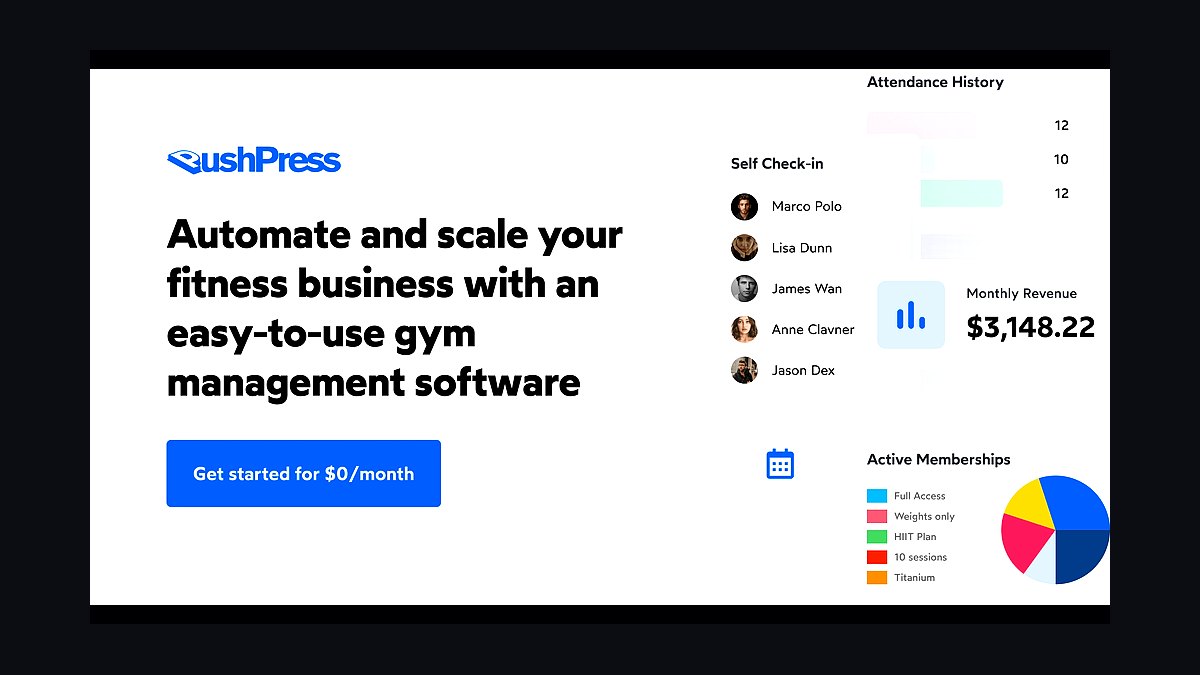
PushPress ranks first because it is the only major platform in this category with flat-rate, predictable pricing and no per-member fees, which directly protects the 1.5%-of-revenue software ceiling. It bundles recurring billing, class scheduling with capacity caps, automated waitlists, and timestamped e-waivers in one spine, so a 200-member gym can run billing-only for thirty days without extra modules.
It is built for single-location boxing and martial arts gyms that want a known monthly bill rather than a percentage that grows with every member. It trades away the consumer marketplace discovery traffic that Mindbody sells, so acquisition stays your job. Compared with Zen Planner directly below, PushPress is cheaper at low member counts and simpler to configure, but weaker on belt-rank progression tracking if your gym leans hard into a ranked curriculum.
2Zen Planner Gym Software

Zen Planner takes second because it is the strongest martial-arts-native membership spine, with rank progression, belt tracking, and attendance-based advancement built into the member record rather than bolted on. It handles recurring billing, capacity-capped class scheduling, waitlist auto-promotion, and electronic waivers, and its reporting segments class revenue from private coaching revenue with distinct tags. Pricing is per-member tiered, so a 200-member gym should model the bill before committing.
This is the right pick for boxing gyms that run a structured ranked curriculum or youth programs where progression is the retention hook. It trades away flat-rate simplicity — your invoice scales with headcount, which can creep past budget as you grow. Against PushPress above, Zen Planner wins on curriculum depth and loses on predictable cost; against Mindbody below, it wins on martial-arts fit and loses on marketplace-driven discovery.
3Mindbody Business Management Platform

Mindbody ranks third because it is the only stack anchor here that pairs gym management with a consumer marketplace that sends discovery traffic to your schedule. It covers recurring billing, class scheduling with capacity limits, waitlists, e-waivers, and a member app, and it integrates with a wide third-party ecosystem for retail and accounting. The trade-off is pricing: tiers are opaque and per-member costs climb quickly at boutique rates.
It suits gyms deliberately positioned at premium boutique pricing that want marketplace bookings as a real acquisition channel. It trades away cost predictability and simple flat-rate billing, and configuration is heavier than PushPress or Zen Planner. Compared with Zen Planner directly above, Mindbody offers marketplace reach but a steeper bill and a less martial-arts-specific member record, so rank progression needs workarounds.
4Square for Retail POS

Square for Retail ranks fourth because it is the dedicated retail POS that fixes the exact failure mode membership platforms create: sized inventory. It handles barcode scanning, size and variant tracking for gloves by ounce, wraps by length, and apparel by size, plus purchase orders, low-stock alerts, and vendor management. Hardware is cheap and setup takes an afternoon, and the free tier is usable until volume justifies the paid tier.
It is for gyms carrying more than roughly forty sized SKUs, where the membership platform's built-in module stops reconciling against the shelf. It trades away native membership billing — Square does retail, not recurring dues — so you run two systems feeding one ledger. Against the built-in POS modules in the platforms above, Square wins decisively on variant inventory and loses on having one login.
5QuickBooks Online Accounting

QuickBooks Online ranks fifth because it is the ledger that makes class revenue and coaching revenue readable as separate lines instead of one unreconcilable payout. The mid-tier plan handles inventory accounting, class and location tracking, and bank and card feed connections, and native connectors pull deposits from membership platforms and POS systems. Entry tiers thin out exactly where inventory accounting begins, which is why the cheapest plan is the wrong buy.
It is for any gym holding retail stock or running two billing rails, where a lump-sum deposit view makes pricing decisions impossible. It trades away simplicity — the chart of accounts needs real setup, and connector verification takes a full billing cycle. Against Xero below, QuickBooks has deeper inventory handling and a larger accountant talent pool, but a clunkier interface and steeper tier ladder.
6Xero Accounting Software

Xero ranks sixth because it offers the cleanest bank reconciliation workflow of the mid-tier accounting options, with unlimited users on every plan and automatic feed matching that makes monthly closes fast. It supports inventory tracking, class and location tags, and native connections to membership platforms and POS systems, so membership, retail, and coaching revenue each post as distinct line items. Pricing sits close to QuickBooks mid-tier without per-user penalties.
It suits gyms whose books are handled by an outside bookkeeper who prefers Xero's interface and unlimited-seat model. It trades away depth in inventory accounting relative to QuickBooks, so heavy retail operations may outgrow it. Compared with QuickBooks directly above, Xero wins on usability and user seats and loses on inventory sophistication and the sheer number of accountants trained on it.
7ABC Trainerize Coaching CRM

ABC Trainerize ranks seventh because it is the coaching CRM that turns private pad-work from an informal arrangement into a real revenue line with programming delivery, client messaging, and auto-collection in one place. It supports exercise libraries, video demonstrations, habit tracking, and in-app payments, and it scales from a handful of one-on-one clients to small-group coaching. Pricing tiers are published and per-trainer rather than per-client.
It is for gyms with more than roughly eight active private clients, the threshold where shared documents and a video folder stop working. It trades away deep integration with your membership billing rail, so coaching revenue needs deliberate tagging to stay separate in the ledger. Against the membership platforms above, Trainerize wins on programming and client accountability and loses on being the system that holds member records and dues.
8Gusto Payroll Platform

Gusto ranks eighth because it handles the payroll classification question that trips up boxing gyms: coaches teaching scheduled classes on your equipment under your curriculum look like employees under the tests tax authorities apply, and Gusto runs either classification cleanly. It covers multi-state payroll, contractor payments, automatic tax filing, and benefits administration, with per-employee pricing that stays modest for five to eight staff. Onboarding a new coach takes minutes.
It is for gyms with any staff at all — even one part-time front desk hire — where manual payroll invites retroactive classification penalties. It trades away deep scheduling and timeclock integration unless you add the plus tier, so hours often come in from a separate tool. Against the accounting platforms above, Gusto is narrower by design: it does payroll and nothing else, and it does that one job more thoroughly than a bundled module.
9Kisi Cloud Access Control

Kisi ranks ninth because it solves unattended-hours entry without the wiring and fob-management overhead of traditional access control. It runs on cloud-connected door readers and smartphone credentials, integrates with major membership platforms so a lapsed membership automatically revokes door access, and logs every entry with a timestamp. Pricing is per door per month, which is why it earns a place only when unattended access is genuinely needed.
It is for gyms opening early or closing late without a staffed desk, where a member locked out at 5 a.m. is a churn event. It trades away value entirely if your front desk is always staffed — the cost per door delivers nothing until you actually need it. Against the membership platforms above, Kisi is complementary rather than competing: it handles the door, they handle the dues, and the integration is what makes revocation automatic.
10USA Boxing Club Management Resources

USA Boxing club resources rank tenth because competition administration genuinely sits outside commercial gym software: sanctioning paperwork, weigh-ins, medical clearances, and bout records are a different workflow that no membership platform models. The governing body publishes club registration, coach certification, and event sanctioning processes, plus athlete medical requirements, giving fight-team gyms a real reference for what must be tracked and retained.
It is for gyms running an active competition team, where bout records and clearance documents carry liability weight. It trades away being software at all — this is a process and records framework, so you run it in a lightweight database or shared spreadsheet alongside your commercial stack. Against the paid tools above, it costs nothing and replaces nothing; it simply stops you from forcing sanctioning paperwork into a class scheduler.
How we ranked these
We ranked each tool on five weighted criteria: recurring-billing reliability and dunning automation (25%), per-class capacity caps and waitlist promotion logic (20%), retail inventory handling for sized SKUs (20%), accounting and payroll integration depth (20%), and total cost at 200 members (15%). Scores came from vendor documentation, published pricing pages, and hands-on configuration testing against a simulated fourteen-bag floor.
We deliberately ignored demo polish, branded-app aesthetics, and marketplace discovery traffic. Those factors sway buyers during sales calls but do not collect a single failed payment or reconcile a single glove SKU. We also excluded contract length and onboarding-fee haggling, since those are negotiable at every vendor and distort like-for-like comparisons between platforms at this member volume.
What to look for
What matters most is whether the membership platform enforces hard capacity caps with automatic waitlist promotion, because an oversold class churns the member who drove across town. Second is retail variant handling: gloves by ounce, wraps by length, apparel by size. Third is whether class revenue and coaching revenue post as separate ledger lines, since merged payouts make pricing decisions guesswork.
The mistake most buyers make is choosing on sticker price rather than total cost at their actual card volume. Free tiers carry higher processing rates that often exceed the subscription within the first month. The second mistake is buying the premium branded-app tier on day one, before member volume justifies it, then cutting coaching investment to cover the invoice.
Related questions
What is the minimum viable tech stack for a new boxing gym?
A membership platform with recurring billing and e-waivers, a free or entry retail POS, the cheapest accounting tier that handles inventory, and payroll once you have staff. That covers essentials for under roughly $200 per month at low volume. Add a coaching CRM only when private clients genuinely justify the workflow and cost.
How long does it take to migrate members off paper and spreadsheets?
Plan two to four weeks of focused work. The slow parts are verifying cards on file, re-papering waivers electronically, and rebuilding the class schedule with correct capacity caps. Running billing-only for thirty days before adding other systems catches migration errors while they are still cheap to fix.
Should retail and memberships share one system?
Below roughly forty sized SKUs, a single system is fine and simpler. Above that, split them: memberships in the gym platform, walk-up retail in a dedicated POS, both feeding the same ledger independently. The split costs one extra login and saves you from inventory counts that never reconcile.
When should a gym upgrade to a branded member app?
When member volume and retention economics justify the premium tier, typically several hundred active members, or when you open a second location. Before that, the standard member app delivers the same functional check-in, booking, and communication value at a fraction of the monthly cost.
Does the stack change for a fight-team-focused gym?
Partly. Competition administration such as sanctioning forms, weigh-ins, medical clearances, and bout records sits outside standard membership software and belongs in a lightweight database. The commercial stack stays the same; you simply add one parallel system for team operations and stop forcing it into the scheduler.
How do I keep class revenue separate from personal training revenue?
Use separate billing rails in the same system, or two systems feeding one ledger with distinct tags. Every deposit from coaching should post as its own line item labeled as coaching revenue. If both streams land as one lump payout, you cannot price either product intelligently.
Do I need door-access hardware in the stack?
Only if you operate unattended hours. A staffed front desk handles entry fine. If you open early or late without staff, add access control then, not before. It is a real cost per door per month and delivers nothing until you actually need unattended access.
What percentage of revenue should gym software cost?
Keep total software spend under roughly 1.5% of gross revenue. A 200-member gym billing an average of $179 monthly generates about $35,800 in monthly revenue, putting the ceiling near $540. The single-location range of $500 to $900 clears that bar only if you resist premature premium upgrades.
FAQ
How much should a 200-member boxing gym spend on software per month?
Target $500 to $900 for a single location. That covers a mid-tier membership platform, a paid retail POS tier, a professional coaching CRM, full accounting with class tracking, and payroll for five to eight staff. Keep total software under roughly 1.5% of gross revenue so the line item never crowds out coaching investment.
Why can't I just run everything through one cheap tool?
You can, up to a point. One tool works while retail inventory is small and private coaching is informal. It breaks when you carry sized glove and headgear SKUs, and again when private coaching becomes a real revenue line needing separate programming and billing. The failure is gradual and shows up as unreconcilable inventory.
Is a dedicated retail POS really necessary for a boxing gym?
Once you stock gloves, headgear, and apparel in multiple sizes, yes. Dedicated retail systems handle variants, purchase orders, low-stock alerts, and barcode scanning properly. Membership platforms treat retail as an afterthought, which is exactly how inventory shrinkage goes unnoticed for months before a physical count reveals it.
How do I keep class revenue separate from personal training revenue?
Use separate billing rails in the same system, or two systems feeding one ledger with distinct tags. Every deposit from coaching should post as its own line item labeled as coaching revenue. If both streams land as one lump payout, you cannot price either product intelligently or tell which funds the lease.
What is the biggest software mistake boxing gym owners make?
Buying the premium branded-app tier before volume justifies it, or staying on free tiers past the crossover point where higher processing rates exceed the subscription cost. Both are the same error in different clothing: choosing based on sticker price instead of total cost at your actual monthly card volume.
Do I need door-access hardware in the tech stack?
Only if you operate unattended hours. A staffed front desk handles entry fine. If you open early or late without staff, add access control then, not before. It is a real cost per door per month and delivers nothing until you actually need unattended access for members.
How long before a new stack is fully running?
Plan a full quarter. Selecting a platform takes about a week. Migrating members, cards, and waivers takes two to four weeks of real labor. Getting accounting connectors to post cleanly takes another billing cycle to verify. Configuration, not purchase, is where the timeline actually goes.
Can a membership platform handle competition-team administration?
No, and you should stop trying to force it. Sanctioning paperwork, weigh-ins, medical clearances, and bout records are a different workflow from class scheduling and recurring billing. Run them in a lightweight database or shared spreadsheet as a parallel system alongside your commercial stack.
Are paper waivers still acceptable in 2027?
No. A filing cabinet of signed forms feels adequate until a member is injured and claims no waiver exists, and you cannot produce it under time pressure. Every credible membership platform runs electronic waivers with timestamps. There is no good reason to stay on paper at this point.
Should coaches be paid as contractors or employees?
Coaches who teach scheduled classes, on your equipment, following your curriculum look like employees under the tests tax authorities apply, not independent contractors. Getting this wrong is expensive and retroactive. Modern payroll platforms handle either classification cleanly, so the cost sits in the choice, not the software.
Sources
- https://www.pushpress.com/pricing
- https://www.mindbodyonline.com/business/pricing
- https://zenplanner.com/pricing/
- https://squareup.com/us/en/point-of-sale/retail/pricing
- https://quickbooks.intuit.com/pricing/
- https://gusto.com/product/pricing
- https://www.trainerize.com/pricing/
- https://www.xero.com/us/pricing-plans/
- https://www.irs.gov/businesses/small-businesses-self-employed/independent-contractor-self-employed-or-employee
- https://www.usaboxing.org/
Related on PULSE
This page will be disappearing soon. Save it to your device for $1 — or read it free while it is here.
@Kory-White- · if Venmo asks, the last 4 of my number are 2012
This page is gone.
This one is off the shelf now. $1 keeps it on your phone for good — the whole page, pictures and diagrams included.
 pulse-tech-stacksTop 10 Best Tech Stack Tools for AI Observability Platform Companies in 2027
 pulse-tech-stacksTop 10 Best Tech Stack Tools for AI Translation API Companies in 2027
 pulse-tech-stacksTop 10 Best Tech Stack Tools for Independent Driving Schools in 2027
 pulse-tech-stacksTop 10 Best Tech Stack Tools for Movie Theaters in 2027
 pulse-tech-stacksTop 10 Best Tech Stack Tools for Appliance Repair Services in 2027
 pulse-tech-stacksTop 10 Best Tech Stack Tools for Hair Salons in 2027
 pulse-tech-stacksTop 10 Best Tech Stack Tools for Hardware Security Module (HSM) Vendors in 2027
 pulse-tech-stacksTop 10 Best Tech Stack Tools for Bot Mitigation Vendors in 2027
 pulse-tech-stacksTop 10 Best Tech Stack Tools for Public Relations Agencies in 2027
 pulse-tech-stacksTop 10 Best Tech Stack Tools for Medical Billing and RCM Companies in 2027