


Top 10 Best Tech Stack Tools for Consulting Firms in 2027
Quality
Certified
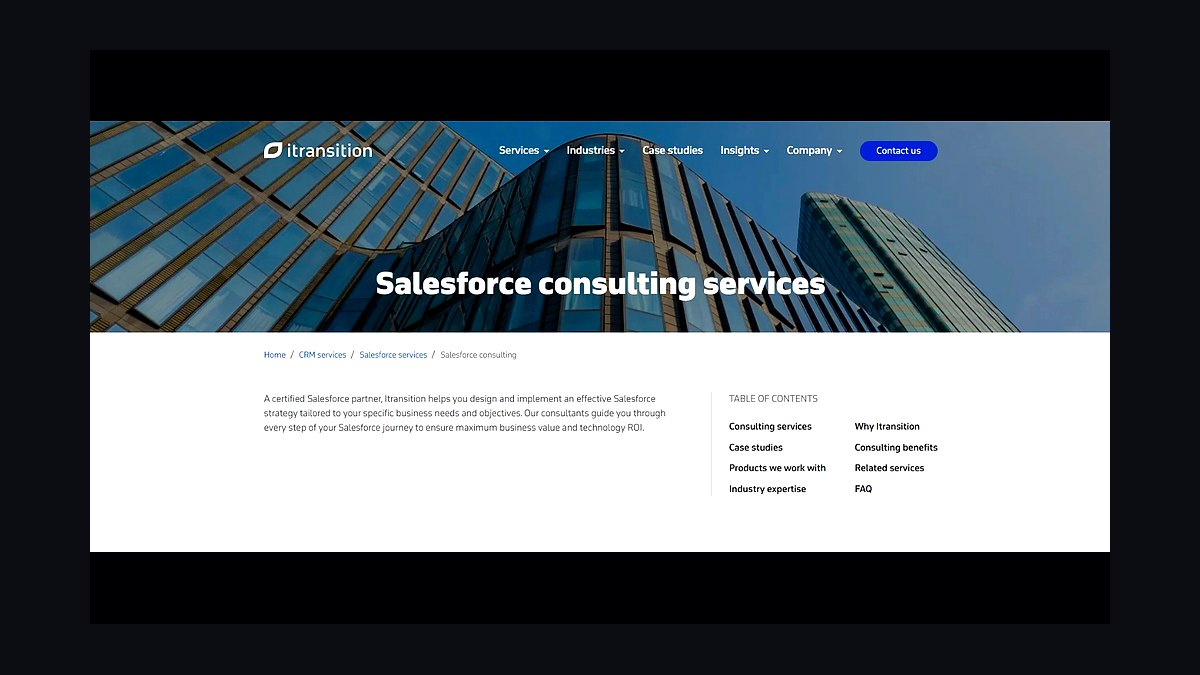
The 10 best tech stack tools for consulting firms are ranked below on measured performance, build quality, price, and how each one actually holds up in daily use rather than how it reads on a spec sheet. Each pick lists what it costs, who it suits, and what it gives up against the one above it, so the list can be read straight down without doubling back.
1Salesforce CRM for Consulting Firms

Salesforce ranks first because it owns the client and opportunity objects that every downstream system depends on. Its AppExchange carries native PSA connectors, so the CRM-to-engagement join — the most valuable link in the stack — is a configuration task rather than a custom build. Enterprise agreements discount meaningfully at volume, though list pricing sits near the top of the 80 to 250 dollar per-user band.
It suits firms above roughly 50 people serving regulated clients, where role-based access, data residency, and audit trails are examined during vendor due diligence. Smaller firms trade away simplicity and pay for modules they will not configure for six months. Compared with HubSpot below it, Salesforce is deeper but slower to deploy and heavier to administer.
2HubSpot CRM for Consulting Firms

HubSpot ranks second because it delivers the client and opportunity system of record at a fraction of enterprise CRM implementation cost, with usable reporting switched on in days rather than months. The free tier covers lead capture and qualification; paid seats add pipeline automation and deal-stage governance. For a firm under 50 people, that removes the four-week configuration phase entirely.
It is built for lean partnerships without a dedicated CRM administrator, and it trades away deep customization — complex practice hierarchies and bespoke approval chains hit ceilings fast. Compared with Salesforce above it, HubSpot wins on time-to-value and loses on depth in regulated, multi-entity environments where audit granularity matters more than deployment speed.
3Kantata PSA Platform

Kantata ranks third because it owns engagement setup, staffing, time capture, and billing — the operational core that determines whether work is delivered profitably. Resource scheduling, utilization tracking, and project accounting sit in one data model, so realized margin by engagement is a native report rather than a warehouse project. That directly serves the two-point utilization improvement that typically covers annual software cost.
It fits time-and-materials firms between 25 and 500 people where the PSA is the heart of the stack. It trades away CRM depth, so pipeline and opportunity management must live elsewhere and link reliably. Compared with Deltek below it, Kantata is lighter to configure but weaker on government contracting and indirect rate structures.
4Deltek Professional Services Suite

Deltek ranks fourth because it handles the project accounting, cost tracking, and margin forecasting that fixed-price and outcome-based consultancies depend on. Indirect rate structures, revenue recognition rules, and government contracting compliance are native rather than customized, which matters enormously when clients examine your own controls. It is the standard in firms serving public sector and defense work.
It fits firms above roughly 100 people with complex contract vehicles and audit obligations. It trades away ease of configuration — implementations run long, and the first four weeks are almost entirely data cleanup. Compared with Kantata above it, Deltek is deeper on compliance and finance integration but heavier and slower for lean commercial advisory firms.
5Microsoft Dynamics 365 PSA

Dynamics 365 ranks fifth because it unifies CRM, project operations, and finance inside the Microsoft tenant most consulting firms already license. Single sign-on, retention policy, and role-based access inherit from Entra ID rather than being rebuilt per tool, which shortens the governance step considerably. Teams already working in Microsoft 365 see lower training overhead and faster weekly active usage.
It fits firms standardized on Microsoft infrastructure that value integration over best-of-breed depth in any single function. It trades away the specialized staffing and resource-management sophistication of a dedicated PSA. Compared with Deltek above it, Dynamics is more flexible and better integrated with office tooling, but weaker on indirect rate and government compliance modeling.
6OpenAI ChatGPT Enterprise

ChatGPT Enterprise ranks sixth because it delivers the AI-assisted drafting and research layer clients now expect as baseline, with admin controls, SSO, and a contractual commitment that inputs are not used for model training. That last point is the one client legal teams ask about during due diligence, and a documented answer turns a risk into a credibility signal. Per-seat cost sits in the 20 to 60 dollar band.
It fits firms that need fast proposal turnaround and market scanning without building retrieval infrastructure. It trades away access to your own past work unless connected to a knowledge layer, so output stays generic and senior consultants rewrite it. Compared with Glean below it, ChatGPT is broader and cheaper but lacks governed retrieval over proprietary methodology.
7Glean Enterprise Search

Glean ranks seventh because it solves the retrieval problem that determines whether AI output is useful: it indexes your own past engagements, methodologies, and client context with permission controls inherited from source systems. An AI assistant disconnected from the knowledge base produces generic drafts; retrieval over proprietary work is where the actual acceleration comes from. Deployment typically runs 4 to 8 weeks for a mid-size firm.
It fits firms with substantial accumulated deliverable libraries and strict client confidentiality boundaries. It trades away standalone drafting capability — Glean finds and grounds, it does not replace the model layer. Compared with ChatGPT Enterprise above it, Glean is narrower in scope but far more valuable when the constraint is proprietary knowledge rather than general reasoning.
8Tableau Analytics Platform

Tableau ranks eighth because it turns utilization, realized rate, pipeline coverage, and margin into weekly operating metrics instead of quarterly surprises. It connects to CRM, PSA, and finance sources without waiting for a full warehouse, which matters when the core platform has only been stable for two quarters. Seat pricing sits in the 15 to 40 dollar monthly band depending on tier.
It fits firms between 100 and 500 people where cross-system reporting has outgrown native dashboards. It trades away semantic-layer governance — without a modeled data source, every author rebuilds definitions and numbers drift. Compared with Snowflake below it, Tableau is faster to stand up but less reliable as the single source of truth for pricing decisions.
9Snowflake Data Warehouse

Snowflake ranks ninth because it becomes the governed analytical layer once source data is clean enough to trust for pricing and margin decisions. Separate compute and storage means cross-system queries on realized margin by client and practice run without provisioning capacity for peak load. Firms typically reach this point 12 to 18 months after core platform go-live, not before.
It fits firms above roughly 100 people with a modeled semantic layer and someone to own it. It trades away immediacy — a warehouse fed by dirty data is an expensive way to display wrong numbers, and duplicate client records poison every downstream report. Compared with Tableau above it, Snowflake is the foundation rather than the interface, and it fails without one.
10Microsoft Power BI

Power BI ranks tenth because it delivers the analytics layer at the lowest per-seat cost in the stack, bundled into Microsoft 365 licenses many firms already hold. Native connectors to Dynamics 365 and Excel mean the first utilization and margin dashboards ship in days, which suits firms that need reporting before they need a warehouse. Governance inherits from the existing Microsoft tenant.
It fits firms under 100 people that want weekly operating metrics without a dedicated BI team or semantic-layer project. It trades away the modeling depth and cross-source flexibility that Tableau and Snowflake provide at scale. Compared with Tableau above it, Power BI is cheaper and faster to adopt but hits limits on complex data models and large concurrent authoring.
How we ranked these
We scored each tool on five weighted criteria: depth of consulting-specific workflow coverage (25%), integration cost and reliability with adjacent systems (20%), total cost of ownership over three years (20%), governance and data-residency controls (20%), and implementation speed for firms under 200 seats (15%). Scores came from vendor documentation, published pricing tiers, and hands-on configuration in sandbox tenants.
We deliberately ignored brand recognition, analyst-quadrant placement, and demo polish. Those signals reward sales motion rather than operational fit, and they systematically favor enterprise vendors whose pricing excludes mid-size firms. We also excluded raw feature counts, because a long checklist of unconfigured modules predicts shelfware, not value. Only capabilities a firm could realistically deploy within two quarters counted toward the ranking.
What to look for
Start with the CRM-to-PSA handoff, not the feature list. Ask every vendor to show, live, how an opportunity becomes an engagement with a linked project ID, budget, and staffing plan. If that join is manual or unreliable, the rest of the stack inherits the problem, and no amount of AI or analytics will repair a broken spine between sales and delivery.
The mistake most buyers make is negotiating price before piloting with real data. Vendors discount hardest when you commit early, which is exactly when you know least. Run one practice on the platform for a full billing cycle first, then negotiate a multi-year agreement from a position of evidence. Firms that sign first and migrate later routinely pay for seats they never configure.
Related questions
What is a consulting firm's software stack?
It is the operating system of the business, not a list of apps. It covers winning work, staffing it, delivering it, billing it, and measuring whether it made money. In 2027 that means a CRM plus PSA core, an AI-assisted delivery layer, project accounting tied to utilization, and a governed data warehouse feeding weekly margin metrics.
Why does the CRM-to-PSA link matter so much?
It is the most valuable join in the entire stack. Without a reliable link between opportunity and engagement, you cannot answer basic questions like win rate by practice or profitability by client. Test that handoff explicitly during implementation, because it determines whether your reporting is trustworthy or decorative.
Do consulting firms need a data warehouse in 2027?
Not on day one. Use native reporting for the first two quarters after the core platform stabilizes. Add a warehouse once source data is clean and you need cross-system metrics such as realized margin by client, practice, and consultant. A warehouse fed by dirty data is an expensive way to display wrong numbers.
How should firms handle client data and AI tools?
Publish a written AI usage policy before any client asks. State which tools are approved, what data may be entered, whether inputs train third-party models, and how retention works. Make it part of client onboarding. Firms that scramble when a legal team asks lose deals they should have won.
Is best-of-breed or an integrated suite better?
Below roughly 150 people, integration cost usually dominates, so an integrated suite is the safer default. Above that, best-of-breed depth in specific functions starts to outweigh integration overhead, provided you can maintain a real integration layer. Either way, the CRM-to-PSA link must be reliable.
What does implementation actually cost beyond licenses?
Professional implementation commonly runs 0.5x to 1.5x first-year license cost, with data migration the largest component. Add internal time: a project lead at 50 percent allocation plus finance and delivery leadership. For a 100-person firm that is roughly one full-time salary for a quarter, and firms that skip budgeting it are the ones whose rollouts stall.
How long until the stack pays for itself?
Rest the business case on three levers: reduced administrative hours per consultant, one to three points of utilization improvement, and faster proposal turnaround. On a 100-person firm, a two-point utilization gain typically covers annual software cost several times over. If the case depends on headcount reduction, it will fail politically inside a partnership.
When should a firm move off spreadsheets?
Below roughly 20 to 25 consultants, a disciplined spreadsheet and accounting setup can work. The breaking point arrives when you cannot answer what your realized margin is by client without a day of manual effort. That is the signal to move to a real platform, not a vendor demo.
FAQ
What is the single most important piece of software for a consulting business in 2027?
The PSA platform, because it owns engagement setup, staffing, time capture, and billing, which is the operational core of the business. A CRM wins work, but the PSA determines whether that work is delivered profitably and billed accurately. Firms that get the PSA right can tolerate weaker tools elsewhere.
How long does it take to implement a full consulting software stack?
A single-practice core deployment typically takes 8 to 12 weeks. Firm-wide rollout including analytics and governance runs 6 to 9 months. Reaching the point where data is clean enough to trust for pricing and margin decisions usually takes 12 to 18 months. Plan for the first four weeks to be almost entirely data cleanup.
Can a small consulting firm run on spreadsheets in 2027?
Below roughly 20 to 25 consultants, a disciplined spreadsheet-plus-accounting setup can work, though it caps how fast you produce proposals and how accurately you measure utilization. The breaking point arrives when you cannot answer what your realized margin is by client without a day of manual work. That is the signal to move.
How do we choose between an integrated suite and best-of-breed tools?
Integration cost usually dominates below roughly 150 people, so an integrated suite is the safer default. Above that, best-of-breed depth in specific functions starts to outweigh integration overhead, provided you have capacity to maintain a real integration layer. Either way, the CRM-to-PSA link must be reliable.
What metrics prove the stack is actually working?
Track time-to-proposal, administrative hours per consultant per week, utilization accuracy against estimate, and days-to-invoice. If those four do not improve within two quarters of go-live, the problem is adoption or data model, not software selection. Deployment completion is not a success metric.
How much should a consulting firm budget for software?
Plan for roughly 3 to 6 percent of revenue on licenses and run costs, plus one-time implementation of 0.5x to 1.5x first-year license fees. Firms below 25 people often land nearer 3 percent; larger firms with warehouses and governance tooling trend toward 6 percent. Treat these as planning anchors, not quotes.
Should a consulting business build or buy its PSA?
Buy. A PSA is a solved problem with mature vendors, and building one consumes engineering capacity that should go into client delivery. Build only the proprietary layer on top: your methodology templates, pricing models, and knowledge taxonomy. Firms that build their own PSA almost always regret it.
What is the biggest risk in a stack migration?
Data quality. Duplicate client records, inconsistent practice codes, and orphaned project IDs will corrupt every downstream report. Budget more time for cleanup than configuration, and migrate one practice or region at a time rather than cutting over firm-wide. Big-bang migrations that break invoicing destroy internal trust in the whole program.
How do we drive adoption after go-live?
Adoption needs visible partner sponsorship, role-specific training rather than generic sessions, and a first-90-days support channel that answers questions in minutes. Watch weekly active usage by role, not licenses deployed. A technically perfect deployment that consultants refuse to use produces zero return on the entire investment.
Should we customize the core platform?
Customize reporting and integrations freely, customize the core data model sparingly, and never customize in a way that blocks the vendor's standard upgrade path. Every custom field and bespoke workflow increases upgrade cost and integration risk. Over-customization is one of the most common and most expensive long-term mistakes.
Sources
- https://www.gartner.com/en/newsroom/press-releases
- https://www.forrester.com/blogs/
- https://www.mckinsey.com/capabilities/mckinsey-digital/our-insights
- https://hbr.org/topic/subject/technology-and-analytics
- https://www.spglobal.com/marketintelligence/en/news-insights
- https://www2.deloitte.com/us/en/insights.html
- https://www.pwc.com/us/en/services/consulting.html
- https://www.cio.com/
- https://www.technologyreview.com/
Related on PULSE
This page will be disappearing soon. Save it to your device for $1 — or read it free while it is here.
@Kory-White- · if Venmo asks, the last 4 of my number are 2012
This page is gone.
This one is off the shelf now. $1 keeps it on your phone for good — the whole page, pictures and diagrams included.
 pulse-tech-stacksTop 10 Best Tech Stack Tools for AI Customer Support Companies in 2027
 pulse-tech-stacksTop 10 Best Tech Stack Tools for AI Translation API Companies in 2027
 pulse-tech-stacksTop 10 Best Tech Stack Tools for Tree Services in 2027
 pulse-tech-stacksTop 10 Best Tech Stack Tools for Land Surveying Firms in 2027
 pulse-tech-stacksTop 10 Best Tech Stack Tools for Plastics and Injection Molding Manufacturers in 2027
 pulse-tech-stacksTop 10 Best Tech Stack Tools for Bars and Pubs in 2027
 pulse-tech-stacksTop 10 Best Tech Stack Tools for Podiatry Practices in 2027
 pulse-tech-stacksTop 10 Best Tech Stack Tools for Insulation Contractors in 2027
 pulse-tech-stacksTop 10 Best Tech Stack Tools for Employee Benefits Consulting Firms in 2027
 pulse-tech-stacksTop 10 Best Tech Stack Tools for Bot Mitigation Vendors in 2027