
Should I Hire a Fractional CRO If We Are Integrating Two Sales Teams After a Merger?
 Curated byKory White · Fractional CRO · Maryland
 PULSEKNOWLEDGE LIBRARY
Quality
Certified

Yes — hire a fractional CRO when a merger leaves you with two sales teams, two comp plans, and two CRMs. You get neutral senior leadership in one to two weeks at roughly a third to half the cash cost of a full-time CRO, with a typical six-to-twelve-month engagement covering integration.
The job this role is actually hired to do
The mistake most acquirers make is treating a post-merger sales leader as a general management hire. It isn't. Integrating two sales teams after a merger is a defined project with a start, a middle, and an end, and the person you bring in is being hired to complete that project — not to run a revenue org indefinitely.
The concrete deliverables of a merger-integration fractional CRO engagement are narrow enough to write into a scope document:
One forecast. Before the merger you had two pipelines, two definitions of "qualified," two win-rate formulas, and two forecast calls. After, you need one number that the board can trust. If Company A calculated win rate as closed-won divided by total opportunities and Company B used closed-won divided by qualified opportunities, blending the two produces a figure that means nothing. The fractional CRO's first job is to force a single set of definitions and rebuild the historical baseline against them, so the combined-entity number has a real denominator.
One compensation plan. Two plans running side by side past the first two quarters guarantees resentment. Reps compare pay stubs. They always compare pay stubs. A rep on a 50/50 base-to-variable split who sits next to a rep on 60/40 will work out within a month who is getting the better deal on a bad month, and the one who feels cheated updates their LinkedIn.

One territory map. Geography-based ownership on one side and vertical-based ownership on the other cannot coexist. Somebody has to decide which model wins and who loses accounts in the transition.
One leadership decision, deferred deliberately. This is the underrated deliverable. Naming the permanent head of the combined sales organization in month one is the single most expensive decision available to you, because you'll make it on political information rather than performance information. The fractional CRO holds that seat while you gather six to nine months of actual data on who can lead a combined team.
A named successor and a clean handoff. The engagement is a failure if the fractional CRO leaves and the organization reverts. Part of the scope is coaching whoever you eventually promote — and writing down the operating cadence so it survives the transition.

What this role is *not* hired to do: carry a personal quota, manage day-to-day rep coaching for thirty people, own marketing, or be in your Slack at 9pm on a Tuesday. If you find yourself wanting those things, you want a full-time VP of Sales, and you should hire one.
The neutrality point deserves emphasis because it's the actual product you're buying. An internal VP promoted from either legacy company arrives with a decade of relationships, loyalties, and grudges. When that person cuts a territory, half the combined org reads it as a political act regardless of the underlying math. When an outsider with no history cuts the same territory using the same math, it reads as a decision. That difference is worth real money in retained headcount.
How it fits the RevOps stack
A fractional CRO is not a replacement for your RevOps function — it's the decision-making layer that sits on top of it and finally gives it a single set of instructions. In most post-merger orgs the RevOps team is the group suffering most, because they're being asked to produce reporting from two systems with incompatible schemas while two executives each insist their definitions are correct.
Practically, the working relationship breaks into layers. At the bottom sit the two source systems — say Salesforce on one side with a heavily customized object model, and HubSpot on the other with a different lead-scoring model and lighter customization. Above that sits the reconciliation work: deduplication, stage mapping, field-by-field decisions about what to migrate, what to archive, and what to abandon. Above that sits the reporting layer, where a single pipeline view and a single forecast get produced. And above all of it sits the fractional CRO, whose function is to arbitrate — to decide, quickly and with authority, which definition wins when the two systems disagree.

That arbitration is the bottleneck in almost every failed integration. RevOps analysts can build anything you ask for; what stalls them is that nobody with standing will say whether an opportunity created by the acquired company's SDR team counts as sourced pipeline under the new model. Those questions pile up by the dozen. Without someone empowered to answer them in a day, a six-week CRM consolidation becomes a six-month one.
Expect the CRM consolidation itself to run three to six weeks of concentrated effort for two mid-size teams, and longer if either side has years of custom objects nobody documented. A pattern worth copying: run a thirty-day parallel reporting period where both teams keep working in their existing system while the new consolidated instance is built and validated alongside. Weekly reconciliation meetings during that window catch mapping errors while they're still cheap to fix. The alternative — a hard cutover on a Monday morning — reliably produces a quarter of distrust in the numbers, and a sales team that doesn't trust the CRM stops updating the CRM.
One scoping decision to make early: does the fractional CRO personally lead the data migration, or do you hire separate technical help? Leading it personally consumes a meaningful share of their limited days, and those are your most expensive hours. The common arrangement is that the CRO sets the target-state model and the decision rules, and a RevOps contractor or your internal ops team executes against it. That keeps senior judgment pointed at comp, territory, and people — the things only they can do.

Pricing, engagement models, and typical ranges
Fractional CRO pricing is a monthly retainer priced against days of commitment, and the honest way to think about it is days per month, not dollars per hour.
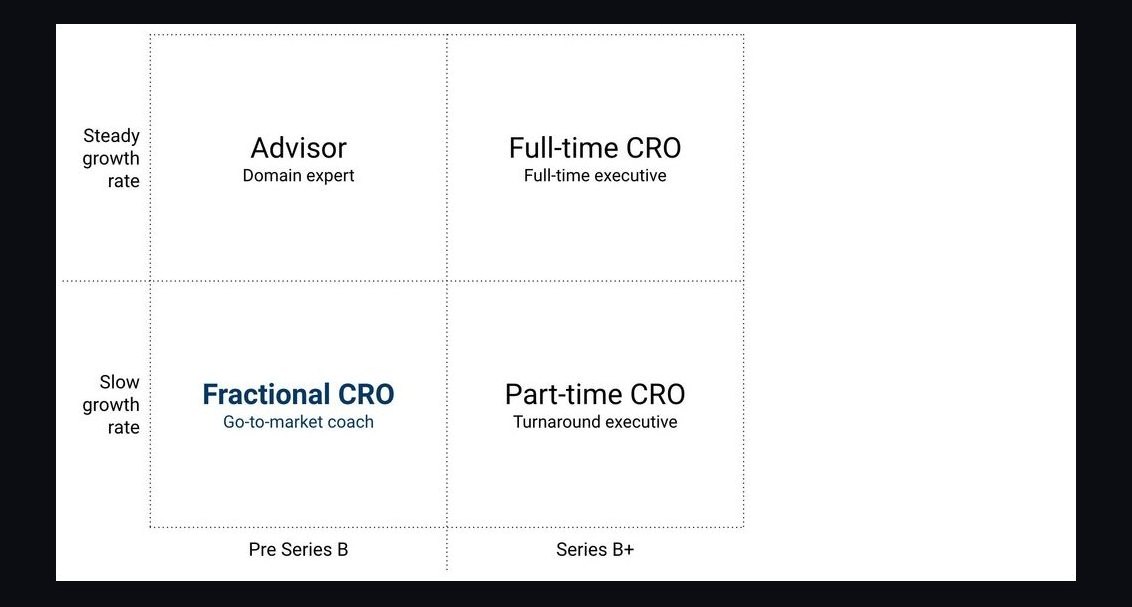
The commitment. Merger-integration engagements typically run eight to twelve days a month — call it two to three days a week. The lower end fits a combined team under twenty reps where both sides already run the same CRM and the comp plans are structurally similar. The upper end fits thirty-plus reps, multiple product lines, genuinely conflicting comp structures, and a messy data migration. Below about six days a month, you're buying advice; you aren't buying someone who can actually drive an integration, because they won't be present for enough of the decisions.
The duration. Six to twelve months is standard, matched to the integration itself. Shorter than six and you'll be handing off mid-comp-cycle, which is the worst possible moment. Longer than twelve and you should ask honestly whether you're using a fractional engagement to avoid making a permanent hire.
The equity component. Where equity is part of the package it commonly lands in the range of half a percent to one and a half percent, vesting over the engagement, usually with a cliff and with milestones tied to the actual deliverables: unified comp plan live, single forecast process running, named retention targets still employed at month nine. Tie vesting to integration milestones rather than pure time — it aligns the incentive with finishing rather than extending.

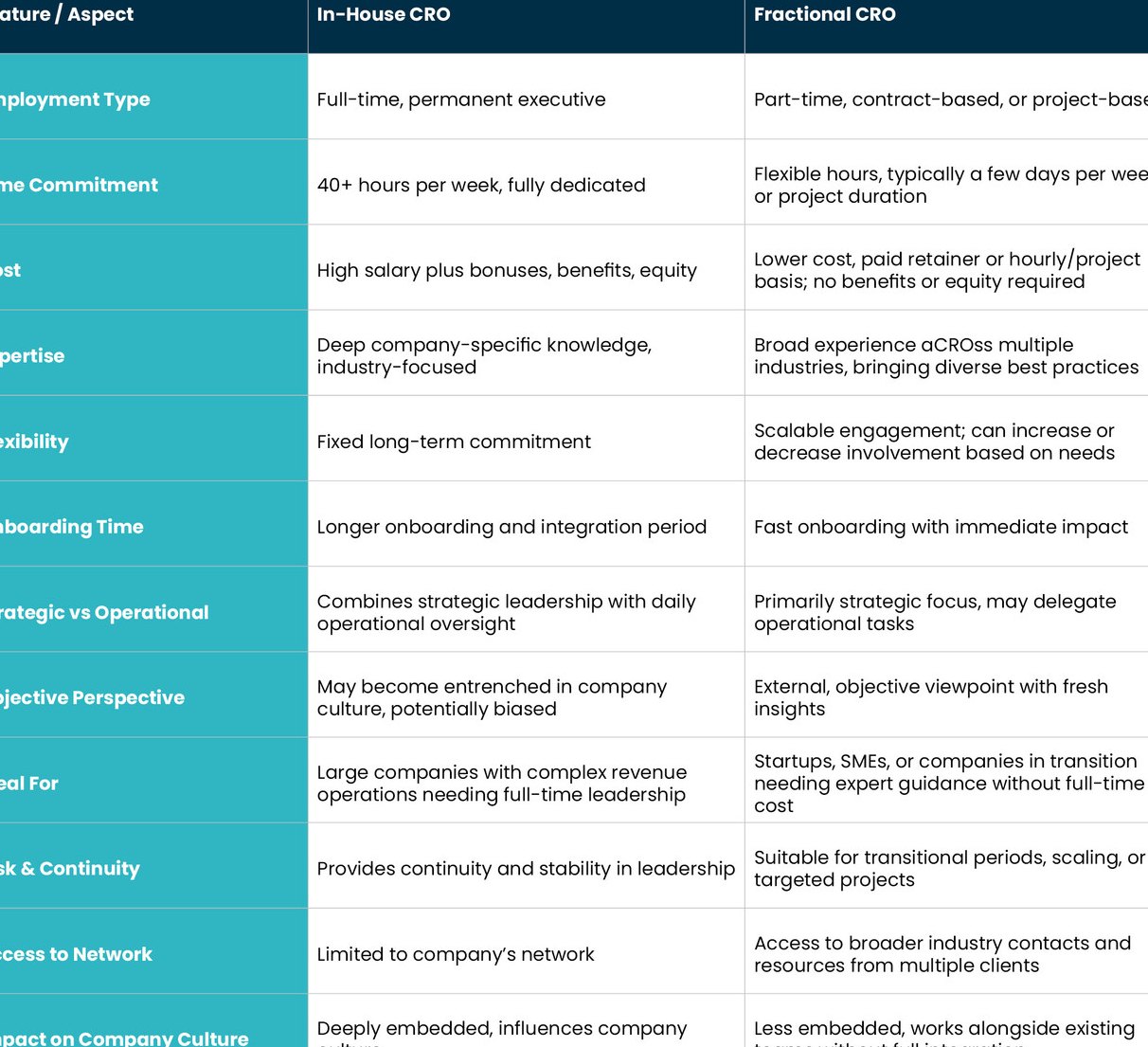
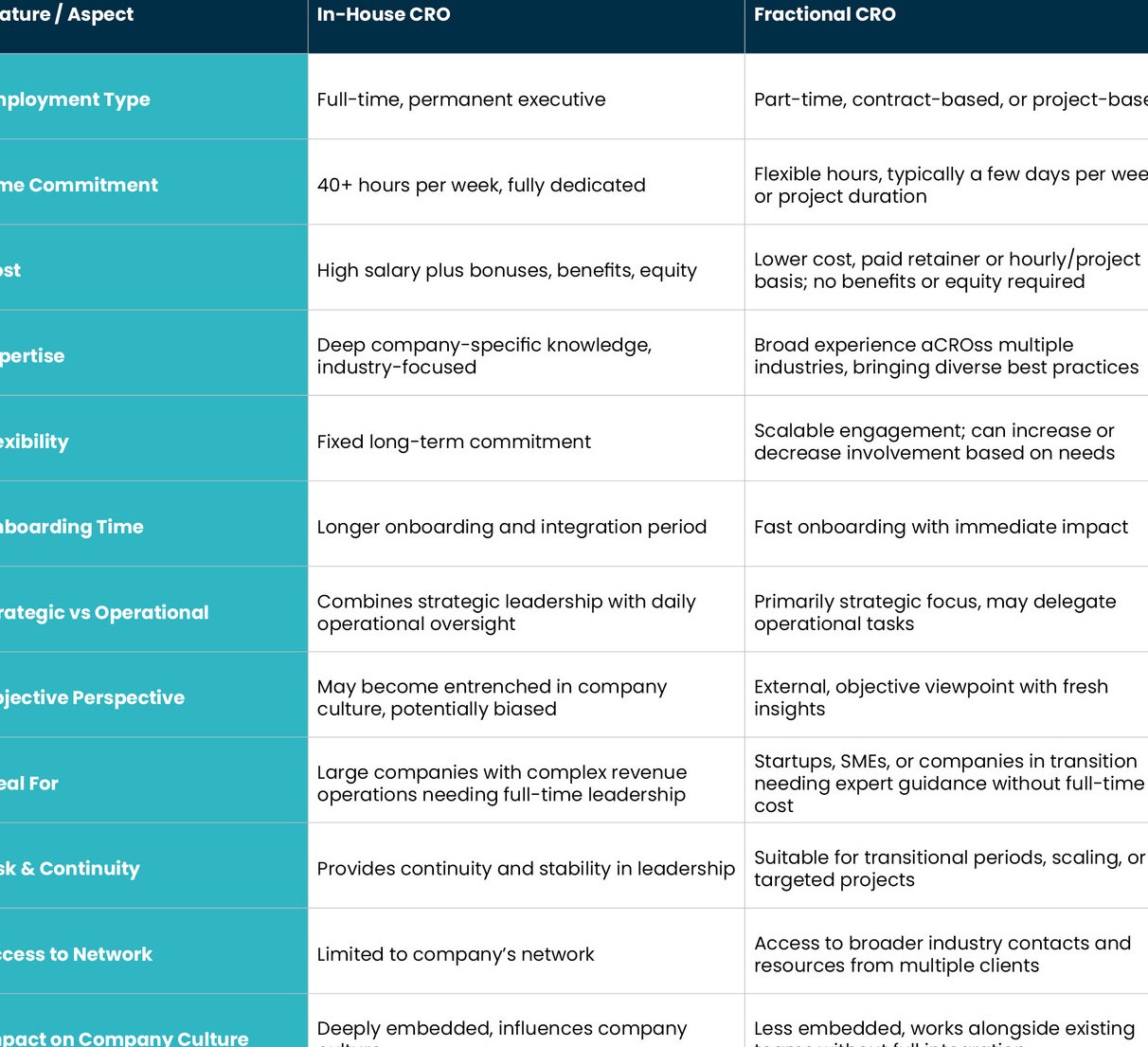
The comparison that matters. A full-time CRO in a company of this size is a total-compensation conversation in the mid-six figures once you combine base, variable, and benefits, plus an equity grant several times larger than the fractional figure. It also takes sixty to ninety days to run a proper search, and that's before notice periods. Then there's the asymmetry nobody prices in: if a full-time CRO is wrong for the role, you discover it around month five, and unwinding that costs six figures in severance plus the lost momentum of restarting the search — during the exact window when the integration needed continuity. A fractional engagement typically carries a thirty-day notice. The exit is cheap, which means the decision to enter it is cheap.
Structuring the contract. A few provisions worth insisting on:
- A paid diagnostic period, priced separately. Two to three weeks, fixed fee, producing a written integration plan. Both sides get an exit ramp if the fit is wrong, and you own a useful artifact either way.
- Defined days, not vague availability. Specify which days. "Two days a week" without naming them becomes zero days a week during a busy month at their other client.
- A named succession deliverable. Write into the scope that the engagement produces a recommendation on permanent leadership, with supporting evidence.
- Thirty-day mutual notice. Symmetric. If they can leave in thirty days, you should be able to as well.
- Clarity on decision rights. Can they restructure territories unilaterally? Can they terminate? In practice most fractional CROs recommend and facilitate personnel decisions rather than executing terminations themselves, and that boundary should be explicit before the first hard conversation, not during it.

The budget-adjacent cost people forget: integration work generates work. Territory carving, comp modeling, and CRM cleanup all need execution capacity underneath the strategy. Assume you'll need either an internal RevOps analyst or contract help alongside the CRO. Buying senior judgment and then giving it nobody to direct wastes the judgment.
How to evaluate and shortlist
The market for fractional executives has expanded fast, which means the distribution of quality is wide. The screening problem is that everyone's LinkedIn says roughly the same thing. Here's what actually separates candidates for merger-integration work specifically.
Screen for integration reps, not revenue résumés. Someone who scaled a single company from ten million to fifty million is impressive and may be entirely wrong for this. Merging two organizations is a different skill from growing one. Ask directly: how many times have you unified two sales organizations after a transaction? You want a number, and you want it to be more than one. Then ask about the one that went badly, because someone with genuine reps will have one, and their account of what they'd do differently tells you more than any success story.
Ask for the artifact, not the anecdote. A practitioner who has done this work has documents — a redacted territory-carving framework, a bridge comp plan structure, a diagnostic interview guide, a thirty-sixty-ninety milestone template. Someone who has only done it once and is generalizing will describe a process in the abstract. Ask them to walk you through a real artifact with the client details removed. The specificity gap is immediately obvious.

Test the comp question. Give them your actual scenario: Company A runs 60/40 base-to-variable with a ninety-day ramp, Company B runs 50/50 with a sixty-day ramp, and ask what they'd do. The wrong answer is "split the difference." Averaging two plans reliably produces a plan that motivates nobody — it's the single most common CEO error in these integrations, driven by an instinct toward fairness that produces incoherence instead. A strong answer describes a bridge period: both teams hold their existing structure for one to two quarters under a unified quota methodology so nobody takes a pay cut mid-transition, then a single new plan lands with sixty to ninety days of advance notice so reps can adjust behavior before the money changes.
Probe the neutrality claim. Neutrality isn't automatic just because someone is external. Ask how they'd handle a dispute where two reps — one from each legacy company — both claim the same large account. You want to hear a *rule*, applied consistently, rather than a case-by-case judgment. Something like: the rep who sourced the original meeting holds credit for a defined period, regardless of which company they came from. Rules survive scrutiny. Judgments look like favoritism to whoever lost.
Check current client load. Four or five concurrent clients means you're getting a fraction of a fraction. Two to three is realistic for someone doing eight to twelve days with you. Ask what else is on their plate and when those engagements end.

Ask about the exit before you start. How do previous engagements have ended? Did they hand off to a permanent hire? Is the cadence they built still running a year later? A fractional CRO whose past clients all reverted after departure built something dependent on their presence, which is the opposite of the deliverable.
Reference-check laterally. Talk to the CEO who hired them, obviously — but also try to reach someone from the *acquired* side. That's the population that tells you whether the neutrality was real or performed. Ask specifically whether the acquired team's top performers stayed.
Where to source candidates: peer communities of revenue leaders and RevOps practitioners, your investors' operating networks (PE and growth-equity firms keep bench lists of operators who've done post-transaction integration, and this is one of the few situations where the investor introduction is genuinely high-signal), and boutique fractional-executive networks that vet for operating history rather than just placing résumés. Run a real process across three to five candidates even under time pressure — the comparison itself teaches you what you're looking for.
Buyer decision framework
Not every merger needs this hire. Two honest disqualifying cases:

Tuck-in acquisitions. Absorbing a five-person team into an existing fifty-person sales org isn't an integration; it's an onboarding. What you need is a competent sales-ops person to handle the data migration and a manager to run the ramp. Bringing in a fractional CRO for this is over-tooling.
Small, aligned teams. If the combined org is under fifteen reps and the two legacy sales leaders are already genuinely aligned on comp philosophy and process — actually aligned, not politely agreeing in front of you — you may be able to run this internally. The honesty test: has either leader personally run a post-merger integration before? Most have not, and most will be systematically biased toward their own team without recognizing it as bias.
The cases that argue strongly *for* the hire: two teams of comparable size where neither side naturally dominates, comp plans that differ materially in structure, conflicting territory models, visible friction between the two legacy leaders, or a CEO who would otherwise absorb fifteen-plus hours a week mediating pipeline and comp disputes. That last one is the quiet killer. During the months after a transaction, CEO attention is the scarcest resource in the company, and it should be pointed at customers, product, and the non-sales parts of the integration — not at adjudicating who owns an account.

The stakes on the leadership decision are worth stating plainly. Post-merger sales attrition is a well-documented risk, and it concentrates on the side that feels marginalized — which is nearly always the acquired side, and disproportionately its strongest reps, because they have the most options. Replacing a productive rep costs meaningfully more than their salary once you count recruiting, ramp time, and the pipeline that walks out with them. A single top performer leaving with their book of business can erase the difference between the fractional engagement and doing nothing several times over.
On sequencing, the pattern that holds across engagements starts with a diagnostic block rather than action: interviewing ten to fifteen reps across both teams, reading both comp plans line by line, auditing CRM data quality, and mapping the live pipeline. Two to three weeks. Skipping this to look decisive is a false economy — decisions made in week one on political information get reversed in week eight, and every reversal costs credibility with the team you're trying to hold together.
The first thirty days after that are mostly about stopping harm: freeze comp changes so nobody's pay moves unpredictably, commit publicly to which CRM survives, and start a single joint forecast call so both teams see the same number weekly. Days thirty-one through sixty are design work — the new comp plan and territory model, tested against real historical data so you can see who wins and loses before you announce anything. Days sixty-one through ninety are rollout, training on the unified process, and the retention conversations with the reps you've identified as flight risks. Those conversations should happen before someone resigns, not after, and identifying who to have them with is one of the highest-return outputs of the diagnostic.
Finally, define what "done" looks like before you start. Concrete completion criteria: one comp plan live and paid against for at least one full cycle, one forecast the board accepts, territory disputes resolved under a written rule set, target retention of named key reps achieved, and a permanent leader identified with a documented handoff. Engagements that drift past twelve months usually drift because nobody wrote those criteria down at the beginning.
Related questions
Can the acquiring company's VP of Sales just run the integration?
Sometimes — but only if they've personally run one before and the acquired team's leaders trust them. Most haven't, and most will unconsciously protect their own team's comp, territory, and people. That bias is invisible to the person holding it and obvious to everyone on the other side.
How soon after the deal closes should the engagement start?
Ideally the search runs during diligence so the CRO starts within a week or two of close. The freeze-and-diagnose window is most effective before reps have started making their own assumptions about what's coming. Every week of silence after close generates rumor.
Should the fractional CRO become the permanent CRO?
Occasionally, and it's a reasonable outcome if both sides want it. But don't design for it. The value of the arrangement comes partly from the fact that they're leaving, which is what lets them make unpopular decisions without protecting a future position.
What if the two legacy sales leaders both want the top job?
Assume at least one will leave within the year regardless. A neutral fractional CRO gives you six to nine months of performance data to make the choice on evidence rather than politics, and gives the person who doesn't get it a defined runway rather than an ambush.
Does this work when the two companies sell different products?
Yes, and the case is often stronger. Cross-sell assumptions in the deal model almost never survive contact with a sales team that doesn't know the other product. Someone neutral has to decide whether reps sell the full catalog or stay specialized — and that decision belongs to nobody's legacy org.
FAQ
What exactly is a fractional CRO?
A senior revenue executive who works part-time — commonly two to four days a week — for a defined period, usually six to twelve months. You get executive-level judgment on revenue strategy, compensation design, and organizational structure without a permanent headcount commitment or a full-time compensation package. In a merger context, the engagement is scoped as a project with completion criteria rather than an open-ended leadership role.
How is this different from hiring a consultant?
A consultant produces recommendations; a fractional CRO holds the seat and makes decisions. The distinction matters most in an integration, where the bottleneck is authority rather than analysis. Plenty of merged companies have a good integration plan sitting in a deck that nobody had standing to execute. Make sure the engagement letter grants actual decision rights over comp design, territory assignment, and cadence — otherwise you've bought an expensive consultant.
Will they have enough context on two teams they've never met?
That's what the diagnostic period is for. Interviewing ten to fifteen reps across both organizations, reading both comp plans in full, and auditing pipeline data gets an experienced operator to working knowledge in two to three weeks. The counterintuitive part: an outsider often surfaces the real problems faster than an insider, because reps will tell a neutral party things they won't tell someone in their reporting chain.
Can a fractional CRO make personnel decisions?
They recommend and facilitate more often than they execute. Restructuring teams, reassigning territories, and eliminating redundant roles typically fall within their remit; terminations usually route through the CEO and HR. Settle this boundary in the contract before the first difficult decision arrives, because ambiguity here surfaces at exactly the worst moment — mid-dispute, with an audience.
What happens if we skip this and manage it ourselves?
The predictable failure modes are political stalemate between the two legacy leaders, attrition concentrated among the acquired side's top performers, and a CRM nobody trusts producing forecasts nobody believes. Any one of those individually costs more than the engagement. The most common specific error is the CEO trying to be fair by averaging the two comp plans — the resulting plan usually motivates neither team.
How do we know the engagement worked?
Measurable completion criteria, set at the start: one comp plan live through a full pay cycle, one forecast the board accepts, territory disputes resolved under written rules, named key reps retained through month nine, and a permanent leader identified with a documented handoff. If those hold six months after the CRO leaves, it worked. If the organization reverts to two cadences within a quarter, it didn't.
Sources
- Harvard Business Review — M&A and post-merger integration research
- McKinsey & Company — M&A integration insights
- Bain & Company — M&A report and integration practice
- SHRM — compensation and workforce integration guidance
- Pavilion — community for revenue leaders
- RevOps Co-op — revenue operations practitioner community
- SaaStr — SaaS sales leadership and org design
- First Round Review — sales and leadership hiring guidance
- Salesforce — CRM administration and data management documentation
- HubSpot — CRM data import and object model documentation
Related on PULSE
- [Does a PE-backed martech company need a fractional CRO in 2027?](/knowledge/tl13255)
- [Does a manufacturing company need a fractional CRO or a full-time CRO in 2027?](/knowledge/tl10475)
- [Does a bootstrapped edtech company need a fractional Chief Revenue Officer in 2027?](/knowledge/tl16296)
- [Does a founder-led government contracting company need a fractional Chief Revenue Officer in 2027?](/knowledge/tl16576)
- [Should I hire a fractional CRO in Bethany Beach in 2027?](/knowledge/tl20031)
- [Should I hire a fractional Chief Revenue Officer in Clinton in 2027?](/knowledge/tl20305)
This page will be disappearing soon. Save it to your device for $1 — or read it free while it is here.
@Kory-White- · if Venmo asks, the last 4 of my number are 2012
 pulse-toolsShould I Hire a Fractional CRO If I Need to Rebuild Trust After a Failed CRO in 2027?
 pulse-toolsWhat does a fractional CRO cost in Dagsboro in 2027?
 pulse-toolsHow much does a fractional Chief Revenue Officer cost for a $1M to $5M ARR company in 2027?
 pulse-toolsShould I Hire a Fractional CRO If I Need a 30-60-90 Plan Before a Board Meeting in 2027?
 pulse-toolsWhere do I find an interim CRO in Jersey City in 2027?
 pulse-toolsShould I Hire a Fractional CRO If I Need to Stand Up RevOps From Scratch in 2027?
 pulse-toolsWhere do I find a fractional head of revenue in Nashville in 2027?
 pulse-toolsWho is the best fractional CRO in Temple Hills in 2027?
 pulse-toolsWhere do I find an interim CRO in Fort Lauderdale in 2027?
 pulse-toolsShould I Hire a Fractional CRO If I Need to Build a Partner Channel in 2027?