
Should I Hire a Fractional CRO If I Am Prepping for an Exit in 18 Months?
 Curated byKory White · Fractional CRO · Maryland
 PULSEKNOWLEDGE LIBRARY
Quality
Certified

- Build a forecasting cadence that produces a weekly or bi-weekly commit with variance under 10%.
- Document your sales playbook - from lead generation through close, including objection handling and competitive positioning.
- Coach your existing sales team on enterprise selling skills, especially if you have junior reps.
- Prepare the revenue section of your data room - including cohort analyses, logo retention curves, and expansion revenue trends.
- Stress-test your pricing and packaging to ensure you are not leaving money on the table or creating churn risk. The output is not just more revenue (though that should happen too). The output is a defensible revenue story that an acquirer's CFO and corporate development team can verify in a week. ## When a Fractional CRO Is Not the Right Answer Be honest with yourself here. If your company is pre-product-market fit, below 1M ARR, or still figuring out who your customer is, a fractional CRO will be frustrated and expensive. They are operators, not founders - they expect a functioning product and a repeatable lead source. If you need someone to build the sales function from scratch while you also iterate on product, you may be better off with a full-time sales leader who can grow with the company over several years. Also, if your exit plan is a fire sale - you need to sell within 6 months due to cash constraints - a fractional CRO cannot save you. They need time to build systems and demonstrate results. In that scenario, you should focus on finding a buyer who values your technology or team, not your revenue operations. ## Choosing the Right Fractional CRO for an Exit Not all fractional CROs are created equal. You want someone who has been on the sell side of a transaction, ideally multiple times. Ask them: - "What was the biggest surprise you encountered during due diligence?"
- "How did you handle a deal that fell out of the forecast two weeks before close?"
- "Can you walk me through the revenue documentation you built for your last exit?" Look for experience in your industry or a similar sales motion (e.g., enterprise vs. SMB, product-led vs. sales-led). A fractional CRO who has only worked in SaaS may struggle in a services business, and vice versa. Also consider their availability - 8 days per month is very different from 16 days per month. For an exit prep, you likely need at least 12 days per month for the first 6 months. ```mermaid
flowchart TD A[Founder/CEO: Exit in 18 months] --> B{Revenue above 2M ARR?} B -->|Yes| C{Have a repeatable sales process?} B -->|No| D[Focus on product-market fit first] C -->|No| E[Hire fractional CRO for 18 months] C -->|Yes| F{Forecasting accuracy over 80%?} F -->|No| E F -->|Yes| G[Consider a fractional CRO for documentation only] E --> H[Build data room, coach team, fix CRM] H --> I[Exit ready in 18 months]
- a retainer for a seasoned operator (10+ years, multiple exits) who works 12–16 days per month.
- Equity is rare but possible - typically 0.5%–2% with a 2-year vest and a single-trigger acceleration tied to the exit. Most fractional CROs prefer cash because they are already trading time for flexibility. You can structure the engagement as a monthly retainer with a 90-day termination clause. Avoid long-term contracts - you want the freedom to pivot if the relationship isn't working. Include clear deliverables in the first 90 days: a documented sales process, a cleaned CRM, and a forecasting model that you can run yourself. ## The Risk of Doing Nothing The biggest risk in an 18-month exit timeline is that you run out of time to fix problems that acquirers will discover. Common issues that kill deals: - Revenue concentration - more than 30% of revenue from one customer.
- Churn spikes - a cohort that is leaving faster than you realize.
- Forecast inaccuracy - your gut says 90% confidence, but the data says 40%.
- Undocumented processes - the sales team "just knows" how to sell, but no one can write it down. A fractional CRO is your insurance policy against these problems. They cost money, but the cost of a failed exit - or a lower valuation - is far higher. ```mermaid
flowchart LR subgraph Pre-Exit A[Current state: Founder-led sales] B[Fractional CRO engagement] C[Systematized revenue engine] end subgraph Diligence D[Auditors review pipeline] E[Customer calls] F[Financial modeling] end subgraph Outcome G[Higher valuation] H[Faster close] I[Cleaner earn-out] end A --> B --> C --> D --> G C --> E --> H C --> F --> I title: How to Decide If a Fractional CRO Is Right for Your Exit Prep
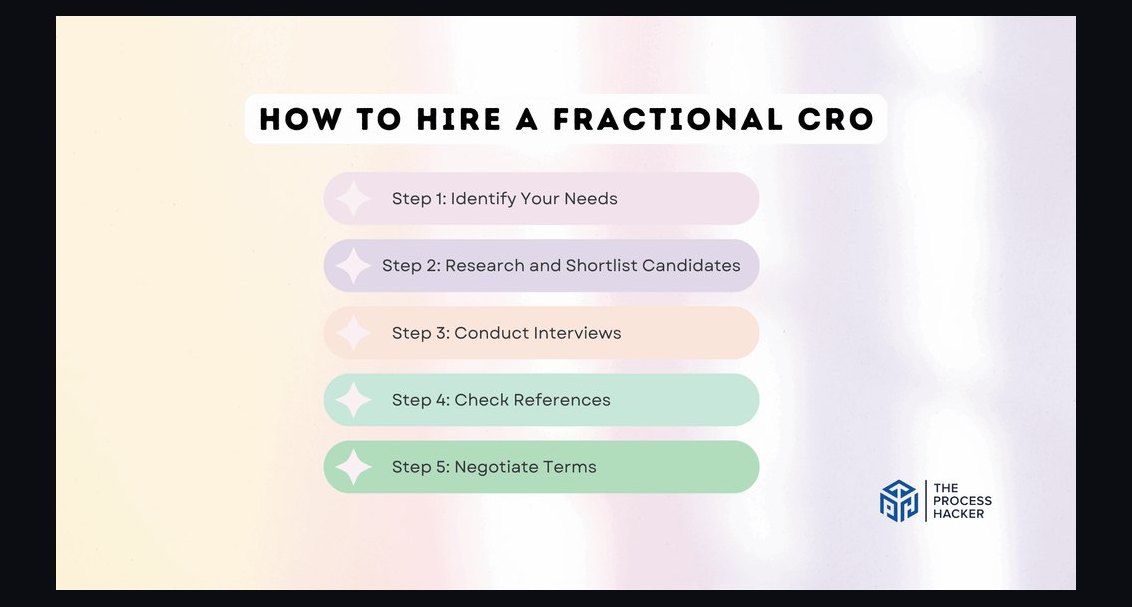
- Audit your current revenue team | Map who owns pipeline, forecasting, and customer expansion today - if it's just you, you need help.
- Define the exit story | Write down what acquirers will ask: revenue concentration, churn rate, sales cycle length, and whether those metrics are improving.
- Assess your budget runway | Fractional CROs is scoped as a retainer; ensure you can fund 18 months without starving product or support.
- Interview for exit experience | Ask candidates: "How many companies have you taken through due diligence?" Look for someone who's been on the seller's side.
- Set a 90-day sprint plan | The first quarter should focus on forecasting accuracy, pipeline hygiene, and a documented sales playbook - not just revenue growth.
type: tip A fractional CRO can also serve as a "revenue Sherpa" for your board and investors. They speak the language of acquirers - ARR quality, gross retention, net dollar retention, and sales efficiency - which makes your story more compelling in the data room. Yes, if your goal is a clean, defensible revenue story for acquirers and you lack enterprise sales leadership in-house. A fractional CRO for 18 months is typically scoped as a retainer depending on scope (strategy-only vs. hands-on pipeline management), days per week committed, and whether you offer equity. The right fractional leader can build repeatable processes, tighten forecasting, and document your go-to-market engine - all things acquirers pay a premium for.
- Pavilion – Community for revenue leaders, including fractional roles
- RevOps Co-op – Peer network for revenue operations professionals
- Harvard Business Review – General management and strategy articles
- First Round Review – Startup leadership and sales playbooks
- SaaStr – SaaS-specific advice on exits and revenue leadership
- LinkedIn – Network for finding and vetting fractional CRO candidates People also search for: fractional cro 18 Months · hire a fractional cro in 18 Months · 18 Months fractional cro · fractional cro near me ## Related on PULSE - [Does a PE-backed martech company need a fractional CRO in 2027?](/knowledge/tl13255)
- [Should I hire a fractional CRO in Bethany Beach in 2027?](/knowledge/tl20031)
- [Does a bootstrapped edtech company need a fractional Chief Revenue Officer in 2027?](/knowledge/tl16296)
- [Does a founder-led government contracting company need a fractional Chief Revenue Officer in 2027?](/knowledge/tl16576)
- [Should I hire a fractional Chief Revenue Officer in Clinton in 2027?](/knowledge/tl20305)
- [Does a manufacturing company need a fractional CRO or a full-time CRO in 2027?](/knowledge/tl10475)
This page will be disappearing soon. Save it to your device for $1 — or read it free while it is here.
@Kory-White- · if Venmo asks, the last 4 of my number are 2012
 pulse-toolsWhere do I find a fractional head of revenue in Bellevue in 2027?
 pulse-toolsWhere do I find a fractional head of revenue in Pasadena in 2027?
 pulse-toolsHow do I find a fractional CRO in Plantation in 2027?
 pulse-toolsWho is the best fractional CRO in Smyrna in 2027?
 pulse-toolsWhat should an SMB company look for in a fractional CRO in 2027?
 pulse-toolsWhere do I find a fractional revenue leader in Santa Monica in 2027?
 pulse-toolsWhat does a fractional CRO cost in Dagsboro in 2027?
 pulse-toolsHow much does a fractional CRO cost for a real estate company in 2027?
 pulse-toolsHow do I find a fractional CRO in Oakton in 2027?
 pulse-toolsShould I Hire a Fractional CRO If I Need Interim Coverage During a Medical Leave in 2027?