
Should I Hire a Fractional CRO If My Two Co-Founders Disagree on GTM Strategy?
 Curated byKory White · Fractional CRO · Maryland
 PULSEKNOWLEDGE LIBRARY
Quality
Certified

Yes, but only when the disagreement is about execution and sequencing rather than vision. A Fractional CRO earns their fee by converting a founder argument into a falsifiable test: instrument parallel GTM pilots, read the pipeline data, and let the market settle what opinions could not. If Founders Disagree on what company they are building, hire an alignment coach instead.
This vs. the common alternatives
When two co-founders are deadlocked on go-to-market, the instinct is to reach for the nearest available lever. There are five realistic options, and they solve genuinely different problems. Understanding which one you actually need is most of the decision.
Hire a full-time VP of Sales or CRO. This is the most expensive and most politically loaded option. A permanent revenue leader walks into a founder war already owned by whoever championed the hire. Every strategic call becomes a proxy fight, and the new executive spends their first two quarters managing up rather than managing pipeline. Full-time CRO compensation typically runs $250K-$350K base plus bonus plus equity plus benefits, often $400K-$600K fully loaded at a growth-stage company — and that is before you account for the cost of a bad fit. The advantage is continuity and depth: a permanent leader can build a durable team, own a number for years, and grow into the scale of the business. The disadvantage is that you are making a multi-year commitment to resolve a question that might be answerable in ninety days.
Hire a sales or GTM consultant. Consultants advise; they do not operate. You get a deck, a framework, a set of recommendations, and an invoice. The problem with a consultant in a founder-disagreement scenario is that recommendations are exactly what you already have too many of. Both founders have a thesis. Adding a third opinion does not break the tie — it adds a third side to a two-sided argument. Consultants are excellent when you know what you want to do and need help doing it better. They are poor when the core problem is that nobody has run the experiment.
Promote someone internally. Cheaper on paper, and sometimes correct. But an internal promotion inherits the founder politics wholesale. The newly promoted revenue lead is someone both founders already have a relationship with, and that relationship is now the thing under pressure. Internal candidates also rarely carry the multi-company pattern library — the "I have watched this exact PLG-versus-enterprise debate play out at four companies" credibility — that lets them say something neither founder can dismiss. If your internal candidate has genuinely run revenue at two or three prior companies, this option improves dramatically. If they have only ever worked at your company, they are being asked to referee a fight they have no standing to referee.
Run a founder alignment session. This is the correct intervention when the disagreement is foundational. A neutral facilitator — a board member, an executive coach, a seasoned operator who is not being paid to run revenue — helps the founders surface whether they actually agree on the customer, the problem, and the value proposition. If they do not, no revenue hire will save you. If they do, the session often reveals that the "GTM fight" was really a communication failure, and the whole engagement becomes unnecessary. This is the cheapest option and the one most often skipped.
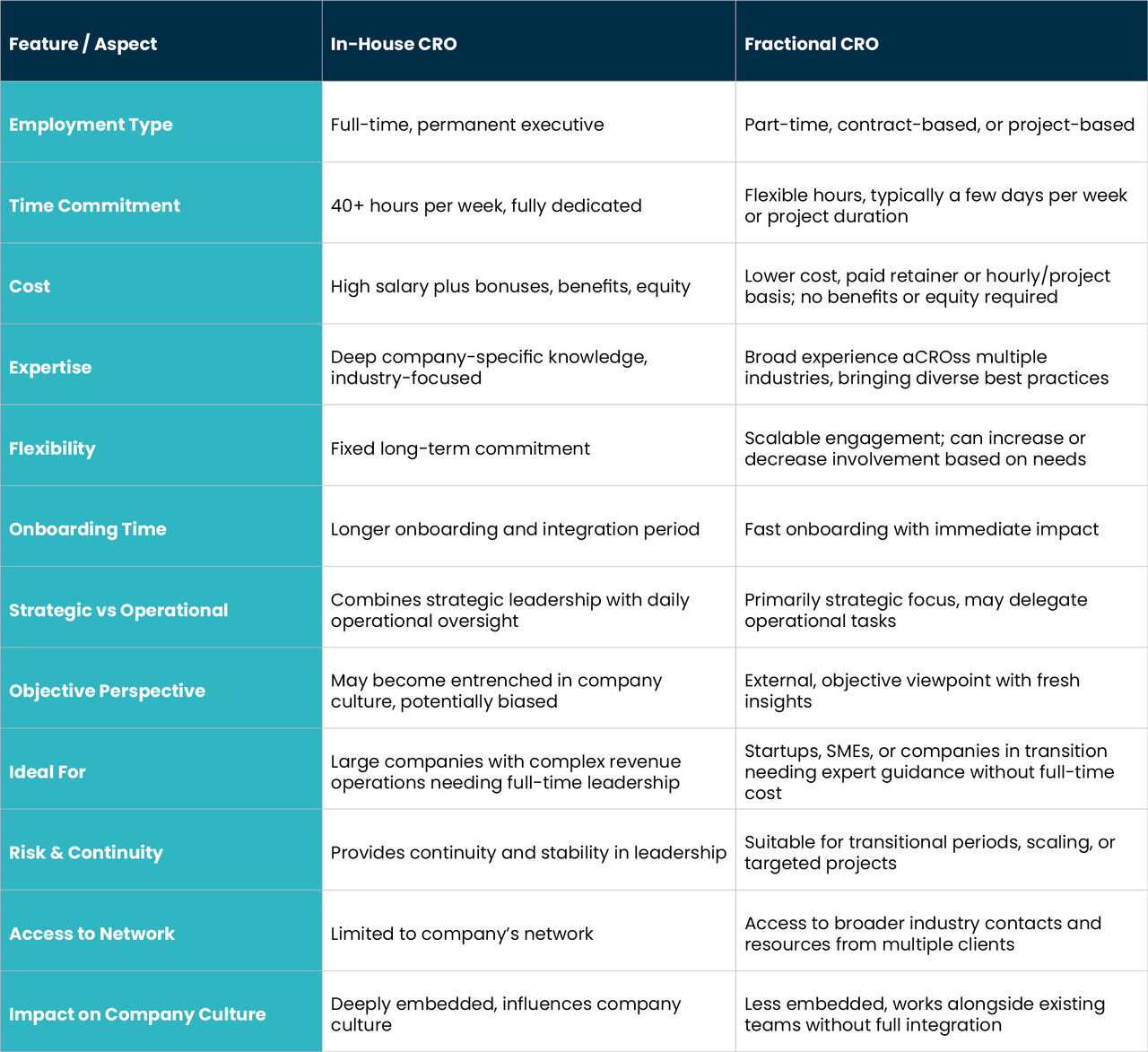
Hire a Fractional CRO. Senior revenue leadership on a part-time, fixed-term basis — typically two to four days per month over four to six months. The distinguishing feature is neutrality plus authority plus operational capability. A Fractional operator has no long-term political stake, no equity axe to grind, and a portfolio of prior companies that gives them standing neither founder can easily dismiss. Crucially, they can actually run the test: instrument the funnel, coach the sellers, control messaging during the test window, and report comparative data. That combination — outsider credibility plus hands-on execution — is what none of the other four options provide simultaneously.
The trade-off is real. A Fractional CRO is not cheap, does not give you continuity beyond the engagement, and depends entirely on both founders pre-committing to abide by the evidence. If either founder will reject data that contradicts their thesis, the engagement fails regardless of how good the operator is. And a Fractional CRO cannot fix a vision problem; they can only resolve an empirical one.

For a deeper breakdown of the role's scope and where it fits in an org, see the fractional revenue leadership guide.
How to choose between them
The decision tree is short, and the first branch matters more than all the others combined. Before you spend a dollar on revenue leadership, run the diagnostic.
Ask each founder to independently write down three things: the ICP (who exactly is the buyer), the top three buyer pains, and a one-sentence value proposition. Do this separately, without discussion, and compare the documents afterward. If those documents substantially agree and only the *motion* differs — inbound versus outbound, PLG versus sales-led, SMB velocity versus enterprise land-and-expand — you have an execution disagreement. If the ICP and value proposition themselves diverge, you have a foundational disagreement, and revenue leadership is the wrong tool entirely.
The second branch is capability. Do you have in-house senior revenue reps who can design and read a fair test? If yes, you may be able to run the experiment yourselves and bring in a Fractional CRO only as an optional advisor. If no, the Fractional hire is doing real work.
A few practical notes on reading this tree. "Substantially agree" means the documents would lead a reasonable third party to the same targeting decision. It does not mean word-for-word identical. Founders who describe the same buyer in different language are aligned; founders who describe different buyers are not. And the capability branch is not about headcount — it is about whether anyone in the building has personally run a comparative GTM experiment and knows how to keep it clean.

If you land on the Fractional branch, the next decision is mandate design, covered below. If you land on the alignment branch, do not skip it. Founders who "park" a foundational disagreement and hire revenue leadership anyway typically end up six months poorer, with a whipsawed sales team and a worse founder relationship than when they started.
Costs, timelines, and expected impact
Pricing for Fractional CROs varies widely by experience, geography, and scope, so treat any figure as a range to validate against live quotes rather than a fixed rate. As a working frame, fractional revenue executives commonly bill either a monthly retainer or a day rate. Retainers for a two-to-four-day-per-month engagement typically run from the low thousands to the low tens of thousands per month depending on seniority and scope. Day rates for experienced operators commonly land in the $1,500-$4,000 range, with former CROs of scaled companies at the top of that band and first-time fractional operators at the bottom.
Compare that to the fully loaded cost of a full-time CRO — base, bonus, equity, benefits, and recruiting fees often totaling $400K-$600K in year one at a growth-stage company. A four-month Fractional engagement at three days per month might cost $25K-$60K. You are buying a slice of their time and a fixed engagement rather than a permanent seat, and the math reflects that.
Always get the specific scope and rate in writing. Confirm explicitly whether tooling costs, any test-cell headcount (SDRs, AEs), and travel sit inside or outside the retainer. Never anchor your budget to a number you read online; anchor it to two or three actual proposals from operators whose references you have actually called.
Timeline. For a diagnosis-and-resolution engagement, four to six months is typical, at two to four days per month. That is enough presence to instrument the org, coach the sellers, and run comparative pilots, without paying full-time money for a part-time problem. Insist on a written interim readout at the 30- and 60-day marks so neither founder can later claim the process was opaque. Define the exit condition explicitly up front: the engagement ends when the GTM motion is chosen, documented in a repeatable playbook, and either handed to an internal owner or used as the spec for the eventual full-time revenue leader.
Expected impact. The economic case is a straightforward option-value argument. The cost of a stuck founder GTM disagreement is not the Fractional CRO's fee — it is the burned runway from a sales team thrashing between two motions, the pipeline that never converts because the message keeps changing, and the founder relationship damage that compounds every week the fight continues. If a four-month engagement resolves that, it pays for itself many times over in avoided waste, independent of which GTM motion wins. Model it as insurance against continued indecision, not as a line item to minimize.
How to judge whether it is working. On the hard axis: are the pilots actually instrumented, are you getting clean comparative data on CAC, sales-cycle length, win rate, and retention, and is that data trending toward a defensible decision? On the soft axis — and this one matters just as much — has the *temperature* of the founder disagreement dropped? A good Fractional CRO changes the conversation from "you're wrong" to "let's see what the numbers say," and you should feel that shift within the first month. If, sixty days in, the founders are arguing just as hard and the CRO has quietly aligned with one of them, the engagement is failing and you should call it. For benchmarks on what healthy early revenue metrics look like during a test like this, see the SaaS revenue benchmarks reference.
One more cost most founders undercount: their own time. The co-signed mandate, threshold-setting, and interim readouts all require both founders' active participation. Budget a few hours a week each. Treating the CRO as fully self-service undermines the alignment the engagement is supposed to produce.

Implementation and handoff details
The single most important structural decision is that both founders must co-sign the mandate before the engagement starts. If one founder hires the Fractional CRO over the other's objection, you have not neutralized the conflict — you have armed one side of it. The operator now walks in as an agent of Founder A, and Founder B is correct to distrust every recommendation. The whole value of the neutral outsider evaporates on day one.
Get both founders in a room, agree in writing on what question the CRO is being asked to answer, and agree in advance on what evidence would settle it. This pre-commitment is doing the real work; the CRO is just the instrument that generates the evidence.

Frame the mandate as a falsifiable test, not an opinion contract. A weak mandate reads "help us figure out our GTM strategy" — that just invites the CRO to pick a side and reignite the fight. A strong mandate reads: "Over the next 90 days, run parallel instrumented pilots of the PLG motion (Founder A's thesis) and the outbound enterprise motion (Founder B's thesis), holding spend roughly equal, and report on CAC, sales-cycle length, win rate, and 90-day retention for each. We will fund whichever clears these pre-agreed thresholds." Now the CRO's job is to run a clean experiment, not to arbitrate egos, and both founders have already agreed to abide by the outcome. The GTM experiment design framework covers how to size these pilots so the results are readable rather than swamped by noise.
Give real but bounded authority. The CRO needs enough operational control to actually run the pilots — budget for tooling and a small SDR/AE test cell, authority over messaging and process during the test window — but the founders retain the final strategic call. The CRO's role is to make that call *obvious* by generating undeniable evidence, not to make it for you.
Plan the handoff from day one. The best outcome is that the CRO resolves the disagreement, documents the winning motion into a repeatable playbook, and in doing so writes the job spec for whoever runs revenue next — whether that is an internal promotion, a full-time VP of Sales, or the same Fractional operator converting to a permanent or advisory role. You should end the engagement with three durable assets: a *decided* GTM strategy, a *documented* motion, and *aligned founders* who reached that alignment through evidence rather than attrition. If your contract does not address conversion terms, negotiate them at signing rather than from scratch at month five.

Three situations argue against hiring at all. First, when the disagreement is foundational rather than executional — fix vision alignment first, because the revenue question is downstream of a question you have not answered. Second, when you are pre-product-market-fit and pre-revenue: a Fractional CRO is a scaling and optimization instrument, and if you have no customers and no repeatable interest, there is nothing to optimize. The founders should be doing the messy, unscalable early selling themselves, because that is how you *discover* the GTM strategy rather than delegate the discovery. Third, when one founder simply will not be bound by evidence. The entire mechanism depends on both founders pre-committing to abide by a fair test. If you already know one co-founder will reject the data whenever it contradicts their thesis, no amount of clean pilot data will resolve it, and you are paying an expensive operator to generate reports that will be ignored. That is not a revenue problem; it is a founder-governance problem, and it belongs in front of your board.
RevOps owns the instrumentation. This is the part founders routinely under-resource. Someone has to define the funnel stages, wire the CRM fields, ensure both pilots report against identical definitions of a qualified opportunity, and keep the data clean enough that the comparison is honest. If your RevOps function is one overworked generalist, that person becomes the bottleneck and the pilots slip. Budget for it explicitly in the mandate, and make sure the Fractional CRO and the RevOps lead are working from the same measurement spec before the first pilot launches.
Related questions
How is a Fractional CRO different from a sales consultant?
A consultant advises and exits with a deliverable; a Fractional CRO takes operational ownership of the revenue motion for a fixed term — hiring, coaching, and running pilots as an embedded part-time executive, not an outside advisor. The distinction matters most when the problem is a stuck decision rather than a knowledge gap.
Can a Fractional CRO break a genuine founder deadlock?
Only if the deadlock is about execution, not vision, and both founders pre-commit to abide by the results of a fair test. They break deadlocks by generating evidence, not by casting a tie-breaking vote. If one founder will reject contrary data, no operator can help.
How long should a Fractional CRO engagement last?
For resolving a specific GTM disagreement, typically four to six months at two to four days per month — enough to instrument the org and run comparative pilots, with a defined exit once the motion is chosen and documented. Shorter engagements rarely produce readable data.
What if both founders want to hire different Fractional CROs?
That is a red flag that the disagreement is foundational, not executional. Pause the revenue hire and run a founder alignment session first; two competing operators will institutionalize the conflict rather than resolve it, and you will pay twice for the privilege.
Should the Fractional CRO report to one founder or both?
Both, jointly, with a co-signed mandate. Reporting to a single founder re-politicizes the role and forfeits the neutrality that makes the hire worth doing. The reporting line is the single clearest signal of whether the engagement has a chance.
FAQ
Will hiring a Fractional CRO make the sales team feel like a temp is in charge?
Not if you frame it correctly. Introduce them as senior leadership brought in to build the revenue engine for this stage, with real authority over the test. Sellers generally welcome an experienced operator who reduces the strategic whiplash they have been suffering from the founder disagreement. What they do not welcome is ambiguity about who decides — so be explicit about the CRO's authority during the test window and about what happens after.
How do we pick a Fractional CRO who will not just side with one founder?
Interview for pattern-matching and intellectual honesty, not charisma. Ask candidates how they would design a fair test between your two GTM theses and what evidence would change their mind. A good one describes an experiment; a weak one immediately tells you which founder is right. Also ask for two references from engagements where the answer turned out to contradict the founder who hired them.
What deliverables should we require at the end of the engagement?
A chosen GTM motion backed by comparative pilot data, a documented and repeatable playbook, a clean handoff to an internal owner or the spec for a full-time hire, and a written recommendation on revenue-team structure for the next stage. Get these enumerated in the contract, not agreed verbally at the kickoff.
Can we convert a Fractional CRO to full-time if it goes well?
Often yes, and it is a common and healthy outcome. The engagement functions as an extended working interview for both sides. Just make sure the initial contract addresses conversion terms — notice period, fee treatment, equity expectations — so it is not a renegotiation from scratch at month five.
Is it cheaper to just promote someone internally to run this?
Usually not, if the internal candidate lacks the multi-company pattern-matching that gives a Fractional CRO their neutral authority. An internal promotion inherits the founder politics; the whole point of the Fractional model here is buying an outsider's earned credibility. That said, if your internal candidate has genuinely run revenue at two or three prior companies, the calculus changes.
What is the biggest mistake founders make with this hire?
Using it to avoid a conversation they need to have with each other. If the disagreement is really about vision or control, a Fractional CRO becomes an expensive way to postpone the reckoning. Diagnose the disagreement type honestly before you spend the money — the diagnostic costs an afternoon, and the wrong hire costs a quarter.
Sources
- Harvard Business Review — Why Co-Founders Fall Out
- First Round Review — Revenue Leadership at Early-Stage Startups
- SaaStr — When to Hire Your First Head of Sales
- OpenView Partners — Go-to-Market Strategy and Motions
- Bessemer Venture Partners — State of the Cloud and GTM Benchmarks
- Y Combinator — Founder Disputes and How to Resolve Them
- Gartner — Chief Revenue Officer Role Overview
- Andreessen Horowitz — The Fractional Executive Model
Related on PULSE
- Fractional revenue leadership guide
- [Should I Hire a Fractional CRO If We Are Integrating Two Sales Teams After a Merger in 2027?](/knowledge/tl0364)
- [Should I Hire a Fractional CRO If My GTM Works in the US but Not Abroad in 2027?](/knowledge/tl0591)
- [Should I Hire a Fractional CRO If I Have Missed Quota Two Quarters in a Row in 2027?](/knowledge/tl0351)
- [Should I Hire a Fractional CRO If My Last Two Sales Hires Failed in 2027?](/knowledge/tl0557)
- Founder GTM alignment playbook
This page will be disappearing soon. Save it to your device for $1 — or read it free while it is here.
@Kory-White- · if Venmo asks, the last 4 of my number are 2012
 pulse-toolsShould I Hire a Fractional CRO If My Pricing Has Not Changed in Five Years in 2027?
 pulse-toolsHow do I hire a fractional VP of Sales in Charleston in 2027?
 pulse-toolsShould I Hire a Fractional CRO If My Board Added a New Revenue Target Mid-Year in 2027?
 pulse-toolsHow do I hire a part-time CRO for a biotech company in 2027?
 pulse-toolsHow do I hire an outsourced CRO for a telecom company in 2027?
 pulse-toolsHow do I hire a fractional CRO in Leipsic in 2027?
 pulse-toolsShould I Hire a Fractional CRO If I Have No Sales Enablement Function in 2027?
 pulse-toolsHow do I hire a fractional VP of Sales in Reading in 2027?
 pulse-toolsHow do I hire an interim CRO for a legaltech company in 2027?
 pulse-toolsHow do I hire an outsourced CRO in Santa Monica in 2027?