
Should I Hire a Fractional CRO If I Am Entering a Regulated Market?
 Curated byKory White · Fractional CRO · Maryland
 PULSEKNOWLEDGE LIBRARY
Quality
Certified

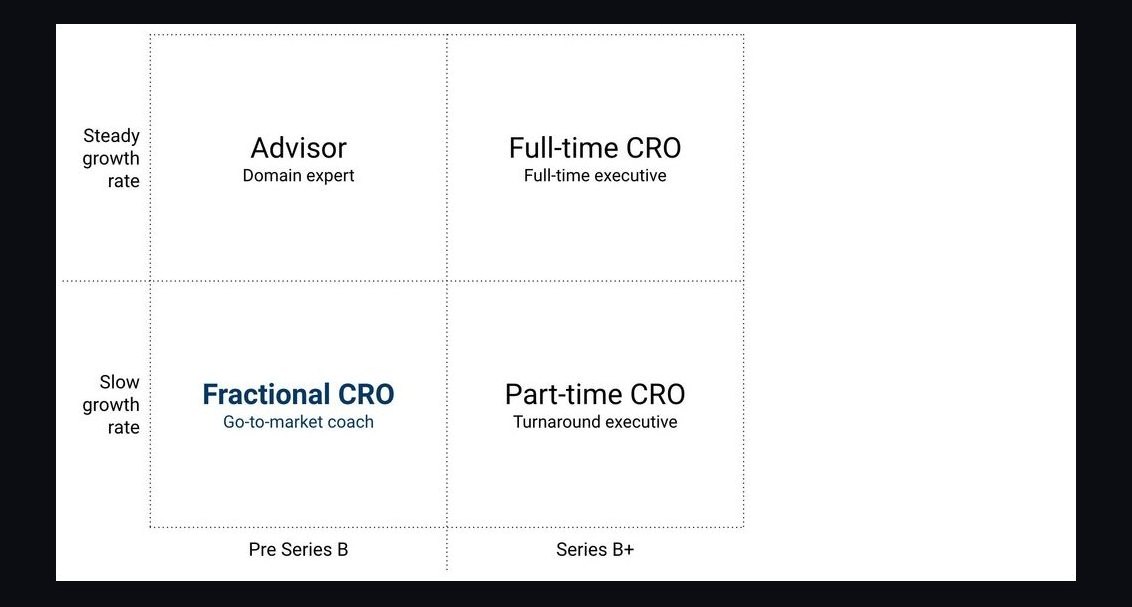
Yes, in most cases. A fractional CRO is well-suited to a company entering a regulated market because you buy senior, compliance-literate revenue leadership for a fraction of a full-time package while your go-to-market motion is still unproven. The condition: they must have operated inside your specific regime, not merely adjacent to it.
Signals you actually need this
The decision is rarely a coin flip. There are concrete, observable signals that a company entering a regulated market needs fractional revenue leadership rather than another account executive, a sales consultant, or a full-time Chief Revenue Officer. If three or more of the following describe your company today, the fractional path is usually the correct call.
You have between two and ten quota-carrying reps and no repeatable motion. Below two reps, you do not have a revenue engine to lead — you have a founder selling, and what you need is deal help, not a leader. Above roughly ten to twelve reps, the management load alone starts to justify a full-time executive who is present every day. The two-to-ten band is exactly where a fractional CRO does the most good: enough people to need a system, not enough scale to need a permanent C-suite line item.
Your first regulated deal took two to four times longer than your unregulated deals did. This is the single loudest signal. When a founder tells you that a deal which should have closed in 45 days took 140 because security review, legal review, or a licensing question surfaced in week six, that is a process defect, not bad luck. Compliance-gated selling has predictable friction points, and someone who has run the motion before knows where they sit and how to front-load them into qualification instead of discovering them at contract.

Your reps are improvising answers to compliance questions on live calls. Ask your team what they say when a prospect's counsel asks about data residency, HIPAA business associate agreements, SOC 2 scope, or how performance figures in a deck were calculated. If you get five different answers from five reps, you do not have a claims problem you can fix with a training deck — you have an absent operating model. A regulated market punishes improvisation in a way that a dev-tools market simply does not.
Your CRM is storing things it should not be storing. Open the lead-notes field and read fifty records. In healthcare-adjacent companies you will frequently find patient details a rep pasted from an email. In financial services you will find account numbers. Neither is malicious; both are the direct result of nobody having designed the data-capture surface with a regulator in mind. Fixing this is a RevOps design problem with a compliance blast radius, and it is exactly the work a fractional CRO owns in the first sixty days.
Your compensation plan pays only on signature. A plan with 100% of variable tied to closed-won and no clawback, no clean-revenue gate, and no quality component creates quiet pressure to rush the very checks that keep you out of trouble. Founders almost never see this as a compliance risk because it looks like a finance decision. A revenue leader who has been through an audit sees it immediately.

Your compliance or legal function describes sales as "the problem." If your general counsel or compliance officer has started routing sales requests to the bottom of the queue, the relationship has already broken. Repairing it requires someone with executive standing who can negotiate a real service-level agreement between the two functions — a peer conversation a VP of Sales usually cannot have and a consultant has no standing to force.
You have a board or investor pushing for a full-time CRO and you cannot yet write the scorecard. If you cannot articulate what the person would be measured on in twelve months beyond "grow revenue," you are not ready to hire permanently. A six-to-nine-month fractional engagement is the cheapest possible way to generate that scorecard from real operating data instead of from a job description template.
Counter-signals worth naming. If you already have a strong VP of Sales who is performing, a compliance function embedded in the deal process, and a motion that has closed fifteen or more similar deals with predictable cycle times, you probably do not need a CRO of any kind right now — you need to hire more of the reps who are already working. And if you are pre-product-market-fit with no repeatable buyer, a fractional CRO will spend the engagement doing discovery work the founder should be doing personally. Entering a regulated market does not by itself justify the hire; the combination of regulatory friction and an unproven, scaling motion does.
What good looks like versus what bad looks like
The variance in outcomes across fractional CRO engagements is enormous, and it is almost entirely predictable from behaviors visible in the first thirty days. Below is the working distinction between an engagement that compounds and one that quietly burns retainer.

Good: they name your rules in the interview. Bad: they reassure you. A candidate who has sold into financial services will reference the SEC marketing rule and FINRA Rule 2210 by name and describe how a testimonial or a performance figure changed the shape of a specific deal. A healthcare operator will talk about business associate agreements, minimum-necessary data handling under HIPAA, and how a security questionnaire moved from week eight to week two of the cycle. A generalist will say "I've worked in highly regulated environments" and change the subject. Ask for the rule number. The answer separates the field faster than any reference call.
Good: they build a claims library. Bad: they build a pitch deck. In an unregulated market, sales enablement is persuasion. In a regulated market, enablement is a controlled vocabulary — an approved-claims library where each statement a rep is allowed to make is written down, tied to substantiating evidence, and versioned with an approval date and reviewer. Good operators produce this in the first sixty days, usually with a spreadsheet before any tooling. Bad operators produce a beautiful narrative deck full of claims nobody has cleared.
Good: they redesign the comp plan early. Bad: they raise quota. A regulated-market comp plan typically holds back a portion of variable compensation against clean-revenue conditions — no compliance exception opened on the deal, documentation complete, contract executed without a non-standard indemnity the company would not have accepted twice. A common structure is 70 to 80 percent of variable paid at close and the balance released after the file passes review. It costs nothing extra in aggregate and changes rep behavior on the calls you never hear.

Good: they set a compliance SLA. Bad: they escalate everything. The measure of a working compliance-gated motion is what fraction of deals need human review. If every deal escalates, the queue becomes the bottleneck and reps route around it. A well-designed motion pushes 80 to 90 percent of deals through pre-approved paths and reserves review for genuine exceptions, with a published turnaround — often 24 to 48 hours for a standard question, five business days for anything requiring outside counsel.
Good: they work in your systems. Bad: they work in their own. If the artifacts live in the fractional CRO's personal Google Drive, in their template library, or in their head, you are renting rather than buying. Everything of value should land in your CRM, your enablement tool, and your documentation — configured, not described.
Good: they name their exit at the start. Bad: they optimize for renewal. The strongest operators will tell you in the first conversation what triggers the end of the engagement: a documented motion, a hired VP, a validated segment, a specific number of closed deals through the new process. If a candidate cannot describe how a prior engagement ended, assume it did not end well.

Good: they partner with compliance. Bad: they route around it. Watch the first time a deal stalls on a compliance question. The good operator walks into that function's office and negotiates a path. The bad one asks you for an override. Overriding your compliance function to hit a number is the behavior that ends companies in regulated verticals, and no revenue result is worth establishing it as precedent.
Real cost and ROI ranges
The economics are the reason most founders look at fractional leadership in the first place, so it is worth being precise about how the money actually moves rather than trading in vague claims about savings.
How engagements are priced. Fractional CRO work is almost always sold as a monthly retainer tied to a committed number of days, occasionally as a day rate, and rarely as an hourly arrangement. A typical structure is two to three days per week over a six-to-twelve-month term, with a ramp period in month one where the operator is closer to full-time while they audit the business. Equity sometimes appears as a small advisory-style grant with standard vesting, though many operators in regulated verticals prefer cash-only arrangements precisely because equity in a company facing regulatory risk is hard to price. Ask whether the retainer includes travel, whether unused days roll forward, and what happens to the fee if you pause the engagement — the answers vary widely and are always negotiable at signing, never after.

What you are actually comparing against. The honest comparison is not retainer versus base salary. A full-time CRO package includes base, a variable component usually equal to 40 to 60 percent of base at target, equity that dilutes existing holders, employer taxes and benefits, recruiting fees that commonly run 25 to 33 percent of first-year cash compensation for a retained search, and a severance exposure if the hire does not work out. Executive searches at this level regularly take three to six months to fill and another three to six months to ramp. That means a full-time hire made today may not produce leverage until two or three quarters from now, while a fractional operator is typically working inside your business within two to four weeks of first conversation. In a regulated market where the cost of a badly designed motion compounds, that timing gap is frequently worth more than the fee difference.
Where the return actually comes from. Four sources, in rough order of reliability:
*Avoided rework.* The most common expensive mistake is building a go-to-market motion, hiring against it, and then discovering that a licensing requirement, a data-handling constraint, or a claims restriction forces a rebuild. Rebuilding a motion after six months typically means re-writing enablement, re-training the team, re-configuring the CRM, and eating the ramp time of reps hired against the old model. That is a multi-quarter setback, and it is the single largest thing a regulated-market operator is being paid to prevent.

*Cycle-time compression.* Pulling security review, legal review, and eligibility verification forward into qualification does not eliminate the work, it just stops it from happening serially at the end. Companies that front-load these steps routinely take weeks out of their cycle. Measure it: track median days from first meeting to closed-won before the engagement and again ninety days in. If nothing moved, ask why.
*Win-rate improvement through better qualification.* In regulated markets a meaningful share of early pipeline is not actually winnable — the prospect lacks the license, the data cannot legally cross the boundary, or the procurement process requires a certification you do not yet hold. Encoding eligibility into qualification kills those deals in week one instead of week ten, which raises win rate and frees selling capacity even if total pipeline shrinks. Founders often panic at the shrinking pipeline number; that reaction is the reason this work needs executive standing.
*Reduced regulatory exposure.* This is real but hard to price, because the return is the absence of an event. What you can price is the observable proxy: the number of open compliance exceptions per hundred closed deals, and the completeness of the deal file when an auditor or an acquirer's diligence team asks for it.

A workable ROI test. Before signing, write down three to five numbers you will measure at day 90 and day 180 — median cycle time, win rate on qualified opportunities, percentage of deals escalating to compliance review, percentage of closed deals with a complete documented file, and ramp time for a new rep. Put them in the engagement letter. If the fractional CRO objects to being measured on operating metrics rather than bookings alone, that objection tells you something. Bookings in the first two quarters of a regulated motion are heavily influenced by deals that were already in flight; the process metrics are what actually attribute to the new leadership.
When the math does not work. If your total revenue plan for the year is small enough that the retainer represents a large share of gross new revenue, the answer is usually to buy fewer days per month rather than a different person — a strong operator at one day per week paired with a capable internal RevOps owner often outperforms a weaker operator at three days. And if you need the CRO primarily to carry deals personally rather than to build a system, you are buying an expensive senior seller, and the economics of that are much worse than simply hiring two good account executives.
How it plugs into your workflow
Hiring the person is the easy part. The value comes from where the role sits in your operating cadence and what it changes structurally. Here is what a well-run engagement looks like week to week and stage to stage.
Days 1 to 30: audit and instrument. The operator should spend the first month largely reading and listening — call recordings, closed-lost reasons, CRM field hygiene, the current comp plan, the compliance function's backlog, and the last twenty deal files. The deliverable at day 30 is not a strategy deck. It is a written map of where the current motion is undefended: which claims are unsubstantiated, which fields capture data they should not, which stages have no compliance control, and which deals closed with documentation that would not survive review. Insist that this document names specific records and specific rules.

Days 30 to 90: design and gate. This is where the compliance-gated stage model gets built. Each deal stage acquires two exit criteria — a commercial one and a control one — and deals cannot advance until both are met. Lead capture gets a consent and data-handling check. Qualification gets an eligibility verification against whatever licensing or jurisdictional constraint applies. Discovery and demo get bounded to the approved-claims library. Proposal gets a legal and pricing review with a published turnaround. Contract gets an approvals archive. Closed-won triggers a documented handoff. Alongside this the comp plan is redesigned and the escalation queue gets an owner and an SLA.
Days 90 to 180: run, tune, and train. The operator runs the motion with the team, watching the escalation ratio. If more than roughly one in five deals is escalating, the pre-approved paths are too narrow and need widening; if essentially nothing escalates, the gates are probably decorative and someone should audit a sample of files to check. Weekly cadence typically includes a pipeline review that inspects control-stage compliance alongside forecast, a deal desk for exceptions, and a standing joint session with compliance.
Days 180 onward: hand off. The engagement should end into something — a hired VP of Sales, a promoted internal leader, a conversion of the fractional CRO to full-time, or a reduced advisory cadence. Whichever it is, the exit test is the same: can the team run the motion for a full quarter without the operator present, and does the documentation survive an outside reader?

Who owns what between visits. A fractional leader working two days a week needs a full-time counterpart. In practice that is a RevOps lead or a senior sales operations person who holds the systems work, maintains the claims library, keeps the escalation queue moving, and escalates decisions rather than waiting for the next on-site day. Engagements without this internal owner stall in the gaps, and the retainer gets spent on catching up rather than moving forward.
Where it touches the rest of the business. Marketing inherits the claims library and a review gate before publication. Finance inherits the clean-revenue component of the comp plan and the clawback mechanics. Product inherits a feed of regulatory blockers that killed deals — often the highest-value output of the whole engagement, because it tells the roadmap which certification or control unlocks a segment. Compliance inherits a partner with a defined SLA instead of an unpredictable stream of urgent requests. If the engagement only ever touches the sales team, it is under-scoped.
The documentation standard. In an audit, in diligence, or in a regulator's inquiry, "we trained the reps not to do that" carries almost no weight. What carries weight is a written process, evidence it was enforced, and a record of the exceptions and how they were resolved. Build the deal file so that a stranger could reconstruct why each claim was permissible, where the data went, who approved the non-standard terms, and when. That file is the durable asset the engagement leaves behind, and it is worth more at your next financing or acquisition than any quarter's bookings.
Related questions
How is a fractional CRO different from a sales consultant?
A consultant advises and hands over recommendations. A fractional CRO carries operational ownership of the revenue number, manages the team, sits in pipeline reviews, and is accountable for the motion running. In a regulated market that ownership — and the executive standing to negotiate with compliance as a peer — is the whole point.
Do I need a CRO or a VP of Sales first?
It depends on breadth. A VP of Sales owns the selling team. A CRO owns sales, marketing alignment, and revenue operations together. When compliance dependencies run across all three — claims in marketing, data capture in systems, incentives in comp — the broader mandate is usually the better first senior hire.
Can a fractional CRO convert to full-time later?
Frequently, and it is a healthy path. Many engagements function as an extended trial: the operator proves the motion, and if fit and economics work, converts or recruits and hands off to their own replacement. Agree the conversion mechanics and any fee at signing, not at the moment you want to convert.
Which regulated markets most need this?
Healthcare, financial services and wealth management, insurance, pharmaceuticals and life sciences, fintech, cannabis, and government technology. The common thread is a licensing body or regulator whose rules govern what you can claim, what data you can hold, and who is permitted to buy — any of which can halt growth outright.
What if my compliance team already blocks everything?
That is a scoping problem, not a reason to skip the hire. Make repairing the compliance-revenue relationship an explicit day-90 deliverable with a measurable output: a published escalation SLA, a set of pre-approved paths covering the majority of deals, and a standing joint review. Measure the escalation ratio monthly.
FAQ
What exactly is a fractional CRO?
A senior revenue leader working part-time or on an interim basis who owns the full commercial engine — sales, marketing alignment, and revenue operations — typically two to three days a week under a multi-month engagement rather than as a salaried executive. They manage people and carry the number, which is what separates the role from advisory work.
Will a fractional CRO handle my regulatory compliance for me?
No. They design a revenue motion that respects your requirements and partner closely with legal and compliance, but they do not replace those functions and they do not assume legal liability. Accountability for a compliance breach remains with your company and its officers, which is why an internal compliance owner is non-negotiable regardless of who leads revenue.
How do I verify someone's regulated-market experience is real?
Ask for rule-level specifics tied to a real deal: which rule applied, what it forced them to change, and what the outcome was. Then call a reference from that engagement and ask the compliance or legal counterpart, not just the CEO. Generalists reassure; operators cite.
How long should the engagement run?
Most run six to eighteen months, structured around a defined objective — usually a documented, repeatable, compliant motion that a team can execute without the operator present. Write the end state into the engagement letter with review points at day 90 and day 180 so either side can exit cleanly if the fit is wrong.
What should they leave behind on exit?
A documented motion with controls embedded in the CRM and stage gates, an approved-claims library with owners and review dates, a comp plan that rewards clean revenue, a trained team, a functioning escalation queue with an SLA, and complete deal files. If the value lives in their relationships or instincts rather than your systems, the engagement failed regardless of the bookings.
What is the biggest risk in this hire?
Divided attention. A part-time leader carrying several clients cannot match a full-time executive's depth on your specific regulatory nuances. Mitigate by scoping tightly to a small number of outcomes, requiring genuine embeddedness rather than advisory calls, and staffing a full-time internal owner who keeps work moving between the operator's days.
Sources
- U.S. Securities and Exchange Commission — Investment Adviser Marketing Rule
- FINRA — Rule 2210, Communications with the Public
- U.S. Department of Health & Human Services — HIPAA for Professionals
- Federal Trade Commission — Advertising and Marketing Guidance
- U.S. Food and Drug Administration — Prescription Drug Advertising
- National Association of Insurance Commissioners
- Harvard Business Review
- Gartner — Sales and Revenue Operations Research
- McKinsey & Company — Growth, Marketing and Sales
- Bessemer Venture Partners — Cloud and Go-to-Market Benchmarks
Related on PULSE
- [Should I Hire a Fractional CRO If My Healthcare Company Is Entering Payer Contracts in 2027?](/knowledge/tl0393)
- [Should I Hire a Fractional CRO If I Cannot Hire a Great Full-Time CRO in My Market in 2027?](/knowledge/tl0556)
- [Should I Hire a Fractional CRO If I Am Taking the Company to Market in a Year in 2027?](/knowledge/tl0600)
- [Should I hire a fractional CRO in Dupont Circle in 2027?](/knowledge/tl19206)
- [How do I hire a fractional CRO in Ellicott City in 2027?](/knowledge/tl14077)
- [How do I hire a fractional CRO for a martech business in 2027?](/knowledge/tl9039)
This page will be disappearing soon. Save it to your device for $1 — or read it free while it is here.
@Kory-White- · if Venmo asks, the last 4 of my number are 2012
 pulse-toolsWhat should I look for in a fractional CRO in San Diego in 2027?
 pulse-toolsWho is the best fractional CRO in Frederick in 2027?
 pulse-toolsWhere do I find a fractional head of revenue in Nashville in 2027?
 pulse-toolsWhere do I find a fractional VP of Sales in Minnesota?
 pulse-toolsHow much does a fractional Chief Revenue Officer cost for a $1M to $5M ARR company in 2027?
 pulse-toolsWhere do I find a fractional CRO in Georgia in 2027?
 pulse-toolsHow do I find a fractional CRO in Christiana in 2027?
 pulse-toolsShould I Hire a Fractional CRO If I Need to Fix Attribution Before Raising in 2027?
 pulse-toolsWho is the best fractional CRO in Temple Hills in 2027?
 pulse-toolsWhat KPIs should a fractional CRO own at a clean energy company in 2027?