
Should I Hire a Fractional CRO If I Need Interim Leadership During a CRO Search?
 Curated byKory White · Fractional CRO · Maryland
 PULSEKNOWLEDGE LIBRARY
Quality
Certified

Yes — hire a fractional CRO when the seat is empty and the search will realistically run three to six months. You get seasoned revenue leadership one to three days a week, a stabilized forecast, and sponsored deals for a fraction of a full-time package. Skip it only if a strong VP of Sales can genuinely hold the wheel.
The end-to-end process, from vacancy to clean handoff
The mistake most companies make is treating the interim decision as a hiring event rather than a process with a defined arc. It is closer to running two parallel workstreams: one that keeps revenue moving, and one that finds the permanent leader. If you conflate them, both suffer — the interim gets distracted by the search, or the search gets shaped around whoever is already sitting in the chair.
Here is what the sequence actually looks like when it is run well.
Day 0–7: scope the gap honestly. Before you call a single fractional operator, write down what the departing CRO actually owned. Not their title — their *load*. Did they personally sponsor the top five enterprise deals? Did they own the marketing relationship, or did the CMO report elsewhere? Were they the one who ran the weekly forecast call and applied the haircut, or did a RevOps lead do that and the CRO just presented it? This inventory determines whether you need one day a week or three, and whether the gap is a leadership gap or an execution gap. A surprising number of "CRO vacancies" are really "we lost the person who held four enterprise relationships," which is a different — and cheaper — problem to solve.
Day 7–21: source and contract. Fractional CRO sourcing runs through a narrower funnel than a permanent search: operator networks, PE/VC portfolio referrals, fractional-executive firms, and your own board's rolodex. You are looking for someone who has held the CRO title before, ideally more than once, and preferably through a transition. Two or three conversations is usually enough — this is a two-quarter engagement, not a decade-long bet, and the cost of a mediocre fractional is bounded in a way the cost of a bad permanent hire is not. Contract within two weeks or you have burned a third of the value.

Day 21–35: onboarding compressed into a fortnight. A permanent CRO gets a ninety-day listening tour. A fractional interim does not get one and should not want one. The first two weeks are pipeline review deal by deal, one-on-ones with every sales manager and the top quartile of reps, a read of the comp plan, and a sit-in on the forecast call as an observer before taking it over in week two. By the end of the second week they should be able to name the three deals most likely to slip and the two people most likely to resign.
Day 35–120: run the function. This is the bulk of the engagement — owning the forecast, sponsoring at-risk deals, keeping the operating cadence intact, and representing revenue to the board. Notably, the interim should be explicitly *forbidden* from large structural changes. No territory redesigns, no comp plan overhauls, no re-orgs. Those are the permanent CRO's decisions, and an interim who makes them is spending someone else's political capital and handing their successor a mess wrapped in a bow.
Day 120+: overlap and exit. Two to four weeks of overlap with the incoming permanent CRO, a written state-of-the-org document, warm introductions to key accounts and partners, and a defined last day. Then they leave.

The two workstreams — interim coverage and permanent search — run in parallel and converge exactly once, at the handoff. Everything in the contract should be written to make that convergence happen on a date rather than by exhaustion.
Where the vacancy creates revenue and where it leaks it
An empty CRO seat does not fail all at once. It leaks, and the leaks are predictable enough that you can pre-position against each one.
The forecast is the first thing to go. Without a single owner integrating signals across the funnel, what reaches the board is an aggregation of individual rep commits with no judgment applied. Reps are structurally optimistic; that is not a character flaw, it is what happens when someone is quota-carrying and looking at their own deals in isolation. The CRO's actual job on the forecast call is to apply a haircut informed by pattern recognition across hundreds of deals. Remove that and the number does not just get less accurate — it gets systematically *high*, which is the worst possible direction, because the board plans hiring and spend against it.
Deal sponsorship disappears next. Mid-market and enterprise deals routinely need an executive on the vendor side: someone to call the economic buyer, hold a line on discounting, or unstick a procurement review. Reps escalate those requests upward, and with the top seat empty they go to a CEO who has eleven other things on fire, or nowhere at all. In practice the deals do not die loudly — they slip a quarter, then another, and by the third quarter the champion has changed jobs and the opportunity is dead. It reads as normal pipeline decay in the CRM, which is precisely why nobody attributes it to the vacancy.

Cross-functional alignment drifts. A CRO usually holds the seam between sales, marketing, RevOps, and customer success. That seam is maintained by meetings and arbitration — who owns the MQL definition, whether an account expansion counts as new business, which team owns the renewal conversation. With no arbiter, each function optimizes locally. Marketing chases volume because volume is what their dashboard shows. CS optimizes for ticket closure. Sales grinds on the deals in front of them. Nobody is wrong individually and the system degrades anyway.
The attrition leak is the expensive one. Sales talent reads leadership vacuums as instability faster than almost any other function, partly because reps interview constantly by nature of the job — they talk to recruiters the way everyone else talks to colleagues. A quarter with no plan and no named interim is enough for A-players to start taking calls. Losing two top performers mid-search can erase more revenue than a full year of fractional fees, and the replacement cost compounds: recruiting, ramp time of six to nine months, and the accounts that go quiet during the gap.
**Where interim coverage actually *creates* value, not just prevents loss.** A good fractional operator has run the play you are stuck on before. They have seen the comp plan that accidentally rewards discounting, the forecast category definitions that let deals hide in "commit," the SDR-to-AE handoff that leaks a fifth of the meetings booked. Those are pattern-matched fixes, not strategy work, and an experienced interim can often ship two or three of them inside a quarter. That is upside your permanent CRO would have gotten to in month five.

The adjacent case worth noting: this same math applies to other revenue-adjacent vacancies. A CMO gap leaks pipeline volume with a two-quarter lag, which makes it feel harmless and then isn't. A VP Customer Success gap leaks net revenue retention, which shows up in the renewal cohort three quarters out. Interim coverage decisions follow the same shape — the question is always how long the leak takes to become visible versus how long the search takes.
Concrete numbers, benchmarks, and how to size the decision
Treat this as a sizing exercise rather than a philosophical one. Four numbers drive it.
Number one: search duration. CRO searches typically run three to six months from kickoff to a signed offer. Add thirty to sixty days for notice periods — senior revenue leaders rarely walk out the same week — and another thirty to sixty days before the new person is genuinely productive. Realistically, you are looking at two to three quarters between the departure and effective leadership. Price the interim against that full window, not against the search alone. This is the single most common underestimate: companies budget for "a few months" and are still uncovered nine months later.
Number two: full-time comp as the baseline. A mid-market CRO commonly lands in the range of $250K–$400K base, with total on-target compensation frequently exceeding $500K once variable and equity are counted. Executive search fees, if you use a retained firm, are conventionally around a quarter to a third of first-year cash compensation. That is your comparison point, and it is worth noting that the search fee alone can approach the entire cost of a fractional bridge.

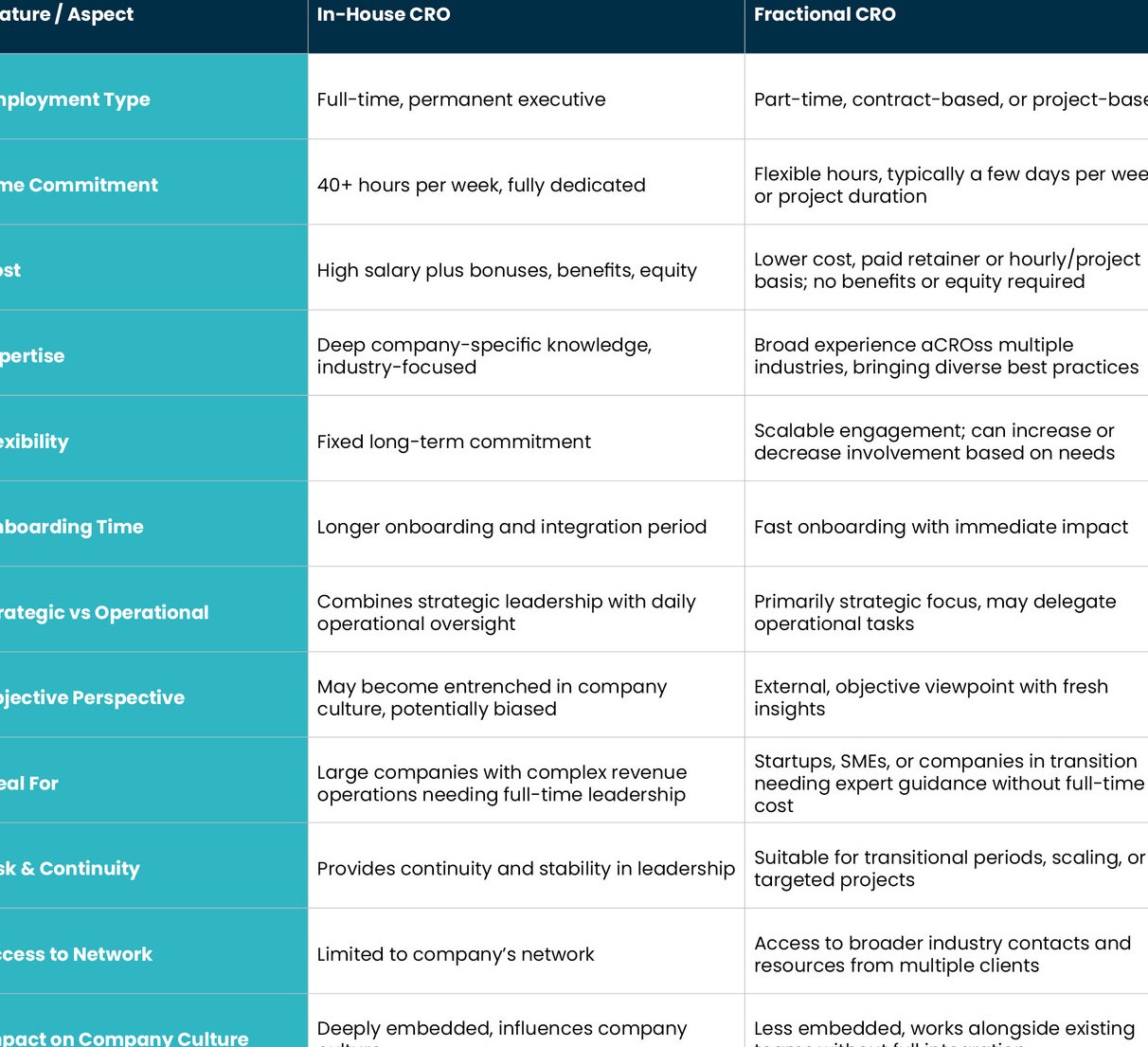
Number three: the fractional retainer. Fractional CRO engagements are typically priced as a monthly retainer scaled to the days-per-week commitment. A one-to-three-day-a-week engagement over two quarters lands well below a full-time package — but the exact figure varies enormously by market, operator seniority, and scope, so get quotes rather than trusting a range you read somewhere. The structural point holds regardless of the specific number: you are buying maybe a quarter to a half of an executive's time at something well under a full executive's cost, with no equity dilution and no severance exposure.
Number four: exposed revenue. This is the one people skip. Take your quarterly new-business number and estimate what fraction depends on executive-level involvement — deal sponsorship, forecast discipline, cross-functional arbitration. For most mid-market orgs that is meaningfully large; walk your top twenty open opportunities and mark the ones where the departing CRO was personally involved in the last ninety days. That is your exposed number. Multiply it by your honest estimate of slip probability without coverage. Then add the fully-loaded replacement cost of one or two top reps.
Run those four numbers and the decision usually stops being close. The fractional retainer is a known, bounded, cancellable cost. The vacancy exposure is a probabilistic loss with a long tail and no cap.

A useful threshold. The clearest fit is a company at roughly $10M in revenue and up, or any organization carrying a board-watched forecast. Below that line, a strong VP of Sales or a hands-on founder can often hold the function for a quarter and the fractional cost may genuinely outweigh the risk. The exception below $10M: if the departing leader personally owned relationships or forecast discipline nobody else can replicate, size doesn't save you.
The option-value argument. The real alternative to interim coverage is often a rushed permanent hire made under the pressure of an empty seat. A bad CRO hire is among the most expensive mistakes a revenue org can make — a year of lost momentum, severance, a second search, and a team that has now watched two leaders leave. Paying for interim coverage so you can run a patient, rigorous search is cheap insurance against that far larger error. That is the strongest financial case for fractional interim leadership, and it has nothing to do with the retainer versus salary comparison everyone leads with.
Pitfalls, and the specific structures that prevent them
The interim quietly becomes permanent. The most common failure mode. The operator settles in, the search loses urgency because the pain went away, and eighteen months later you are paying a retainer with no permanent leader and a team that has stopped asking. Prevent it with a named exit trigger in the contract: "through the onboarding of the permanent CRO, with a two-to-four week overlap." Tie any success bonus to a clean transition, explicitly *not* to length of tenure. If the incentive rewards duration, you will get duration.
The interim becomes a candidate by drift. Sometimes the fractional operator turns out to be great and everyone starts wondering. That can work — but only if it was agreed explicitly at the start. Left ambiguous, it corrupts the whole structure: the interim has an incentive to slow-walk the search, and every finalist they interview is a competitor. The clean default is that the fractional supports the search — helps build the scorecard, interviews finalists, gives a read — but is not a candidate.

Part-time rates for full-time expectations. Write down which days, which meetings, and which decisions are in scope. An interim expected to be reachable five days a week at a fractional retainer will either burn out or quietly deprioritize you for another client. Both outcomes are bad and both are avoidable with a one-page scope document.
The interim reorganizes. Tempting, especially for an operator who sees an obvious structural problem. Resist it. Territory redesigns, comp overhauls, and re-orgs are decisions the permanent CRO has to live with and should therefore make. An interim who re-orgs is spending capital they will not be around to repay. The correct move is to *document* the recommendation and hand it to the successor with the reasoning attached — which is genuinely valuable and costs nobody anything.
Nobody owns the handoff. A clean handoff is arguably the single biggest predictor of whether the permanent hire succeeds in their first two quarters. Yet it is usually left informal because the interim is already mentally gone and the new CRO is drinking from a firehose. Make it a deliverable: a written state-of-the-org document covering pipeline, team assessment, open issues, key relationships, and the decisions deliberately deferred. Make final payment contingent on it if you have to.

The internal candidate gets bruised. If your VP of Sales was a plausible successor and you bring in an outsider over them, you have sent a message whether you meant to or not. Handle it directly: tell them where they are, what the gap is, and what would close it. A good fractional interim can actively mentor that person — which turns a demotivating moment into an accelerated development plan and often produces the next CRO internally two years later.
RevOps gets orphaned. If RevOps reported into the departing CRO, that team suddenly has no executive advocate at exactly the moment when clean data and reliable reporting matter most. Make sure the interim explicitly picks up that reporting line rather than letting it float to whoever has capacity. An unowned RevOps function during a leadership gap is how you end up with a forecast nobody trusts, which is the failure mode that started this whole list.
The board is under-communicated. Investors read silence as concealment. A short weekly or biweekly note from the interim — forecast status, search status, anything material — costs twenty minutes and buys enormous patience. It also, incidentally, makes the interim's value legible, which matters when it is time to justify the retainer.
Selection checklist: choosing and contracting the right operator
Once you have decided to hire, the selection criteria are narrower than a permanent search and much more specific. You are not optimizing for cultural fit over five years. You are optimizing for speed of comprehension and clean exit.

Have they held the CRO title before, in a comparable motion? Comparable matters more than impressive. Someone who ran a $200M enterprise field sales org may struggle in a PLG-inflected mid-market business with a two-week sales cycle, and vice versa. Ask them to describe your motion back to you in the first conversation. If they can't, they will spend the first month learning it, and you do not have a month.
Have they done an interim engagement before? Interim is a distinct skill from permanent leadership. It requires making decisions without complete context, building trust with a team that knows you are temporary, and — hardest of all — deliberately not doing the things you would do if you were staying. Ask directly: "Tell me about an interim engagement that ended well, and one that didn't." The answer to the second question is the informative one.
Can they read your pipeline in one sitting? Give a serious finalist a redacted pipeline export and your comp plan. Ask what they see. A strong operator will come back with specific observations — deals miscategorized as commit, a discount pattern clustering at quarter-end, a stage conversion that breaks down between demo and proposal. A weak one will come back with a framework.

Do they have references from a handoff? Ask to speak to the *permanent* CRO who succeeded them, not just the CEO who hired them. That reference tells you whether the exit was clean, whether the documentation was real, and whether the incoming leader inherited a running function or a repair job.
Is their availability real? Fractional operators often carry two to four clients. Ask how many, and what the other engagements demand. A fractional carrying four clients and offering you three days a week is either overcommitted or about to be.
What goes in the contract, minimally: specific days and named meetings in scope; the scope of decision authority, including what is explicitly out of bounds; the KPIs they own; an exit trigger tied to the permanent hire's onboarding; a two-to-four week overlap; a clause stating whether they are a candidate for the permanent role; and a written handoff deliverable as a condition of final payment.
One adjacent note on sequencing. If you are also running a search for a CMO or a VP of Sales at the same time, do not stack two interims. Bring in one revenue leader with a broad enough remit to hold both seams temporarily, and stagger the permanent searches. Two part-time outsiders arbitrating between each other's functions is worse than one with a wider brief.
Related questions
How long does a CRO search actually take end to end?
Three to six months from kickoff to signed offer is typical, plus thirty to sixty days of notice and another thirty to sixty before the hire is genuinely productive. Budget two to three quarters of reduced leadership capacity, not one.
Should I promote my VP of Sales to interim CRO instead?
Sometimes — it is a legitimate audition and costs nothing extra. But a board-watched gap is a high-stakes place to run an experiment. A fractional operator can cover the risk today while mentoring that VP toward readiness for a future promotion.
What is the difference between a fractional CRO and a consultant?
A consultant diagnoses and recommends. A fractional interim CRO owns the number, manages the team, sits in the forecast call, and sponsors deals. Ownership versus advice — and it changes the contract, the cadence, and the price entirely.
Can this model work for a company under $10M in revenue?
Yes, when the departing leader held relationships or forecast discipline nobody else can replicate. Otherwise a founder or strong VP of Sales can usually hold a quarter, and the retainer may not clear the risk it offsets.
What KPIs should an interim revenue leader own?
Forecast accuracy against commit, current-quarter attainment, pipeline coverage ratio, at-risk deal recovery, and voluntary sales attrition. Notably not long-horizon metrics they cannot influence in two quarters — those belong to the permanent hire.
FAQ
How is a fractional CRO different from an interim CRO?
"Interim" describes the purpose — bridging a leadership gap — while "fractional" describes the time commitment, part-time rather than full-time. Most interim engagements are fractional, but a large company in crisis might hire a full-time interim CRO instead. For a normal mid-market search, the fractional interim model gives you genuine ownership of the number and the team without a full executive salary or equity grant.
Will hiring a fractional CRO slow down my permanent search?
It should do the opposite. Removing the pressure of an empty seat lets you run a patient, rigorous search rather than settling for the best available candidate in week six. The risk to watch is the engagement becoming permanent through inertia — the pain goes away, urgency fades, and the search quietly stalls. Prevent it by writing an exit trigger tied to the permanent CRO's onboarding into the contract on day one, and by keeping the search on its own reporting cadence to the board.
Can a fractional interim CRO also be a candidate for the permanent role?
Only if everyone agrees explicitly at the start. Left ambiguous it corrupts the incentives: the interim may deprioritize the search or subtly shape the scorecard around their own profile, and every finalist becomes a rival they are asked to evaluate. The cleaner default is that the fractional supports the process — helping build the scorecard and interviewing finalists — but is not in the running.
What should the interim be explicitly forbidden from doing?
Territory redesigns, comp plan overhauls, and re-orgs. These are decisions the permanent CRO has to live with for years and should therefore make. An interim who reorganizes is spending political capital they will not be around to repay and handing their successor a structure they did not choose. The right move is to document the recommendation with reasoning and pass it forward.
How quickly should a fractional CRO be productive?
Faster than a permanent hire, by design. Experienced interim operators skip the ninety-day listening tour: they read the pipeline, comp plan, and forecast within the first two weeks and start unblocking deals immediately. A good one is protecting the current-quarter number by the end of the first fortnight and drafting the handoff document by the end of the first quarter.
What happens to RevOps during the gap?
Make sure the interim explicitly picks up that reporting line rather than letting it float to whoever has capacity. RevOps loses its executive advocate exactly when clean data and reliable reporting matter most, and an orphaned RevOps function is the fastest route to a forecast nobody trusts — which is the problem the interim was hired to solve in the first place.
Sources
- Harvard Business Review — leadership transitions and executive onboarding
- SaaStr — hiring VPs of Sales and revenue leadership
- Bessemer Venture Partners — State of the Cloud benchmarks
- OpenView Partners — SaaS benchmarks and go-to-market data
- Korn Ferry — executive compensation and search market insights
- Pavilion — revenue leadership community and executive resources
- First Round Review — hiring and onboarding executives
- Chief Outsiders — fractional executive engagement models
- McKinsey & Company — leadership transitions research
Related on PULSE
- [Should I Hire a Fractional CRO If I Need Interim Coverage During a Medical Leave in 2027?](/knowledge/tl0596)
- [Should I Hire a Fractional CRO If I Acquired a Company and Need to Cross-Sell in 2027?](/knowledge/tl0579)
- [Should I Hire a Fractional CRO If I Need to Rebuild Trust After a Failed CRO in 2027?](/knowledge/tl0592)
- [Should I Hire a Fractional CRO If I Need to Fix Attribution Before Raising in 2027?](/knowledge/tl0584)
- [Should I Hire a Fractional CRO If I Need a 30-60-90 Plan Before a Board Meeting in 2027?](/knowledge/tl0581)
- [Should I Hire a Fractional CRO If I Need to Build a Partner Channel in 2027?](/knowledge/tl0570)
This page will be disappearing soon. Save it to your device for $1 — or read it free while it is here.
@Kory-White- · if Venmo asks, the last 4 of my number are 2012
 pulse-toolsWhere do I find a fractional VP of Sales in Delaware?
 pulse-toolsWhere do I find an outsourced CRO in Palo Alto in 2027?
 pulse-toolsShould I Hire a Fractional CRO If I Need to Build a Partner Channel in 2027?
 pulse-toolsHow do I find a fractional CRO in Bridgeville in 2027?
 pulse-toolsWhere do I find an interim CRO in Jersey City in 2027?
 pulse-toolsHow do I find a fractional CRO in Plantation in 2027?
 pulse-toolsShould I Hire a Fractional CRO If I Need to Fix Broken Lead Routing and Handoffs in 2027?
 pulse-toolsFractional CRO vs Full-Time CRO: When Do I Make the Switch in 2027?
 pulse-toolsWhere do I find a fractional head of revenue in Georgia?
 pulse-toolsHow much does a part-time CRO cost in Baton Rouge in 2027?