
Should I Hire a Fractional CRO If I Am Launching Outbound for the First Time?
 Curated byKory White · Fractional CRO · Maryland
 PULSEKNOWLEDGE LIBRARY
Quality
Certified

For most first-time outbound launches, a fractional CRO is premature. Validate the channel yourself first — founder-led calls until you close a handful of deals — then hire senior help to systematize what worked. The exception is a technical founder selling a complex, high-ACV product into a small buyer community, where early mistakes are expensive and reputational.
The job a fractional CRO is actually hired to do
A fractional Chief Revenue Officer is a senior revenue leader who works part-time — commonly one to three days a week — across a small portfolio of companies on a monthly retainer instead of a salary-and-equity package. In a mature organization the title covers the entire revenue engine: sales, marketing alignment, RevOps, forecasting, pricing, territory design, and compensation. When the company in question has never run an outbound motion, that scope collapses to something much narrower, and understanding the collapse is most of the decision you are trying to make.
In a first-outbound context, a good fractional CRO does four things. First, they define the ideal customer profile with enough precision that a list-builder can act on it — not "mid-market SaaS" but "Series B through D companies, 150 to 600 employees, running a specific stack, where the VP of Support owns the budget." Second, they design the motion itself: which channels, how many touches, over how many days, with what offer and what qualification bar. Third, they build the measurement scaffolding so you can distinguish a broken motion from an underfed one — a sequence with a 0.4% reply rate and a sequence that only reached forty people are different problems with different fixes, and without instrumentation they look identical. Fourth, they hire and ramp the first one or two reps who will actually run the thing.
What they are explicitly not doing is dialing sixty times a day. This is the trap founders walk into with their eyes open: they retain a strategist and then quietly expect that person to also be the individual contributor generating meetings. Three months later nobody is happy, the retainer feels expensive, and the motion is half-built because the strategist spent their days doing rep work. If you need someone to run the plays, hire a rep or an agency. If you need someone to design the plays and the org that runs them, that is the fractional CRO. Conflating the two is the single most common reason these engagements fail, and it fails in a way that looks like a people problem when it was actually a scoping problem.
The engagement structure carries the same signal. Healthy arrangements are three to twelve months with a named mandate and a handoff — "stand up outbound, hire and ramp one SDR, hand a documented playbook to a full-time leader by end of Q3." An open-ended retainer with no exit criteria is a warning sign, because the entire value of *fractional* is temporary senior leverage, not a permanent part-time seat that quietly ossifies into a line item nobody re-examines.
There is a related role worth separating out here, because titles blur. A fractional VP of Sales owns the sales motion specifically — reps, pipeline, quota, coaching. A fractional CRO owns that plus marketing alignment and the RevOps layer underneath. For a pure first-outbound problem, the VP-shaped mandate is often the better fit and sometimes the cheaper one. Buy the scope, not the title.
How the role fits the RevOps stack around it
The reason a fractional CRO can look either brilliant or wasteful is that their output depends heavily on what already exists beneath them. Outbound is not a standalone activity; it sits on top of a data layer, a systems layer, and a reporting layer, and a senior leader parachuting into a company with none of those spends the first six weeks building plumbing instead of designing strategy — at strategist rates.
Before the engagement starts, four things should exist in some form. A CRM with a clean object model — accounts, contacts, opportunities, and a stage definition somebody can actually explain. A sequencing tool wired to that CRM so activity logs automatically rather than through a weekly spreadsheet import. A data source for contacts, whether that is a paid provider or a manually built list. And a definition of what counts as a qualified meeting, agreed before the first email goes out rather than argued about after the first no-show.
None of that requires a CRO. A competent RevOps contractor or a technically comfortable founder can assemble it in two to three weeks. Doing so first is the cheapest possible way to increase the value of any senior hire that follows, because it means their calendar goes toward judgment calls rather than field mapping.
The downstream half of the stack matters just as much and gets ignored more often. Outbound that works creates load elsewhere: more demos on AE calendars, more security questionnaires, more onboarding volume, more support tickets ninety days later. A revenue leader who designs a motion without checking whether the delivery side can absorb the wins has built a machine that generates churn. This is the sort of second-order thinking that justifies senior pay — and equally, it is the sort of thinking a founder who has personally handled every customer conversation already does instinctively, which is part of why founder-led selling is not a phase you buy your way past.
There is an adjacent scenario worth naming: companies that already run inbound or product-led motions and are adding outbound as a second channel. That situation is meaningfully easier, because the data layer exists, conversion benchmarks exist, and the ICP has real evidence behind it. Adding outbound on top of a working inbound engine is a bolt-on, and a fractional leader has a much shorter runway to value there — sometimes eight weeks instead of six months. The hard version of this question is the cold start, where nothing has been proven and every assumption is still an assumption.

Pricing, engagement models, and what the money buys
Fractional CRO pricing varies widely by geography, scope, and the operator's track record, so treat any figure as illustrative rather than a quote. The shape of the market is consistent even where the numbers are not. Light advisory arrangements — a few hours a month, a standing call, review of your sequences and pipeline — sit at the low end, typically a few thousand dollars monthly. Hands-on engagements where the person is in your systems multiple days a week, building sequences, running hiring loops, and sitting in on calls, run into the low-to-mid five figures monthly. The variables that move price are days per week, whether they are building versus advising, and whether they have done your specific motion before.
Three structures show up in practice. A retainer buys a fixed number of days per month and is the most common; it is predictable for both sides and works well when the mandate is broad. A project fee buys a defined deliverable — an ICP document, a playbook, a hired and ramped SDR — and suits companies who want a specific artifact rather than ongoing presence. A retainer plus milestone bonus ties part of the fee to outcomes like first qualified meetings booked or a rep hitting ramped quota; strong operators are usually comfortable with this because they trust their process, and reluctance to accept any outcome linkage is itself informative.
Equity sometimes enters the conversation, usually as a small advisory-sized grant on a short vesting schedule. Be careful here. A meaningful equity grant to a part-time person before you have proven the motion is exactly the dilution a fractional arrangement is supposed to avoid. Cash for a defined period, with the option to convert to full-time later if it works, keeps the decision reversible — and reversibility is the entire point at this stage.

The ROI question is where founders reason badly, because they benchmark the CRO against pipeline generated in the first quarter. That is the wrong yardstick for a first-outbound motion. The output you are buying is a working, documented, transferable motion — not this quarter's bookings. At the end of the engagement you should own: a validated ICP with evidence behind it, a sequence booking meetings at a defensible rate, a written qualification framework, a comp plan for the reps, and a hire who can run all of it without the CRO in the room. If those exist, the engagement paid for itself even when the raw pipeline number was modest, because you own an asset that compounds. If pipeline was large and it evaporated the week they left, you rented a producer and learned nothing.
A useful comparison is total first-year cost against what you own at the end. A full-time CRO carries salary, benefits, ramp risk, and meaningful equity, and is difficult to reverse if the fit is wrong — a bad senior hire costs six to nine months even when everyone behaves well. A fractional CRO costs cash only, for a bounded window, and is designed to end. An SDR plus an hourly advisor is the cheapest of the three but pushes strategic responsibility back onto the founder, which is fine if the founder has commercial instincts and catastrophic if they do not. Match the shape of the spend to the shape of the uncertainty.
One more cost people forget: your own time. Any senior hire consumes founder hours in context transfer — customer stories, competitive history, product roadmap, why the last three deals died. Budget four to six hours a week for the first month. An engagement where the founder is too busy to supply context produces generic strategy, and generic strategy at five figures a month is the most expensive way to learn nothing.

Evaluating and shortlisting the right operator
The market for fractional revenue leadership is full of people who held a senior title once and are between full-time roles. Some are excellent; some are consultants with a better title. The screening job is to tell them apart before you sign, and the questions that do it are unglamorous.
Ask what they built at their last engagement that still runs. This is the single highest-signal question, because it separates people who produced durable systems from people who produced activity. A real answer sounds like: "I built the ICP scoring model and the three-sequence library, hired the first two SDRs, and the playbook is still what that team runs eighteen months later." A weak answer is a list of things they advised on.
Ask for the specific numbers from a motion they stood up cold. Not "we grew pipeline 3x" — reply rates, meetings per hundred contacts, show rates, opportunity-creation rates, and how those changed between month one and month four. Operators who have genuinely built outbound remember these numbers because they stared at them weekly. People who supervised from a distance produce round percentages and vague timeframes.

Ask about a motion that failed and what they concluded. The useful version of this answer names a specific wrong assumption — targeted the wrong persona, priced the offer wrong, built for a buying committee that did not exist — and describes how they detected it. Anyone who has run enough outbound has killed a sequence they were confident about. Someone with no failure story either has thin reps or is managing your impression.
Check whether their experience matches your motion's shape, not just its industry. Selling a $2,000 annual product at volume and selling a $200,000 platform to a buying committee are different disciplines that happen to share a word. Someone who has only ever run high-velocity SMB outbound will design sequences that read as spam to an enterprise buyer, and someone who has only run enterprise will build a process too heavy to survive at volume. Industry familiarity is nice; motion-shape familiarity is the requirement.
Ask how many other clients they carry and how the days are allocated. Three to four clients is normal. Beyond that, calendar math gets hard, and you should ask directly what happens when two clients have a crisis in the same week. Ask about their handoff record — how many engagements ended cleanly with a full-time replacement running the motion, versus quietly extending year over year. Repeated open-ended extensions are not always a bad sign, but they are always worth a question.
Finally, structure a paid trial before the full engagement. Two to four weeks, a defined deliverable — an ICP document and a first sequence set, say — at a proportional fee. You learn how they think, how they write, how they handle pushback, and whether they actually do the work or narrate it. Any operator confident in their value will take a paid trial. It is the cheapest insurance available in this entire decision, and it converts a hiring gamble into a small purchase.
A decision framework you can run in an afternoon
The decision resolves cleanly against three variables: how much validated signal you already have, how expensive your mistakes are, and whether the founder can credibly do the strategic work themselves.
The strongest case for a fractional CRO as your first real go-to-market hire is the technical-founder-plus-complex-sale combination. If two engineers are selling a six-figure platform into mid-market IT departments, a badly designed first motion does not just waste spend — it burns reputation inside a small buyer community where the same few hundred accounts talk to each other at the same conferences. In that world, senior judgment is cheap insurance. They will get positioning right, keep you from spraying a generic sequence at named accounts that deserved a considered approach, and set a qualification bar that fills the calendar with real opportunities instead of tire-kickers.

The weakest case is high-volume, low-ACV SMB outbound where the founder already has commercial instincts. When success is fundamentally a numbers-and-messaging game, a CRO is overkill. You need volume, fast iteration on copy, and somebody dialing — none of which is a CRO's job. The money goes further on a rep, decent data, and tooling. Strategic judgment compounds at scale; at the "does anyone want this" stage it is cheaper bought as a handful of advisory hours than as a monthly retainer.
The premature-hire failure mode deserves naming plainly: hiring before you have closed a single deal through founder-led selling. If you cannot yet articulate who buys, why they buy, and what objection killed the last three deals, there is nothing to systematize. The first two months go to discovery you should have done yourself for free, and you will have paid strategist rates for founder-level learning. Founder-led sales is not a phase seniority lets you skip — it is the raw material seniority later refines.
Assuming you decide yes, four scoping rules separate a great engagement from an expensive disappointment. Write a time-boxed mandate that names deliverables and the handoff; the exit condition is the most important sentence in the contract. Give them real authority over the narrow domain and stop overriding calls — if you validated enough to bring in senior help, you validated enough to let them design the motion. Make knowledge transfer an explicit deliverable, so every play and qualification rule lands in a document your team owns rather than in their head. And watch leading indicators over bookings in the first sixty to ninety days; revenue is lagging and noisy that early, while reply rates, meetings per hundred contacts, show rates, and opportunity-creation rates tell you within weeks whether the motion is alive.
Alternatives worth choosing instead
The fractional CRO is one point on a spectrum, and for many first-outbound situations a cheaper point serves better.

Founder-led outbound is the default starting point and the one most companies skip too quickly. Before you pay anyone, the founder should personally run outbound long enough to close the first several deals. This is not a cost-saving compromise — it generates the raw material any later hire needs. Founders learn the real objections, the language buyers actually use, and which segments convert, and that learning does not exist until someone does it. Hiring a CRO to skip it is hiring an editor before writing the draft.
An SDR plus an hourly advisor is the sweet spot for high-volume, lower-complexity motions. Execution capacity from the rep, periodic senior sanity-checks from an advisor at a few hours a month. It costs a fraction of a full retainer and works well when the motion is more about volume and iteration than deep strategic design.
An outbound agency stands up a motion fast when speed beats ownership, but the trade is real: agencies rent you a motion rather than build you a capability, and when you stop paying, pipeline usually stops too. Best used as a bridge to prove the channel works while you decide whether to build in-house — not as a permanent arrangement.

A fractional RevOps contractor is the underrated option. Frequently the actual bottleneck is not strategy but plumbing: no clean CRM, no attribution, no way to see which sequence produced which meeting. Fixing that is a fraction of a CRO retainer and makes every subsequent decision better-informed. If your diagnosis is "we cannot tell what is working," you have an instrumentation problem, not a leadership problem.
A full-time VP of Sales or CRO is right once you have a repeatable motion and are hiring to scale a team around it. Before repeatability, a full-time senior hire is expensive, dilutive, and often mismatched — the person great at scaling a proven motion is frequently not the person great at inventing one from nothing.
The through-line: match the seniority and permanence of the hire to the stage of the motion. Early and unproven wants cheap, fast, and reversible. Proven and scaling wants senior, permanent, and equity-aligned. The fractional CRO occupies the middle — validated enough to systematize, not yet proven enough to scale — and that middle band is narrower than founders who over-hire into it tend to assume.
Related questions
How much does a fractional CRO cost per month?
Retainers commonly range from a few thousand dollars for light advisory work to low-to-mid five figures monthly for hands-on, multi-day-per-week engagements. Price scales with days per week, whether they build or merely advise, and their track record with your specific motion shape.
Should a technical founder hire a fractional CRO before their first sales rep?
Often yes, when the founder lacks go-to-market instinct and the sale is complex or high-ACV. The CRO designs the motion and hires the rep, so seniority arrives before headcount rather than after it.
What is the difference between a fractional CRO and a sales consultant?
A fractional CRO owns the revenue function and executes a mandate — designing the motion, hiring, building the org. A consultant advises and recommends but does not own outcomes or make hiring calls.
How long should a fractional CRO engagement last?
Typically three to twelve months with a defined handoff. The value of fractional is temporary senior leverage; an open-ended retainer with no exit criteria defeats the purpose and usually signals scope creep.
Can a fractional CRO run outbound themselves?
No, and expecting it is the most common misuse. They design the motion, build measurement, and hire the reps who execute. Asking a strategist to also dial sixty times a day wastes the retainer.
FAQ
Is a fractional CRO worth it before product-market fit?
Usually not. Before PMF you are still discovering who buys and why, and that discovery is founder work nobody can do for you. A fractional CRO systematizes a motion that exists; when none exists, there is nothing to systematize. The exception is a technical founder facing a complex, high-stakes sale where early mistakes carry real reputational cost in a small buyer community.
What should I measure to know if the engagement is working?
In the first sixty to ninety days, watch leading indicators — sequence reply rates, meetings booked per hundred contacts, show rates, opportunity-creation rates — rather than closed revenue, which is lagging and noisy that early. At the end of the engagement the real deliverable is a documented, transferable motion plus a hire who can run it without the CRO present.
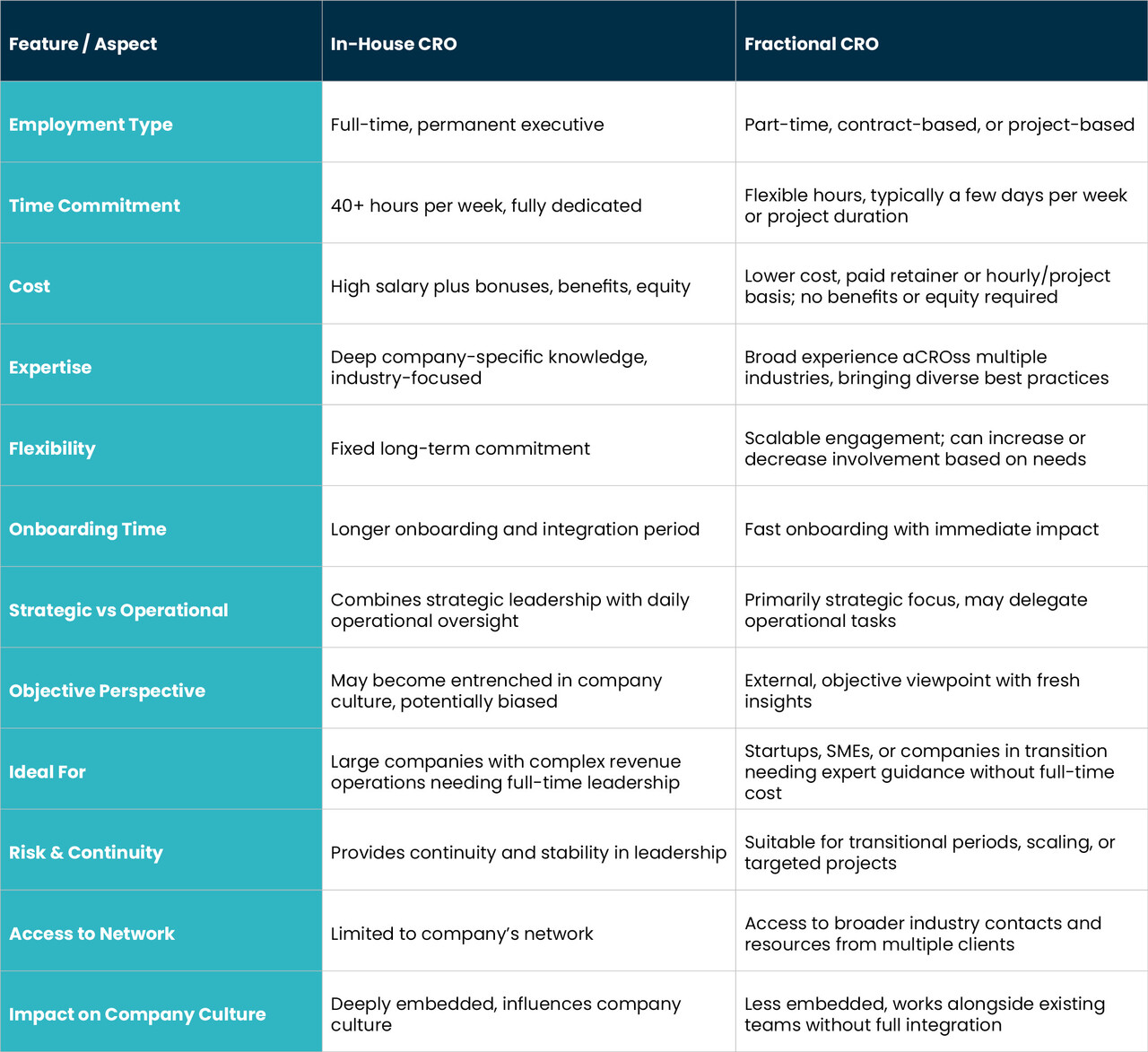
How is a fractional CRO different from a full-time CRO?
A fractional CRO works part-time across several companies on a retainer, with little or no equity, against a fixed mandate. A full-time CRO is a salaried executive with meaningful equity and permanent ownership of the revenue function. Fractional fits the validate-and-systematize stage; full-time fits the scale-a-proven-motion stage.
Will a fractional CRO hire my sales team for me?
Yes, and hiring and ramping the first one or two reps is among the highest-value things they do. They know what a strong early-stage SDR or AE looks like, how to structure comp for an unproven motion, and how to ramp someone into a playbook they just wrote. You make the final call; they run the process.
Do I need a fractional CRO or a fractional VP of Sales?
For pure first-outbound work, a sales-focused leader is frequently the closer fit and sometimes cheaper. A CRO owns the whole revenue engine including marketing alignment and RevOps; if the need is specifically standing up an outbound sales motion, buy that narrower scope. Define the work first, then find the person whose experience matches it.
Is outbound even the right first channel to build?
Not always, and it is worth settling before any hire. If your buyers do not respond to cold outreach, or inbound and product-led motions fit your market better, standing up outbound first may be the wrong bet regardless of who runs it. Prove you can book a meeting or two before investing in leadership to scale the channel.
Sources
- First Round Review — sales and go-to-market guidance for early-stage founders
- SaaStr — when to hire sales leadership at a SaaS startup
- Harvard Business Review — building and structuring sales organizations
- Y Combinator Startup Library — how to sell as a founder
- OpenView Partners — go-to-market and product-led growth resources
- Predictable Revenue — outbound sales development resources
- Pavilion — revenue leadership community and benchmarks
- Bessemer Venture Partners Atlas — cloud and go-to-market benchmarks
- Andreessen Horowitz — enterprise go-to-market resources
Related on PULSE
- [Fractional CRO vs full-time CRO — which should I hire in 2027?](/knowledge/tl9205)
- [Should I Hire a Fractional CRO If I Am Bootstrapped and Cannot Afford a Full-Time CRO in 2027?](/knowledge/tl0377)
- [Should I Hire a Fractional CRO If I Cannot Hire a Great Full-Time CRO in My Market in 2027?](/knowledge/tl0556)
- [Should I Hire a Fractional CRO If I Am Hiring My First Sales Manager in 2027?](/knowledge/tl0586)
- [Should I Hire a Fractional CRO If I Need to Build My First Sales Playbook in 2027?](/knowledge/tl0384)
- [Should I Hire a Fractional CRO If I Am Launching a Second Product Line in 2027?](/knowledge/tl0361)
This page will be disappearing soon. Save it to your device for $1 — or read it free while it is here.
@Kory-White- · if Venmo asks, the last 4 of my number are 2012
 pulse-toolsHow do I hire a fractional VP of Sales in South Bend in 2027?
 pulse-toolsHow do I hire a fractional CCO in Roswell in 2027?
 pulse-toolsHow do I hire a fractional VP of Sales in Chicago in 2027?
 pulse-toolsHow do I hire a fractional VP of Sales in Monroe in 2027?
 pulse-toolsHow do I hire a fractional CCO in Melbourne in 2027?
 pulse-toolsHow do I hire a fractional VP of Sales in Roswell in 2027?
 pulse-toolsHow do I hire a fractional CRO in Ogden in 2027?
 pulse-toolsHow do I hire a fractional CCO in Monroe in 2027?
 pulse-toolsHow do I hire a fractional VP of Sales in Greenville in 2027?
 pulse-toolsShould I Hire a Fractional CRO If I Need to Build My First Sales Playbook in 2027?