

What should I look for in a fractional CRO in Tucson in 2027?
 Curated byKory White · Fractional CRO · Maryland
Quality
Certified

Look for a hands-on operator who compresses real revenue leadership into 10–20 hours a week: proven buying-committee multi-threading, a named qualification methodology like MEDDPICC, fluency configuring revenue-intelligence tooling, a vendor-consolidation plan, working knowledge of Tucson's talent costs and network, and a written 90-day plan with gradeable numbers.
This vs. the common alternatives
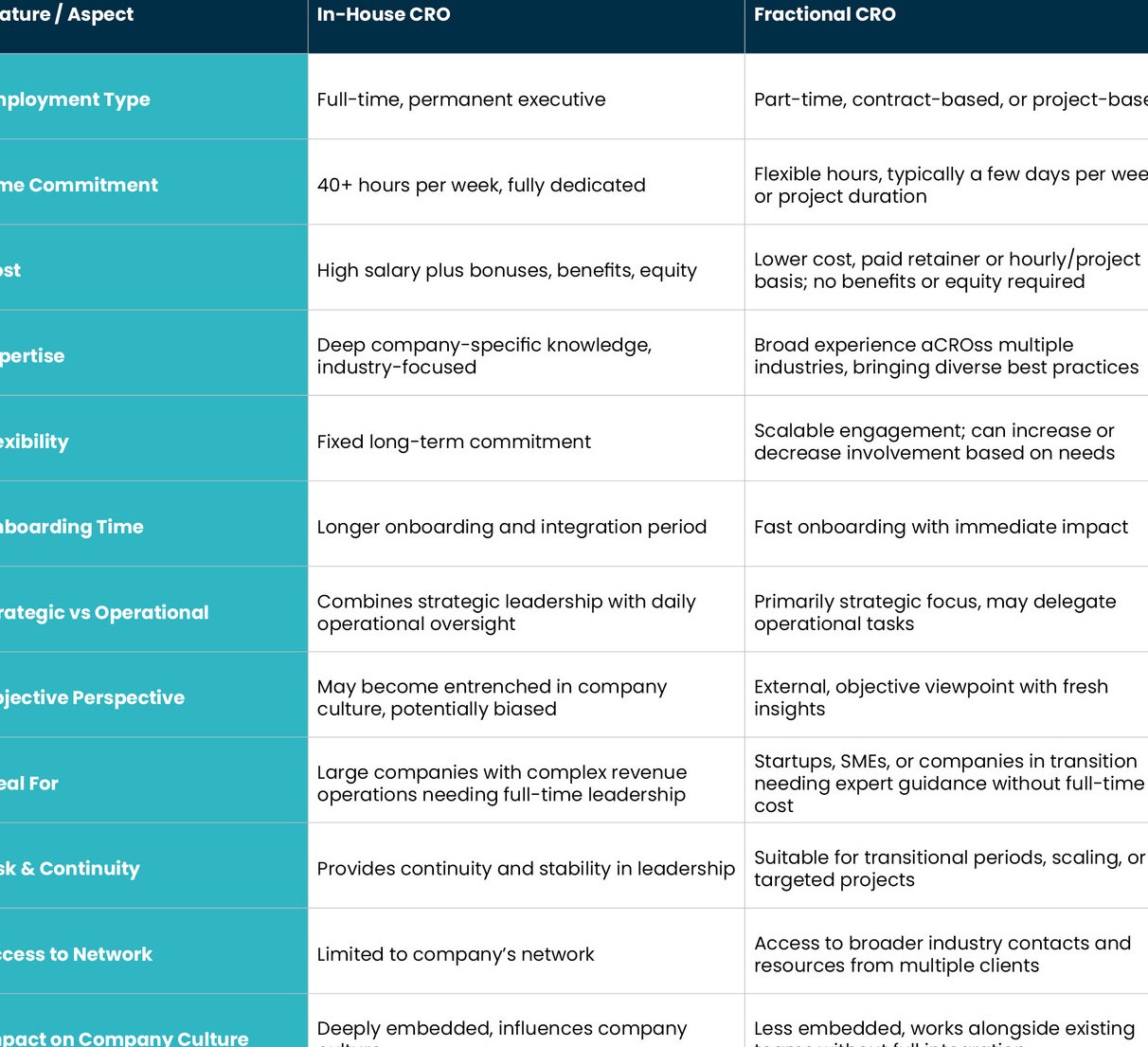
Before you evaluate any individual candidate, get honest about what you are actually buying, because most Tucson companies exploring a fractional CRO are really choosing between five different things and only one of them is a fractional CRO. The alternatives look interchangeable on a website. They are not interchangeable in what they leave behind.
A full-time CRO is the option you are implicitly rejecting. Total compensation for a real full-time revenue executive — base, variable, and equity — is a large annual commitment for a company doing a few million in revenue, and it usually arrives with a hiring cycle measured in months plus a ramp measured in quarters. Below a certain revenue floor, the math simply does not work: you would spend a meaningful chunk of new ARR on the person hired to produce it. The fractional model exists to break that chicken-and-egg problem. The trade-off is attention. A full-time CRO thinks about your business every waking hour; a fractional one thinks about it on the days they are contracted to, which means the operating rhythm has to be tighter and more explicit than it would be with a full-time hire who can absorb ambiguity by being constantly present.

A sales consultant advises. They diagnose, they hand you a deck, and the implementation burden lands back on you — which is fine if you already have a competent VP of Sales who just needs an outside read, and disastrous if you don't. The distinction that matters: a consultant is accountable for the recommendation, a fractional CRO is accountable for the number. Ask any candidate directly whether they will own the forecast. If the answer wobbles, you are talking to a consultant with better positioning.
A VP of Sales — full-time, in-seat — is often the right answer instead of a fractional CRO, and a genuinely good fractional candidate will tell you so if it's true. A VP runs the team, coaches the reps, and manages the pipeline day to day. A CRO, fractional or not, is broader: pricing, packaging, channel strategy, marketing-to-sales handoff, RevOps architecture, and the board-facing forecast. If your actual problem is "my four reps aren't hitting quota and nobody is coaching them," you may need a VP more than you need a strategist. If your problem is "I have no idea which segments are profitable, my CRM is a landfill, and I can't forecast within 40%," that is CRO-shaped work.
An agency or outsourced SDR shop solves top-of-funnel volume and nothing else. It is a supplier, not a leader. Plenty of Tucson companies buy an SDR agency, get meetings, fail to convert them, and conclude that outbound doesn't work — when the actual failure was mid-funnel qualification discipline nobody owned.
A RevOps contractor cleans your systems: CRM hygiene, reporting, routing, territory logic, attribution. This is genuinely valuable and frequently the cheaper first move. Some companies discover after ninety days of RevOps cleanup that their pipeline was never broken — their data was, and their existing leadership can operate perfectly well once the numbers stop lying to them. A candid fractional CRO candidate who hears your situation and says "spend three months on RevOps first, then call me" has just demonstrated more judgment than one who takes the engagement immediately.

The uncomfortable version of this comparison: a fractional CRO is the right answer in a narrow band — when you have real product-market fit signals, a team of roughly three to fifteen sellers, deals complex enough to need methodology, and a founder still personally closing who needs to stop. Outside that band, one of the four alternatives is usually cheaper and more effective, and the ability to say that out loud is itself a screening criterion.
How to choose between them
Choosing well means running a structured filter rather than reacting to whoever interviews best, because the failure mode here is charisma. Fractional revenue leaders are, by profession, excellent at selling. The one who tells the most compelling story in a first conversation is not reliably the one who will still be useful in month seven, and a Tucson company that hires on chemistry alone tends to discover the gap around week ten, when the honeymoon plan meets an actual quarter.

Start by diagnosing your own bottleneck before you diagnose candidates. Pull four numbers: win rate on qualified opportunities, average sales cycle in days, forecast accuracy against the last three closed quarters, and pipeline coverage against target. Those four tell you which shape of help you need. Weak coverage with healthy conversion is a demand-generation problem — an agency or a marketing hire may beat a CRO. Healthy coverage with weak conversion is a sales-execution problem, which is VP or CRO territory. Numbers you cannot produce at all is a RevOps problem, and it should be fixed before anyone builds strategy on top of unreliable data.
Then apply hard gates in sequence, cheapest filter first. Years of genuine B2B leadership in a comparable motion — someone who scaled a self-serve product will struggle in a nine-month enterprise cycle, and vice versa. Named methodology, not improvisation. Demonstrated tool configuration, not tool awareness. Buying-committee experience at the stakeholder count your deals actually involve. Willingness to be on the ground in Tucson during the build phase. A written 90-day plan with numbers attached. Each gate is binary; a candidate who fails one does not get partial credit for being likable.
Run the gates as a working session, not an interview. Give the finalist read-only access to a sanitized slice of your pipeline and ask for a two-hour teardown: which deals are real, which are zombies, what they would kill this week, what they would coach tomorrow. You learn more from watching someone reason over your actual mess than from any war story, however well told. It also surfaces the difference between an operator and a narrator within about twenty minutes.
Reference calls deserve one specific question that most people never ask. Instead of "were they good," ask: *what broke after they left?* If the answer is "nothing, the cadence stuck," you have found a systems-builder. If the answer is "honestly, things drifted back within a quarter," you have found someone who carried the org personally — which is exactly the outcome a fractional engagement is supposed to prevent, since the whole premise is that you are renting the construction of an engine rather than renting a driver forever.

Finally, weigh portfolio load explicitly. Ask how many clients they currently serve and how many hours each consumes. Someone quietly running eight engagements is selling you the residue of their week. Two to four concurrent clients is a reasonable working range for a person offering 10–20 hours to each; beyond that, arithmetic stops cooperating.
Costs, timelines, and expected impact
Pricing in this market clusters around a monthly retainer scaled to committed hours. A 10–20 hour week typically lands in the low-to-mid five figures per month, and structures vary: pure retainer, retainer plus a performance component tied to bookings or pipeline targets, or retainer plus a small equity grant when the company is early and cash-constrained. Tucson pricing tends to sit modestly below coastal rates, though the strongest operators price nationally regardless of geography, so do not assume a local discount is available or that a cheap quote signals local value — it may simply signal thin demand for that person's time.
Structure the commercial terms so you can grade the decision. A three-month trial with a 30-day opt-out is the standard protective shape, and a confident operator will not flinch at it. Most engagements that work run six to twelve months; the strongest extend to eighteen or twenty-four when the person is genuinely building rather than firefighting. Beware the open-ended monthly retainer with no defined end state — a fractional CRO who becomes permanent infrastructure has quietly converted into an expensive part-time employee with no benefits obligation and no succession plan.

Set expectations on the shape of the curve, because the first month rarely produces revenue and shouldn't. Weeks one and two are diagnosis: pipeline audit, CRM hygiene review, vendor-stack inventory, one-on-ones with every seller to find where deals actually die. Weeks three and four install machinery — qualification scoring in the CRM, a structured deal-review cadence anchored to recorded calls rather than manager memory. Weeks five through eight are execution: targeted outbound sequences, live coaching on buying-committee mapping using real open deals. Weeks nine through twelve produce a revised forecast with a defensible confidence range plus a cycle-time compression plan. Revenue impact from work started in month one frequently doesn't land until month four or five in a six-to-nine month cycle, which is precisely why you grade the leading indicators during the trial rather than waiting for closed-won.
Realistic impact ranges matter more than ambitious ones. Well-run tooling and process improvements tend to produce efficiency gains in the neighborhood of 15–25% on things like rep ramp time or administrative load — meaningful, compounding, and unglamorous. Vendor consolidation commonly reduces monthly software spend by roughly 20–30% within the first quarter, because most stacks carry redundant seats and shelfware nobody has logged into since onboarding week. Forecast accuracy landing within about ten percent of actuals after ninety days is a reasonable bar. Anyone promising doubled pipeline in thirty days is describing a fantasy, and the promise itself is the disqualifier — not because ambition is bad, but because it reveals either inexperience or a willingness to tell you what you want to hear, and you cannot afford either from someone who will own your forecast.
The Tucson cost picture cuts both ways on the team you build underneath. Entry-level SDR compensation locally runs meaningfully below Phoenix and dramatically below coastal markets, which is real leverage if your CRO knows how to recruit and develop rather than import. The University of Arizona and Pima Community College supply a steady stream of coachable entry-level talent, and a leader plugged into those channels can staff a development-first team at a genuine cost advantage. The offsetting reality is that senior sellers are thinner on the ground here, so expect any credible plan to involve a hybrid team — local juniors plus remote seniors — and expect the CRO to have an explicit answer for how they keep coaching quality consistent across that split rather than letting the remote half quietly drift.

Budget for the adjacent costs too, because they are frequently larger than the retainer surprise. A CRO who consolidates your stack may still need to add one tool you don't have — call analytics being the common gap — and may recommend a part-time RevOps analyst to sustain the hygiene work after month three. Neither is a failure of the engagement; both are normal. What is not normal is a plan that quietly requires three new platforms and two new headcount before anything improves, which usually means the person is rebuilding their last company's stack rather than solving yours.
Implementation and handoff details
The engagement's real risk is not selection — it's what happens in the seams. A fractional leader who never gets proper access, or whose decisions get quietly overruled by a founder who can't let go, will produce a lovely deck and no change. Front-load the mechanics.
Give full system access in week one: CRM admin rights, call-recording access, marketing-automation visibility, billing and renewal data, and the actual closed-lost reasons rather than the sanitized ones. Withholding data to protect a fragile narrative wastes the diagnosis window you are paying for. Establish decision rights explicitly and in writing — which decisions the CRO makes alone (pipeline stage definitions, deal review cadence, qualification standards, rep coaching plans), which need founder sign-off (pricing changes, headcount, terminations, vendor cancellations above a threshold), and which are founder-only. Ambiguity here is the single most common cause of a stalled engagement, and it is entirely preventable with a one-page RACI written before day one.

Communicate on a fixed rhythm rather than ad hoc. A weekly pipeline review, a weekly written update with the four tracked numbers, and a monthly business review with the founder or board is a sustainable cadence for a part-time leader. Ad hoc Slack access sounds flexible and reliably degrades into the fractional CRO absorbing whatever noise surfaces that day instead of doing the structural work you hired them for.
Plan the handoff from the start, not from the panic. A healthy end state transitions ownership to a full-time VP of Sales while the fractional CRO tapers into an advisory role — often a monthly review for a quarter or two — rather than disappearing on a Friday. Write the handoff artifacts into the engagement scope explicitly: documented pipeline stage definitions with exit criteria, the qualification framework as it was actually implemented in your CRM, the deal-review agenda, the onboarding path for a new seller, dashboard definitions, and the vendor decisions with reasoning attached so the next leader doesn't re-buy what was just cut. If those artifacts don't exist, the engine leaves with the person and you have rented a driver, not built a machine.
Downstream, this work reshapes more than sales. Marketing gets a real definition of a qualified lead and stops optimizing for volume nobody can convert. Finance gets a forecast it can build a hiring plan on. Customer success inherits accounts that were sold accurately rather than oversold, which shows up in renewal rates two or three quarters later. Product gets structured loss reasons instead of anecdotes. A good fractional CRO treats those adjacent functions as stakeholders rather than afterthoughts, because the RevOps layer they install — the data model, the definitions, the reporting — is shared infrastructure that every one of those teams will operate on long after the engagement closes.

Watch for the failure patterns that predict a bad quarter. Champion tunnel vision: a leader who only ever discusses the primary contact and never mentions finance, legal, IT, or procurement will let deals stall on exactly the stakeholders they ignored, and with committees of eight to twelve people common in mid-market and enterprise deals, a single unaddressed blocker can freeze a quarter. Refusal of any in-person presence, in a relationship-driven business community like Tucson's, usually correlates with someone who wants the title without the ground game — expect a serious candidate to be physically present a couple of days a week during the build phase and plugged into local professional and technology-community networks. Gut-feel qualification with no named framework means there is no repeatable system to install. And an unwillingness to be measured, this early, is the loudest signal of all: a good operator welcomes the scorecard, because measurable outcomes are how they earn the extension.
Related questions
How much should a fractional CRO in Tucson cost?
Typically a low-to-mid five-figure monthly retainer for 10–20 hours weekly, sometimes with a performance component or small equity grant. That sits well below a full-time CRO's loaded compensation, which is the core economic reason companies choose the fractional model.
Should I hire a RevOps contractor before a fractional CRO?
Often yes. If you cannot produce win rate, cycle time, and forecast accuracy on demand, your problem is data integrity, not strategy. Three months of RevOps cleanup is cheaper and makes any subsequent leadership hire far more effective.
Can a fractional CRO run a fully remote sales team?
Yes, with a disciplined weekly cadence of one-on-ones, pipeline reviews, and call-recording-anchored coaching. In Tucson, pair that remote rhythm with periodic in-person offsites, since local business culture still runs substantially on face-to-face trust.
How is a fractional CRO different from a sales consultant?

A consultant advises and hands you a plan; a fractional CRO owns execution — the forecast, the pipeline, and the reps report into them for the engagement's duration. You are buying accountability for outcomes, not a recommendation you then implement yourself.
When should I convert to a full-time VP of Sales?
When the engine is repeatable: methodology adopted, forecast reliable within roughly ten percent, deal reviews running without prompting. At that point you need daily presence more than strategic architecture, and a VP costs less than continued fractional leadership.
FAQ
What is the typical cost of a fractional CRO in Tucson?
Expect a monthly retainer in the low-to-mid five figures for 10–20 hours per week, sometimes paired with a small equity stake or a performance bonus tied to revenue targets. This generally runs well below the fully loaded cost of a full-time CRO, which is the main appeal of the model. Tucson rates sit modestly below coastal markets, though strong operators often price nationally regardless of where the client sits.
How do I verify a candidate's tooling experience rather than taking their word for it?
Ask which specific platforms they personally configured and coached a team on in the last twelve months — not used, configured. Then request a working session where they walk through a real dashboard from a prior engagement and explain which signals they acted on and what decisions followed. Someone who can only describe features is describing software they have heard of, not software they have run.

What should the 90-day plan actually contain?
Diagnosis in weeks one and two, machinery installed in weeks three and four, execution and coaching in weeks five through eight, and a rebuilt forecast plus cycle-time plan by week twelve. Every milestone needs a number attached. A plan listing "improve culture" and "align teams" with no metrics is a plan you cannot grade, which means it is a plan you cannot enforce.
How many other clients is too many?
Two to four concurrent engagements is a reasonable working range for someone offering 10–20 hours to each. Beyond that the arithmetic stops working, and your hours become whatever remains after the loudest client stops calling. Ask directly, ask for the hour split, and treat evasiveness on this question as a meaningful signal.
What metrics should I track to measure their impact?
Track pipeline velocity from lead to qualified opportunity, win rate on qualified deals, average deal size, and forecast accuracy. A reasonable early bar is forecast accuracy within roughly ten percent of actuals after ninety days, with win rate and deal size trending upward as qualification discipline takes hold and unqualified deals stop entering the pipeline in the first place.
What happens to the work when the engagement ends?
If it was done properly, the stage definitions, qualification framework, deal-review cadence, dashboards, and onboarding path all live in your systems and documentation, and a full-time VP inherits a running engine. Write those handoff artifacts into the engagement scope on day one. If they were never produced, the machinery leaves with the person.
Sources
- Gong Labs: sales research and call analytics
- Gartner: sales research and buying-committee insights
- Forrester: B2B sales and revenue research
- McKinsey: The future of B2B sales
- Harvard Business Review: sales and marketing insights
- SaaStr: go-to-market and sales leadership
- Clari: revenue intelligence platform
- U.S. Bureau of Labor Statistics: Occupational Employment and Wage Statistics
- University of Arizona: Eller College of Management
- Pima Community College
Related on PULSE
- How much does a fractional CRO cost in Tucson in 2027?
- How much does an outsourced CRO cost in Tucson in 2027?
- How much does a part-time CRO cost in Tucson in 2027?
- How much does an outsourced Chief Revenue Officer cost in Tucson in 2027?
- What should I look for in a fractional CRO in Scottsdale in 2027?
- How do I evaluate a fractional Chief Revenue Officer in the Pacific Northwest in 2027?
This page will be disappearing soon. Save it to your device for $1 — or read it free while it is here.
@Kory-White- · if Venmo asks, the last 4 of my number are 2012
This page is gone.
This one is off the shelf now. $1 keeps it on your phone for good — the whole page, pictures and diagrams included.
 pulse-toolsShould I Hire a Fractional CRO If My Reps Are Sandbagging the Forecast in 2027?
 pulse-toolsHow do I hire a fractional CRO in Iowa in 2027?
 pulse-toolsHow do I hire a fractional VP of Sales in Oshkosh in 2027?
 pulse-toolsShould I hire a fractional CRO in Bowie in 2027?
 pulse-toolsShould I Hire a Fractional CRO If I Need to Build a Partner Channel in 2027?
 pulse-toolsHow do I hire a fractional CRO in South Carolina in 2027?
 pulse-toolsHow do I hire a fractional CRO in Philadelphia in 2027?
 pulse-toolsHow do I hire a part-time CRO in Salt Lake City in 2027?
 pulse-toolsShould I Hire a Fractional CRO If I Am Preparing for a Series B in Six Months in 2027?
 pulse-toolsHow do I hire a fractional CRO in Denver in 2027?