

How do I hire a fractional VP of Sales in Indianapolis in 2027?
 Curated byKory White · Fractional CRO · Maryland
Quality
Certified

Hire a fractional VP of Sales in Indianapolis by writing a single-sentence revenue mandate, sourcing through Pavilion, RevOps Co-op, and referral networks, and paying a fixed monthly retainer for two to five days per week on a three-to-six-month contract with defined 90-day metrics and a clean off-ramp clause.
The job this role is actually hired to do
A fractional VP of Sales is not a cheaper full-time VP. That framing is the single most common reason these engagements fail in the first ninety days. A full-time VP of Sales is hired to own an outcome indefinitely — the number, the team, the culture, the recruiting pipeline, the quarterly rhythm. A fractional VP of Sales is hired to install a *system* and then leave. The deliverable is not revenue. The deliverable is the machine that produces revenue, handed to someone who will still be there in year three.
That distinction changes everything downstream: what you write in the contract, how you measure them, and whether you should hire one at all. If you cannot articulate the system you want installed, you are not ready to hire fractionally. You are ready to hire a closer, or a consultant, or nobody.
In practice, the Indianapolis engagements that work fall into a handful of recognizable jobs-to-be-done. The first is process installation at the zero-to-one stage. The founder has closed the first fifteen or twenty customers personally through relationships and force of will. Revenue exists but nobody can explain why it exists. There is no stage definition, no qualification framework, no notion of what a "real" opportunity looks like. The fractional leader's job is to reverse-engineer the founder's instinct into something a twenty-six-year-old rep can execute: written stage exit criteria, a discovery framework, a call structure, a pricing floor, an objection library sourced from actual recorded calls. This takes roughly eight to sixteen weeks at two to three days a week, and the output is a document plus the training to use it.
The second job is rep ramp and coaching. You have three to eight reps, you hired them fast, and they are producing wildly different numbers with no diagnosable reason. The founder does not have the bandwidth or the skill to run weekly one-on-ones, call reviews, and pipeline inspection. A fractional leader who is genuinely good at this will rebuild your ramp: a thirty-sixty-ninety plan per rep, a certification gate before a rep touches a live enterprise deal, weekly call scoring against a rubric, and a coaching cadence that survives their departure because you have documented it.

The third job is market or motion expansion. You sell to mid-market logistics companies and now want to sell into hospital systems, or you sell direct and want to build a channel. The motions are genuinely different — cycle length, stakeholder count, procurement, security review, pricing structure. Hiring a full-time VP for an unproven motion is an expensive bet. Hiring a fractional leader who has *run that specific motion before* is a cheaper way to find out whether the motion works before you staff it.
The fourth job is bridge leadership. Your VP of Sales left, you have six reps who need someone to run the forecast call on Monday, and a real search takes four to seven months. A fractional leader keeps the machine running, and — this is the underrated part — writes the scorecard for the permanent hire based on what they observed from the inside. That scorecard is worth more than most retained-search intake calls.
There is a fifth job that people rarely name out loud but which is extremely common: telling the founder something they will not hear from an employee. A fractional leader with no career dependency on you will say "your win rate isn't a sales problem, it's a pricing problem" or "two of these five reps will never make it." Employees hedge that. That candor is part of what you are buying, and if a candidate never disagrees with you in the interview process, you are probably buying the wrong thing.
Note what is *not* on this list: being a bag-carrying closer. Some fractional VPs will close deals for you, and in an early-stage company they usually should, at least to prove the playbook works with their own hands. But if closing is the primary job, you want a fractional AE or a commission-based partner, not a VP, and you should price it that way.
How it fits the RevOps stack around it

A fractional VP of Sales does not operate in isolation, and the most expensive mistake Indianapolis founders make is hiring one into a vacuum where no data exists. The leader spends the first month doing archaeology instead of leadership, and you pay VP rates for CRM cleanup.
Understand the layers. At the bottom sits the system of record — Salesforce or HubSpot, occasionally Pipedrive at the smallest end. Above it sits the activity and engagement layer — Outreach, Salesloft, Apollo, or plain email sequencing. Above that sits the intelligence layer — Gong, Chorus, Clari, or nothing at all. And above all of it sits the human operating rhythm: the forecast call, the pipeline review, the deal desk, the QBR.
A fractional VP of Sales works almost entirely at the top layer, the rhythm. But the rhythm only works if the layers beneath produce trustworthy data. If your opportunity stages are "Interested / Really Interested / Verbal / Closed," no leader on earth can forecast off that. If reps log calls inconsistently, activity coaching is guesswork. So the honest sequencing question is: do you need a fractional VP of Sales, or do you need a fractional RevOps person first?
The rule of thumb worth applying: if your CRM data is so unreliable that you cannot answer "what is our win rate by lead source over the last two quarters" in under ten minutes, spend four to six weeks on RevOps hygiene before or alongside the sales leadership hire. Many fractional VPs will happily do this themselves, and some are excellent at it. But you are paying a leadership rate for operations work, and a good candidate will tell you that directly rather than billing you for it silently.
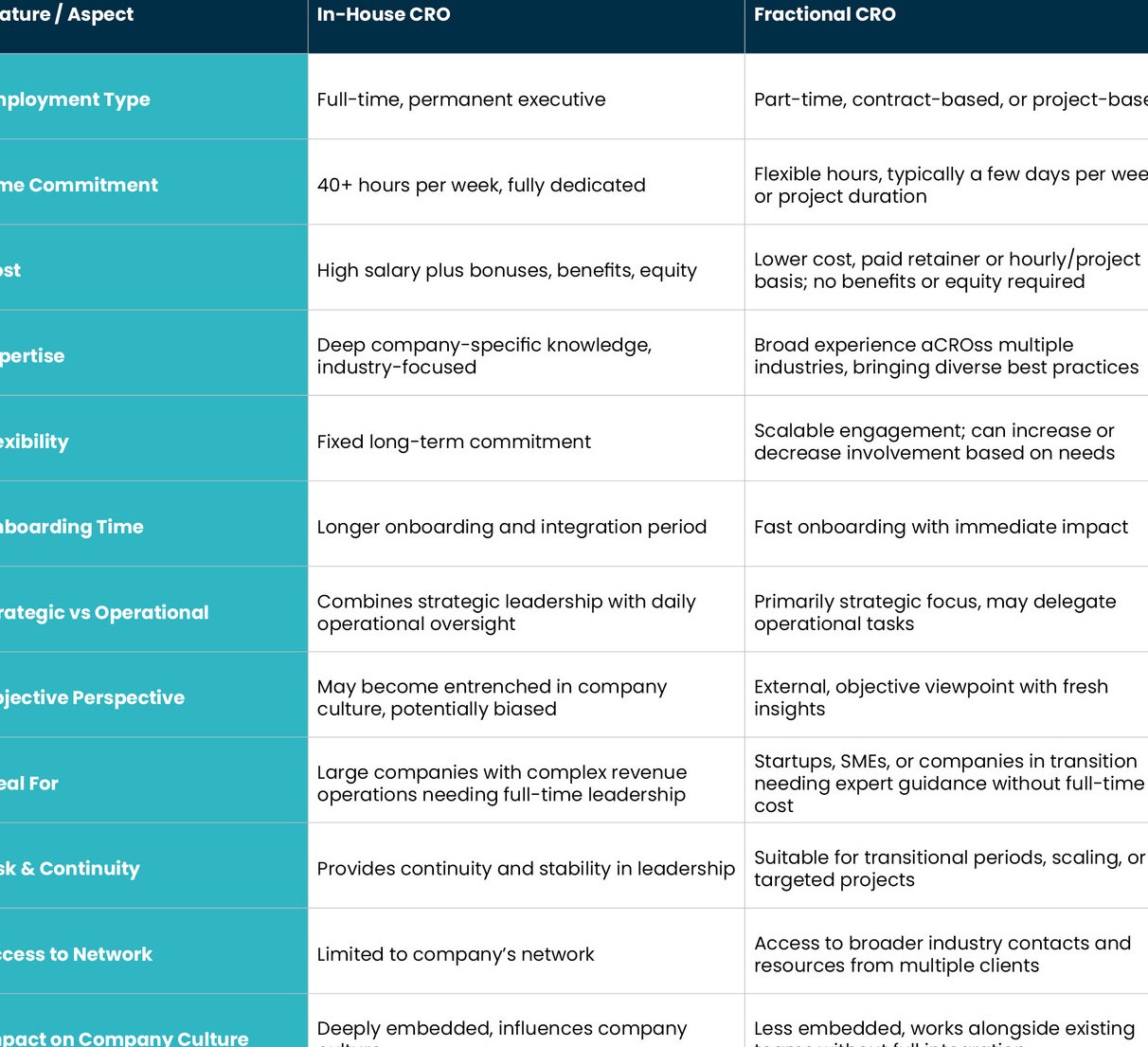
There is a related staffing question that Indianapolis companies in the five-to-fifteen-million range hit constantly: fractional VP of Sales versus fractional CRO versus fractional RevOps versus sales enablement contractor. The distinctions matter for scope and price. A VP of Sales owns the selling team and its process. A CRO owns marketing, sales, customer success, and the operations connecting them — including the handoffs where most mid-market revenue leaks. RevOps owns the systems, data, and reporting that make either job possible. Enablement owns content, training, and certification. A single fractional person can wear two of these hats at once. Nobody credibly wears four.

Downstream effects are worth planning for as well. A competent fractional leader will surface problems that live outside sales: marketing generating volume with no qualification, customer success absorbing churn caused by overselling, a pricing model that punishes multi-year deals. If nobody owns those functions, the recommendations pile up unactioned and both sides get frustrated. Decide in advance who is authorized to act on cross-functional findings — usually the founder — and put a standing thirty-minute weekly slot on the calendar for exactly that.
Pricing, engagement models, and what actually drives the number
Fractional VP of Sales pricing is not standardized, and any source that quotes you a single national figure is guessing. What *is* consistent is the structure of the pricing and the variables that move it. Understand those and you can evaluate any quote you receive.
The dominant model is a fixed monthly retainer tied to a committed number of days. Engagements typically range from roughly one day per week at the light-advisory end to four or five days per week at the near-embedded end. Two days per week is the most common shape for a company under about five million in revenue. The retainer is quoted monthly, not hourly, and the day commitment is the unit you negotiate.
Four variables move the number more than anything else. First, days per week — the obvious one, and roughly linear, though most leaders discount the marginal day because context-switching cost drops. Second, seniority and specificity of experience: someone who has run your exact motion in your exact vertical commands a real premium over a generalist, and usually earns it by compressing the diagnostic phase. Third, hands-on versus advisory: a leader who runs your Monday forecast call, sits in on deals, and coaches reps individually is doing materially more work than one who reviews a dashboard and gives you an opinion. Fourth, market: an Indianapolis-based leader typically prices below a coastal-based one for equivalent experience, which is one of the genuine advantages of hiring in this market — though the remote norm has compressed that gap considerably since 2020.

On structure, a few rules are worth holding firm regardless of who you hire:
Insist on a fixed retainer, not commission-only. A commission-only fractional VP is incentivized to chase closeable deals in the current quarter, which is the exact opposite of installing a durable process. You will get short-term revenue and no machine. If someone proposes commission-only, they are telling you they intend to sell, not lead.
Never pay a percentage of total revenue. It sounds aligned and is not. It pays the leader for revenue they had nothing to do with — your existing base, renewals, expansions closed by the founder — and creates a bill that grows without a corresponding increase in work.
A modest performance component is fine and often good. Ten to twenty percent of the retainer held against defined milestones is a reasonable structure, provided the milestones are things the leader controls: playbook delivered by week six, all reps certified on discovery by week ten, forecast accuracy within a stated band for two consecutive months. Do not tie it to a bookings number the leader cannot control in a ninety-day window.
Equity in place of cash is a real option and a real trade. Fractional leaders sometimes accept a partial equity component, often in the low single-digit percentage range depending on stage and time commitment, to reduce your cash burn. Two cautions. First, equity aligns to a multi-year outcome while a fractional engagement is a multi-month one — vest on a schedule matched to the engagement, with a cliff, not a grant on day one. Second, equity makes off-ramping messier. If your primary reason for going fractional is optionality, paying cash preserves it.
Contract length should be three to six months with a thirty-day out. Shorter than three months and you cannot judge results, because the first four to six weeks are diagnostic by definition. Longer than six months without a renewal decision and you have quietly hired a part-time employee without the accountability structure of one. Build in a defined renewal conversation at day ninety.

Budget for the second-order costs too. A fractional leader who does the job well will recommend spend: a Gong seat so call coaching is possible, a data enrichment tool, occasionally backfilling a rep who should not have been hired. Reserve something for tooling and be explicit about what authority they have to spend. The other cost is your own time — expect four to six hours a week of founder involvement in the first month. Founders who cannot commit that get proportionally less value, and it is the most common cause of a disappointing engagement.
How to evaluate and shortlist candidates
Start with sourcing, because the Indianapolis pool is smaller than a coastal one and the sourcing channel shapes the quality of what you see.
Local operator networks are the highest-signal channel. The Indianapolis chapter of Pavilion, RevOps Co-op meetups, TechPoint's community, and Indiana's startup ecosystem groups all put you in a room with people who have actually run revenue here. Referrals from other founders in the same stage and vertical are better still — ask specifically for someone who worked with a fractional leader and would hire them again, and then ask the harder question: who did they hire that they would *not* hire again, and why.
Fractional-executive networks and platforms widen the pool quickly, including groups like CRO Syndicate that assemble senior revenue practitioners. Vetting quality across these varies enormously, so treat a platform listing as a lead source, never as a completed reference check.
Your own alumni network is underused. VPs of Sales from Indianapolis-anchored companies — the life sciences and diagnostics ecosystem around Eli Lilly and Roche, the logistics and distribution corridor, the enterprise software presence downtown — often move into fractional work after an exit or an acquisition. They know the market's rhythm, its long enterprise cycles, and its relationship-first buying culture.
On the local-versus-remote question: strong fractional leaders are overwhelmingly remote-capable and many serve clients across several time zones. Requiring an Indianapolis address will shrink your pool by an order of magnitude for no proportional gain. What you should require instead is regular in-person presence at the moments that require it — quarterly team sessions, key customer visits, board meetings, and the first week of onboarding. Write the travel expectation into the contract with a specific cadence rather than a vague "as needed," and decide who pays for it.

Now the screening itself. Ignore the headline metrics on the profile. "Grew pipeline 3x" is unfalsifiable without the denominator, the timeframe, and what else changed. Ask instead:
"Walk me through the first thirty days at your last engagement — what did you look at, in what order?" A strong answer is boringly specific: pull two years of closed-won and closed-lost, interview every rep individually, listen to fifteen to twenty recorded calls, map the actual stages reps use versus the ones in the CRM, sit in on live discovery. A weak answer jumps straight to "I built a new deck" or "I redid the messaging."
"Tell me about an engagement that didn't work. What was the actual cause?" The honest answers are usually product-market fit that sales cannot fix, a founder who would not delegate, a comp plan that rewarded the wrong behavior, or a culture problem outside their authority. Someone who has never had an engagement fail either has not done many or is not telling you the truth.
"How do you handle a founder who still wants to close every deal?" This is a live question in most Indianapolis founder-led companies. The good answer involves a staged handoff — the founder stays in the room but stops running the call, then joins only at specific stages, then only for named strategic accounts — plus a plan for what to do when the founder inevitably backslides.
Ask for a written thirty-day diagnostic plan specific to your business, not a generic one. Give them a call transcript or your pipeline export with names redacted and ask what they see. This is the single highest-signal screen available, and it is where generalists and specialists separate visibly. Pay them for it if it takes more than an hour or two — a few hundred dollars for a real diagnostic is the cheapest due diligence you will ever run.

Take two references, and ask for a specific pair: one client where the engagement went well, and one where it ended early. The second call tells you far more. Ask that reference what the leader did in the last month of the engagement — whether they documented, handed off, and left the team better, or whether they simply stopped showing up.
Finally, screen for fit with the market's actual selling conditions. The dominant Indianapolis motions — enterprise health and life sciences, logistics and distribution, manufacturing, insurance, and a growing enterprise software scene — skew toward long cycles, multi-stakeholder procurement, regulated buying, and relationship-driven trust-building. A leader whose entire career is product-led self-serve SMB software will find the transition harder than their résumé suggests. Ask directly about the longest sales cycle they have personally managed and how many stakeholders were in the buying committee.
A decision framework for whether to hire at all
The most valuable section of any hiring guide is the part that tells you not to hire. A fractional VP of Sales is genuinely the wrong answer in several common situations, and recognizing yours early saves you a quarter and a five-figure sum.
Do not hire one if you have no repeatable motion. If every deal closes for a different reason, at a different price, to a different buyer persona, there is no process to install. What you have is a product or positioning problem wearing a sales costume. Founder-led selling for another two quarters, with rigorous notes on why each deal actually closed, is the cheaper path.
Do not hire one if you will not delegate. If you intend to remain in every deal, on every call, approving every discount, you will pay for an expensive advisor whose recommendations you override. Be honest about this in the interview, because the good candidates are screening you for it too.
Do not hire one to fix a demoralized or dysfunctional team. Culture repair requires daily presence, difficult conversations at unscheduled moments, and the authority to make personnel changes. Two days a week does not buy that. That is a full-time leadership problem.
Do not hire one when you actually need reps. If your process is sound and your bottleneck is capacity, hire an AE. A leader with nobody to lead is a very expensive process consultant.

Do hire one when you have a working motion you cannot yet describe, when you have reps who are underperforming for diagnosable reasons, when you are entering a genuinely new motion, when your VP just left, or when you want an experienced read on whether you are ready for a full-time leader at all.
That last case deserves its own note, because it is the highest-ROI use of a fractional engagement and the most overlooked. Retained search for a VP of Sales is expensive and slow. A mis-hire at that level costs a year of momentum plus severance plus the team damage. Three months of fractional leadership before you open the search gives you a scorecard written from inside your business, a clean-enough CRM to hand over, and often a candidate the fractional leader knows personally. Some fractional leaders will help run the search as part of the engagement — ask whether they do and whether it costs extra.
Plan the exit at the start. Every engagement should specify: what documentation exists at the end, who owns the playbook, what the handoff to an internal leader looks like, and what happens if you want to convert the fractional leader to full-time. That last one is common enough to deserve a clause — a right of first refusal with a defined conversion fee, typically around one month's retainer, keeps the conversation clean instead of adversarial.
Related questions
What should the first 30 days look like?
Data audit and interviews, not new initiatives. Expect a closed-won and closed-lost review, individual rep conversations, fifteen-plus recorded call listens, a stage-definition audit, and a written diagnostic with three prioritized recommendations by roughly day thirty.
Can a fractional VP of Sales hire and fire reps?
They can run the process — scorecard, interviews, ramp plan, performance management — but final authority normally stays with the founder or CEO. Define this explicitly in the contract; ambiguity here causes more friction than compensation ever does.
How is this different from a sales consultant?

A consultant diagnoses and recommends. A fractional VP of Sales carries an operating role: runs the forecast call, owns the number in the interim, coaches reps directly, and is accountable for adoption of what they installed, not just its design.
Should I hire fractional if I only have one rep?
Usually no. With one rep, founder-led coaching plus a strong RevOps foundation gets you further per dollar. Fractional leadership starts paying for itself around three to five reps, when consistency across people becomes the constraint.
What if I want them full-time later?
Common and often ideal — you have both effectively run a long working trial. Include a right-of-first-refusal clause with a defined conversion fee, typically about one month's retainer, so the transition is a negotiation you planned rather than one you improvise.
FAQ
What's the difference between a fractional VP of Sales and a fractional CRO?
A fractional VP of Sales owns the selling team and its process: hiring, ramp, coaching, pipeline management, forecast discipline, and deal strategy. A fractional CRO owns the full revenue engine including marketing, customer success, and revenue operations, and spends much of their time on the handoffs between those functions where revenue leaks. As a rough threshold, companies under about five million in revenue are usually best served by a VP of Sales profile; above that, when marketing and post-sale motions are large enough to conflict with each other, a CRO scope starts to make sense.
Does my fractional VP of Sales need to live in Indianapolis?
No, and requiring it will shrink your candidate pool dramatically. Most strong fractional leaders work remotely across multiple clients and time zones. What you should require is defined in-person presence at the moments that need it — onboarding week, quarterly team sessions, key customer meetings, and board updates. Write a specific travel cadence into the agreement rather than "as needed," and settle who covers expenses up front. Local familiarity with Midwest buying culture is genuinely valuable; a local zip code is not.

How do I stop paying for someone who just gives advice?
Write a statement of work with dated, verifiable deliverables rather than a scope description. Examples: CRM stages redefined and backfilled by week two, discovery framework documented and all reps certified against it by week six, ninety-day playbook delivered by week eight, forecast accuracy within a defined band for two consecutive months. Hold ten to twenty percent of the retainer against those milestones. If the deliverables are artifacts you can point at, the advice-only failure mode becomes structurally impossible.
How much of my own time will this take?
More than most founders expect. Budget four to six hours a week during the first month — onboarding context, deal history, customer introductions, and the standing weekly session where cross-functional findings get decided. It drops to roughly two hours a week after the diagnostic phase. Engagements where the founder disengages after week two are the most reliable predictor of a disappointing outcome, ahead of price, seniority, or industry fit.
What if my CRM is a mess before they start?
Assume the first three to five weeks go to cleanup, and decide consciously whether you want to pay leadership rates for it. Two reasonable paths: bring in a RevOps contractor or agency for four to six weeks before the leadership engagement starts, or accept the cleanup as phase one and write it into the scope explicitly so nobody is surprised by a month with no visible sales progress. The one option that never works is pretending the data is fine.
How do I know at ninety days whether it's working?
Judge leading indicators, not bookings — a quarter is too short for pipeline built now to close. Look for: written stage definitions that reps actually use, a forecast that has been within a stated accuracy band for two consecutive months, documented ramp and coaching cadences, a measurable shift in rep activity quality on recorded calls, and at least one thing you now know about your funnel that you did not know before. If none of that exists, exercise the off-ramp without guilt.
Sources
- Pavilion — community for revenue leaders
- RevOps Co-op — revenue operations community
- Harvard Business Review — Sales & Marketing
- First Round Review
- SaaStr
- TechPoint — Indiana's tech ecosystem organization
- SHRM — Employment Contracts and Independent Contractors
- U.S. Bureau of Labor Statistics — Sales Managers
- Gong Labs — sales research
Related on PULSE
- When to hire a full-time VP of Sales instead of a fractional one
- Fractional CRO vs fractional VP of Sales: scope and price differences
- How to write a 90-day sales playbook from scratch
- RevOps hygiene checklist before hiring sales leadership
- Building a rep ramp plan that survives leadership turnover
- Forecast accuracy: how to measure it and what good looks like
This page will be disappearing soon. Save it to your device for $1 — or read it free while it is here.
@Kory-White- · if Venmo asks, the last 4 of my number are 2012
This page is gone.
This one is off the shelf now. $1 keeps it on your phone for good — the whole page, pictures and diagrams included.
 pulse-toolsHow do I hire an outsourced CRO in San Antonio in 2027?
 pulse-toolsShould I Hire a Fractional CRO If I Need to Stand Up RevOps From Scratch in 2027?
 pulse-toolsShould I Hire a Fractional CRO If I Need to Build a Partner Channel in 2027?
 pulse-toolsShould I hire a fractional CRO in Cumberland in 2027?
 pulse-toolsShould I hire a fractional CRO in Waldorf in 2027?
 pulse-toolsShould I Hire a Fractional CRO If I Need to Build My First Sales Playbook in 2027?
 pulse-toolsShould I hire a fractional CRO in Bowie in 2027?
 pulse-toolsHow do I hire a fractional CRO in Louisiana in 2027?
 pulse-toolsHow do I hire a fractional CRO in Tulsa in 2027?
 pulse-toolsHow do I hire an interim CRO in Kansas City in 2027?