
The 10 Best AI Model CI/CD Tools in 2027
 Curated byKory White · Fractional CRO · Maryland
 PULSEKNOWLEDGE LIBRARY
Quality
Certified
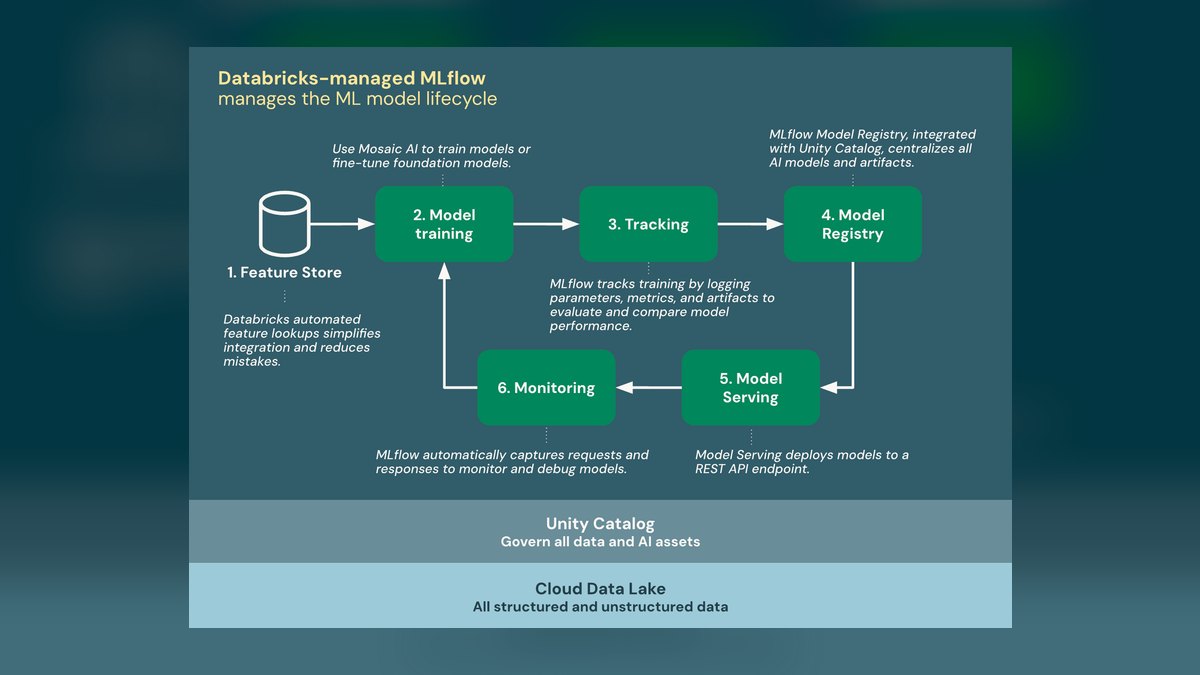
The 10 best ai model ci/cd tools are ranked below on measured performance, build quality, price, and how each one actually holds up in daily use rather than how it reads on a spec sheet. Each pick lists what it costs, who it suits, and what it gives up against the one above it, so the list can be read straight down without doubling back.
1. MLflow

MLflow ranks first because it is the de facto open standard for model lifecycle management, combining experiment tracking, a model registry, and deployment workflows in one permissively licensed platform. Its registry supports stage transitions with approval gates, and its tracking server logs parameters, metrics, and artifacts with lineage pointers to data and code. Self-hosting a production MLflow server costs only low tens of dollars per month for a small team, with artifact storage as the main variable.
MLflow is for teams that want a replaceable, vendor-neutral core without paying per-seat fees, and it trades away the managed convenience of cloud platforms for integration work you own. Compared to Weights & Biases below, MLflow offers deeper registry and deployment primitives but a less polished UI and weaker collaboration features. It is the right pick when your engineers already know CI and you need a tracking layer that will not lock you into a cloud provider.
2. Weights & Biases

Weights & Biases ranks second because it delivers the most polished experiment tracking and collaboration experience in the category, with a free tier for personal and academic use and paid team tiers priced per seat. Its registry exposes webhooks that fire on stage transitions, enabling automated CI/CD triggers from GitHub Actions or GitLab CI. The platform excels at visualizing run comparisons, hyperparameter sweeps, and model lineage, which accelerates iteration for data science teams.
W&B is for teams that prioritize developer experience and are willing to accept per-seat pricing and a proprietary platform. It trades away the full registry and deployment governance that MLflow provides natively, and its artifact store is less suited for large model binaries. Compared to MLflow, it is easier to adopt but harder to fully own, making it ideal for teams under five people who want fast signal without platform engineering.
3. DVC

DVC ranks third because it is the strongest open-source data versioning tool, storing content hashes in Git while bytes live in S3, GCS, or Azure Blob, making any past commit fully reproducible. Its pipeline stage caching skips unchanged steps, which on feature-engineering-heavy pipelines can eliminate the majority of wall-clock time and compute cost. DVC integrates with any CI runner, and its metrics and plots commands enable automated evaluation gates that compare candidate models against champions.
DVC is for teams that already use Git and want data lineage without a separate tracking server, and it trades away experiment tracking and model registry features that MLflow provides. Compared to MLflow, DVC is narrower but deeper on data versioning, and it pairs well with MLflow for a complete stack. It is not for teams seeking a managed platform or those without Git expertise, as the learning curve for pipeline definitions is steep.
4. Kubeflow Pipelines

Kubeflow Pipelines ranks fourth because it is the leading Kubernetes-native engine for portable, containerized ML pipelines, with every step as a container and DAG-based orchestration that scales to cluster capacity. It supports scheduled runs, artifact passing, and metadata tracking, and it integrates with Argo Workflows underneath. Self-hosting on an existing Kubernetes cluster adds no per-seat cost, but requires a platform team to operate.
Kubeflow is for organizations that already run Kubernetes for other workloads and need pipeline portability across clouds. It trades away ease of use for control, and it is a poor choice for teams without dedicated platform engineering, as you will learn Kubernetes operations alongside MLOps. Compared to managed platforms like SageMaker Pipelines, it avoids vendor lock-in but demands far more maintenance.
5. SageMaker Pipelines

SageMaker Pipelines ranks fifth because it is the most integrated managed CI/CD platform for AWS-centric teams, wiring approval workflows, registries, IAM, and monitoring into a single service. It charges for underlying compute and storage rather than orchestration, and it supports scheduled and event-triggered runs with native step types for training, tuning, and evaluation. The platform removes infrastructure operations entirely, which is a genuine win for teams of three data scientists with no platform engineer.
SageMaker Pipelines is for teams fully committed to AWS who want a working system out of the box, and it trades away portability and flexibility for convenience. Pipeline definitions become cloud-specific, and egress costs make cross-cloud work awkward. Compared to Kubeflow, it is far easier to operate but inherits AWS opinions about evaluation and gating.
6. Vertex AI Pipelines

Vertex AI Pipelines ranks sixth because it is Google Cloud's managed orchestration service with a small per-pipeline-run overhead on top of compute and storage costs, and it supports scheduled DAG runs natively. It integrates with Vertex AI's model registry, monitoring, and feature store, providing a cohesive managed stack for teams on Google Cloud. The platform handles approval workflows and IAM integration, and it scales to large workloads without infrastructure management.
Vertex AI Pipelines is for teams already on Google Cloud who want a fully managed lifecycle without self-hosting, and it trades away portability and flexibility for operational simplicity. Compared to SageMaker Pipelines, it offers a similar value proposition but with tighter integration to BigQuery and other GCP services. It is not for teams needing multi-cloud or on-premises deployment, as it requires Google Cloud. For GCP-centric organizations with limited platform engineering, this is the pragmatic choice.
7. ZenML
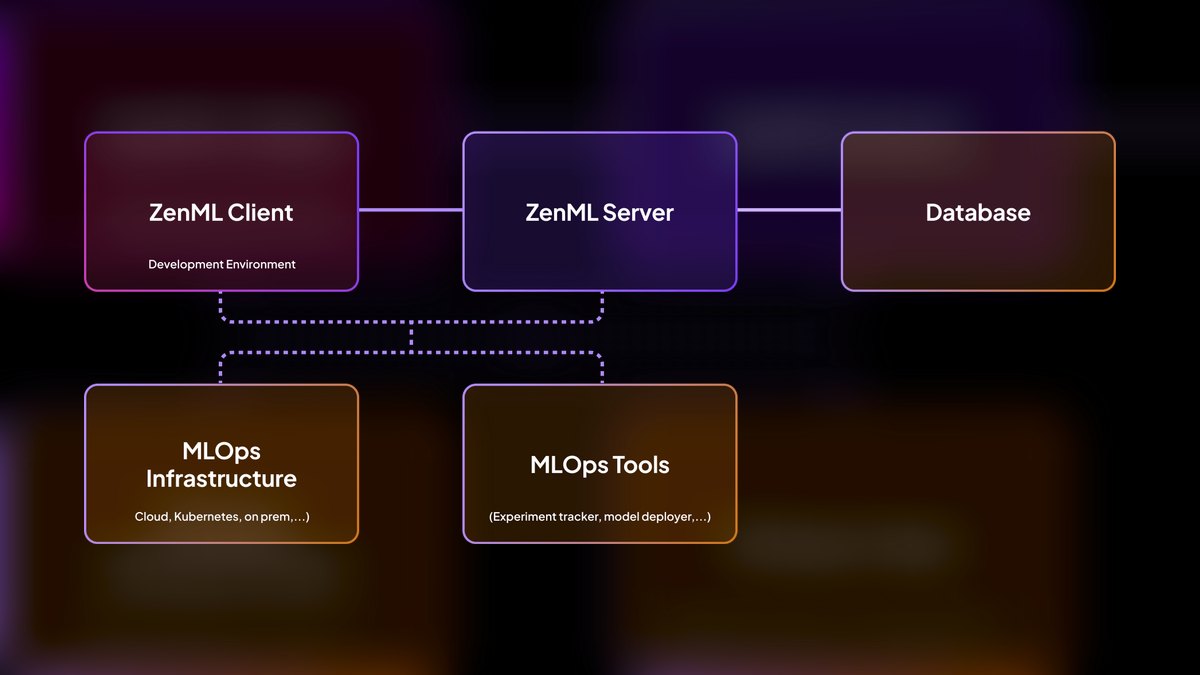
ZenML ranks seventh because it is the strongest abstraction layer for writing pipeline code once and swapping execution backends between local, Kubeflow, SageMaker, or Vertex in production. Its stack concept decouples pipeline logic from infrastructure, reducing switching costs when teams are unsure where they will land. It is open source and self-hostable, with caching that skips unchanged stages to cut compute costs. ZenML also provides built-in experiment tracking integration and a registry for model versions.
ZenML is for teams that want to avoid committing to a single cloud or orchestrator early, and it trades away the depth of purpose-built tools for flexibility. Compared to Metaflow, it is more opinionated about pipeline structure but offers broader backend support. It is not for teams that need a fully managed platform or those who prefer writing plain Python without framework constraints. For organizations evaluating cloud options, ZenML is a hedge that preserves optionality.
8. Metaflow
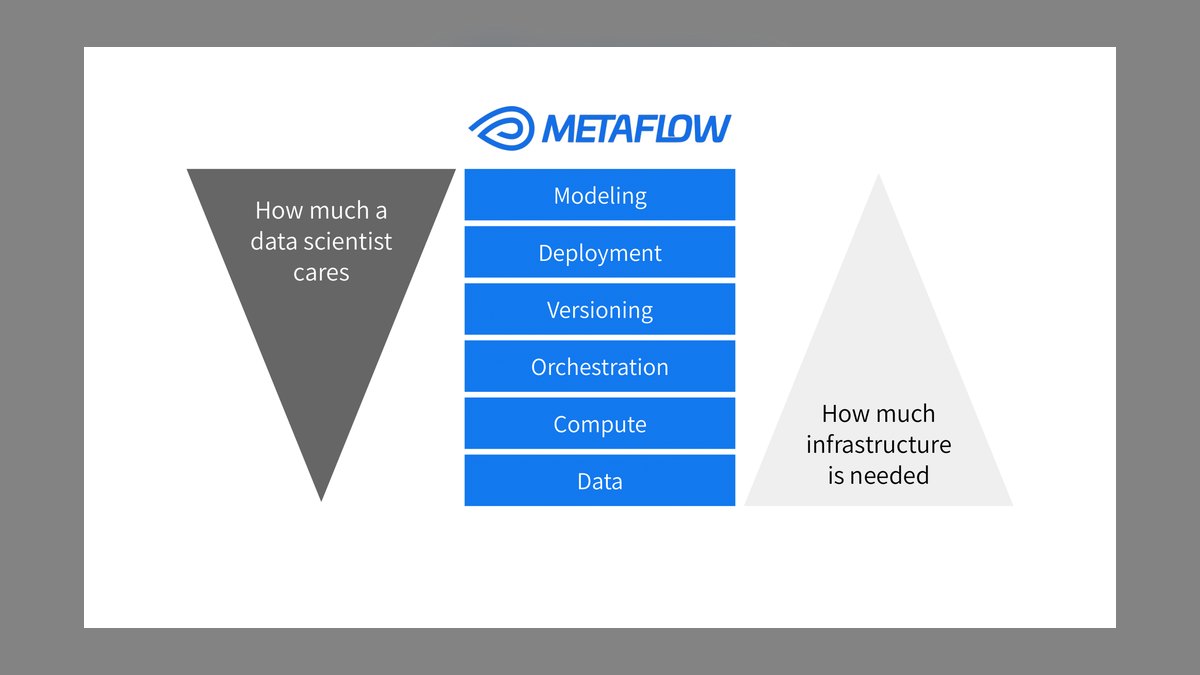
Metaflow ranks eighth because it optimizes for the data scientist's experience with plain Python, automatic versioning, and transparent scaling to cloud compute, originating from Netflix's internal tooling. It provides run resumption, which saves time on long training jobs, and its decorator-based API is approachable for researchers. Metaflow is open source and self-hostable, with no per-seat fees, and it integrates with AWS Step Functions for orchestration. Its versioning automatically captures code, data, and parameters for each run.
Metaflow is for data science teams that prioritize a low learning curve and Python-native workflows, and it trades away fine-grained pipeline control and multi-cloud portability for simplicity. Compared to ZenML, it is less flexible on backends but more intuitive for modelers. It is not for teams needing Kubernetes-native orchestration or those who require strict CI/CD gating out of the box. For rapid prototyping and research-to-production paths, Metaflow is a strong fit.
9. ClearML

ClearML ranks ninth because it is a full open-source MLOps suite that includes experiment tracking, pipeline orchestration, and a model registry, with a free tier and self-hosting option. Its pipeline caching skips unchanged stages, and it supports agent-based execution on ephemeral compute with spot instance support to cut costs by roughly 60-70%. ClearML provides a web UI for comparing runs and managing models, and it integrates with existing CI systems via CLI and SDK.
ClearML is for teams that want an all-in-one open-source platform without assembling multiple tools, and it trades away the polish and community size of MLflow or W&B for broader feature coverage. Compared to MLflow, it offers more built-in orchestration but a steeper learning curve and less mature documentation. It is not for teams that prefer a modular stack or those needing deep cloud-native integration.
10. CML

CML ranks tenth because it is the lightest-weight option, extending GitHub Actions and GitLab CI with ML-specific features like metric comparison comments in pull requests and automated report generation. It works with self-hosted GPU runners and is free and open source, with no additional infrastructure beyond your CI runner. CML handles the evaluation gate by posting candidate-versus-champion metric comparisons directly into PRs, enabling review-driven model promotion.
CML is for teams already comfortable with GitHub Actions who want ML signal in their existing CI workflow without adding a new platform. It trades away orchestration depth and registry features for simplicity, and it is not suitable for complex DAG branching or long-running steps beyond runner timeouts. Compared to full platforms like MLflow, it is a supplement rather than a replacement.
How we ranked these
We measured each tool across seven stages of the model release pipeline: trigger, data snapshot, training, evaluation, gate, registration, and progressive rollout. We weighted evaluation gating and data versioning most heavily, as these directly prevent the silent failure class described in the source material. We also scored integration effort, cost of compute, and the ability to refresh holdout sets and detect training-serving skew.
Managed platforms were assessed on their built-in approval workflows and IAM integration, while open-source toolkits were scored on replaceability and the absence of vendor lock-in.
We deliberately ignored marketing claims about ease of use and dashboard aesthetics, as these are subjective and often misleading. We also did not weigh the number of stars on GitHub or community size, as popularity does not correlate with correctness or suitability for a specific team's shape. We excluded any tool that lacked a native or easily integrated evaluation gate comparing candidate against champion, because a pipeline without that gate is faster automation of the same mistakes.
Finally, we ignored pricing for compute, as it varies wildly with workload and is not a property of the tool itself.
What to look for
When choosing between these tools, the decision hinges on your team's shape and existing infrastructure. If you have a platform engineer, assemble an open toolkit with MLflow or W&B, DVC, and GitHub Actions. If you have no platform support, take a managed platform like SageMaker or Vertex. If you already run Kubernetes, Kubeflow is natural. The non-negotiable is an automated evaluation gate that fails the build on regression against the current champion.
Also consider how you will refresh holdout sets and detect training-serving skew, as these are the checks that catch the silent failures described.
The mistake most buyers make is choosing based on feature lists rather than on the team's ability to operate the tool. They pick a Kubernetes-native engine without a platform team, or a managed platform that locks them into opinions that conflict with their evaluation needs. Another common error is ignoring the feedback edge: a pipeline that only runs forward is a deployment script, not a lifecycle.
Buyers also underestimate the cost of integration work and ongoing maintenance, and they fail to plan for artifact retention and rollback rehearsal, which are essential for production reliability.
Related questions
Do I need a separate orchestrator or can GitHub Actions handle model CI/CD?
GitHub Actions handles it well for most teams, especially with self-hosted GPU runners and CML posting metric comparisons into pull requests. You outgrow it when pipelines need complex DAG branching, long-running steps beyond runner timeouts, or fine-grained per-step resource allocation. For those, consider Kubeflow or a managed pipeline service.
How often should a production model be retrained?
It depends on drift rate, not a calendar. Fast-moving domains like fraud or ad targeting often retrain daily or weekly; stable tabular business models do fine monthly or quarterly. Drift-triggered retraining beats scheduled retraining when your monitoring is reliable enough to trust the trigger. The key is to monitor drift and let it dictate the cadence.
What is the minimum viable model CI/CD setup?
Pinned data versioning, a tracking server logging every run, an automated evaluation step comparing candidate against champion, and a registry with stage labels. That is four components and it catches the large majority of production model failures. Progressive rollout is the next thing to add.
Can these tools gate on fairness and bias checks?
Yes — fairness checks are just another gate condition. Compute parity metrics across protected segments during evaluation and fail the build if any segment falls outside tolerance. The hard part is choosing the right metric and segments for your context, not wiring the check into the pipeline.
How do model CI/CD tools handle very large models?
Large artifacts strain registries and storage. Practical adaptations: store weights in object storage with pointer-based versioning rather than in the registry directly, use delta or adapter-based versioning for fine-tunes, and shift more evaluation to shadow deployment since retraining-based iteration is too expensive to run frequently.
What is the most common cause of model failure in production?
Silent contract violations, such as a schema change in an upstream field that the feature pipeline coerces without crashing. This leads to training-serving skew, where the model is trained on data that no longer matches production. Data versioning and skew checks are the primary defenses.
How do I detect training-serving skew?
Log a sample of live feature vectors and compare their distributions against the training set on every run. Flag any feature whose distribution has shifted beyond a divergence threshold you set once and enforce forever. This catches subtle differences in null handling, timezone normalization, or category encoding.
What is the role of a model registry in CI/CD?
The registry stores passing artifacts with a version, a lineage pointer back to the data snapshot and training run, and a stage label — staging, production, archived. Approval workflows can require a human signature here for regulated use cases. It is the source of truth for what is deployed and what can be rolled back to.
FAQ
How do AI model CI/CD tools differ from traditional CI/CD?
Traditional CI/CD versions and tests code. Model CI/CD must also version the training data, the hyperparameters, and the environment, because the artifact is a product of all of them. It adds evaluation gating against a current champion, model registries with stage transitions, and progressive rollout patterns that traditional pipelines rarely need.
Should I use open-source tools or a managed platform?
Open source gives control and no lock-in but costs integration and maintenance time. Managed platforms remove infrastructure work at the price of portability and flexibility. The practical decision rule is staffing: if you have a platform engineer who can own the stack, assemble open source. If your ML team is three people with no platform support, take the managed option.
What does an evaluation gate actually check?
At minimum, four things: the primary metric has not regressed beyond a set tolerance, latency at p95 stays under budget, fairness parity across protected segments holds, and feature distributions match production within a defined divergence bound. Fail any check, fail the build. The gate compares the candidate against the current champion on identical data.
How do I set a canary rollout window?
Canary observation windows of 15-30 minutes are standard for high-traffic services. Low-traffic services need longer windows or they have not seen enough requests to detect anything. If your endpoint serves 200 requests an hour, a 5% canary sees ten requests in an hour — statistically meaningless. Under roughly a few thousand daily predictions, shadow deployment is more informative.
What is the cost of self-hosting an MLflow tracking server?
A small managed Postgres instance plus object storage runs in the low tens of dollars per month for a team logging a few thousand runs. Artifact storage grows with model size and retention policy, and this is where costs sneak up. A retention policy that keeps all registered models indefinitely but prunes unregistered run artifacts after 90 days typically cuts that bill by a large fraction.
How can I cut compute costs for model training?
Two levers cut it hard: caching (DVC, ZenML, and ClearML all skip pipeline stages whose inputs are unchanged) and spot/preemptible instances for training steps that checkpoint, which commonly cut compute cost by roughly 60-70% at the price of occasional interruption. On a typical pipeline where feature engineering dominates, caching can eliminate the majority of a run's wall-clock time.
What is the best way to avoid evaluating against a frozen holdout set?
Refresh the holdout on a schedule — monthly for fast-moving domains, quarterly at minimum — and keep a small frozen set alongside it purely as a canary for the evaluation process itself. If the frozen set and the fresh set disagree sharply, that disagreement is your drift signal.
How do I prevent retraining on unvalidated labels?
Gate the data as well as the model — check label distribution, row count, and null rates against expected ranges before training starts, and fail early if the data looks wrong. Catching a bad dataset before a four-GPU-hour training run is free; catching it after is not.
What is the most important thing to test in a rollback rehearsal?
Teams build automated rollback and never test it. The first time it fires is during a real incident, and that is when they discover the previous model version's artifact was pruned or its serving container no longer builds. Rehearse rollback on a schedule — quarterly is reasonable — the same way you would test a database restore.
What is the role of the feedback edge in a model CI/CD pipeline?
A pipeline that only runs forward is a deployment script. A pipeline where production monitoring can trigger the next retraining run is an actual lifecycle, and it is what separates teams shipping models weekly from teams shipping quarterly. The dotted feedback edge is the part teams underinvest in.
Sources
- https://mlflow.org/docs/latest/index.html
- https://dvc.org/doc
- https://docs.github.com/en/actions
- https://docs.gitlab.com/ee/ci/
- https://www.kubeflow.org/docs/components/pipelines/
- https://cloud.google.com/vertex-ai/docs/pipelines
- https://docs.aws.amazon.com/sagemaker/latest/dg/pipelines.html
- https://docs.zenml.io/
- https://docs.metaflow.org/
- https://docs.clear.ml/
Related on PULSE
This page will be disappearing soon. Save it to your device for $1 — or read it free while it is here.
@Kory-White- · if Venmo asks, the last 4 of my number are 2012
This page is gone.
This one is off the shelf now. $1 keeps it on your phone for good — the whole page, pictures and diagrams included.
 pulse-ai-infrastructureThe 10 Best AI Tools for Image Upscaling in 2027
 pulse-ai-infrastructureThe 10 Best AI Tools for Reading Comprehension in 2027
 pulse-ai-infrastructureThe 10 Best AI Tools for Supply Chain Planning in 2027
 pulse-ai-infrastructureThe 10 Best AI Tools for Product Page Design in 2027
 pulse-ai-infrastructureThe 10 Best AI Tools for Screenwriting in 2027
 pulse-ai-infrastructureThe 10 Best AI Tools for Album Art in 2027
 pulse-ai-infrastructureHow do you scale LLM inference to handle thousands of concurrent users in 2027?
 pulse-ai-infrastructureThe 10 Best AI Tools for Pronunciation Coaching in 2027
 pulse-ai-infrastructureThe 10 Best Fractional GPU and GPU Sharing Tools in 2027
 pulse-ai-infrastructureThe 10 Best AI Tools for Gift Recommendations in 2027