
What Is an SNDA and Why Do I Need One?
 Curated byKory White · Fractional CRO · Maryland
 PULSEKNOWLEDGE LIBRARY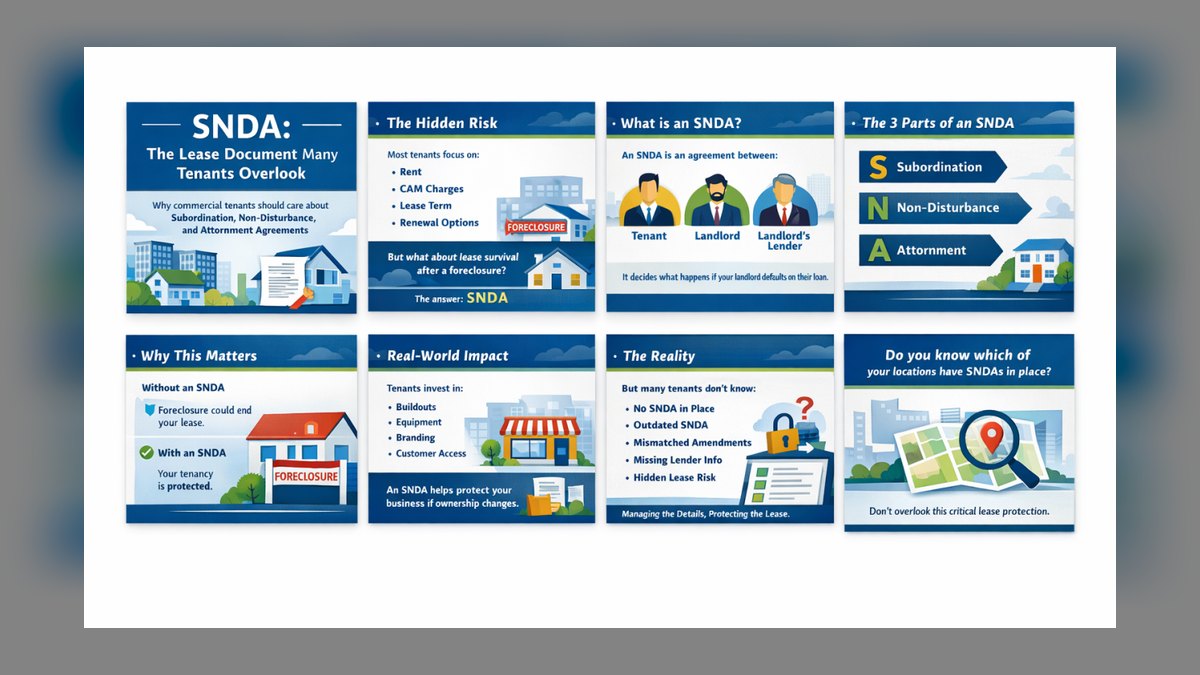
An SNDA — Subordination, Non-Disturbance, and Attornment agreement — is a three-party contract among you, your landlord, and the landlord's mortgage lender. Its non-disturbance clause guarantees that if the landlord defaults and the lender forecloses, your lease survives unchanged as long as you keep paying rent and don't default.
What each letter of the SNDA actually does
The acronym packs three distinct legal mechanics, and they do not all work in your favor — so it pays to know which is which before you sign anything. The order in which they help you actually runs backwards from the order of the letters.
Subordination puts your lease *behind* the lender's mortgage in priority. This part benefits the lender, not you. It means that in any conflict between your lease and the loan, the loan wins, and if the lender forecloses, your lease does not outrank their security interest. Landlords and their banks almost always demand it, because a lender financing a building does not want existing leases to sit ahead of its lien. In most commercial deals you cannot strip subordination out entirely — but you can condition it on getting the next piece.

Non-Disturbance is your half of the bargain and the entire reason to sign. It is the lender's written promise that even though your lease is subordinate, a foreclosure will *not* disturb your possession. Your lease, your negotiated rent, your renewal options, and your tenant-improvement terms all survive intact — provided you are not in default. Without this clause, subordination is pure downside: you have agreed your lease ranks below the mortgage and gotten nothing in return.
Attornment is your promise to recognize the new owner — the lender, or whoever buys the building at a foreclosure sale — as your landlord and to keep paying rent to them. This part benefits the new owner by keeping the rent stream intact through a change in ownership. It is generally fine, because you want a landlord and you want to stay, but watch for language that lets the new owner *ignore* obligations the previous landlord owed you.

The clean trade, when the document is balanced, is this: you give subordination and attornment, and in exchange you receive non-disturbance. A lease or lender form that demands the first two while treating the third as optional — available only "upon request" or "if the lender agrees" — is a one-sided document you should push back on hard.
Why an SNDA protects your buildout money
Here is the concrete nightmare an SNDA is built to prevent. Suppose you sign a seven-year lease and invest $200,000 in tenant improvements — the landlord's TI allowance covers $100,000 and you fund the other $100,000 out of your own pocket to build out kitchens, fixtures, specialized lab or medical space, or custom retail interiors. Two years into the term, the landlord stops paying the mortgage. The lender forecloses and takes ownership of the building.

Without a non-disturbance clause, the foreclosing lender may have the legal right to terminate your lease and re-lease the space to someone else at today's market rate. In that scenario you can lose several things at once. First, the roughly $100,000 you sank into improvements that are now physically bolted to a space you no longer occupy — you cannot pry a built-out kitchen off the walls and take it with you. Second, the below-market rent you carefully negotiated, which is exactly what gives a foreclosing lender the incentive to terminate and re-lease higher. Third, the direct relocation cost of finding, designing, permitting, and rebuilding a comparable space somewhere new, which for a significant footprint routinely runs well into six figures. Fourth, the business disruption of moving on the new owner's timeline rather than your own — lost revenue, lost foot traffic, and possibly lost customers who cannot find you.
With non-disturbance in place, none of that happens. The new owner steps into the previous landlord's shoes, and your lease simply continues on the same terms: same rent, same remaining term, same renewal options, same improvement arrangements. That continuity is why tenant-representation brokers and commercial real estate attorneys treat a signed SNDA as a standard, mandatory deliverable on any lease where the tenant is investing real capital or committing to a long term. It is not an exotic ask or a luxury protection — it is the mechanism that carries everything you negotiated through a change in the building's ownership.

How to negotiate a tenant-favorable SNDA
A lender's standard SNDA form is drafted by the lender's counsel to protect the lender. Treat it as an opening position, not a take-it-or-leave-it document, and push for a handful of specific tenant protections.
Make the executed SNDA a condition of your lease obligations. This is your single strongest lever. The most protective version says you owe no rent and begin no buildout until the lender has signed. Chasing a lender's signature after you have already moved in and started paying rent gives you almost no leverage, because you have already committed everything. Raise the SNDA during lease negotiation, before you sign — ideally written into the lease as an explicit landlord obligation — while you still have the ability to walk.
Protect your TI allowance and rent credits. Standard lender forms typically say the new owner is *not* bound by the prior landlord's obligations, which can include an unfunded tenant-improvement allowance or promised free rent. If your landlord still owes you $100,000 of TI or three months of abatement when the foreclosure hits, a boilerplate SNDA can wipe that obligation out. Negotiate language that preserves any allowance or rent credit you have not yet received so a change in ownership does not cancel money you are owed.
Preserve your offset and self-help rights. If your lease lets you offset repair costs against rent, or make certain repairs and deduct the cost, make sure those rights survive into the relationship with the new owner — at minimum for amounts the new owner is put on notice of going forward.

Narrow the new owner's "not liable for" list. Lender forms routinely exclude the new owner from liability for the prior landlord's defaults, for prepaid rent beyond one month, and for a security deposit the lender never actually received. Tighten these carve-outs where you can, and if the lender will not honor your security deposit, negotiate to escrow it or hold it somewhere protected.
Lock in notice and cure obligations. Require the lender to notify you before completing a foreclosure and give you the chance to keep performing so your tenancy is not disrupted by a process you never saw coming. Finally, have a commercial real estate attorney review the final version — the cost of that review is trivial next to a six-figure buildout you could lose overnight.

When you absolutely need one — and when you can skip it
Not every deal warrants pushing hard for an SNDA, and negotiating leverage is finite, so it helps to know where this protection genuinely matters. The general rule is straightforward: the more capital you are sinking into the space and the longer you are committing, the more an SNDA matters.
You need an SNDA when the building carries a mortgage — which nearly all commercial buildings do — and any one of these is true: your lease term runs longer than roughly three to five years; you are investing meaningful tenant-improvement dollars, generally $50,000 or more; you negotiated below-market rent worth protecting; or your business depends on specific build-out, exclusive-use, or signage rights that would be painful or impossible to reproduce elsewhere. A clinic near a hospital, a restaurant with a custom kitchen, a retailer relying on a high-foot-traffic corner, or a lab with specialized infrastructure all fall squarely in this category. In these cases a wiped-out lease means walking away from real, unrecoverable money and possibly your customer base.
You can reasonably skip it when the building is owned free and clear with no mortgage — verify this with a title search rather than taking the landlord's word — or when you are on a short-term or month-to-month lease with minimal investment and a generic, easily replaceable space. Even when the building has no current mortgage, though, include a lease clause requiring an SNDA for *any future financing*, because landlords refinance constantly and a mortgage placed next year can subordinate a lease that had no lender to worry about when it was signed. When in doubt, get the SNDA. It generally costs you a negotiation cycle rather than actual money, and the downside it protects against is enormous.
Red flags to watch for around the SNDA
A handful of patterns should make you slow down and read carefully. The most common trap is a lease that requires automatic subordination to current *and future* mortgages without any non-disturbance guarantee attached — this hands the lender everything and gives you nothing. Closely related is a lease that "self-subordinates" the moment a new loan is placed, quietly stripping your protection every time the landlord refinances.

Be wary when a landlord waves off the SNDA as "just a formality" and asks you to sign the lender's form unread, or when the SNDA excludes your TI allowance, free rent, and offset rights with no room for negotiation. Another warning sign is a landlord who cannot or will not produce the lender's contact information so you can actually obtain the agreement — if getting the lender to the table is impossible during negotiation, it will be impossible during a crisis. In each of these cases the fix is the same: slow down, insist on non-disturbance in writing as a condition of your subordination, and get an attorney's eyes on the final language before you commit a dollar to the space.
Related questions
Is an SNDA the same as an estoppel certificate?
No. An estoppel certificate is a snapshot certifying your lease's current terms and confirming no defaults exist, usually requested by a buyer or lender. An SNDA is a forward-looking protection that governs what happens to your lease if the landlord's lender forecloses. The two often travel together but do different jobs.
Who typically drafts the SNDA?
The landlord's lender usually provides the form, because subordination and attornment protect the lender's position, so they have the strongest interest in the language. That form is written to favor the lender, which is why you should expect to redline it and, ideally, have your own attorney review the final version before signing.
Does an SNDA cost money to put in place?
The agreement itself is routine paperwork that lenders sign constantly, so it rarely carries a meaningful direct fee. Your real cost is attorney review time and a negotiation cycle during lease discussions — trivial compared with the buildout investment or below-market rent it protects if the landlord ever defaults.
What if the building has no mortgage today?
Then there is no lender who could disturb your tenancy right now, and an SNDA may be moot for the moment. But landlords refinance frequently, so you should still write a clause into your lease requiring the landlord to deliver an SNDA on your behalf for any future financing placed against the property.
FAQ
What does SNDA stand for? SNDA stands for Subordination, Non-Disturbance, and Attornment agreement. Each word covers one piece: subordination puts the lender's mortgage ahead of your lease, non-disturbance keeps you in your space if the landlord defaults, and attornment means you will recognize the new owner as your landlord after a foreclosure. The non-disturbance clause is the part that actually protects you.
Do I really need an SNDA if my lease is solid? A strong lease protects you against your landlord, but not against the landlord's lender. If the property is foreclosed on, the lender can potentially terminate leases that were signed after the mortgage was recorded — even airtight ones. The SNDA is what carries your protections and negotiated terms through a change in ownership.
When should I ask for an SNDA? The best time is during lease negotiation, before you sign, ideally written in as a landlord obligation. Asking later, once you have already committed and started paying rent, gives you far less leverage. If you are investing in a buildout or signing a long-term deal, raise it early while you can still walk away.
Who signs an SNDA? It is a three-party agreement among you as the tenant, your landlord, and the landlord's lender. The lender usually drives the form, since subordination and attornment protect its position. Because all three parties sign, expect some back-and-forth before the language is finalized.
Can the terms of an SNDA be negotiated? Yes. Lenders often present a standard form, but the non-disturbance terms, cure periods, treatment of your TI allowance and deposit, and which lease obligations survive foreclosure are all commonly negotiated. It is worth having a commercial real estate attorney review it, because the lender's default language tends to favor the lender.
What happens without an SNDA if the landlord defaults? If there is no non-disturbance protection in place, a foreclosing lender may have the right to terminate your lease and remove you, even if you have paid every bill on time. That can mean losing your location and any tenant improvements you funded. The SNDA is designed to prevent exactly that outcome.
Sources
- https://www.investopedia.com/terms/s/snda.asp
- https://www.nolo.com/legal-encyclopedia/commercial-leases-subordination-nondisturbance-attornment.html
- https://www.cbre.com/insights/services/tenant-representation
- https://www.jll.com/en-us/services/tenant/tenant-representation
- https://www.law.cornell.edu/wex/subordination
- https://www.naiop.org/research-and-publications/
- https://www.boma.org/
- https://www.irem.org/
Related on PULSE
- [What Is a Tenant Improvement Loan and Should I Use One?](/knowledge/bo0091)
- [What Is a Go-Dark Clause and Should I Fight for One?](/knowledge/bo0052)
- [What Is an Estoppel Certificate and How Do I Avoid Getting Trapped by One?](/knowledge/bo0017)
- [Gross Lease vs Triple Net (NNN): Which One Actually Saves Me Money?](/knowledge/bo0012)
This page will be disappearing soon. Save it to your device for $1 — or read it free while it is here.
@Kory-White- · if Venmo asks, the last 4 of my number are 2012
 pulse-recentWhat percentage of total buildout costs does a landlord typically fund versus what I pay out of pocket in 2027?
 pulse-recentHow Do I Calculate My Real Cost When the Landlord Funds the Buildout in 2027?
 pulse-recentHow do I legally document my landlord's required buildout improvements before signing in 2027?
 pulse-recentHow much longer does my lease term need to be before a landlord will fund 100% of my buildout instead of a partial allowance in 2027?
 pulse-recentHow Much Do Draw-Inspection and Disbursement Fees Cost on a Landlord-Funded Buildout in 2027?
 pulse-recentHow do I insure landlord-installed HVAC and electrical systems separately from my own buildout equipment in 2027?
 pulse-recentHow do I budget for the landlord's construction management fees in a buildout in 2027?
 buildoutsAs-Is vs Warm Shell vs Turnkey: Which Delivery Saves Me the Most?
 buildoutsHow Do I Challenge My Property Tax Pass-Through as a Tenant?
 buildoutsHow Do I Audit My CAM Reconciliation to Claw Back Overcharges?