

Best Nissan Rogue Model Years (Ranked) in 2027
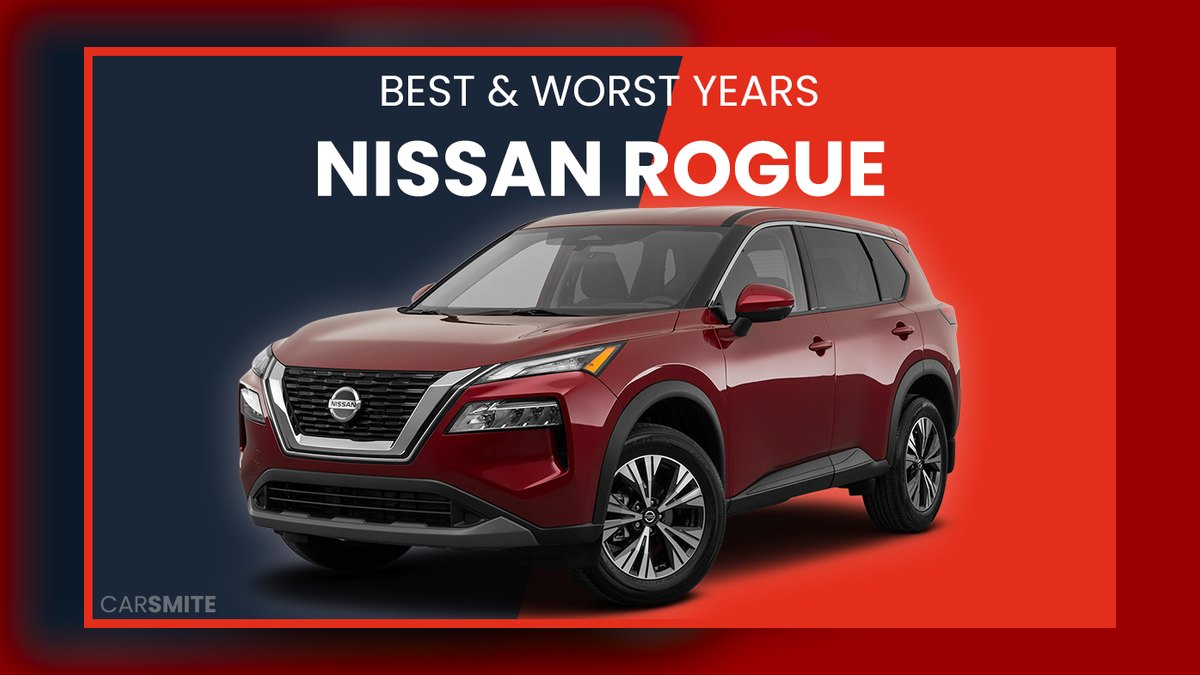
The best used Nissan Rogue is the 2022, which pairs the 201-hp 1.5-liter VC-Turbo three-cylinder with a revised CVT, a roomy upscale cabin, and standard Safety Shield 360. The best value is a serviced 2019 at roughly $15,000–$19,000. Avoid 2013–2015 unless transmission service is documented.
The two Rogues you are actually choosing between
Strip away the ten-year model list and every Rogue purchase collapses into two real options: a third-generation car (2021–2024, chassis code T33) or a late second-generation car (2018–2020, chassis code T32). Everything older is a price decision, not a quality decision, and everything newer is a warranty decision. The T32-versus-T33 fork is where the money and the risk actually live.
The late T32 is the known quantity. It uses the 2.5-liter QR25DE naturally aspirated four-cylinder rated at 170 horsepower and 175 lb-ft, driving through Nissan's Jatco-supplied CVT. EPA figures land around 26 mpg city and 33 mpg highway with front-wheel drive, dropping a point or two with all-wheel drive. Automatic emergency braking became standard for 2018, which matters enormously for resale and for insurance underwriting. The cabin is plain but genuinely roomy, with the Divide-N-Hide cargo floor that lets you build a two-tier trunk — a feature owners who haul gear consistently rate above the infotainment. What you are buying is a competent, unremarkable crossover with one asterisk: the transmission.
The T33 is a different vehicle wearing the same nameplate. The 2021 launched on a stiffer platform with a substantially better interior — soft-touch materials where the T32 had hard plastic, rear doors that swing open close to 90 degrees, available 12.3-inch digital instruments, a 9-inch touchscreen, and an available head-up display. The 2021 still used the 181-hp version of the 2.5-liter four. Then for 2022 Nissan replaced it with the 1.5-liter VC-Turbo, a variable-compression three-cylinder rated at 201 horsepower and 225 lb-ft, with EPA estimates near 30 mpg city and 37 mpg highway in front-drive form. That is more power and better fuel economy from a smaller engine, an unusual combination that comes from the variable-compression mechanism trading compression ratio for boost depending on load.
So the honest framing is three tiers, not ten ranked years. Tier one is 2022–2024: best powertrain, best cabin, best CVT, highest price. Tier two is 2021: the good platform with the old engine, at a meaningful discount. Tier three is 2018–2020: the value zone, where standard safety tech and a mature version of the T32 meet used prices that have already absorbed most of their depreciation. Below that, 2013–2017 cars are cheap for reasons that show up on the repair invoice.
The trade-off nobody puts on the window sticker is complexity. The VC-Turbo has a multi-link variable-compression mechanism, direct injection, and a turbocharger. It is the most sophisticated engine Nissan has ever put in a mass-market crossover, and long-term high-mileage data on it is still thin — the oldest examples are only a few years old. The 2.5-liter four, by contrast, is a design with well over a decade of field history and a repair network that knows it cold. If you plan to own the car to 200,000 miles and do your own maintenance, there is a defensible argument for the simpler engine. If you plan to own it for five years and want the fuel economy, the turbo wins.
How to decide between a T32 and a T33
The decision is less about which Rogue is better in the abstract and more about which failure mode you can absorb. A T32 at $16,000 with unknown transmission history carries a plausible $4,000-plus exposure — a CVT replacement is not a cheap repair, and on a car worth $16,000 it is a substantial fraction of the vehicle's value. A T33 at $25,000 carries less mechanical risk but ties up nine thousand more dollars and depreciates faster in absolute terms over the next three years.
Work the decision in this order: budget ceiling, then service documentation, then powertrain preference, then options. Most buyers do it backwards — they fall for a trim level, then rationalize the year. That is how people end up with a loaded 2015 SL for the price of a base 2018 with standard automatic emergency braking, which is a bad trade in every dimension that matters.
Two decision rules are worth stating flatly. First, on any T32, a documented car beats a cheaper mystery car every single time — the service history is worth more than trim level, color, or twenty thousand miles on the odometer. Second, if you cannot get to roughly $15,000, you are shopping in the risk zone, and you should either save longer or shift to a different nameplate whose cheap years are less fragile. There is no clever way to buy a $9,000 Rogue safely; there is only a way to buy one with clear eyes and a repair fund.
One more angle that shoppers underweight: how you will use the car changes the ranking. A CVT is happiest at steady cruise and least happy under sustained high-load operation — long grades, towing, stop-and-go in heat. If your commute is flat highway, a well-kept T32 is a reasonable bet. If you live somewhere with real elevation change, or you routinely carry four adults and cargo up a mountain pass, the newer transmission and the turbo's torque at low rpm are worth paying for. Same car, different answer, driven entirely by duty cycle.
Concrete numbers behind each option
Here is the specification and pricing picture in plain figures. Used values move with the market and with condition, so treat these as market positioning rather than quotes.
2022–2024 (T33, VC-Turbo). 1.5-liter variable-compression turbo three-cylinder, 201 hp, 225 lb-ft. EPA roughly 30 city / 37 highway / 33 combined front-drive. Typical asking range in the mid-$20,000s to low $30,000s depending on year, trim, and mileage. Standard Safety Shield 360 (automatic emergency braking with pedestrian detection, blind-spot warning, rear cross-traffic alert, lane-departure warning, high-beam assist), with ProPILOT Assist adaptive cruise and lane centering available and standard on upper trims. Many are still inside or near the end of the original five-year powertrain warranty period, which is a real, quantifiable asset.
2021 (T33, 2.5L). 2.5-liter four, 181 hp. New platform, new interior, standard Safety Shield 360. Typically asks in the high teens to mid-$20,000s. Buys you the good cabin and the good structure at a discount to the turbo cars.
2018–2020 (late T32). 2.5-liter four, 170 hp. EPA roughly 26 city / 33 highway front-drive. Automatic emergency braking standard from 2018 on; ProPILOT Assist available. Values commonly run from the low teens for a higher-mileage 2018 to around $21,000 for a clean low-mileage 2020. This is the value band, and the 2019 in particular tends to sit at the best intersection of price, standard safety content, and remaining service life.
2015–2017 (early-to-mid T32). Same 170-hp 2.5-liter, earlier CVT calibration and hardware. Automatic emergency braking not standard before 2018. Values commonly from single digits to the mid-teens. The 2017 mid-cycle refresh brought updated styling and more available driver aids. Earlier examples in this band draw more transmission complaints.
2013–2014 (first generation, S35). 170-hp 2.5-liter with the first-generation CVT — the weakest transmission of any Rogue. Cheapest entry point, highest failure probability, and the years most owner forums flag as problem cars. Nissan extended CVT coverage on a range of earlier vehicles when they were new, but on a car this old that coverage is long expired for practically every buyer.

Now the number that actually decides the purchase: cost per year of trouble-free ownership. A $17,000 documented 2019 you keep six years with routine maintenance and one CVT fluid service pencils out very differently from a $9,000 2015 that needs a $4,500 transmission in year two. The cheap car becomes the expensive car, and you spent the intervening months without transportation. Run that arithmetic before you get attached to a listing.
Budget for maintenance explicitly. CVT fluid service on the interval Nissan and most independent shops recommend for severe use — roughly every 30,000 to 40,000 miles — is not free, but it is a fraction of a replacement. Tires on a compact crossover are a recurring line item. AWD examples add a second differential and a coupling to the service list. None of this is unusual for the segment; it is only unusual if you failed to plan for it and treated the purchase price as the total cost.
Implementation details and sequencing for the purchase
Treat buying a used Rogue as a process with a defined order, not a weekend of browsing. The sequence below is what separates buyers who get a good car from buyers who get a story.
Start by fixing your budget and your must-haves before you look at a single listing. Decide the ceiling, decide whether you need all-wheel drive, and decide whether standard automatic emergency braking is a requirement — if it is, your search floor is model year 2018, full stop. Then filter listings for cars with visible service history in the description or a clean vehicle-history report showing dealer maintenance.
On the phone or in the message thread, ask one question before you drive anywhere: has the CVT fluid been changed, and can you see the invoices? A seller who cannot answer that has told you what you needed to know. This single filter will eliminate more than half of your candidate list and save you most of your weekends.
The test drive has a specific protocol for this vehicle. Drive from cold. Accelerate gently from a stop and hold light throttle around 20 to 40 mph — that is where CVT judder shows up as a shudder or vibration you feel through the floor. Listen for whine that rises with road speed rather than engine speed. Get on a highway on-ramp and demand full acceleration; hesitation, a flare in engine speed without corresponding thrust, or any warning light is a walk-away. If it is hot out, or you have a grade nearby, use it — CVT overheating protection reduces power and will announce itself under exactly those conditions. Then check air conditioning at full cold, work the Divide-N-Hide cargo panels, cycle the infotainment and backup camera, and on AWD cars listen for binding or clunk on a slow full-lock turn.
After the drive, pay for an independent pre-purchase inspection. On a $16,000 car, an inspection is a rounding error against a transmission bill, and a shop that scans for stored transmission and engine codes will find things a test drive cannot. Ask specifically for a transmission fluid condition check and a scan of any stored powertrain codes, including history codes the seller may have cleared.
Negotiation on this vehicle has a specific lever: documentation. A car with a stack of invoices deserves to hold its asking price. A car without them is, by definition, a car whose largest component has unknown remaining life, and the discount should reflect that. State it plainly to the seller. Many will meet you, and the ones who will not are telling you the market has already priced their optimism.
Once you own it, sequence the first six months. Change the CVT fluid immediately unless you have an invoice showing it was done inside the last 15,000 miles — with the correct Nissan NS-series fluid, not a universal substitute, because CVTs are unusually sensitive to fluid specification. Complete any open recalls at a dealer, which is free. Then set a calendar reminder tied to mileage, not date, for the next fluid interval. The whole reliability story on this vehicle is a maintenance story, and the owner who treats the transmission as a serviceable component rather than a sealed unit gets a very different outcome.
Where the Rogue sits against its neighbors
No ranking is useful in isolation, so it is worth naming the alternatives, because the reason a Rogue is affordable used is the same reason its competitors are not. The compact crossover class is crowded, and two nameplates in particular carry a reliability reputation that shows up directly in resale pricing. The practical consequence: at any given budget, the Rogue gives you more equipment, more mileage headroom, or a newer model year than those rivals will. You are being paid, in features and years, to take on transmission risk.
That is not automatically a bad trade. If you buy a documented late T32 or a T33 and service the transmission on schedule, you captured the discount without inheriting the problem. It becomes a bad trade only when the buyer takes the discount and then skips the maintenance that justified it — which, at scale, is precisely what produced the reputation in the first place.
Two adjacent options are worth a look while you shop. Nissan's smaller Rogue Sport, sold in the same showrooms through 2022, is a different and narrower vehicle on a different platform — cross-shop it deliberately rather than assuming a listing labeled "Rogue" is the vehicle you researched, because trim and body confusion between the two is common in classified listings. And the Rogue hybrid variants that appeared in some markets and model years complicate the used picture further; verify the exact powertrain in the VIN decode rather than trusting the seller's description.
One upstream angle that changes what you see on lots: fleet and rental cycles. Compact crossovers move in volume through rental fleets, and those cars return to the retail market at two to three years old with high mileage, base trims, and consistent, if minimal, dealer-network maintenance. A former fleet Rogue is not automatically a bad car — the oil got changed — but it will have been driven hard by many drivers, and the CVT duty cycle in rental service is not gentle. Check the history report for the number of prior owners and the registration type; a two-year-old car with 60,000 miles and one corporate owner is telling you its whole story.
Finally, understand how the same math looks from the seller's side. Dealers price used inventory against auction comps and days-on-lot, and a Rogue with no service records still shows up in the comp set alongside one with a full history — the pricing systems mostly do not distinguish. That gap is your opportunity. The documented car is worth more than the market prices it, and the undocumented car is worth less. Every dollar of that spread is yours if you do the phone screen. Dealer revenue depends on inventory turning quickly, which is exactly why a well-reasoned offer on a car that has sat for sixty days often lands.
Related questions
Which Nissan Rogue year has the fewest transmission complaints?
Third-generation cars from 2021 onward draw the fewest CVT complaints, with the 2022 and newer VC-Turbo models on the revised transmission looking strongest. Among second-generation cars, 2018 through 2020 are meaningfully better than 2013 through 2016.
Is the 1.5-liter three-cylinder turbo reliable long-term?
Too early for definitive high-mileage data — the oldest examples are only a few years old. It is a more complex engine than the 2.5-liter four, with variable compression, direct injection, and a turbo. Keep oil changes strictly on interval.
Should I buy a 2021 or wait for a 2022?
If the price gap is small, take the 2022 for the 201-hp turbo and roughly 37 mpg highway. If the 2021 saves several thousand dollars and you prefer a naturally aspirated engine with a longer service track record, the 2021 is a sound buy.
Does all-wheel drive change which model year to buy?
Not the ranking, but it changes the inspection. AWD adds a rear differential and coupling to service. Fuel economy drops one to two mpg. Verify smooth engagement without binding or clunking on slow full-lock turns.
How many miles is too many on a used Rogue?
Mileage matters less than documentation. A 90,000-mile car with CVT fluid invoices is a better bet than a 55,000-mile car with none. Above roughly 120,000 miles on an undocumented T32, assume a transmission replacement is in your future.
FAQ
Are Nissan Rogue CVT transmissions really that unreliable?
The early ones earned the reputation. First-generation and early second-generation units drew a disproportionate share of complaints, typically presenting as shudder under light load, whining, hesitation, or overheating on grades. Transmissions in 2018-and-newer cars are meaningfully better, and the third-generation units from 2021 onward draw the fewest complaints of any Rogue. Fluid service on a 30,000-to-40,000-mile interval is the single highest-leverage thing an owner controls.
What is the best used Rogue under $20,000?
A documented 2019 or 2020. Both have automatic emergency braking standard, the mature version of the 170-hp 2.5-liter, and the later CVT calibration. Expect roughly $15,000 to $21,000 depending on mileage and trim. Prioritize the car with transmission service invoices over the one with the nicer trim level.
How long does the 2.5-liter four-cylinder last?
With consistent oil changes, this engine family routinely reaches high mileage — 150,000 to 200,000 miles is a reasonable expectation for a maintained example. The engine is generally not the limiting component on a Rogue; the transmission is. Budget your ownership plan around the CVT, not the motor.
Which model years should I avoid outright?
2013 and 2014 are the highest-risk years, and 2015 to 2016 carry more transmission complaints than the later second-generation cars. None of these are unbuyable if the price is low enough and the transmission has documented service or a replacement, but they are not the years to buy on faith.
Is a Rogue with a replaced CVT a good buy?
It can be one of the better buys on the lot, provided you see the invoice showing what was installed, when, and by whom, and whether any warranty remains on the work. A car with a documented replacement at 90,000 miles has a newer transmission than a same-year car with an original unit. Verify the work was done with correct-specification fluid.
Do Rogues hold their value well?
Not especially, relative to the segment leaders, and that is the buyer's advantage. Weaker resale means a used Rogue delivers more equipment and more remaining life per dollar than better-regarded rivals at the same price. The discount is real; whether it is a bargain depends entirely on whether the transmission was maintained.
Sources
- https://www.nissanusa.com/vehicles/crossovers-suvs/rogue.html
- https://www.fueleconomy.gov/feg/findacar.shtml
- https://www.iihs.org/ratings/vehicle/nissan/rogue-4-door-suv
- https://www.nhtsa.gov/recalls
- https://www.edmunds.com/nissan/rogue/
- https://www.caranddriver.com/nissan/rogue
- https://www.kbb.com/nissan/rogue/
- https://www.consumerreports.org/cars/nissan/rogue/
Related on PULSE
- [Best Nissan Ariya Model Years (Ranked)](/knowledge/ca0583)
- [Best Nissan Armada Model Years (Ranked)](/knowledge/ca0580)
- [Best Nissan Juke Model Years (Ranked)](/knowledge/ca0585)
- [Best Nissan 370Z Model Years (Ranked)](/knowledge/ca0584)
- [Best Nissan 350Z Model Years (Ranked)](/knowledge/ca0723)
 pulse-aquariumsTop 10 Aquarium Filters 2027
 pulse-aquariumsTop 10 Canister Filters 2027
 pulse-reviewsTop 10 Cabin Cruiser Boats 2027
 aqTop 10 Hang-On-Back Aquarium Filters 2027
 pulse-skillsSkill Drill: Upselling and Cross-Selling for Telecom
 pulse-skillsSkill Drill: Objection Handling for SaaS Sales
 pulse-skillsSkill Drill: Discovery Questions for Medical Device Sales
 pulse-skillsSkill Drill: Creating Urgency for SaaS Sales
 pulse-skillsSkill Drill: Relationship Selling for Furniture Manufacturing
 pulse-skillsSkill Drill: Active Listening for Healthcare Sales