
How do you coach reps to handle questions during a demo?
 Curated byKory White · Fractional CRO · Maryland
 PULSEKNOWLEDGE LIBRARY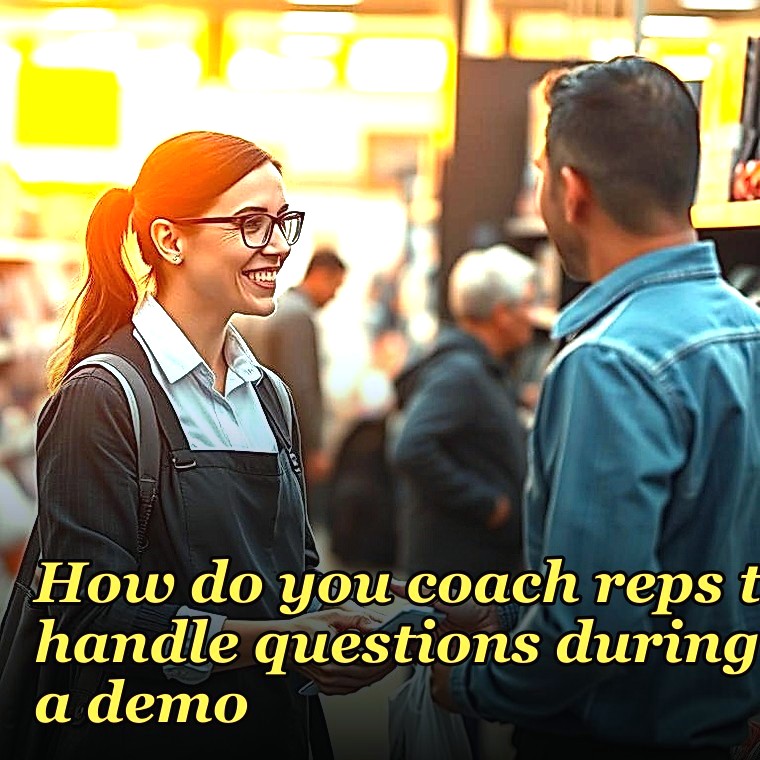
Coach reps to treat demo questions as buying signals, not interruptions. Drill one reflex — acknowledge, clarify, answer tight, confirm it landed — until it is automatic. Diagnose first whether the gap is skill, will, knowledge, or system, then fix that specific gap with recorded call review and role-play, and measure demo-to-next-step conversion.
The demo that died on question four
A mid-market rep is twenty-two minutes into a forty-five-minute demo. The screen shows a dashboard. The VP of Sales on the buyer side unmutes and asks, "How does this handle territory changes mid-quarter?" The rep says "Great question," and then talks for four minutes and ten seconds — territory design, the rules engine, a tangent about a customer in logistics, a promise that "we can definitely do that." The VP says "okay" and does not speak again for the rest of the call. The demo ends with "send us the deck and we'll circle back internally." It never converts.
Watch that clip with the rep and you find three separate failures stacked on top of each other, and only one of them is what the rep thinks it is. First, the rep never established what "handles territory changes" meant to this buyer — mid-quarter reassignment of open pipeline, credit splits on deals already in flight, or comp clawback. Those are three different answers and two of them the product does poorly. Second, the rep answered for 250 seconds when the honest answer was two sentences. Third, the rep never checked whether the answer landed, so nobody in the room had a chance to say "no, that's not what I meant." The VP went quiet not because they were satisfied but because they had privately concluded the rep did not understand their business.
This is the pattern that shows up in most demo post-mortems. The rep remembers it as "they went cold." The recording says the deal died at 22:14, on a question the rep treated as an interruption to get past rather than the most valuable thirty seconds of the whole call. Buyers ask questions about the things they are actually going to have to defend internally. A question about territory mid-quarter is a question about a specific painful thing that happened to that VP last February. The rep who explores it wins a champion; the rep who buries it in a feature monologue loses one.
The scenario generalizes well past software demos. The same failure shows up in a solutions engineer's technical deep-dive, a customer success QBR when the sponsor asks why adoption is flat, a RevOps analyst presenting forecast accuracy to a CRO who interrupts with "what changed in the methodology," and a partner enablement session where a reseller asks something the enabler cannot answer. Anywhere a person presents to a stakeholder with authority, the questions are the meeting. The presentation is scaffolding.
So when you set out to coach this, do not start with "here's a better way to answer questions." Start by watching one recording with the rep and pausing at every single question the buyer asked. Count them. Most reps are shocked by the number — a good discovery-led demo draws eight to fifteen buyer questions, and a bad one draws two or three, which is its own diagnostic. Then for each question, ask the rep three things: what did they actually ask, did you know the answer, and did you choose to answer it well? The rep's honest reaction to those three questions tells you which coaching problem you have before you spend a minute on technique.
How the mechanism actually works
The reflex you are building has four beats, and each beat is doing a different job. Reps who have only learned it as a script recite the words and still lose the room, because they do not know what each beat is for.
Acknowledge buys the rep 1.5 seconds and signals to the room that the question is welcome. "Good question" is fine but overused; "That's the thing most teams get burned on" is better because it also validates. The real function is a hard stop on the presenting momentum. Reps who skip acknowledge tend to talk straight through the question and into their answer, which reads as defensive even when it isn't.
Clarify is the beat that actually moves win rates, and it is the one reps skip. The clarifying question does three things at once: it buys thinking time, it confirms the rep heard the real question, and it very often surfaces that the buyer meant something narrower or more specific than the words suggested. "When you say integration, do you mean writing back to your CRM or reading from your billing system?" A useful drill metric here: track how often the paraphrase changes the direction of the answer. In our experience with recorded reviews, it is a meaningful minority of the time — enough that skipping it is a real risk, not a theoretical one.
Answer should be short and true. Cap it. The two-sentence rule is deliberately too tight for some questions, but reps who feature-dump need the artificial constraint to break the habit, and a rep who answers in twenty seconds and then stops has handed control back to the buyer, which is exactly where you want it. If the honest answer is "we do that partially," say that. Technical buyers fact-check, and a caught overstatement in a demo poisons the entire evaluation.
Confirm is the cheapest, most-skipped beat. "Does that get at what you were asking?" It costs three seconds and it either closes the loop or exposes that the answer missed — which is enormously valuable while you are still on the call and worthless after. Confirm also creates a natural handoff back to the buyer, which is why demos with a high confirm rate tend to have more buyer talk time overall.
The fifth branch, off the main loop, is the park. Every rep needs a verbatim line for the question they cannot answer: "That's a sharp question and I want to give you an accurate answer, not a guess. Let me confirm with our solutions engineer and get you a precise answer by end of day — does that work?" Then the follow-through: write it in the CRM, send it the same day. Coach explicitly that a clean "I'll find out" beats a confident wrong answer, and that the follow-through is the part being graded. Reps who park and never deliver train buyers to distrust every future commitment.
There is a second, distinct park for the off-topic question — the tangent that would derail the flow. Same acknowledge, then "I want to give that the time it deserves, so let me park it and come back at the end — does that work?" and then literally type it into a visible notes doc. The visible capture is what makes it not feel like a brush-off. Role-play the pushback, too, because some buyers say "no, I need that now." The fallback is a fast triage: is this a deal-breaker or a curiosity? Deal-breaker gets answered now, briefly, or handed to the SE on the call.
Upstream of all of this sits discovery, and it is worth naming because a large share of demo-question chaos is a discovery failure wearing a demo costume. If the rep did not learn before the call that this buyer's pain is mid-quarter territory churn, then every question in the demo is a surprise. Reps with strong discovery get questions they anticipated; reps with weak discovery get ambushed and then get coached on question handling, which is treating the symptom. Before you build a question-handling program, sample five demos and check whether the questions being fumbled were knowable from a decent discovery call. If most of them were, fix discovery first.
Numbers, cadence, and what to actually track
Coaching without measurement turns into vibes — "she seemed smoother this week." Put numbers on it, and pair one behavior metric with one outcome metric so a rep cannot game the behavior without moving the deal.
The behavior metrics come out of call recordings and are cheap to pull from any conversation-intelligence tool, or by hand if you don't have one:
- Clarify rate — of the buyer questions in a demo, what percentage did the rep clarify or paraphrase before answering? Most untrained reps start near zero. A reasonable first target is clarifying on anything ambiguous, which in practice lands somewhere around a third to a half of questions; clarifying on all of them sounds robotic.
- Answer length after a buyer question — measure seconds from the end of the buyer's question to the rep's next full stop or handoff. Set a working ceiling of 30 seconds for a standard product question. Reps with a four-minute answer in the recording know exactly what you are talking about when they see the number.
- Confirm rate — percentage of answers followed by a check ("does that cover it?"). This should climb toward most answers; it's the easiest behavior to move and the one that produces the fastest visible change in call dynamics.
- Parked-question follow-through — percentage of "I'll find out" commitments that got a documented reply within the promised window. Target 100%, no exceptions, because this is a trust metric, not a productivity one.
- Buyer talk time after a question is answered — do they follow up, or go quiet? Sustained silence after an answer is the strongest single leading indicator that the answer missed.
The outcome metric is demo-to-next-step conversion, measured per rep against their own 90-day baseline. Not demo-to-close, which is too lagging and too contaminated by deal factors outside the rep's control. Next step means a scheduled, calendared, mutually agreed follow-on — not "they said they'd get back to us." Establish the baseline before you start coaching, because a rep who improves from 41% to 52% has evidence; a rep who "feels better about demos" has nothing.
The cadence that works is front-loaded and then tapers. Over the first thirty days, review two recorded demos per week with the rep, focused on nothing but question handling — resist the urge to also coach their discovery, their pricing framing, and their closing in the same session, because coaching three behaviors at once reliably changes zero of them. Add one fifteen-minute role-play drill per week. Build or refine the objection battlecard together in that window rather than handing them a finished one; the act of building it is most of the learning.
Days 31 through 60, shift the question from "did you run the loop" to "did the answer move the deal." Introduce curveball and price-pressure scenarios into role-play. Have the rep self-score their own clips against a four-item scorecard before the 1:1 — clarified before answering (Y/N), answer under 30 seconds (Y/N), confirmed it landed (Y/N), parked unknowns cleanly (Y/N) — so they arrive already aware and you spend the session on the interesting 20% instead of establishing basic facts.
Days 61 through 90, drop to a spot-check: one demo a week, and the rep leads the debrief while you confirm or challenge. This is also when you compare conversion against the baseline. Expect the behavior metrics to move in two to three weeks and the conversion metric to take a full quarter, because it's gated on deal cycle length. Managers who panic at day 30 because pipeline hasn't moved usually abandon the program right before it works.
A practical note on time: this costs a manager roughly 60 to 90 minutes per rep per week in the first month, tapering to about 30. With a span of eight reps, that is real. Prioritize — run the intensive version on the two or three reps where the demo-to-next-step gap is widest, and put everyone else on the self-scoring and peer-review track. This is where the RevOps function earns its keep: someone has to own the recording tags, the scorecard fields, the baseline dashboard, and the report that tells you whether the coaching investment is paying, and that someone is usually not the frontline manager.
The drills themselves are worth specifying, because "do role-play" is not an instruction anyone can follow. Four that work: the interrupt drill, where you play a buyer who cuts in with a pointed question every sixty seconds and the rep must run the full loop each time without losing the demo thread. The curveball gauntlet — five questions the rep cannot fully answer (security certifications, uptime commitments, why you lost a specific competitive deal), scored only on the park technique and the follow-through promise, never on the content of a bluff. The two-sentence cap, where a common product question must be answered in two sentences and then the rep stops talking. And the live whisper, where you sit silently in a real demo and send a single chat cue — "clarify first" — at the moment it's needed. The whisper is the highest-leverage of the four because the correction lands in the live context, but it only works if you whisper a cue and never take over the answer.
Trade-offs: when this coaching is the wrong tool
Question-handling coaching is not free and it is not always the binding constraint. Four alternatives compete for the same manager hours, and picking wrong wastes a quarter.
Fix discovery instead. If the questions blindsiding reps were answerable from a competent discovery call, the demo is not the problem. Symptom: the rep's demo is a feature tour because they had nothing specific to demo against. Coaching the loop here makes a rep smoother at handling surprises they should never have had. Do the discovery work first, then the demo work; the demo coaching will land far better on a rep who walks in knowing what matters.
Build the knowledge asset instead. If five reps fumble the same security question, that is not five skill problems, it is one missing battlecard. The fix is a one-page answer with the honest version, the competitive framing, and the escalation path, plus a five-minute team drill. Cheap, scalable, and it makes the individual coaching sessions shorter because you stop re-teaching content in a skill session.
Fix the system instead. Sometimes the demo environment is the problem — stale data, a broken sandbox, a flow that forces the rep into a screen the product does badly. Reps then get questions about the artifact rather than the value. No amount of loop practice fixes a demo environment that generates bad questions. Symptom: multiple reps get the same weird question, and it is about something on the screen rather than about the buyer's business.
Add a solutions engineer instead. For genuinely technical evaluations, a second person on the call whose job is depth is usually better than turning an AE into a shallow SE. The trade-off is cost and SE capacity; the guardrail is that the AE still runs the loop and hands off deliberately rather than going silent whenever a hard question lands. A rep who defers everything to the SE has learned helplessness, not judgment.
There is also a live judgment call inside the technique itself, and it's worth coaching explicitly: take questions live, or hold them to the end? The default should be live for anything that reveals what the buyer cares about — those questions are free discovery and should reshape the rest of the demo in real time. Hold only for deep technical tangents that would cost the room. A rep who holds everything runs a tidy demo that nobody remembers; a rep who takes everything runs forty-five minutes that never gets to the point. The judgment is the skill, and it's coached by reviewing the calls where they chose wrong in both directions.
Pitfalls that quietly waste the quarter
Coaching the deal instead of the skill. The most common failure. A rep brings a live opportunity to the 1:1, the manager tells them what to say in that specific demo, everyone feels productive, and nothing transfers. You have won one deal and taught nothing. The tell is that your coaching notes are full of account names instead of behaviors. Fix: always end the session on a named repeatable behavior and a way you'll both know it happened.
Rescuing the rep live. A manager sits in on a demo, the buyer asks the hard question, the rep hesitates, and the manager jumps in and nails it. The deal may survive; the rep learns that hard questions get taken away from them. Whisper the cue, sit on your hands, and debrief after. This is genuinely difficult when revenue is on the line, which is why you should only sit in on demos where you're willing to let the rep be imperfect.
Skipping the diagnosis. Drilling technique on a knowledge gap is the classic waste. So is the reverse — handing a nervous rep another battlecard when the actual problem is that they're afraid of pushback. The four-bucket sort (skill, will, knowledge, system) takes ten minutes with a recording and saves weeks.
Coaching everyone the same way. The confident over-talker and the anxious freezer need opposite interventions. The over-talker needs the two-sentence cap and a hard confirm habit. The freezer needs explicit permission to say "I don't know," plus the parking line rehearsed enough times that it's available under stress. Handing both the same scorecard produces one improved rep and one confused one.
Mistaking smoothness for effectiveness. A rep can sound polished, run the loop mechanically, and still lose, because they're clarifying and confirming their way through answers that don't matter to the buyer. If the behavior metrics improve and demo-to-next-step doesn't move within a quarter, the technique is being executed on the wrong content — go back to discovery and to whether the demo is aimed at a real problem.
No follow-through from the manager. A great 1:1 with no recording review the following week is theater, and reps read it accurately as theater. If you commit to reviewing their next three demos, review the next three demos. Coaching credibility is spent from the same account as any other commitment.
Punishing the honest "I don't know." If a rep parks a question and the manager's reaction is visible frustration, you have just taught the rep to bluff. Grade the park and the follow-through, and treat a well-handled unknown as a win in the review, out loud, in front of the team.
Letting the tooling do the diagnosis. Conversation-intelligence platforms will happily hand you talk-ratio charts and question-count trends. Those are inputs. The judgment about whether this rep's problem is will or skill is a human read on a human, and it does not come out of a dashboard. Use the tool to find the ninety seconds; do the thinking yourself.
Related questions
How is this different for a solutions engineer versus an AE?
Same loop, different failure mode. SEs rarely lack knowledge; they over-answer, going five levels deeper than the question warranted. Coach SEs mainly on the answer cap and the confirm beat, and on deliberately routing commercial questions back to the AE rather than fielding them.
Should reps ever say "I'll have to check" more than once in a demo?
Yes, but twice is a signal and three times is a problem — usually a mis-qualified call or a rep demoing outside their competence. Track it. A pattern of parks in the same topic area means a missing battlecard, not a struggling rep.
How do you coach this for a team demo with multiple presenters?
Assign question ownership before the call: who takes commercial, who takes technical, who takes security. The handoff itself needs coaching — a named pass ("Priya owns that one") beats an awkward pause. Debrief handoffs separately from individual answers.
What if the buyer asks a question you know will hurt you?
Answer it honestly and briefly, then reframe to how customers work around it. Concealment gets discovered during procurement, and a gap disclosed in the demo costs a fraction of a gap discovered in security review with legal already engaged.
Can conversation-intelligence tools score this automatically?
They can flag question moments, talk ratios, and answer lengths reliably, which removes most of the manual review time. They cannot reliably tell you whether an answer was correct or whether it landed with that specific buyer — that still needs a person who knows the deal.
FAQ
How do I coach a rep who gets defensive when a buyer challenges the product?
This is a confidence problem, not a technique problem, so drilling the loop harder will not fix it. Reframe the challenge out loud: a buyer who pushes is a buyer who is seriously considering you, and indifference is what should worry you. Give the rep a verbatim non-defensive default — "That's exactly the kind of thing worth pressure-testing; let me show you how teams handle it" — and rehearse it until it beats the defensive reflex to the punch. Then review recordings specifically for the moment of challenge and grade only that moment.
What should a rep do when they genuinely don't know the answer during a demo?
Park it cleanly rather than guess. Acknowledge the question, say plainly that you want to be accurate rather than fast, commit to a specific same-day follow-up with a time, log it in the CRM, and then actually deliver it. A rep who says "I'll confirm with our SE and have you an answer by four" and sends it at three-forty builds more credibility than one who improvises something plausible. Technical and security buyers verify everything, and one caught overstatement contaminates the whole evaluation.
How do I stop a rep from feature-dumping every time they get a question?
Cap the answer and force the confirm. The two-sentence drill feels artificial in practice and that is the point — it breaks the monologue reflex. The confirm question ("does that cover it?") does the structural work, because it hands the floor back to the buyer at exactly the moment the rep would otherwise keep going. Show the rep their own answer-length numbers from the recordings; nothing changes behavior faster than seeing "4:10" next to a question they remember as brief.
Should reps take questions throughout the demo or hold them to the end?
Take the ones that reveal what the buyer cares about; park the deep tangents. A question about how something works in the buyer's specific situation is free discovery and should reshape the rest of the demo on the spot. A request to go four layers into the data model is a tangent for most rooms. The judgment call is the actual skill here, so coach it by reviewing calls where the rep chose wrong in both directions, not just the over-answering ones.
How often should I review demo recordings with each rep?
Twice a week for the first thirty days on a single behavior, then weekly, then a spot-check by day 90. Consistency beats intensity: a focused fifteen-minute review of one ninety-second clip every few days outperforms a monthly hour-long deep dive, because the rep gets a correction while the last demo is still fresh and before the bad habit re-cements.
Who should own this program — the frontline manager or RevOps?
The coaching conversation is the manager's and cannot be delegated. The infrastructure is RevOps: recording tags, scorecard fields, the demo-to-next-step baseline by rep, and the quarterly report on whether the coaching investment moved conversion. Managers who have to build their own dashboards stop coaching within a month, which is a systems failure rather than a manager failure.
Sources
- Gong Labs — sales conversation research and call analysis
- Harvard Business Review — sales and communication research
- RAIN Group — sales coaching research and frameworks
- Winning by Design — demo and discovery frameworks
- Sandler — coaching salespeople and handling stalls
- Salesforce — sales coaching best practices
- MIT Sloan Management Review — management and coaching research
- HubSpot Sales Blog — product demo and objection handling guides
Related on PULSE
- [What single question should a sales manager ask during a ride-along to evaluate a rep's ability to handle objections?](/knowledge/cg0864)
- [How do you coach reps to stay motivated during a slow quarter?](/knowledge/cg0142)
- [Top 10 Questions to Ask During a Role-Play Coaching Session](/knowledge/cg0925)
- [Top 10 Questions to Ask a Struggling Sales Rep During a 1-on-1](/knowledge/cg0909)
- [Top 10 questions to enhance a rep's active listening during calls](/knowledge/cg0899)
- [What specific question helps a rep realize they are not asking enough discovery questions during the first call?](/knowledge/cg0882)
This page will be disappearing soon. Save it to your device for $1 — or read it free while it is here.
@Kory-White- · if Venmo asks, the last 4 of my number are 2012
 sales-coachingHow do you keep coaching consistent when you're swamped?
 sales-coachingHow do you deliver tough feedback to a sensitive sales rep?
 sales-coachingHow do you coach a rep who's slipping after a strong start?
 sales-coachingHow do you know when coaching won't fix a sales rep?
 sales-coachingHow do you use the GROW model to coach salespeople?
 sales-coachingHow do you coach reps to stop doing feature-dump demos?
 sales-coachingHow do you have a comp conversation without demotivating a rep?
 sales-coachingHow do you coach a rep to forecast a deal honestly?
 sales-coachingHow do you coach reps to act on AI call-coaching feedback?
 sales-coachingHow do you coach a farmer rep to start hunting new logos?