 Pulse Reviews and Analysis
How do you coach a rep to handle a competitor comparison objection?
 Curated by Kory White · Fractional CRO, CRO Syndicate
Direct Answer
Coach the rep to stop arguing the comparison and start reframing the decision. A competitor comparison objection ("Vendor X does this cheaper / has this feature / a friend uses them") is almost never a feature fight — it is a sign the buyer is anchored on the wrong criteria. Teach your rep a three-move sequence: acknowledge without bashing, ask a question that re-anchors on the buyer's real outcome, then prove the differentiator that maps to that outcome with a proof point.
The manager's job is to diagnose whether the rep is losing on skill (doesn't know the differentiators), knowledge (no battlecard), will (gets rattled and discounts), or a system problem (no real differentiation in the segment). Drill the reframe verbatim in role-play until it is reflexive, and never let the rep trash the competitor — buyers trust sellers who stay gracious.
This is the 2027 default for crowded, AI-saturated categories where every vendor demos well.
Why This Happens — Diagnose Before You Coach
Before you script anything, find the actual cause. Reps fail competitor comparison objections for four very different reasons, and the fix for each is opposite. Coaching a knowledge gap with a confidence pep-talk wastes everyone's time.
- Skill gap: The rep knows the facts but can't *land the reframe* under pressure — they go feature-for-feature and lose, or freeze and discount.
- Knowledge gap: The rep doesn't actually know how you win against that competitor — no current competitive battlecard, no proof points, no traps to set.
- Will / confidence gap: The rep believes the competitor is genuinely better and folds, often pre-emptively offering a discount the buyer never asked for.
- System / fit problem: In this segment you really don't differentiate, or the competitor is the right call. No script fixes a losing position; that's a product, pricing, or targeting conversation, not a coaching one.
Pull the call recording from Gong or Chorus before the 1:1 and listen to the exact 90 seconds where the objection landed. What the rep did in that window tells you which branch you're on.
The Coaching Conversation
Run this as a 1:1 using the GROW model (Goal, Reality, Options, Will). Keep your mouth closed and ask — the rep should be talking 70% of the time. Below are the verbatim questions to use.
Goal — set the target for the session. Open with: *"On the Riverside deal you mentioned they're also looking at [Competitor]. What do you want the buyer to believe by the end of your next call?"* This forces the rep to articulate the destination instead of the feature list.
Reality — surface what actually happened. Play the recording, pause at the objection, and ask: *"Walk me through what you heard them really saying there. Was that a feature request, a price test, or a 'help me justify my decision' moment?"* Then: *"What did you say next, and how did the buyer react?"* Most reps realize on their own that they jumped to defending features.
Options — generate the reframe, don't hand it over. Ask: *"If you weren't allowed to mention a single feature, how would you respond to 'Competitor X is cheaper'?"* Let them struggle, then co-build the three-move sequence:
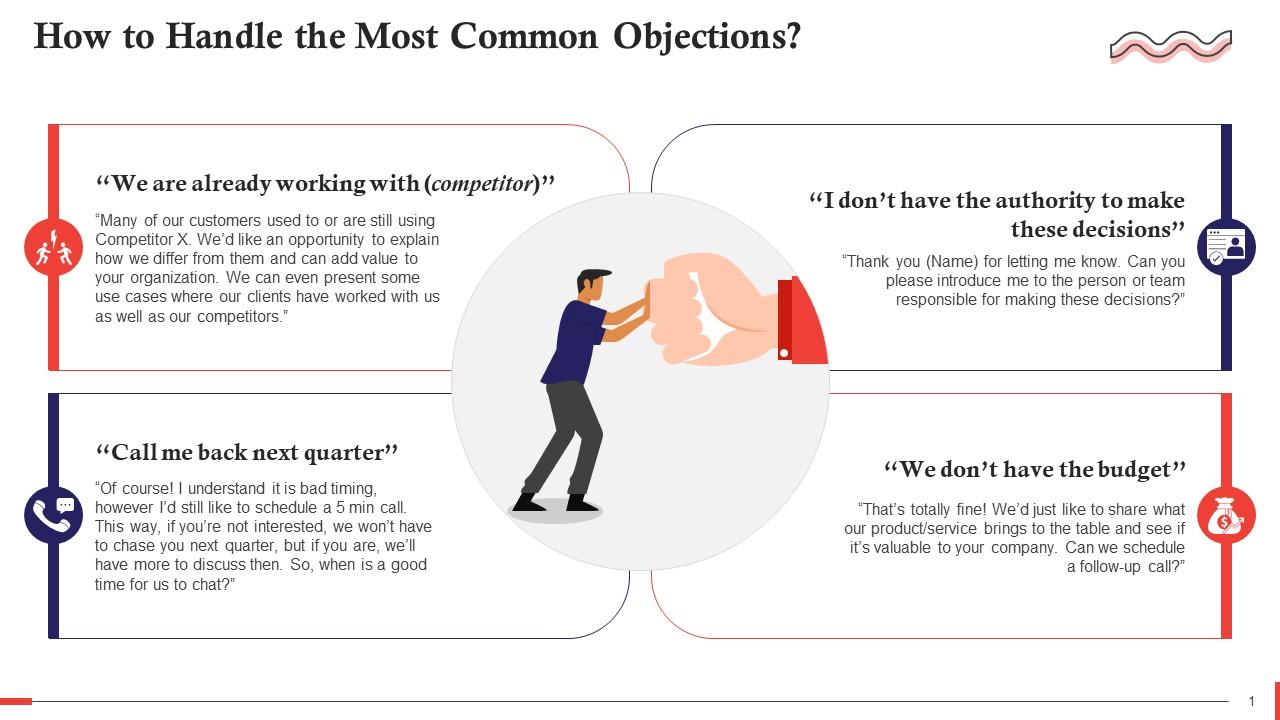
- Acknowledge graciously (never bash): *"Competitor X is a solid product — a lot of teams shortlist both of us, so it's smart you're comparing."*
- Re-anchor with a question: *"Can I ask — when you looked at X, what was the one outcome you were most trying to protect? Because that's usually where the two of us diverge."*
- Prove the differentiator with a proof point: *"Where teams pick us is [specific differentiator]. For example, [named customer] switched from X for exactly that reason and cut ramp time by a third. Want me to show you how that'd work on your numbers?"*
Add the trap-setting move from Command of the Message / MEDDIC thinking: plant a question the buyer should ask the competitor. *"One thing I'd ask any vendor: how do they handle [your known weakness of the competitor]? That tripped up the last two teams who compared us."* This is legitimate when it's true and framed as buyer due diligence — it is not bashing.
Will — lock the commitment. Close with: *"What exactly will you say on the next call, and when is it?"* Have them say the reframe out loud to you before they leave. If they can't say it cleanly to you, they won't say it to the buyer.
The Coaching Plan / Cadence
One conversation doesn't build a reflex. Use a tight loop over two to three weeks, then maintain it. A practical 30/60/90: by day 30 the rep can deliver the reframe verbatim in role-play; by day 60 it shows up unprompted on real recorded calls; by day 90 their competitive win-rate against the named competitor has moved.
Weekly rhythm: one recorded-call review (15 min), one live role-play drill (10 min), and one scorecard check against the leading indicators below. Refresh the battlecard the moment the competitor changes pricing or ships a feature — a stale competitive battlecard is worse than none because it makes the rep sound wrong.
Drills & Role-Play
- The reframe gauntlet: You play the buyer and fire the objection three ways — price ("X is 20% cheaper"), feature ("X has native [feature]"), and social proof ("My peer uses X"). The rep must run the acknowledge → re-anchor → prove sequence each time without bashing. Score them with a simple scorecard: graciousness (0/1), re-anchor question asked (0/1), proof point named (0/1), no volunteered discount (0/1).
- Battlecard recall: Cold, no notes — rep names the top three reasons you win vs. The competitor and the one trap-setting question. If they can't, it's a knowledge gap, not a skill gap.
- Call-review teardown: Use a real Gong clip. Pause at the objection and have the rep narrate the better response before you reveal what they actually said.
- Devil's-advocate switch: Make the rep argue *for* the competitor for 60 seconds. Understanding the competitor's genuine strengths kills the urge to bash and sharpens the honest differentiation.
What to Measure
Watch leading indicators, not just the quarter-end number:
- Competitive win-rate vs. The named competitor in your CRM (Salesforce) or Clari — the lagging proof, but track the trend.
- Reframe adoption rate: % of recorded calls where the rep runs the sequence instead of going feature-war (taggable in Gong/Chorus).
- Discount discipline: average discount on competitive deals — a will-gap rep's number drops as confidence rises.
- Objection-to-next-step conversion: how often a competitor objection still ends in a booked next meeting.
- Time-to-competence: weeks until the reframe appears unprompted on live calls.
Common Mistakes Managers Make
- Coaching the deal, not the skill. You save the Riverside deal by jumping on the call yourself, and the rep learns nothing. Coach the pattern so they win the next ten.
- Handing over the script instead of building it. A reframe the rep co-created sticks; one you dictated evaporates under pressure.
- Letting the rep bash the competitor. It feels strong and reads as insecure. Buyers punish it. Police graciousness hard.
- Treating a system problem as a skill problem. If you genuinely lose to that competitor in that segment, no amount of role-play helps — escalate the fit, pricing, or targeting issue.
- No follow-through. One great 1:1 with no recorded-call check next week means the old habit returns by Friday.
- Coaching everyone the same. A confident rep needs knowledge; a knowledgeable rep needs confidence. Diagnose first.
FAQ
How do I stop my rep from bashing the competitor? Make graciousness an explicit line item on the role-play scorecard and dock them for any negative adjective. Reframe it as a sales advantage: *"The buyer trusts the person who stays gracious."* Buyers read trash-talk as fear. Replace bashing with honest trap-setting — true questions the buyer should ask any vendor.
What if the competitor genuinely is cheaper or better on that feature? Acknowledge it openly and move the anchor to the outcome the buyer is actually protecting. *"You're right, they're cheaper on license — the question is total cost once you factor in ramp and the rework teams hit at month six."* Honesty buys the right to reframe; denial loses it.
Should I build a battlecard or coach off the cuff? Build one. A current competitive battlecard with three win-reasons, three proof points, and two trap-setting questions is the single highest-leverage asset for these objections. Keep it living — refresh it on every competitor pricing or feature change.
How is this different in 2027 with AI-assisted buyers? Buyers now arrive with AI-generated comparison grids, so feature parity is assumed and the comparison objection comes earlier and sharper. Coaching shifts from features to outcomes and proof — the reframe and a credible named proof point matter more than spec sheets the buyer already pulled.
When is the comparison objection a sign to walk, not coach? When you genuinely don't differentiate for that buyer's use case and the competitor is the right fit. Teach reps to qualify that out early rather than discount into a loss. That's a targeting conversation for you and the rep, not a closing drill.
Bottom Line
A competitor comparison objection is a re-anchoring problem, not a feature fight. Diagnose skill vs. Will vs.
Knowledge vs. System first, then drill one verbatim sequence — acknowledge graciously, re-anchor on the buyer's outcome, prove the differentiator with a named proof point — until it's reflexive. The one move that matters: get the rep to ask a re-anchoring question instead of defending features.
Sources
- Gong Labs: How top reps handle competitive deals
- HBR: The New Sales Imperative
- RAIN Group: Handling Sales Objections
- Challenger: Reframing the customer conversation
- Sandler: Negotiating and handling objections
- Winning by Design: Sales coaching frameworks
- Salesforce: What is a competitive battlecard
- Sales Hacker: Coaching reps on competitive objections
*Sales coaching for competitor comparison objections — how to coach a rep to handle a competitor comparison objection, sales manager coaching guide, competitive objection-handling framework, battlecard reframe drills, and a rep coaching playbook for 2027.*