 Pulse Reviews and Analysis
How do you document and track coaching across your team?
 Curated by Kory White · Fractional CRO, CRO Syndicate
Direct Answer
Document coaching the same way you document deals: one lightweight, durable record per rep that captures the theme you coached, the commitment the rep made, and the progress since last time. The core move is a shared coaching log (one row per 1:1) plus a team-wide skills matrix that ranks every rep against the same selling competencies.
Keep the log to three fields, store it where your team already lives (Salesforce, Gong, or a shared sheet), and review it before every 1:1 so coaching compounds instead of resetting. Tracking across the team is then just an aggregation: roll the matrix up to see who is stuck on the same skill, who is improving, and where your coaching time is actually paying off.
For 2027, let AI call-coaching tools auto-tag the themes so the log fills itself and you spend your time coaching, not typing.
Why This Happens — Diagnose Before You Coach
Most teams do not have a tracking problem; they have a memory problem dressed up as a tracking problem. Managers coach in the moment, the rep nods, and three weeks later nobody remembers what was agreed. Before you buy a tool or build a template, diagnose why coaching is not sticking.
It is almost always one of four causes: a skill gap (the manager never named the specific behavior to change), a will gap (the rep agreed to nothing concrete), a knowledge gap (no one knows what "good" looks like, so progress can't be judged), or a system gap (the record lives in the manager's head or a notebook nobody else can see).
Naming the real cause changes the fix. A skill gap needs a tighter coaching script. A will gap needs a written commitment with a date.
A knowledge gap needs a skills matrix with explicit rubric levels. A system gap needs the log to move out of your head and into Salesforce, Gong, or a shared doc. Route the symptom to the cause before you spend a dollar on enablement tools.
The Coaching Conversation
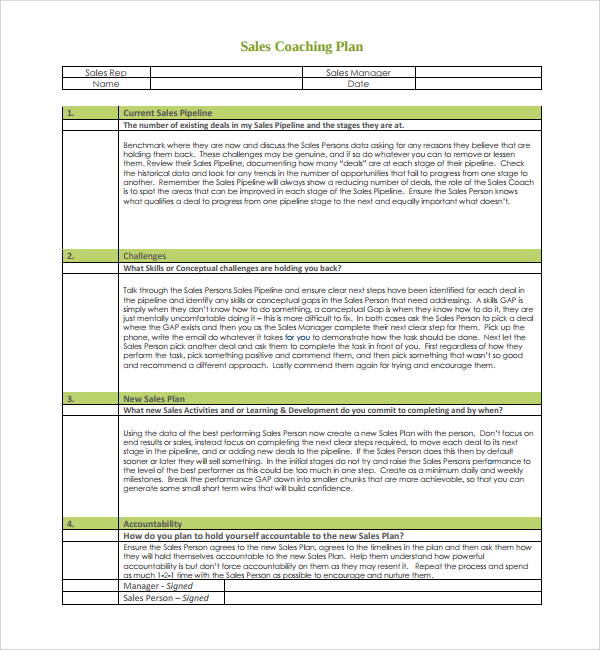
You document by coaching well, then capturing three things. Use a GROW model spine — Goal, Reality, Options, Will — and write the rep's words, not yours, into the log. Here is the verbatim 1:1 close, the part that produces the record.
Open by reviewing last time, out loud, from the log: "Last session you committed to running a discovery call with three quantified-impact questions. Walk me through how it went." This single sentence tells the rep that the log is real and that commitments are tracked. Reps prepare differently when they know you will reopen the page.
Then coach the new theme using GROW. For Goal: "What's the one thing you want to get better at this month that would move your number?" For Reality: "Show me the last call where that showed up — what actually happened?" For Options: "What are two ways you could handle that moment differently next time?" For Will, and this is the line that creates a trackable commitment: "By our next 1:1, what specifically will you have done, and how will we both know it happened?"
Close by writing it down together, on screen, so the rep sees the record being made: "Here's what I'm logging — theme: multi-threading; commitment: add a second contact to your top three deals by Friday; I'll check Salesforce and we'll review next Tuesday." Naming the field you will check (Salesforce contact roles, a Gong call, a CRM stage) turns a vague promise into a measurable one.
If the rep cannot name a concrete action twice in a row on the same theme, that is your signal it is a will problem or a wrong-fit hire — not a coaching-frequency problem.
The Coaching Plan / Cadence
Tracking only works on a rhythm. Run a weekly 30-minute 1:1 per rep with a fixed three-part shape: 10 minutes reviewing last week's logged commitment, 15 minutes coaching one theme, 5 minutes writing the new commitment. Once a month, zoom out: open the skills matrix for the whole team and ask which competency is reddest across the most reps — that becomes the next team-wide training topic.
Once a quarter, score every rep against the matrix again and compare to last quarter; that delta is your coaching ROI, in writing.
The loop is what makes the documentation compound rather than accumulate. Each pass should feed the next.
Drills & Role-Play
The log tells you which drill to run. If three reps are stuck on the same matrix cell — say, objection handling — pull them into a 20-minute group role-play instead of repeating yourself in three separate 1:1s. Run a call review: pick one Gong or Chorus recording, play the 90-second moment that went wrong, and have the rep re-deliver it live until it lands.
For pipeline gaps, run a discovery role-play where you play a skeptical CFO and score the rep against the matrix rubric on the spot, then log the score.
Use a one-page scorecard during drills so the documentation is consistent across managers: list the 5–7 competencies, rate each 1–4, and circle the one to coach next. The scorecard is the unit that feeds the matrix; if every manager scores the same way, the team rollup actually means something.
Rotate a "rep of the week" recording into your team meeting so good behavior is documented and copied, not just corrected.
What to Measure
Do not track "coaching happened." Track whether behavior changed. The honest leading indicators are: session-to-action conversion (what percent of logged commitments were actually completed by the next 1:1), theme recurrence (how many sessions before a theme stops appearing — fewer is better), matrix movement (competency-level change quarter over quarter), and the behavior's own metric (if you coached multi-threading, did average contacts-per-opportunity in the CRM rise?).
Roll these up across the team to find your real picture: a rep whose commitments complete and whose matrix score climbs is coachable and improving; a rep whose theme repeats for six sessions with no metric movement is a performance conversation, not more coaching. Lagging quota tells you what happened last quarter; these leading indicators tell you what next quarter will look like, and they live in the same coaching log you already keep.
Common Mistakes Managers Make
Coaching to the deal, not the skill. It feels productive to save a deal in the 1:1, but if you never name the transferable skill, nothing gets logged and nothing repeats. Always end deal coaching with the skill it generalizes to.
No written commitment. A 1:1 that ends with "sounds good, keep at it" produces no record and no accountability. If you cannot write the commitment in one sentence with a date, you did not coach — you chatted.
No follow-through. Logging a commitment and never reopening it teaches reps the log is theater. The first 10 minutes of every 1:1 must reference last week's entry, or the whole system dies.
Coaching everyone the same. A blanket weekly cadence ignores the matrix. Your two reddest reps may need twice-weekly sessions; your two greenest need monthly check-ins and stretch goals. Let the documented skills matrix set the dose.
Confusing volume with progress. Forty coaching notes that all say "needs to prospect more" is not tracking; it is a stuck signal you ignored. Recurrence in the log is data — act on it.
Hoarding the record. If the log lives only in your notebook, it cannot survive a manager change or roll up to the team. Put it in Salesforce, Gong, or a shared doc the second-line leader can see.
FAQ
What's the minimum viable coaching log? Three columns per session: theme coached, commitment made (with a date), and progress on the prior commitment. Add a competency tag so it rolls up to the skills matrix. Anything more is optional; anything less is not a record.
A shared spreadsheet works on day one — you do not need to buy software to start.
Where should the coaching log live — CRM, Gong, or a spreadsheet? Wherever your team already works, so it gets used. Salesforce or HubSpot custom objects keep coaching next to the deals; Gong and Chorus auto-tag call themes so the log half-fills itself; a shared sheet is the fastest start.
The worst place is a private notebook no one else can read.
How do I track coaching across many managers consistently? Standardize the unit, not the manager. Give every manager the same 5–7 competency scorecard and the same three log fields. When the inputs are identical, the team-wide skills matrix becomes comparable and your VP can see real patterns instead of each manager's personal style.
How often should I update the skills matrix? Score lightly every 1:1 via the scorecard, and do a formal full re-rate once a quarter. The quarterly delta is your coaching ROI; the weekly scores keep the matrix from going stale between formal reviews.
Can AI tools document coaching for me in 2027? Largely, yes — Gong, Chorus, and similar enablement tools now auto-transcribe calls, tag the coaching theme, and surface the moment to review, so the "theme" field fills itself. You still own the commitment and the judgment of whether behavior changed; AI captures what happened, you decide what to do about it.
What if a rep's theme keeps repeating in the log? Three or more sessions on the same theme with no metric movement is a diagnosis, not a coaching cadence to double down on. Check whether it is a will gap or a wrong-fit hire. At that point the documented history becomes the basis for a performance conversation or PIP, not another coaching note.
Bottom Line
The one move that matters is a durable, shared coaching log with three fields — theme, commitment, progress — rolled up into a team skills matrix and reviewed at the start of every 1:1. Store it where your reps already work, let AI enablement tools auto-tag the themes, and measure commitment-completion and matrix movement instead of "coaching happened." Documentation is not the goal; it is what makes coaching compound across the whole team.
Sources
- How the Best Sales Managers Coach (Gong Labs research)
- Sales Coaching: The Ultimate Guide (RAIN Group)
- The GROW Model of Coaching (Harvard Business Review)
- Why Sales Coaching Matters (CSO Insights / Korn Ferry)
- Building a Sales Skills Matrix (Sales Hacker)
- Sales Coaching with Conversation Intelligence (Salesforce blog)
- Coaching to Behaviors, Not Just Numbers (Winning by Design)
*Sales coaching for documenting and tracking coaching across your team — how to coach with a coaching log, sales manager coaching guide, rep coaching framework, skills matrix tracking, and a coaching playbook for 2027.*