


Top 10 Network Cable Testers — Best Overall + Best Value in 2027
Quality
Certified
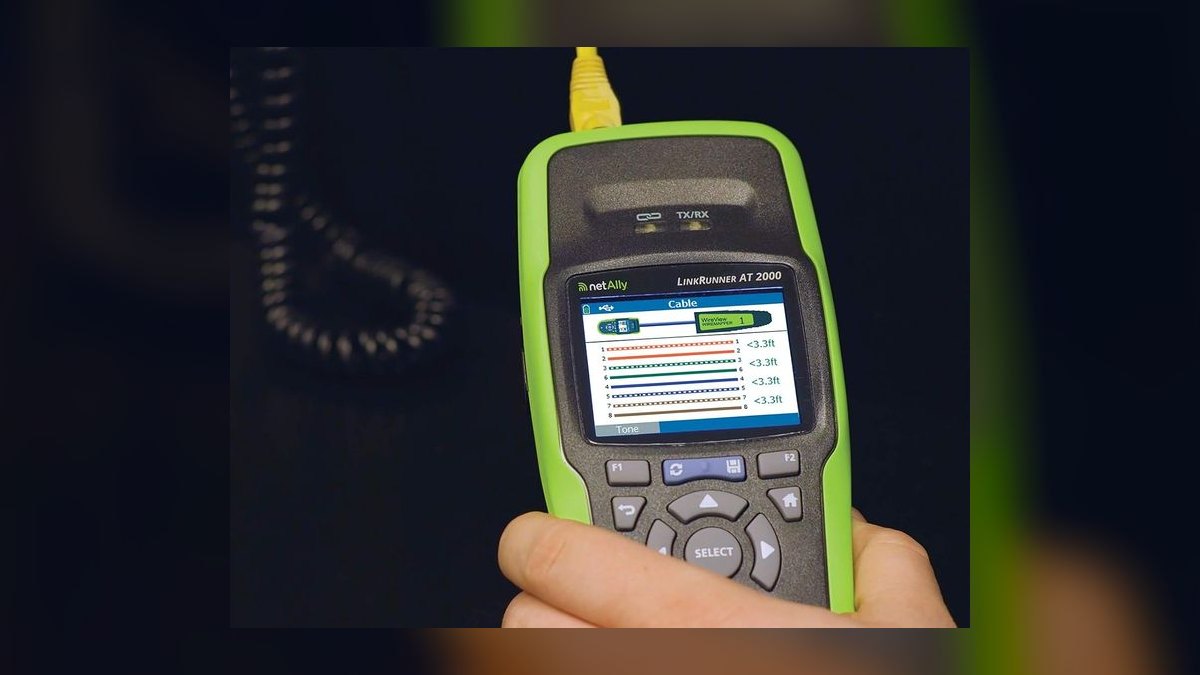
The 10 best network cable testers are ranked below on measured performance, build quality, price, and how each one actually holds up in daily use rather than how it reads on a spec sheet. Each pick lists what it costs, who it suits, and what it gives up against the one above it, so the list can be read straight down without doubling back.
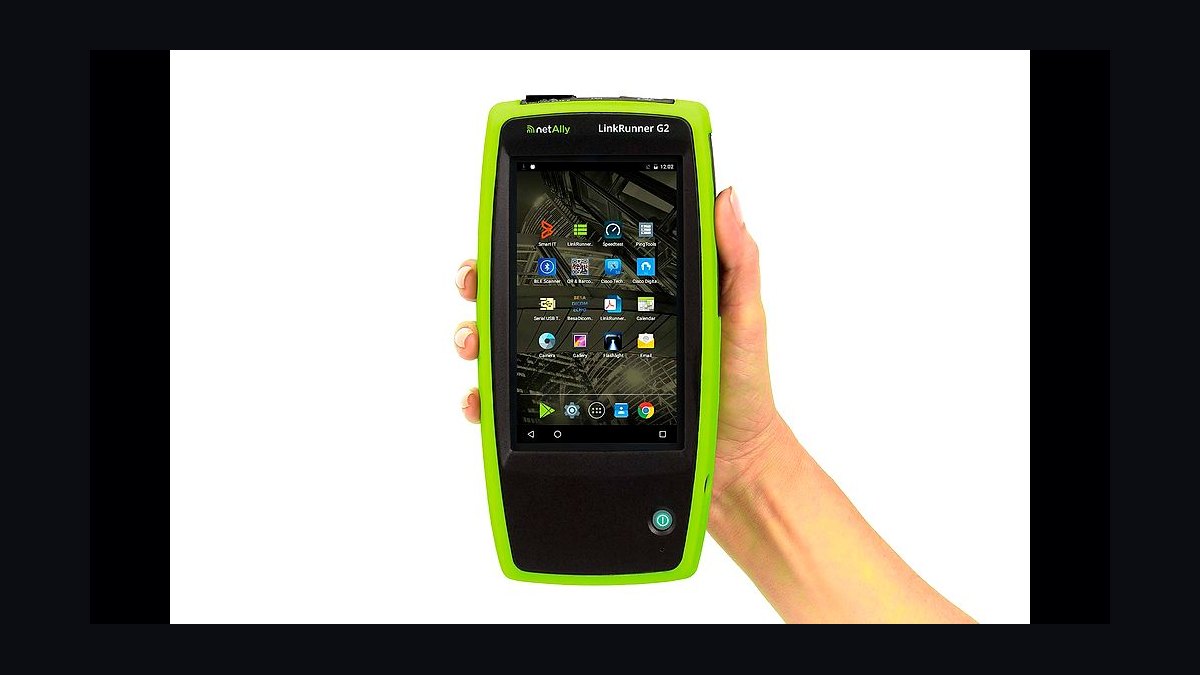
1NetAlly LinkRunner G2
Ranks first because it is the only handheld here that covers physical layer through IP layer in one pass. The Android-based unit runs wire-map, link speed to 1G natively and 10G with an SFP+ adapter, PoE class detection with voltage measured under load, and automatic DHCP, DNS, gateway and traceroute checks. Results upload to the Link-Live cloud with photos and job notes attached. Around $1,199, with a battery that runs a full shift.
Built for field techs and MSPs who bill for documentation and need one tool per truck. It trades away affordability, roughly seventeen times the price of the Klein LAN Scout Jr 2, and its touchscreen and Li-ion pack demand more care than a 9V verifier. Compared with the LinkSprinter 200 below it, you gain a screen, TDR and 10G capability; you pay about $400 more for them.
2NETSCOUT LinkSprinter 200
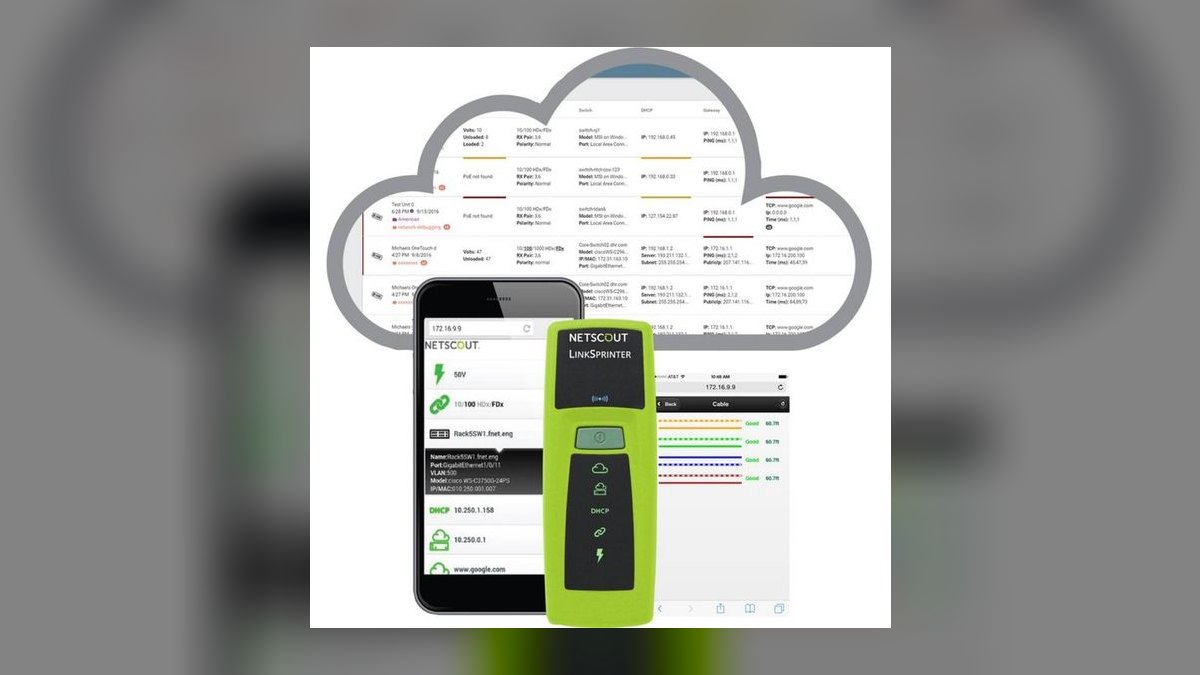
Second because it answers the most common field question, is this drop live and where does it land, faster than anything else here. Six LEDs sequence through link, DHCP, gateway, DNS, internet and VLAN tests, then the full result auto-emails through Link-Live. It reads 10/100/1000 link, measures 802.3af/at PoE voltage, and pulls switch and port identity over CDP or LLDP. About $799, 3.5 ounces, AAA-powered.
For helpdesk and IT teams closing tickets in unlabeled closets, where nearest-switch discovery saves an hour per call. It gives up wire-map and TDR entirely, so a second continuity tester still rides in the bag, and results live on your phone rather than an onboard screen. The LinkRunner G2 above does everything this does plus cable diagnostics; this is the pocketable half.
3Klein Tools Scout Pro 3
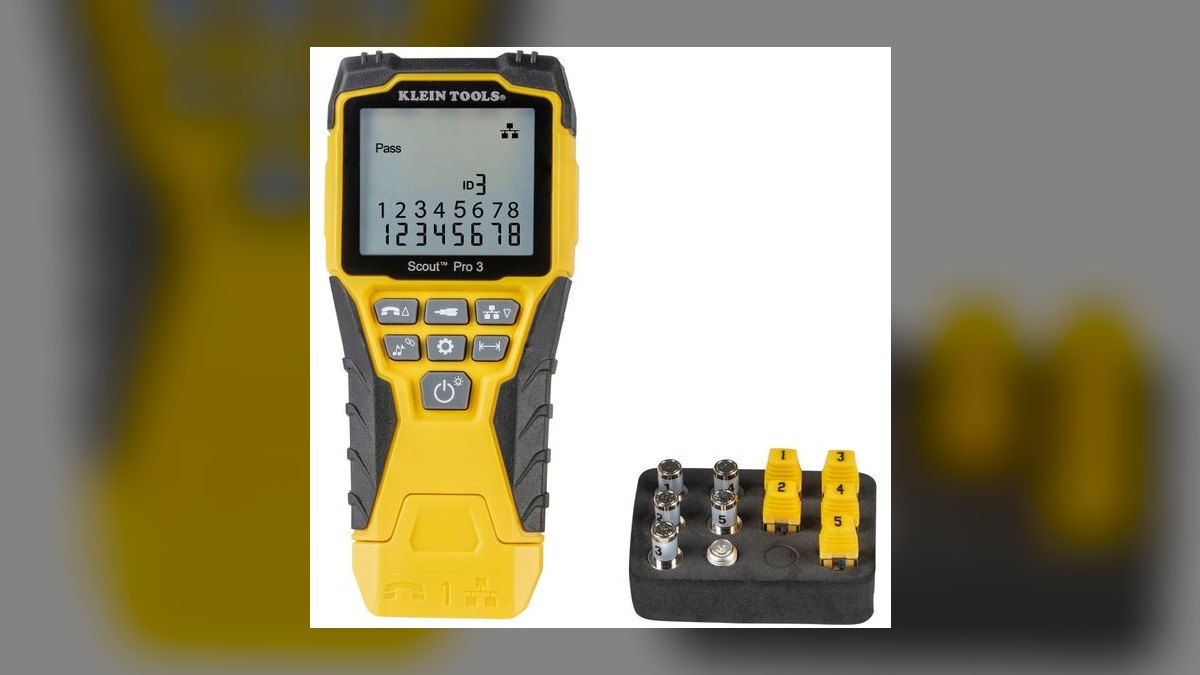
Third for mapping throughput: the kit ships six numbered self-storing remotes, so an entire patch panel gets identified in one walk instead of six trips. It tests RJ45, RJ11/12 voice and F-connector coax, measures length to 2,000 feet by TDR, and flags opens, shorts, miswires, reversed pairs and split pairs. An LED probe and a built-in tone generator handle tracing. Roughly $299 for the complete kit.
Aimed at low-voltage installers running residential and light commercial work where labeling matters more than link speed. It verifies physical layer only, with no Gigabit negotiation test and no cloud reporting, and its PoE detection reports presence rather than class. Against the MicroScanner below it, you trade Fluke's graphical wire-map display and link-speed readout for multi-remote mapping and a toner probe in the same box.
4Fluke MicroScanner MS2-100
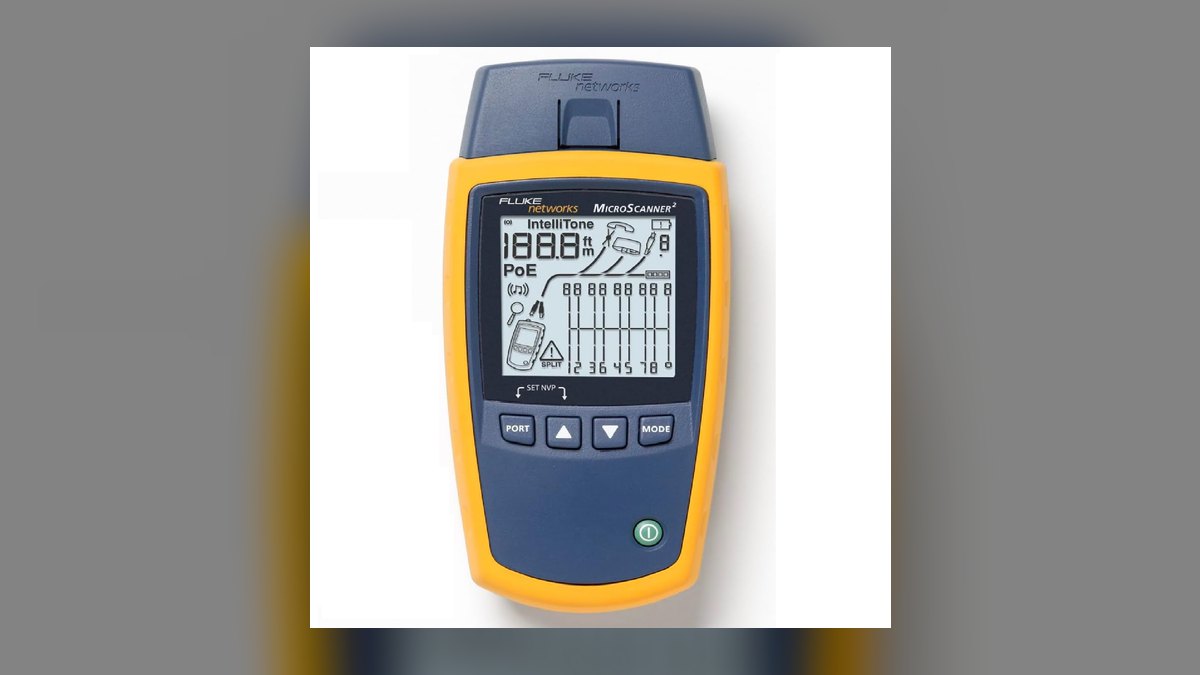
Fourth because it is the fastest single-button verifier here and the one most likely to survive a decade in a tool bag. It draws wire-map as a diagram on a backlit graphical LCD, reports total length and distance-to-fault by TDR, identifies 10/100/1000 link speed, and detects PoE and PoE+ class. It works on Cat5e through Cat6a and coax, running past twenty hours on two AA cells. About $349.
The pick for structured-cabling techs who want Fluke build quality without spending four figures. Results stay on the screen, with no app, no cloud sync and no exported report, and it will not tell you whether a run can carry Gigabit, only that it is wired correctly. It pairs with the IntelliTone Pro 200 probe sold separately, where the Klein kit above bundles its own.
5Fluke CableIQ Qualification Tester
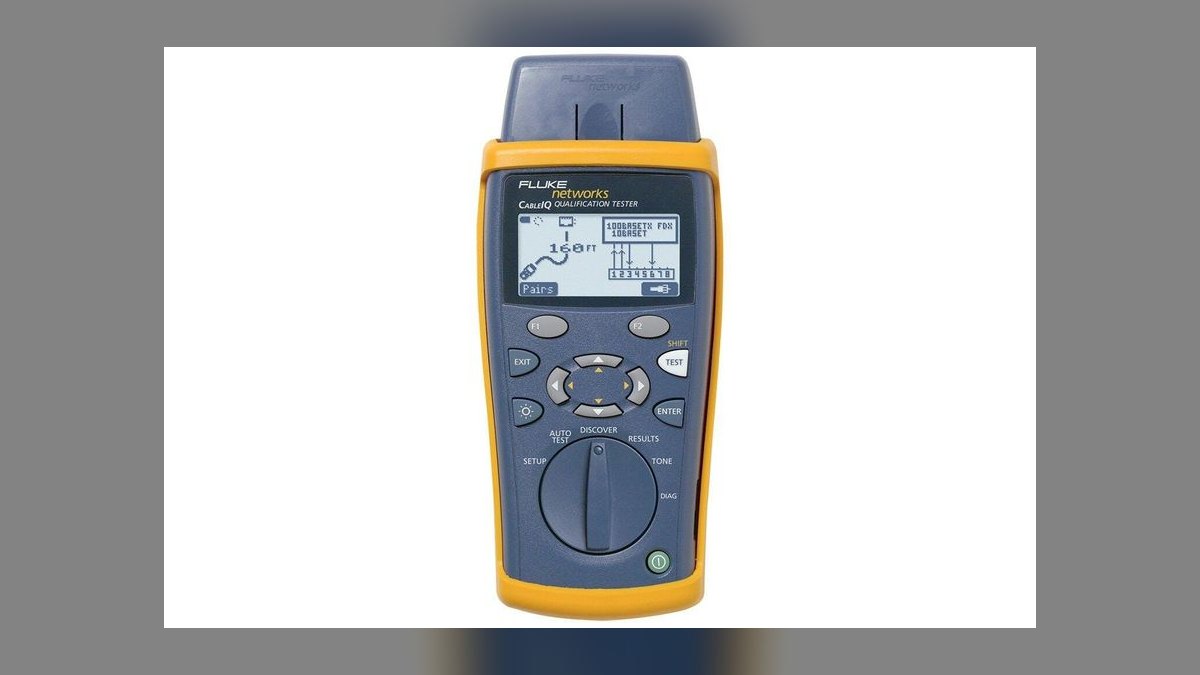
Fifth because it fills the gap between verification and certification, measuring bandwidth, crosstalk and impedance to report what speed an existing run will actually carry. That settles the brownfield question, whether aging Cat5e can push Gigabit, without buying a certifier. It also handles TDR length, distance-to-fault and split-pair detection, and discovers switch port speed, duplex and VLAN tags. Around $1,499 with a rechargeable Li-ion pack.
Worth it for installers auditing inherited cabling before writing an upgrade quote, not for anyone testing patch cords. It does not produce TIA-568.2-D certification reports, so it cannot back a manufacturer warranty on a new commercial install; that still needs a DSX-series certifier. Priced above the LinkRunner G2 yet lacking its IP-layer testing and cloud workflow, it is a narrower, deeper instrument.
6Klein LAN Scout Jr 2
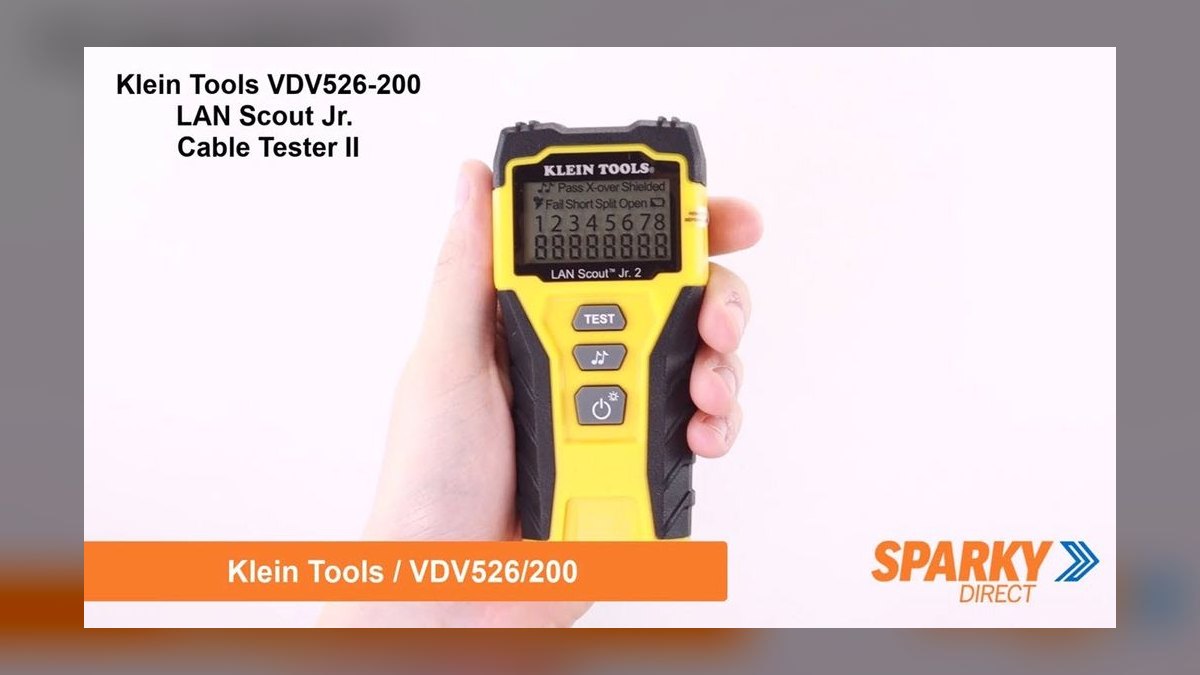
Best value at roughly $69, and it ranks here rather than lower because of the PoE indicator, which warns you before connecting to a live powered drop. That is exactly how cheap clones die. It maps RJ45 wiring on Cat5e, Cat6 and Cat6a end to end and flags opens, shorts, miswires, reversed pairs and split pairs. The remote stores in the body, and a single 9V cell powers it.
This is the tester every IT bag, home lab and AV cart should already own. It gives up length measurement and TDR completely, so it confirms a run is broken without telling you where the break sits. Against the TRENDnet TC-NT2 at a similar street price, you lose coax and phone jacks but gain PoE safety and Klein's lifetime warranty on the tester body.
7Pockethernet Bluetooth Cable Tester
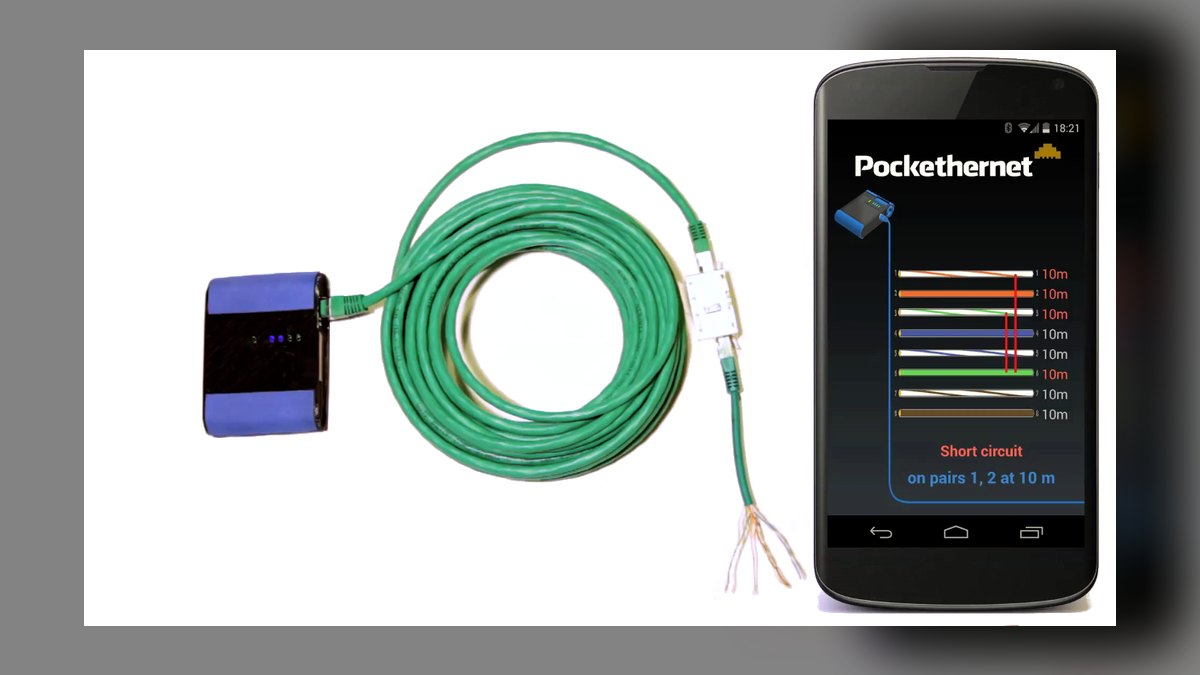
Seventh for capability per cubic inch: a device the size of a pack of gum runs wire-map, TDR length-to-fault, PoE class detection, VLAN discovery, DHCP, ping, traceroute and CDP/LLDP switch identification. Everything surfaces in an iOS or Android app over Bluetooth, which generates PDF job reports carrying a logo and job ID. It covers Cat5e through Cat6a, charges over USB, and costs around $249.
Built for engineers and small MSPs who want LinkRunner-class diagnostics at a fraction of the price and already carry a phone. The catch is that the phone is the screen, so a dead handset or a shielded closet that blocks pairing stops the job cold. Against the MicroScanner above, it adds IP-layer testing and exportable reports but loses instant readouts on the tool itself.
8TRENDnet TC-NT2 Cable Tester
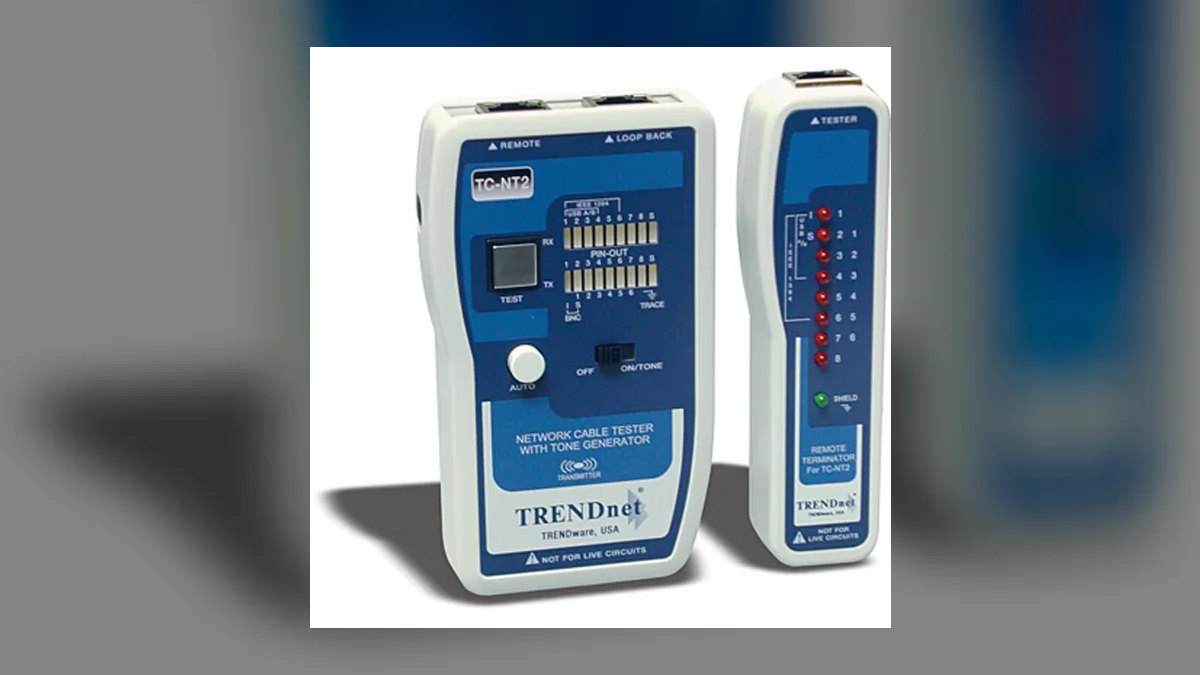
Eighth because it is the honest version of a design cloned under dozens of brand names, shipping with real quality control and a one-year warranty behind it. It checks RJ45, RJ11/12 and BNC coax for continuity, opens, shorts and miswires against both 568A and 568B, and a slow-scan mode lights each pair in turn so a fault is easy to read. Main unit, remote and case run about $69.
For techs who need one cheap box covering data, phone and coax on mixed legacy jobs. There is no PoE warning at all, so connecting to a live powered drop is a gamble, and there is no length or distance-to-fault capability whatsoever. At the same street price, the Klein LAN Scout Jr 2 above trades away coax and phone testing for PoE safety.
9NoyaFa NF-8601 Cable Tester
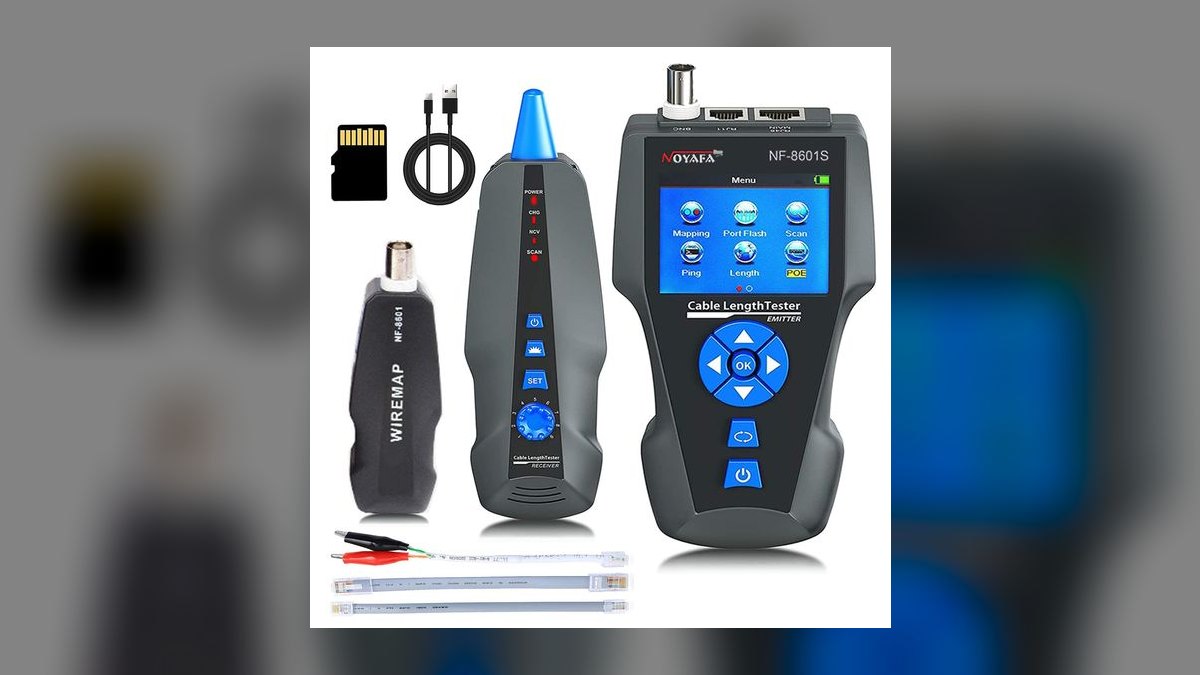
Ninth because it is the cheapest credible route to TDR fault-finding, measuring length up to roughly 2,000 feet on twisted pair, coax and phone line and locating opens and shorts within about a meter. A 2.8-inch color LCD, rechargeable Li-ion battery, PoE detection, port flasher and anti-burn input protection arrive near $129, with a multi-port remote identifier kit sold separately as an add-on.
A sensible buy for budget installers who need distance-to-fault before opening drywall and cannot justify $299 for the Klein kit. The trade is polish and support: firmware strings read as rough machine translation, warranty service runs through the marketplace seller, and long-term accuracy is far less proven than Fluke's. The feature list rivals testers at twice the price; the documentation and build do not.
10Triplett LAN-Pro CTX590
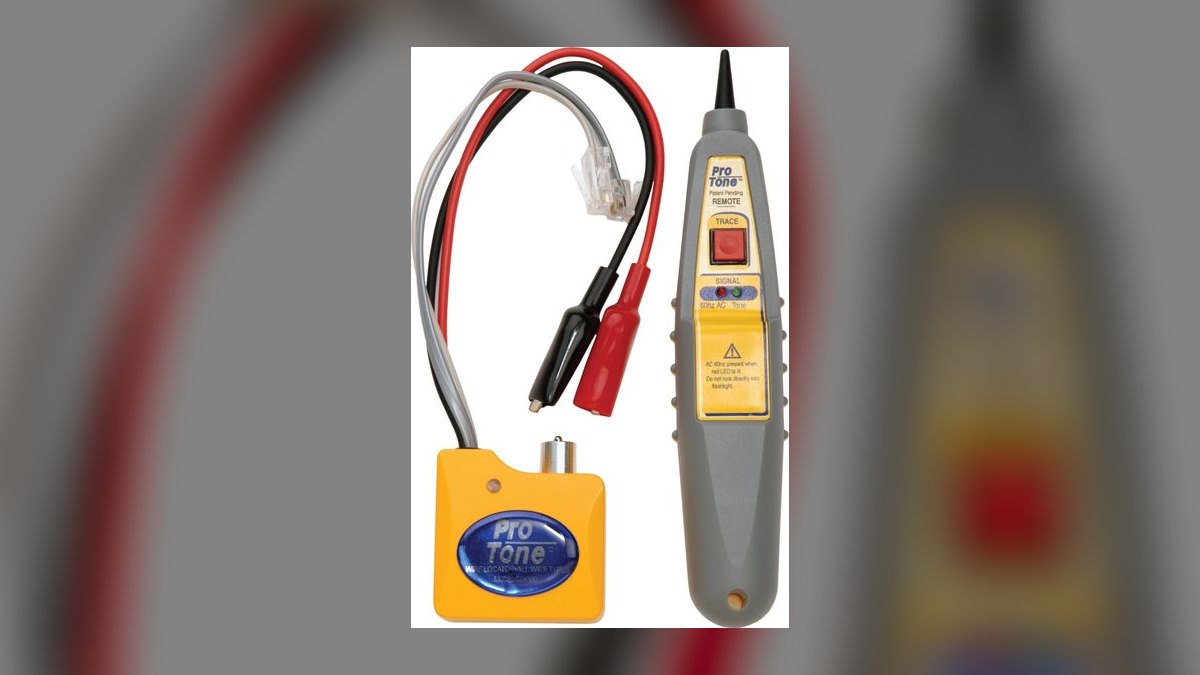
Tenth because its breadth suits mixed-trade work rather than pure network installs: it verifies Cat5e through Cat6a, RG-6 and RG-59 coax, USB and four-conductor alarm or door cable from one unit. Eight remote identifiers are included for mapping a panel in a single pass, a PoE and voltage detector flags hot lines, and it identifies 10/100/1000 link speed. Around $179, running on a 9V battery.
The right call for AV and security integrators pulling camera, intercom and IP signal on the same job, where a network-only tester leaves half the wiring unchecked. It reports strictly on-device, with no app, no cloud and no exported documentation, and its network diagnostics stop well short of the Pockethernet's IP-layer tests. A built-in tone generator works with any analog probe you already carry.
How we ranked these
We weighted certification depth at 30%, wire-map plus TDR distance-to-fault at 20%, PoE intelligence at 15%, app and cloud reporting at 15%, build durability and battery at 10%, and price-to-feature ratio at 10%. Scores came from Fluke Networks and NETSCOUT datasheets, Klein Tools spec sheets, retailer pricing at CDW and B&H, and field reports from r/networking and r/HomeNetworking installers who use these tools daily.
We deliberately ignored full TIA-568.2-D certifiers like the DSX-8000, which start near $10,000 and serve warranty paperwork rather than troubleshooting. We ignored fiber-only instruments — OTDRs, light sources, and power meters — because that is a separate $2K-$5K category. We also ignored screen size, bundled toner probes, and unbranded $20 Amazon clones whose continuity method can trip PoE port protection.
What to look for
The real decision is which tier you need. A verifier ($69-$349) confirms the pairs land on the right pins. A qualifier like the CableIQ tells you whether an existing run can actually carry Gigabit or 10G. A certifier produces the paperwork a manufacturer warranty demands. Buying a verifier when the job requires qualification means guessing at brownfield Cat5e, and buying a certifier for troubleshooting wastes thousands.
The common mistake is treating PoE as a single checkbox. Passive detection only flags voltage present; it will not tell you class or measure voltage under load, and PoE++ at 90W can damage testers that were never designed for 802.3bt. The second mistake is skipping TDR. Continuity says the cable is broken; TDR says it broke 47 meters in, which is the difference between one drywall cut and five.
Related questions
What is the difference between a cable verifier, qualifier, and certifier?
A verifier ($69-$349) checks wire-map, continuity, and faults like shorts and split pairs. A qualifier ($1,000-$1,500, such as the Fluke CableIQ) measures bandwidth and crosstalk to confirm a run supports Gigabit or 10G. A certifier ($8,000-$15,000, such as the DSX-8000) produces TIA-568.2-D reports required for commercial cabling warranties.
Can any tester on this list test fiber?
Only the Fluke Networks LinkRunner G2 handles fiber, and only through an SFP or SFP+ module for link validation. Real fiber certification requires an OTDR, light source, and optical power meter — a separate category running $2K to $5K. Look at the Fluke OptiFiber Pro or EXFO MaxTester if fiber is a regular part of your work.
Will a cheap tester damage a PoE switch?
A modern PoE switch is short-circuit protected, so a quality tester from Klein, Fluke, or NETSCOUT is safe on a live drop. The risk sits with $20 unbranded clones that short pairs together to check continuity — those can trip port protection or report a false fault. The Klein LAN Scout Jr 2 includes a PoE indicator LED for exactly this reason.
Do I actually need TDR length measurement?
Yes if you install cable, no if you only test patch cords. TDR reports distance to a break or short, so you know the fault is 47 meters down a wall instead of opening drywall blind. Accuracy degrades on very short patch cords under about five feet, which is why bench testing rarely benefits. The NoyaFa NF-8601A adds TDR for $129.
Which tester is best under $100?
The Klein VDV526-052 LAN Scout Jr 2 at $69 is our Best Value pick. It maps Cat5e, Cat6, and Cat6a end-to-end, flags opens, shorts, miswires, reversed pairs, and split pairs, and its PoE indicator LED prevents damage on live drops. Klein backs the tester body with a lifetime warranty. The tradeoff is no length measurement and no TDR.
Can these testers validate 10G Ethernet?
Only the Fluke LinkRunner G2, paired with the optional 10G SFP+ adapter, validates a real 10G link. It also covers 2.5G and 5G rates. Full 10G certification requires a DSX-8000 with CableAnalyzer modules, which is outside this list's scope. Many runs labeled Cat6a fail at 10G because of crosstalk from tightly bundled cable.
What does cloud reporting actually save?
Fluke's Link-Live and the Pockethernet app attach GPS, photos, and job notes to each test and push results straight into a ticket queue or PDF. For MSPs billing per drop, that removes the manual write-up at the end of every job. The NETSCOUT LinkSprinter 200 auto-emails results without a screen, which is its entire design premise.
Why buy a multi-remote kit instead of a single tester?
Remotes let you map an entire patch panel in one pass instead of walking back and forth per drop. The Klein Scout Pro 3 kit ships six numbered self-storing remotes plus an LED probe; the Triplett LAN-Pro CTX590 includes eight. On a 48-port panel, that difference is roughly a full afternoon of labor saved on a single install.
FAQ
What makes the Fluke LinkRunner G2 the Best Overall pick?
At $1,199 it is the only tool here that combines wire-map, TDR, link validation to 10G, PoE++ Class 0-8 detection with voltage under load, IPv4/IPv6 connectivity testing, and Link-Live cloud reporting in one Android-based handheld. It covers Cat5e through Cat8 copper plus fiber via SFP. The 5-inch touchscreen, IP54 housing, 8-hour battery, and 3-year warranty back it up.
Is the LinkSprinter 200 worth $799 with no screen?
It is if your work is answering "is this drop live and on which VLAN" repeatedly. Six LEDs sequence through link, DHCP, gateway, DNS, internet, and VLAN tests, then results auto-email to your ticket queue. Switch port discovery via CDP, LLDP, and EDP saves hours in unlabeled closets. It has no TDR or wire-map, so you still carry a continuity tester.
What does the Fluke CableIQ do that a MicroScanner cannot?
The CableIQ ($1,499) measures actual bandwidth, crosstalk, and impedance to tell you what speed an existing run supports — the answer to "can this 15-year-old Cat5e push Gigabit?" The MicroScanner MS2-100 ($349) verifies wire-map, length, distance-to-fault, and link speed present, but does not qualify a cable for a rate. Neither produces TIA-568.2-D certification reports.
How does the Klein Scout Pro 3 kit differ from the LAN Scout Jr 2?
The Scout Pro 3 kit at $299 adds TDR length measurement to 2,000 feet, RJ11/12 voice and F-connector coax testing, a color LCD, a built-in tone generator, and six numbered remotes plus an LED probe. The $69 LAN Scout Jr 2 is RJ45 continuity and wire-map only with one detachable remote. Both carry Klein's lifetime warranty on the tester body.
Why is the Pockethernet a cult favorite among MSPs?
It fits in a pocket and delivers wire-map, TDR length-to-fault, PoE class detect, VLAN discovery, DHCP, ping, traceroute, and CDP/LLDP switch identification through a Bluetooth-paired iOS or Android app — full Layer 1 through Layer 3 diagnostics for $249. The app generates branded PDF reports with customer logos and job IDs. The catch: no internal screen, so shielded closets can leave you stranded.
What separates the TRENDnet TC-NT2 from identical-looking clones?
The TC-NT2 design is sold under dozens of brand names at every price point. TRENDnet's $69 version ships with actual QC and a 1-year warranty, tests RJ45, RJ11/12, and BNC coax, and includes a slow-scan mode that lights pairs one at a time for diagnosis. It has no PoE warning, so treat live PoE drops as off-limits with this tool.
Is the NoyaFa NF-8601A reliable enough for professional work?
For $129 it delivers TDR length to 2,000 feet, fault location within roughly a meter, a 2.8-inch color LCD, PoE detection, a port flasher, and anti-burn circuitry that survives accidental hot connections. Field reports on r/networking rate it the best TDR under $150. The main complaint is rough Chinese-to-English firmware translation, not measurement accuracy.
Which tester suits AV and security installs?
The Triplett LAN-Pro CTX590 at $179 tests Cat5e through Cat6a, RG-6 and RG-59 coax, USB, and 4-conductor alarm and door cable in one unit, with eight remote IDs for mapping a panel in a single walk. It validates link speed at 10/100/1000, includes a tone generator, and carries a 2-year warranty. There is no app or cloud reporting.
Do I need to worry about PoE++ at 90 watts?
Yes, if you touch modern access points, PTZ cameras, or desk phones. Passive-PoE testers only flag voltage present and can be damaged by 802.3bt drops. Only the LinkRunner G2 measures Class 0-8 with real voltage under load. Testers with a PoE detect LED, like the Klein units, at least warn you before you connect something that cannot handle it.
Are bundled toner probes worth using?
Rarely. The probes packed into budget kits trace short runs in quiet environments and struggle in bundled or noisy conditions. The Fluke IntelliTone Pro 200 at $169 outperforms every bundled probe and pairs with the MicroScanner MS2-100. The exception is the Klein Scout Pro 3 kit, whose VDV500-125 LED probe is a genuinely usable tool rather than a throw-in.
Sources
- https://www.flukenetworks.com/datacom-cabling/copper-testing/microscanner-poe
- https://www.netally.com/products/linkrunner-g2/
- https://www.netally.com/products/linksprinter/
- https://www.kleintools.com/catalog/cable-testers-and-locators/scout-pro-3-tester-remote-kit-vdv501-852
- https://www.kleintools.com/catalog/cable-testers/lan-scout-jr-2-tester-vdv526-052
- https://www.flukenetworks.com/datacom-cabling/copper-testing/cableiq-qualification-tester
- https://www.trendnet.com/products/product-detail?prod=175_TC-NT2
- https://www.triplett.com/products/lan-pro-ctx590
- https://www.bhphotovideo.com/c/product/816824-REG/Trendnet_TC_NT2_TC_NT2_Network_Cable_Tester.html
- https://www.nytimes.com/wirecutter/
Related on PULSE
This page will be disappearing soon. Save it to your device for $1 — or read it free while it is here.
@Kory-White- · if Venmo asks, the last 4 of my number are 2012
This page is gone.
This one is off the shelf now. $1 keeps it on your phone for good — the whole page, pictures and diagrams included.
 pulse-reviewsTop 10 Rugged Phones — Best Overall + Best Value in 2027
 pulse-reviewsTop 10 Smart Water Leak Detectors — Best Overall + Best Value in 2027
 pulse-reviewsTop 10 Document Cameras for Remote Demo Recording in 2027
 pulse-reviewsTop 10 Smart Notebooks — Best Overall + Best Value in 2027
 pulse-reviewsTop 10 Tire Inflators — Best Overall + Best Value in 2027
 pulse-reviewsTop 10 NVMe SSD Enclosures — Best Overall + Best Value in 2027
 pulse-reviewsTop 10 Drone Cases — Best Overall + Best Value in 2027
 pulse-reviewsTop 10 Posture Correctors — Best Overall + Best Value in 2027
 pulse-reviewsTop 10 Smart Mirrors — Best Overall + Best Value in 2027
 pulse-reviewsTop 10 Shop Vacuums — Best Overall + Best Value in 2027