


Should I open or buy an AlphaGraphics franchise in 2027?
Quality
Certified
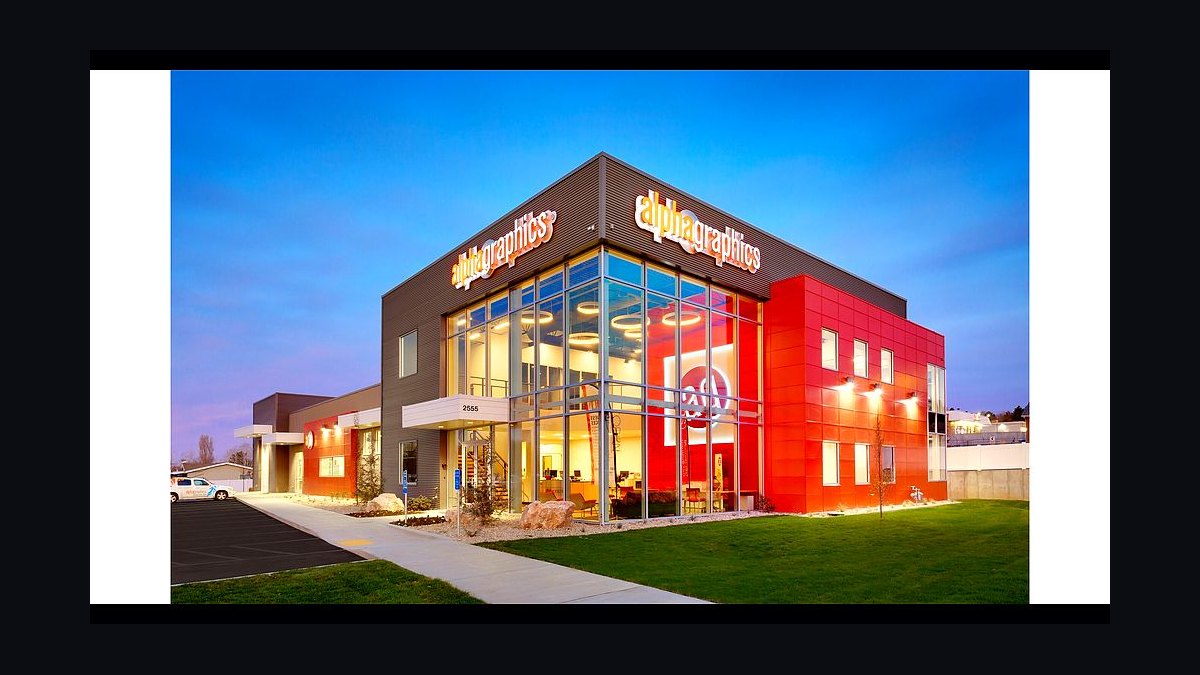
Probably not — unless you already have B2B sales experience, a $400K+ net worth with $150K liquid, and access to a commercial-corridor lease under $4.50/sq ft NNN. An AlphaGraphics franchise in 2027 costs $296,000–$379,000 to open per the 2025 FDD, carries a 7%-sliding-to-3% royalty, and competes in a print industry that contracted 4.6% in 2026 — but operators who push revenue into wide-format signage and vehicle wraps can still clear $300K+ in owner cash flow by Year 3.
What it is and why it matters
AlphaGraphics is a business-to-business print and marketing-services franchise: a Business Center that sells commercial printing, wide-format signage, vehicle wraps, direct mail, and design services to other businesses, not walk-in retail customers. That distinction matters more than anything else in the model. A prospective owner evaluating whether to open a unit in 2027 is not buying a copy shop — they are buying an outbound sales operation with a print production floor attached, and the FDD's numbers only make sense once that's understood.
The initial franchise fee is $48,950, non-refundable, and it buys the brand license, the training curriculum, and access to the corporate marketing and procurement systems. That fee is a small fraction of the real capital commitment. The 2025 FDD's Item 7 range of $296,000–$379,000 covers lease deposits, build-out, a digital production press (typically a Konica Minolta or Ricoh unit), a wide-format printer such as an HP Latex 365, computer and workflow software, insurance, signage, initial training travel to the Salt Lake City headquarters, and three months of working capital. Veteran franchisees and independent franchise consultants routinely say the working-capital line understates real ramp burn by 40–60%, which is why a more realistic all-in figure — including six months of working capital instead of three — runs $355,000 to $465,000.
Why does this franchise exist as a viable category at all when commercial printing as an industry is shrinking? Because "commercial printing" is not one market — it is several markets moving in opposite directions, and AlphaGraphics' economics depend entirely on which side of that split an owner ends up on. Transactional digital printing (letterhead, business cards, basic copy work) is contracting 8–11% a year as small businesses shift to Vistaprint, Moo, and in-house desktop printers. Wide-format signage, vehicle wraps, and large-format graphics are growing 4–9% a year in metros above 250,000 population. An AlphaGraphics center that leans into the growing half of its own product catalog behaves like a completely different business than one that competes on commodity print.
This is why the decision to open or buy in 2027 is really two separate questions bundled into one: can this operator sell B2B accounts, and will this specific unit's revenue mix land in the winning lane or the losing one? Corporate support is real — AlphaGraphics has a 45-year operating history and was named a 2026 Top Franchise by Franchise Business Review with roughly 87–90% franchisee satisfaction on operating experience and brand support — but support does not manufacture demand. The owner still has to generate it.
The step-by-step process
Franchise development teams want a signature quickly. A disciplined buyer runs their own 90-day validation process before committing capital, and the sequence matters because each stage is a gate that should stop a bad decision before it becomes an expensive one.
Days 1–10 are spent validating the market, not the brand. Pull a business database — D&B Hoovers or ZoomInfo are the standard tools — and count businesses with 10+ employees within a 15-mile drive of the target site. The practical minimum is 4,500 such businesses, plus at least two school districts and three hospital systems, since schools and healthcare networks are reliable large-format and wayfinding-signage buyers. A market that doesn't clear this density is not worth pursuing regardless of how good the FDD looks.
Days 11–20 are for requesting and reading the Franchise Disclosure Document. AlphaGraphics' development team typically responds within 48 hours. The document to actually study line-by-line is Item 19, the financial performance representation. The commonly cited $1.37 million average gross sales figure (2024, across 221 of 227 reporting centers) is a mean, not a median — the median sits closer to $1.12 million, and the bottom quartile of units grosses under $640,000. A buyer who only reads the average and skips the distribution is negotiating against their own future numbers.

Days 21–35 are for calling current franchisees, using the Item 20 contact list. Fifteen calls is a reasonable sample size, covering a standard set of questions on ramp time to breakeven, how hard the royalty actually bites once revenue climbs, whether equipment costs came in on budget, and how responsive corporate support has been in practice. The target is eleven or more positive references before moving forward; fewer than that is a signal worth taking seriously, not explaining away.
Days 36–50 go to site selection. The right footprint is 1,800–2,400 square feet of flex-industrial or Class B retail space, not a Class A retail storefront — B2B print customers come to the center in person only a small fraction of the time; the owner and sales staff go to them far more often. Rent above $4.50/sq ft NNN starts eating disproportionately into margin given how thin EBITDA already runs in this model.
Days 51–65 cover lender pre-approval. SBA 7(a) lenders that actively underwrite this brand include Live Oak Bank, Huntington, Wallis Bank, and Byline Bank; a pre-approval target of $250,000–$320,000 at roughly 75% loan-to-value is typical for this category of franchise.
Days 66–80 are for locking the second seat — a dedicated outbound salesperson — before signing the franchise agreement, not after. B2B print sales reps typically earn $55,000–$75,000 base plus 2–4% of net new revenue. If that hire can't be filled or afforded before Discovery Day, that alone is reason to pause.
Days 81–90 end at Discovery Day in Salt Lake City, the final gate before signing. The decision framework below turns these gates into a pass/fail sequence.
Costs, timelines, and typical ranges
The Item 7 investment range in the 2025 FDD breaks down into distinct line items, and each one carries its own risk of running over. The franchise fee is fixed at $48,950. Lease deposits and three months of rent run $9,000–$18,000 depending on whether the space is 1,800 or 3,000 square feet. Build-out and leasehold improvements — flooring, paint, a customer counter, signage — run $30,000–$65,000. Production equipment is the single largest line item at $110,000–$140,000, covering a digital press plus a wide-format printer. Computer systems, workflow software, and point-of-sale run $22,000–$28,000. First-year insurance, permits, and exterior signage run $8,500–$12,500. Training travel and lodging for the roughly three-week initial training program in Utah runs $3,500–$5,500. Working capital is officially listed at $60,000–$64,000, though this is the line franchise consultants most often flag as too thin.
Ongoing costs are where many new owners underestimate the drag on cash flow. The royalty starts at 7% of gross sales and steps down to 3% once a unit's annual revenue passes $1.2 million — a structure that rewards scale but taxes a slow ramp heavily in the early years. On top of the royalty sits a 2.5% brand fund fee, capped at $24,906 per year for a first center ($12,376 for each additional unit in a multi-unit operation). Run the math on the system-average $1.37 million in gross sales and a franchisee is paying roughly $67,000 in royalties plus the capped $24,906 brand fund — about $91,906 a year — before any owner draw.
Industry-banker estimates put EBITDA margins for this brand at 8–12%, which on system-average revenue translates to roughly $110,000–$164,000 of EBITDA. Subtract debt service on a typical $300,000 SBA 7(a) loan at 10.5% over ten years — about $45,000 a year — and the result is owner-operator cash flow in the range of $65,000–$119,000 before health insurance and self-employment tax, though conservative Year-1 projections (before the business has ramped to system-average revenue) run lower, closer to $42,000–$78,000. Breakeven typically lands between months 14 and 22, and full payback on the initial investment takes 4.5 to 7.5 years for an average-performing unit. These are wide ranges, and the width itself is the point: a unit that leans into wide-format work and lands in the top quartile can payback meaningfully faster than a unit stuck in bottom-quartile transactional print.
Where teams get it wrong
The failure patterns in this franchise system are specific and recurring enough to name directly. Roughly 47% of new units fail to clear $750,000 in revenue by their second year, and the operators behind that number tend to share a small set of avoidable mistakes.
The most common is buying in without outbound sales experience or appetite. Engineers, attorneys, and corporate professionals sometimes assume a strong brand and a walk-in storefront will generate demand on their own. This model doesn't work that way — it is a referral- and outbound-driven B2B business, and a center that isn't making roughly 30 outbound contacts a day to property managers, school districts, healthcare networks, and local business owners stalls quickly.
A second mistake is going absentee too early, hiring a general manager at $75,000 a year to run daily operations. Given EBITDA margins of 8–12%, there simply isn't enough margin cushion to support a full management layer between the owner and the customer relationship, especially in the first several years.
A third mistake is site selection in the wrong real estate. Every $1,000 a month of excess rent above the $4.50/sq ft NNN target eats roughly 8.7% of system-average EBITDA — a seemingly small monthly overage compounds into a serious annual drag. Related to this, print demand correlates at roughly 0.72 with commercial office occupancy, so opening in a market with declining office occupancy — some Rust Belt metros and parts of downtown San Francisco have been cited as examples — works against the owner before the doors even open.
A fourth mistake is delaying the wide-format equipment purchase to "see how digital print performs first." Given that transactional digital print is contracting 8–11% annually while wide-format and wraps grow 4–9% annually, waiting to invest in the equipment that actually drives modern unit economics just extends the time spent competing in the shrinking half of the business.
A fifth and more basic mistake is being undercapitalized. The commonly cited $150,000 liquid threshold assumes the FDD's working-capital estimate is roughly accurate; franchisees and consultants who've been through the ramp say it's usually 40–60% too low, which means a buyer who opens at exactly the minimum liquid threshold is often opening with too thin a cushion to survive a slow ramp to breakeven.
Decision framework: when to choose what
The clearest way to think about whether to open, buy a resale, or walk away is to separate the decision into operator fit and revenue-mix outcome, because those two variables predict the result more reliably than the headline investment range does.
On operator fit: this franchise rewards former B2B sales reps or marketing-services professionals who are comfortable with daily outbound prospecting, and it rewards couples or partnerships where one person runs production and the other owns outside sales — solo operators tend to plateau around $600,000 in revenue because there's no one dedicated full-time to new business development. It also rewards operators in metros with 50,000+ small and mid-size businesses within a reasonable drive — cities like Phoenix, Charlotte, Nashville, Tampa, and the Dallas suburbs fit that description — and multi-unit operators running two to four centers off a shared production hub, where the 3% royalty floor and shared overhead can push EBITDA past $400,000 at the third unit.
On revenue mix, the diagram below shows why two AlphaGraphics centers with identical initial investments can end up in entirely different financial positions three years later. A center under 40% wide-format and signage revenue tends to land in the bottom quartile — around $640,000 in revenue and 3% EBITDA — because it's competing directly against Vistaprint, Moo, and increasingly the 2027 Vistaprint–Mimeo merger entity, which undercuts local transactional print pricing by 22–35%. A center in the 40–65% range tracks close to the system average of $1.37 million revenue and roughly 9% EBITDA. A center that pushes past 65% of revenue into wide-format, wraps, and large-format graphics tends to land in the top quartile — around $1.8 million in revenue and 14% EBITDA.

Given that framework, three paths are worth weighing before signing a new franchise agreement. Buying a resale from a retiring franchisee, typically priced at 3.5–4.5x seller's discretionary earnings, skips the 18-month ramp and inherits an existing customer base — often the better risk-adjusted return of the three options. Opening new only makes sense for an operator confident in both their sales ability and their ability to weight the business toward wide-format work from day one. Walking away and considering a pure wide-format specialist franchise, such as FastSigns ($236,000–$317,000, system average $1.06M, 44% gross margins) or Speedpro Imaging ($229,000–$324,000, system average $1.21M), is worth serious consideration for anyone whose conviction is specifically in signage rather than in the broader B2B print category AlphaGraphics occupies.
Related questions
How long does it take to open a franchise and break even in 2027?
For AlphaGraphics specifically, most franchisees reach breakeven between months 14 and 22 after opening, with full payback on the initial investment taking 4.5 to 7.5 years depending on revenue mix and local market density.
Is a resale AlphaGraphics a better buy than opening new?
Often yes for risk-adjusted return — resales from retiring owners typically trade at 3.5–4.5x SDE, skip the ramp period, and come with an existing customer base, though they cost more upfront than the Item 7 range for a new unit.
What franchise fee does AlphaGraphics charge in 2027?
The initial, non-refundable franchise fee is $48,950 per the 2025 FDD, separate from the $296,000–$379,000 total investment range that also covers equipment, build-out, and working capital.
Do I need printing experience to open an AlphaGraphics franchise?
No — prior print production experience isn't required, but strong B2B outbound sales experience is essential, since the business depends on actively selling signage, wraps, and commercial print rather than serving walk-in retail traffic.
What's the biggest financial risk in opening one in 2027?
Undercapitalization against a shrinking transactional-print market — the Item 7 working-capital line is commonly cited as 40–60% too low, and centers weighted toward commodity digital print are being undercut 22–35% by web-to-print competitors.
FAQ
What is the total investment to open an AlphaGraphics franchise in 2027? The all-in investment range is $296,000 to $379,000 based on the 2025 FDD's Item 7, covering the $48,950 franchise fee, production equipment, leasehold improvements, and working capital. Veteran franchisees report realistic all-in costs closer to $355,000–$465,000 once six months of working capital is budgeted instead of three.
How much can I expect to earn in the first year?
Conservative Year-1 owner cash flow after debt service typically runs $42,000 to $78,000. System-wide average gross sales were $1.37 million in 2024, but EBITDA margins generally run 8–12% due to royalty, brand fund, and industry pricing pressure.
How long does it take to break even? Most franchisees reach breakeven between months 14 and 22 after opening. The exact timeline depends on how quickly the owner builds a B2B client base, lands recurring commercial accounts, and controls rent and staffing overhead.
What are the ongoing royalty and marketing fees? Royalties start at 7% of gross sales and step down to 3% once a unit's annual revenue exceeds $1.2 million. A separate 2.5% brand fund contribution applies, capped at $24,906 per year for a first center.
Do I need prior printing or marketing experience? No printing experience is required, but strong B2B sales experience is essential. The business depends on actively selling wide-format signs, vehicle wraps, and commercial print services to local businesses rather than serving retail walk-in traffic.
What are the biggest risks in 2027? The US commercial printing industry contracted about 4.6% in 2026, and transactional digital print specifically is shrinking 8–11% a year against low-cost web-to-print competitors. High lease costs above $4.50/sq ft NNN and undercapitalization at the $150K liquid minimum are the other major risk factors.
Sources
- AlphaGraphics 2025 Franchise Disclosure Document (Item 5, Item 7, Item 19, Item 20)
- Franchise Chatter: AlphaGraphics franchise cost and average sales review
- IBISWorld: Printing in the US Industry Analysis (Industry Code 32311)
- U.S. Bureau of Labor Statistics: Producer Price Index for Commercial Printing (NAICS 32311)
- Franchise Business Review: Top Franchises Report and franchisee satisfaction data
- Vetted Biz: AlphaGraphics Franchise Cost & Profit review
- Franchise Direct: AlphaGraphics franchise UFOC and lender resources
- SBA Franchise Registry: 7(a) loan approval data by franchise brand
- International Franchise Association: Franchise Economic Outlook, B2B services segment
- Live Oak Bank: franchise finance underwriting resources
Related on PULSE
- How long does it take to open a franchise and break even in 2027?
- Should I open or buy a Tommy Gun's Original Barbershop franchise in 2027?
- Should I open or buy a Painting with a Twist franchise in 2027?
- Should I open or buy a FastSigns franchise in 2027?
- Should I buy a resale franchise instead of opening new in 2027?
This page will be disappearing soon. Save it to your device for $1 — or read it free while it is here.
@Kory-White- · if Venmo asks, the last 4 of my number are 2012
This page is gone.
This one is off the shelf now. $1 keeps it on your phone for good — the whole page, pictures and diagrams included.
 franchiseShould I open or buy a Kumon franchise in 2027?
 franchiseShould I open or buy a Merry Maids franchise in 2027?
 franchiseShould I open or buy a Kona Ice franchise in 2027?
 franchiseShould I open or buy a Goddard School franchise in 2027?
 franchiseShould I open or buy a Massage Envy franchise in 2027?
 franchiseShould I open or buy a Valvoline Instant Oil Change franchise in 2027?
 franchiseShould I open or buy a Smoothie King franchise in 2027?
 franchiseShould I open or buy a Culver's franchise in 2027?
 franchiseShould I open or buy an F45 Training franchise in 2027?
 franchiseShould I open or buy a Matco Tools franchise in 2027?