


Should I open or buy a Bad Axe Throwing franchise in 2027?
Quality
Certified
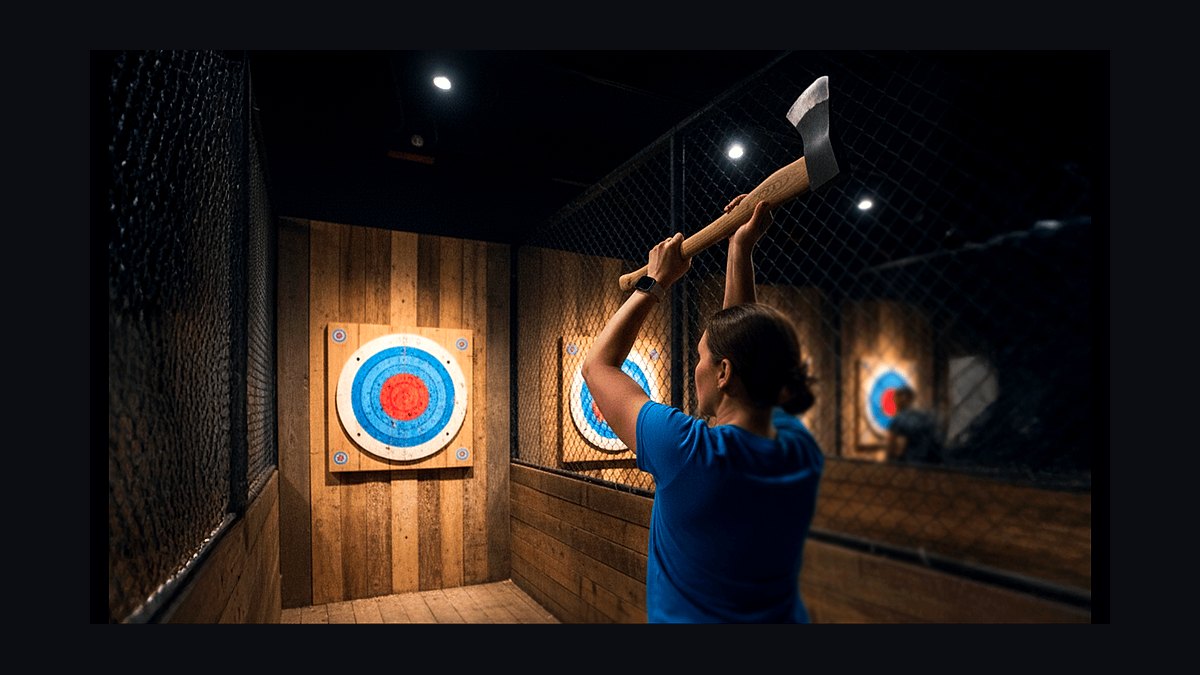
Open a Bad Axe Throwing franchise only if you will personally sell corporate and group events. Total investment runs roughly $150,000–$450,000 against ~8% royalty, and mature venues gross $250,000–$700,000. Walk-in-dependent owners underperform badly; event-sales operators in corporate-dense metros clear $60,000–$180,000.
A Tuesday night that tells you everything
Picture two axe-throwing venues, both open eighteen months, both roughly 3,500 square feet, both carrying the same brand on the door. It is 7 p.m. on a Tuesday in February.
Venue A has three lanes running. A pair of walk-ins who saw the sign from the parking lot, and a birthday group of six that booked online that afternoon. Total ticket for the evening, maybe $400. The coach on shift is being paid $16 an hour to supervise mostly empty lanes. The owner is at home, refreshing the booking dashboard, hoping Friday saves the week.
Venue B has ten lanes running and a waitlist. Six of those lanes are a private buyout: a regional insurance office doing a Q1 kickoff, forty people, catered wings from the taco place two doors down, two-hour package at $45 a head plus a bar tab. That single booking is $2,300 before drinks. The other four lanes are week five of an eight-week league — twenty-four people who paid $110 each up front in January and will show up every Tuesday through March whether it snows or not. The owner is not at the venue. The owner is at a chamber of commerce mixer, because that is where next quarter's insurance office comes from.
Same brand. Same build-out. Same category tailwind. The difference is not luck and it is not location quality, though location matters. The difference is that Venue B's owner treats the business as a business-to-business events operation that happens to use axes, and Venue A's owner treats it as a retail attraction that people will find.
This is the single most important thing to understand before you sign anything. The franchise agreement does not sell you a business — it sells you a licensed format, a safety system, a booking stack, and a brand that ranks well for "axe throwing near me." What it does not and cannot sell you is the outbound sales motion that fills weekday afternoons. Roughly 50–70% of revenue at strong venues comes from group events: corporate team-building, bachelor and bachelorette parties, birthdays, church groups, sports team banquets, fantasy football drafts. That revenue does not walk in. Somebody dials for it.
If you read that scenario and felt energized — you already know four people you'd call about a corporate booking next week — this is a reasonable business to open. If you read it and thought "surely the brand handles that," close the FDD and look at something with a drive-thru window.
How the money actually moves through a venue
The unit economics are simple enough to model on a napkin, which is both the appeal and the trap. Revenue is lanes × hours × utilization × average ticket. Cost is labor, rent, royalty, insurance, and a thin layer of consumables. There is no food cost of goods dragging you down the way a restaurant carries 28–32% COGS — axes and pine target boards are cheap and last. That is why the category attracts first-time franchisees.
The trap is that utilization, not margin, is the whole game. A restaurant with a bad Tuesday still sells sixty covers. A throwing venue with a bad Tuesday sells nothing, and the coach on shift still gets paid. Your fixed cost base — rent, insurance, the general manager's salary — runs about the same whether you did $400 or $2,700 that night. Every incremental booking after break-even flows through at something like 60–70 cents on the dollar. That leverage cuts both directions and it cuts hard.
Here is the flow of a dollar through a mature venue doing roughly $450,000:
Read that diagram as a stress test rather than a projection. The percentages hold reasonably well at scale, but the branch at the bottom is where actual outcomes diverge. Two venues with identical cost structures land at wildly different owner earnings purely on the event-mix question.
Break the revenue into its four channels, because each behaves differently:
Walk-in retail is typically 15–25% of revenue at a mature venue. It is the lowest-margin channel in practice because it arrives unpredictably and forces you to staff for a demand curve you cannot see. It concentrates Friday and Saturday evening. It is worth having — walk-ins become league members and league members become the person who books their company's holiday party — but you cannot build a business on it.
Leagues are the quiet workhorse. An eight-week season at $80–$150 per person, with three or four leagues running concurrently, generates something like $15,000–$40,000 in annual recurring revenue and, more importantly, fills Monday through Wednesday evenings that would otherwise sit dark. Retention on a well-run league runs 60–70% season over season. League members also drink, which matters if you have a liquor license. Treat leagues as a customer-acquisition engine with positive unit economics, not as a revenue line to be optimized.
Private parties — birthdays, bachelor/bachelorette, graduation — are the emotional core of the category and the easiest to sell. They come through search and referral, book on weekends, and carry an average ticket of $400–$1,200 depending on group size and package. Volume here scales with review count and Google Business Profile health more than with any outbound effort.
Corporate events are the margin. A forty-person team-building booking at $45–$60 per head, on a Wednesday afternoon at 2 p.m., is nearly pure contribution: the lanes were empty, the coach was scheduled anyway, and the group buys a bar tab on top. Corporate bookings run $500–$2,000+ each and, critically, they repeat. An HR manager who ran a successful offsite books again next quarter and tells the HR manager at the company across the office park.
The strategic implication is unambiguous: your job as owner is to convert dark weekday hours into corporate revenue. Everything else — the build-out, the brand, the safety program — is table stakes that every venue in the network has.
Real numbers: what you'll actually spend and earn
The 2026 FDD frames total Item 7 investment at roughly $150,000 to $450,000. That range is wide because it spans a second-tier market with a cooperative landlord at the bottom and a dense metro with a raw shell at the top. Build a line-item model rather than anchoring on the midpoint.
Franchise fee: $20,000–$30,000. Paid at signing, non-refundable, covers territory rights, initial training, and access to the operating system. Standard for the category and not worth negotiating hard.
Leasehold improvements: $60,000–$200,000. This is the swing factor and the number most prospective owners underestimate. Axe-throwing build-out is specialized: reinforced lane walls, backstop construction, chain-link or netting separation between lanes, sound dampening (the sport is genuinely loud and adjacent tenants will complain), a queuing and bar area, ADA-compliant restrooms if the shell lacks them. In competitive retail markets, landlords may offer tenant improvement allowances of $30–$60 per square foot; in secondary markets expect $10–$25 or nothing at all. A second-generation restaurant space with existing restrooms and HVAC can save you $50,000 over a raw industrial shell.
Equipment and fixtures: $20,000–$60,000. Axes, target boards (consumable — budget replacement), lane hardware, POS, waiver kiosks, furniture, TVs, sound system, walk-in cooler if you're serving.
Technology and software: $5,000–$15,000. Booking engine, digital waiver platform, POS integration, scheduling. Digital waivers are non-optional in a participant-injury category — the legal exposure of paper or, worse, no waiver, is not a cost you want to discover.
Initial marketing: $10,000–$35,000. Grand opening, pre-launch event sales, local paid media, signage beyond what the landlord provides.
Insurance and permits: $8,000–$30,000 initially, with general liability and participant-accident coverage running $8,000–$18,000 annually thereafter. Coverage requirements in the $2M-per-occurrence / $4M-aggregate range are typical for the category. Add workers' comp at roughly $3,000–$6,000 annually for a small staff. Premiums in the category have been drifting upward as insurers accumulate claims data.
Training and travel: $3,000–$10,000. Two to four weeks of on-site training at an operating location for you and your general manager, plus lodging.
Working capital: $25,000–$60,000. Three to six months of runway. Underfunding here is the most common way a fundamentally viable venue dies — you open, ramp slower than projected, and cannot fund the sales hire that would fix it.
Liquid capital you'll want on hand: $60,000–$120,000 beyond financed amounts, because SBA lenders will ask and because the ramp is longer than the pro forma.
On the revenue side: mature venues gross $250,000–$700,000, with owner earnings of $60,000–$180,000 at margins of roughly 15–30%. Labor runs 28–35% of revenue in year one, settling to 22–28% as booking volume stabilizes and you stop over-staffing against uncertainty. Coaches typically earn $12–$18 per hour depending on market, plus tips from private events — and turnover of 40–60% annually is normal, because the labor pool skews toward students and part-timers.
A note on alcohol: venues serving beer, wine, and seltzer typically see 10–20% of revenue from alcohol, and alcohol-free or BYOB venues run meaningfully lower average tickets — call it 15–25% lower per head. If your jurisdiction has a liquor quota system, licensing can take 3–12 months. Start that process before you sign the lease, not after. Nothing kills a pro forma quite like paying rent for seven months while you wait on a license board.
What else you could do with $300,000
Before committing, price the alternatives honestly — not to talk yourself out of it, but because the comparison sharpens what you're actually buying.
Independent axe-throwing venue. Same build-out, no $25,000 fee, no 8% royalty, no 2% marketing fee. On $450,000 of revenue that's $45,000 a year staying in your pocket — real money. What you give up is the safety and training system (which you will have to build, and which insurers will scrutinize), brand search ranking for "axe throwing near me," negotiated vendor pricing, and the operational playbook that shortens your ramp. Independents work when the owner has hospitality operating experience and an existing local network. First-timers routinely underestimate what the playbook is worth in year one.
Other axe-throwing brands. Stumpy's Hatchet House is the most direct comparison, with a similarly events-oriented model. Interview owners in both systems before choosing — the differentiator is usually territory availability and the quality of the specific franchise development person you'd be working with, not headline economics.
Adjacent competitive-socializing formats. Pickleball-social venues (The Picklr, Chicken N Pickle), golf entertainment (X-Golf, Five Iron, BigShots), and escape rooms all chase the same group-outing dollar. They differ sharply on capital intensity: escape rooms are the low-capital entry point, golf simulators run higher per bay, and pickleball venues need square footage that changes the real estate math entirely. If you're drawn to the category rather than to axes specifically, price at least two of these.
Larger family-entertainment formats — trampoline parks, adventure parks — carry substantially higher capital requirements and heavier staffing, but they capture a broader daypart including weekday daytime youth traffic.
Doing nothing with the capital, or buying an existing venue. Acquiring a resale is chronically underrated. You buy revenue history, an existing customer list, a built-out space, and trained staff, usually at 2–3× seller's discretionary earnings. The catch is that healthy venues rarely sell cheap and struggling ones are usually struggling for a reason that will follow you. Read the seller's event-mix breakdown before anything else; a resale with 70% walk-in revenue is a distressed asset dressed as a going concern.
Here's how the decision actually sequences over ninety days:
The owner-interview step is where the real diligence happens. Item 19 gives you financial performance representations in whatever form the franchisor chose to present them; owners give you the texture. Ask each one the same four questions: what percentage of your revenue is corporate versus walk-in, what did you actually clear last year after paying yourself, how long until you hit positive cash flow, and what would you do differently. Eight conversations produce a distribution. Three produce an anecdote.
The failure patterns, in order of how often they kill people
Assuming the brand generates demand. The most expensive mistake. National marketing support means a website, social templates, and PR — it does not mean a pipeline. Budget $1,500–$4,000 monthly on local paid media in year one (Google Local Service Ads at $8–$20 per lead, Meta ads targeting team-building and date-night intent at $1.50–$3.00 CPC), scaling down to $800–$2,000 as organic and referral traffic compound. Then hire or become the person making outbound calls to HR departments, event planners, and office managers. A dedicated sales and events manager at $35,000–$50,000 plus commission pays for itself in 6–12 months if they close three to five corporate bookings weekly.
Choosing the cheap industrial space. Industrial zoning is where the affordable square footage lives, and it is a defensible choice — but understand you are trading away your walk-in channel entirely and taking on a harder marketing job. If you go industrial, your event sales motion has to be twice as good, and you should model walk-in revenue at near zero rather than at 20%.
Treating insurance as a checkbox. This is a participant-injury category with sharp objects and, frequently, alcohol. Your safety program is not paperwork — it's the thing standing between a bad night and a claim that ends your business. Enforce digital waivers for every single participant with no exceptions, maintain coach certification discipline, keep incident logs, and never let a coach cover more lanes than the operating standard allows because you're short-staffed. The night you cut that corner is the night something happens.

Under-scheduling weekdays, then over-correcting. New owners staff heavy for weekends and go dark Monday through Wednesday, which feels like cost discipline and is actually revenue abandonment. Fill weekdays with leagues (cheap to run, prepaid, sticky) and corporate afternoon bookings before you touch the weekend schedule.
Ignoring reviews. Google Business Profile and Yelp ratings drive private-party bookings more directly than any paid channel. Target 4.5+ stars and respond to every review inside 48 hours. A venue at 4.1 stars gets meaningfully fewer bachelorette inquiries than one at 4.7, and the gap compounds.
Staff churn with no bench. With 40–60% annual turnover baked into the category, the owners who cope are the ones continuously recruiting — university recreation programs, local throwing clubs, existing league members who want shifts. Build league-performance bonuses so your best coaches have a reason to stay through a season.
Signing before the liquor timeline is confirmed. Covered above, but it bears repeating because it recurs. Confirm the licensing path and realistic timeline in writing before executing a lease.
Opening cold. The venues that ramp fastest open with eight to twelve events already on the calendar, sold during build-out. The ones that struggle open the doors and start selling on day one. Presell.
Related questions
How long until a Bad Axe Throwing venue is cash-flow positive?
Most locations reach positive cash flow in 12–24 months. The variable is booking velocity, not cost control. Venues that presell launch events and land two to three corporate bookings weekly within the first quarter compress that window substantially.
Can I run this as a semi-absentee owner?
Poorly. The revenue engine is relationship-driven B2B sales, which does not delegate cleanly to hourly staff. Semi-absentee works only if you hire a strong events manager on commission early — which means funding a salary before the revenue exists.
What size space do I actually need?
Roughly 2,500–4,000 square feet supports eight to twelve lanes plus a queuing and bar area. Ceiling height of at least 12 feet matters more than most people expect. Confirm minimum lane count and parking ratios with the franchisor before signing.
Is the axe-throwing category still growing in 2027?
Competitive socializing broadly remains a durable consumer trend — spend continues shifting toward experiences. But individual metros can saturate. Count competing experiential venues within your trade area, not just other axe brands.
Should I buy an existing venue instead of opening one?
Often yes, if the event mix is healthy. A resale gives you revenue history, trained staff, and a finished build-out. Scrutinize the corporate-versus-walk-in split first — a walk-in-heavy resale is a distressed asset.
FAQ
How much does it cost to open a Bad Axe Throwing franchise?
The franchise fee runs $20,000–$30,000, with total Item 7 initial investment typically between $150,000 and $450,000. That range covers build-out, equipment, initial marketing, insurance, and working capital. Where you land depends primarily on lease terms, the condition of the shell you take, and local construction costs. Plan on $60,000–$120,000 in liquid capital beyond financed amounts.
What are the ongoing fees?
Roughly 8% royalty on gross revenue plus a marketing fee in the 2–3% range. Combined, expect about 10% of top-line revenue going to the franchisor. That's consistent with experiential-entertainment franchising generally, and it's the number to weigh against building an independent venue where you'd keep it but forgo the system.
How much can I realistically earn?
Mature venues gross $250,000–$700,000 with owner earnings of $60,000–$180,000. The spread is almost entirely explained by event mix. Owners who build a corporate pipeline land in the upper half; owners relying on walk-in traffic land in the lower half or below it. Review Item 19 alongside direct conversations with at least eight current franchisees.
Do I need axe-throwing experience?
No. The franchisor's training covers the activity, safety protocols, and coaching standards. What you cannot substitute is comfort with outbound sales — cold-calling HR managers, working chamber events, following up on corporate leads. If that describes work you'd avoid, this is the wrong business regardless of how much you enjoy throwing.
How much does insurance cost and what's required?
General liability plus participant-accident coverage typically runs $8,000–$18,000 annually, with minimums around $2 million per occurrence and $4 million aggregate. Add workers' compensation at roughly $3,000–$6,000 for a small staff. Premiums have been trending upward as the category matures. Digital waiver software for every participant is essential, not optional.
What percentage of revenue should come from group events?
Strong venues run 50–70% of revenue from group and corporate bookings, with walk-ins at 15–25% and leagues filling the remainder while stabilizing weekday utilization. If you model your pro forma with walk-ins as the primary channel, you have built a projection the category does not support.
Sources
- https://www.ftc.gov/business-guidance/resources/consumers-guide-buying-franchise
- https://www.sba.gov/funding-programs/loans/7a-loans
- https://www.franchise.org/
- https://www.bls.gov/oes/current/oes399032.htm
- https://www.census.gov/programs-surveys/cbp.html
- https://www.ibisworld.com/united-states/market-research-reports/arcade-food-entertainment-complexes-industry/
- https://www.franchisebusinessreview.com/
- https://www.entrepreneur.com/franchises/directory
- https://www.osha.gov/smallbusiness
- https://www.irs.gov/businesses/small-businesses-self-employed/starting-a-business
Related on PULSE
This page will be disappearing soon. Save it to your device for $1 — or read it free while it is here.
@Kory-White- · if Venmo asks, the last 4 of my number are 2012
This page is gone.
This one is off the shelf now. $1 keeps it on your phone for good — the whole page, pictures and diagrams included.
 franchiseShould I open or buy a Bahama Breeze franchise in 2027?
 franchiseShould I open or buy a Bruster's Real Ice Cream franchise in 2027?
 franchiseShould I open or buy an Anytime Fitness franchise in 2027?
 franchiseShould I open or buy a Pizza Hut franchise in 2027?
 franchiseShould I open or buy a Roto-Rooter franchise in 2027?
 franchiseShould I open or buy a Massage Envy franchise in 2027?
 franchiseShould I open or buy a Cold Stone Creamery franchise in 2027?
 franchiseShould I open or buy a Dairy Queen franchise in 2027?
 franchiseShould I open or buy a Big O Tires franchise in 2027?
 franchiseShould I open or buy a Jamba franchise in 2027?