


Should I open or buy a FASTSIGNS franchise in 2027?
Quality
Certified
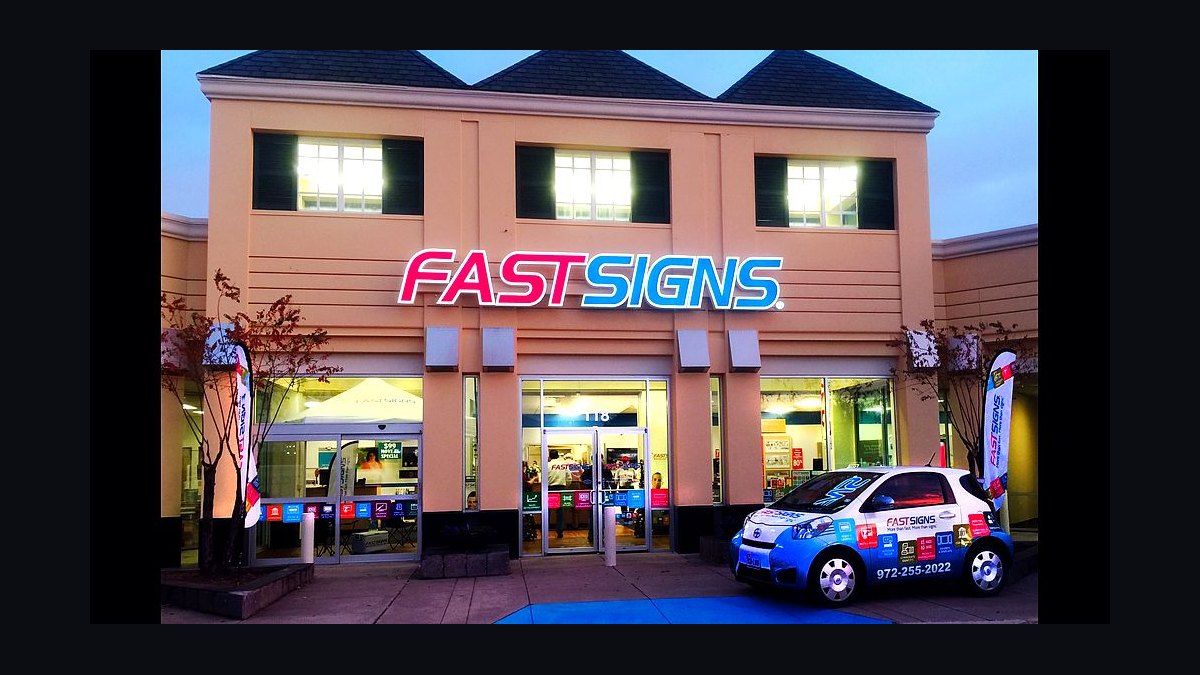
Yes, for the right operator — FASTSIGNS is a strong Monday-Friday B2B franchise, but 2027 buyers face two real paths: open new for $250,000-$350,000 with full territory control, or buy an existing center at 2.5-3.5x net profit for faster cash flow and an established client base. Choose based on your capital, timeline, and tolerance for building clients from zero versus inheriting them.
Opening a new center vs. buying an existing FASTSIGNS franchise
Every prospective FASTSIGNS owner in 2027 is really choosing between two different businesses wearing the same brand. Opening new means signing the franchise agreement, securing a protected territory of roughly 5,000 to 15,000 commercial addresses, finding 1,200 to 2,500 square feet of light-industrial space, and building a client base from zero. Buying an existing center means acquiring a franchisee's operating business — their lease, their equipment, their staff, and critically, their existing book of recurring B2B clients — through a franchisor-approved resale.
The new-build path costs less up front in total dollars but costs more in time. Per the 2026 FDD, total Item 7 investment for a new center runs $250,000 to $350,000, including the $50,000 franchise fee, $50,000-$120,000 in buildout, $90,000-$160,000 in equipment and technology (printers, plotters, design software), and $40,000-$120,000 in working capital to cover the first three to six months while you have no clients and no revenue. That working capital figure matters because a new center typically takes 12 to 24 months to reach the "mature" revenue band FASTSIGNS reports in Item 19. You are building a sales pipeline, a referral network, and brand awareness in your territory simultaneously — all while paying rent, payroll, and royalties on close to zero initial revenue.
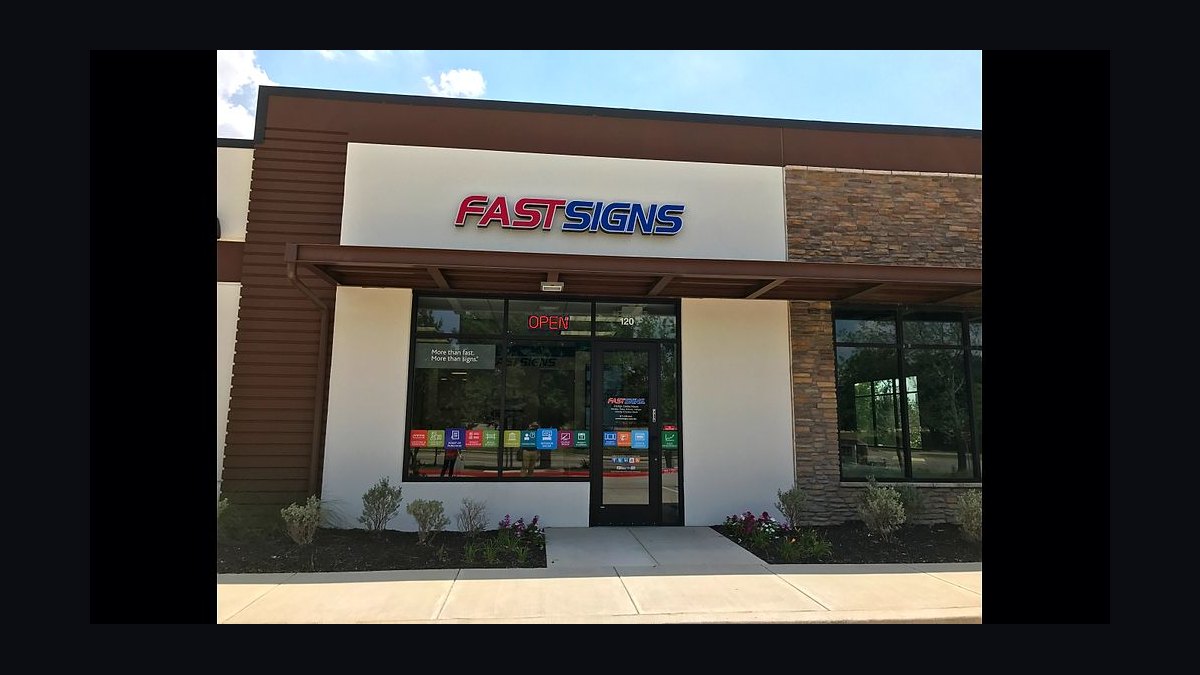
The resale path front-loads a larger purchase price but compresses the timeline dramatically. A mature, profitable FASTSIGNS center sells for 2.5 to 3.5 times its annual net profit — so a center clearing $150,000 a year might sell for $375,000 to $525,000, often more than the all-in cost of opening new. But that premium buys you something a new build cannot: a center already producing $700,000 to $1,500,000 in annual gross revenue, with $110,000 to $300,000 in owner earnings starting in year one, not year two or three. You inherit trained staff (typically four to six full-time employees — a production manager, a salesperson, a graphic designer, and an installer), existing equipment leases, and most importantly, a recurring client roster that took the seller years of consultative B2B selling to build.
The trade-offs run deeper than price. A new build lets you choose your own territory, negotiate your own lease from scratch, and build a client list with no inherited baggage — no underperforming accounts, no bad vendor relationships, no equipment nearing end-of-life. A resale means due diligence on the seller's financials, client concentration risk (if 30% of revenue comes from two accounts, what happens if one leaves), the condition of aging printers and plotters, and a franchisor approval process for the transfer that can add 60 to 90 days. Financing differs too: new builds typically use standard SBA 7(a) startup financing, while resales often qualify for acquisition financing against the existing business's cash flow, which can mean a smaller relative down payment because lenders can underwrite against real, provable revenue rather than projections.
Geography also tilts the decision. If a business-dense market you want — a commercial or corporate-office corridor — already has an available resale, buying removes the territory-competition question entirely; FASTSIGNS will not grant a second franchise inside another's exclusive territory, so a resale may be the *only* way into a saturated metro. If your target market has no resale available, opening new is the only option regardless of preference.
How to decide between opening and buying
The decision tree above collapses to three real questions. First: is a resale even on the table in the market you want? Protected-territory rules mean you often don't get to choose — if nobody is selling in your target metro, the decision is made for you and you open new. Second: can your liquidity support the higher sticker price of a resale, which runs on a multiple of *proven* profit rather than a fixed FDD range? A seller asking 3x a $175,000 net profit wants $525,000, well above the top of the new-build range, and most of that needs to come from cash or acquisition financing rather than a standard SBA startup loan. Third, and most important: does the seller's business survive scrutiny? Request at least two years of tax returns, a client list with revenue concentration by account, equipment maintenance records, and the lease's remaining term and renewal options. A resale with one client generating 40% of revenue is not a stable inheritance — it's a liability with a price tag.
Operators who are naturally patient, enjoy building something from the ground floor, and want to shape a territory to their own sales style tend to do better opening new. Operators who want income sooner, who have the capital or financing to absorb a larger purchase, and who are comfortable managing an inherited team and client base tend to do better buying. Neither path removes the requirement at the center of this brand: you must be willing and able to do consultative B2B sales. A resale buyer who can't maintain the relationships they just paid for will watch that client base erode within a year.
The numbers behind each option
Opening new — Item 7 investment breakdown (2026 FDD):
- Franchise fee: $50,000 flat
- Buildout and leasehold improvements: $50,000-$120,000
- Equipment and technology (printers, plotters, software): $90,000-$160,000
- Signage and decor: $10,000-$30,000
- Initial inventory (substrates, supplies): $10,000-$25,000
- Initial marketing: $15,000-$40,000
- Training and travel: $8,000-$25,000
- Working capital (first 3-6 months): $40,000-$120,000
- Total: roughly $250,000-$350,000, with $80,000-$150,000 typically required in liquid capital, the rest financed.
- Ongoing royalty: ~6% of gross sales; marketing fund: ~2% of gross sales, both deducted weekly.
Buying existing — resale economics:
- Sale price: 2.5x to 3.5x the center's trailing annual net profit (not revenue).
- Example: a center with $145,000-$175,000 in median net profit (the Item 19 benchmark for franchisees open 3+ years) prices between roughly $360,000 and $610,000.
- Financing: most resales use SBA 7(a) acquisition financing or the franchisor's preferred lender network — expect 20-30% down, 10-year terms, and 8-12% interest, with rate depending on your credit profile and the business's cash-flow history.
- Franchisor approval required for every transfer; expect 6-12 months for a seller to find a buyer and close, so a resale buyer searching in 2027 may be working against a seller's multi-month process already in motion.
Underlying business economics, either path:
- Median gross revenue (3+ years open): $875,000
- Cost of goods sold: 35-40% of revenue (materials, subcontractors, shipping)
- Gross profit: $525,000-$568,000 (60-65% margin)
- Operating expenses (rent, payroll, marketing, royalties): $380,000-$450,000
- Median net profit (owner's pre-tax compensation): $145,000-$175,000
- Payroll typically runs 25-30% of revenue across 4-6 full-time staff
- Equipment leases: a primary printer/cutter runs $1,500-$3,000/month; a vehicle-wrap plotter runs $500-$1,000/month
The core difference the numbers reveal: opening new asks you to fund 12-24 months of ramp-up before touching these revenue figures, while buying existing asks you to pay a premium specifically to start at or near them immediately. Whether that premium is worth it depends entirely on how many months of near-zero income you can personally absorb — every month of ramp-up on a new build is a month of royalty, rent, and payroll paid out of pocket or from working capital, not from client revenue.
Implementation and sequencing for 2027
Whichever path you choose, the sequencing shares a common spine but diverges at key points. In the first 15 days, read the 2026 FDD closely — Items 5, 6, 7, and 19 cover fees, investment ranges, and the financial performance representation you'll use to judge any resale's asking price. Days 16 through 45 are for diligence: if opening new, interview at least eight current franchisees about territory density, the realistic timeline to profitability, and how long it actually took them to build a recurring client base. If buying existing, this is when you pull the seller's tax returns, client concentration data, and equipment condition reports, and request the franchisor's input on why the center is being sold.
Days 46 through 90 are where the paths genuinely split. A new-build buyer is now working with FASTSIGNS' site-selection team to secure a territory and negotiate a lease on 1,200-2,500 square feet of light-industrial space with ground-floor access for large sign materials and a loading dock or roll-up door — look for monthly rent in the $2,500-$5,500 range depending on market. A resale buyer is in the franchisor-approval process for the ownership transfer, which typically takes 60-90 days on top of whatever time the seller already spent finding a buyer.
From month three onward, both paths converge again on training: 2-3 weeks at FASTSIGNS University in Dallas covering production (vinyl cutting, digital printing, vehicle-wrap installation), consultative B2B selling, job-costing and CRM software, and local business-development tactics. A new-build owner installs equipment and begins outreach to local businesses from scratch; a resale owner uses the same training period to meet inherited staff, review existing accounts with the outgoing owner, and confirm which clients are retained versus at risk during the transition. Expect a new build to take 4-8 months from signing to opening its doors; a resale closing can move faster once financing and transfer approval clear, sometimes 60-120 days from accepted offer to taking over operations.
After the transition, support is identical regardless of path: a franchise business consultant visits quarterly in year one, then semi-annually, reviewing financials, production efficiency, and sales pipeline. Monthly peer "Mastermind" video calls and an annual convention round out ongoing support. In 2027, FASTSIGNS is also rolling out a centralized CRM pre-loaded with local business leads and automated quoting tools, which should shorten the ramp-up curve for new-build owners specifically, since lead generation has historically been the slowest part of building a client base from zero.
Related questions
How long does it take a new FASTSIGNS center to become profitable?
Most new centers take 12-24 months to reach mature revenue levels of $700,000-$1,500,000 annually, as the owner builds B2B client relationships from scratch in a protected territory.
Can I negotiate the price on a FASTSIGNS resale?
Yes — resale prices (typically 2.5-3.5x net profit) are negotiated between buyer and seller, though the franchisor must approve the final buyer and transfer terms.
Does FASTSIGNS help me find a resale to buy?
Yes, the franchisor maintains a resale database connecting sellers with qualified buyers, though you should still independently verify financials and client concentration before committing.
What happens to existing clients when I buy a FASTSIGNS resale?
Clients typically stay with the business through ownership transition, but retention depends on relationship strength — some accounts tied closely to the outgoing owner may need active re-engagement.
Is SBA financing available for both opening new and buying existing?
Yes — new builds typically use SBA 7(a) startup financing, while resales often qualify for acquisition financing underwritten against the business's existing cash flow and provable revenue.
FAQ
What is the total investment to open a new FASTSIGNS franchise? The total investment typically ranges from $250,000 to $350,000, including the $50,000 franchise fee, equipment, leasehold improvements, initial inventory, and working capital. Actual costs vary by location, lease terms, and local construction pricing.
How much does it cost to buy an existing FASTSIGNS franchise instead? Resale prices run 2.5 to 3.5 times the center's annual net profit, so a profitable center earning $150,000-$175,000 a year typically sells for $375,000 to $610,000, often above the new-build investment range but with revenue starting immediately.
Do I need sign-industry experience to open or buy a FASTSIGNS franchise? No prior sign industry experience is required for either path, but comfort with consultative B2B sales matters more for a new build, since you're generating every client relationship yourself rather than inheriting one.
What are the ongoing fees after I open or buy? Both paths carry the same ongoing fees: roughly 6% royalty on gross sales plus a 2% marketing fund contribution, deducted weekly regardless of whether the center was opened new or acquired through resale.
Which path is faster to start earning income — opening new or buying existing? Buying existing is faster for income, since you inherit a client base generating revenue from day one; opening new typically takes 12-24 months to reach comparable mature revenue levels.
Is the FASTSIGNS resale market competitive in 2027? Resale availability depends heavily on territory — some markets have no centers for sale, forcing a new-build decision, while others may have multiple options; check the franchisor's resale database and current franchisees for leads.
Sources
- https://www.fastsigns.com
- https://www.entrepreneur.com/franchises/fastsigns/335412
- https://franchisebusinessreview.com
- https://www.ibisworld.com
- https://www.signs.org
- https://www.statista.com
- https://www.franchise.org
- https://www.sba.gov/funding-programs/loans/7a-loans
Related on PULSE
This page will be disappearing soon. Save it to your device for $1 — or read it free while it is here.
@Kory-White- · if Venmo asks, the last 4 of my number are 2012
This page is gone.
This one is off the shelf now. $1 keeps it on your phone for good — the whole page, pictures and diagrams included.
 franchiseShould I open or buy a Merry Maids franchise in 2027?
 franchiseShould I open or buy a Little Caesars franchise in 2027?
 franchiseShould I open or buy a Take 5 Oil Change franchise in 2027?
 franchiseShould I open or buy a Bruster's Real Ice Cream franchise in 2027?
 franchiseShould I open or buy a Mac Tools franchise in 2027?
 franchiseShould I open or buy a Cook Out franchise in 2027?
 franchiseShould I open or buy a Subway franchise in 2027?
 franchiseShould I open or buy a Stanley Steemer franchise in 2027?
 franchiseShould I open or buy a McAlister's Deli franchise in 2027?
 franchiseShould I open or buy a Cold Stone Creamery franchise in 2027?