


Should I open or buy a Floor Coverings International franchise in 2027?
Quality
Certified
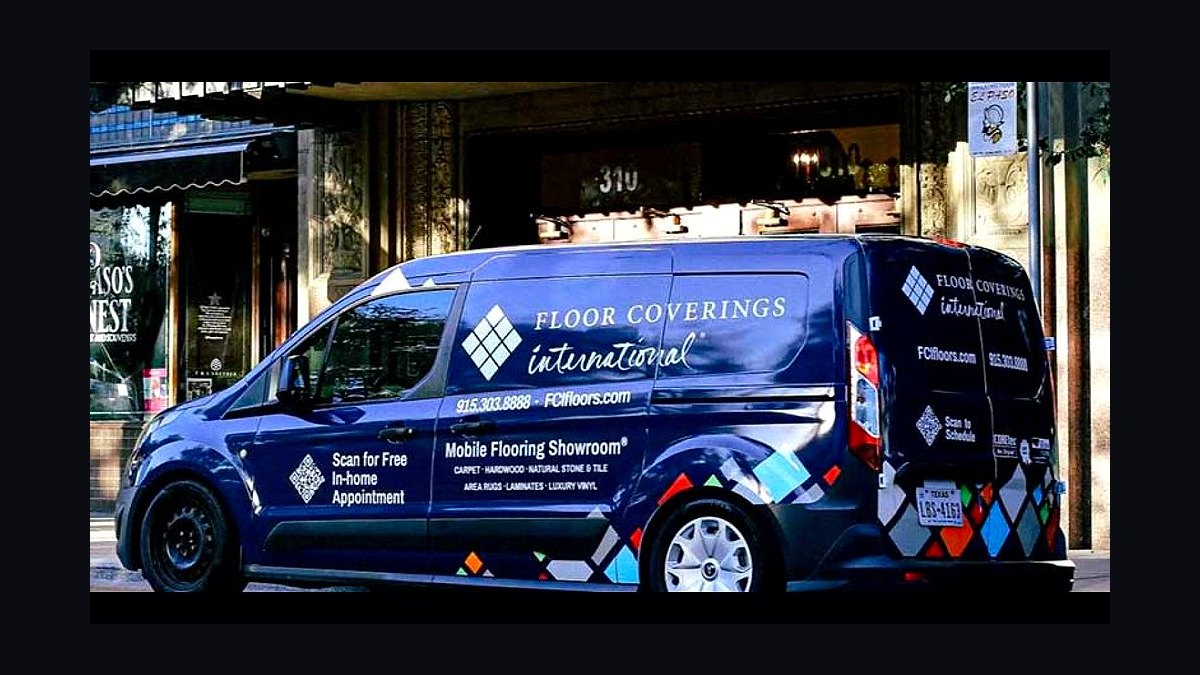
Yes, if you're a sales-driven operator who wants a home-based, mobile flooring franchise rather than a retail storefront. Floor Coverings International brings a branded showroom van and hundreds of samples directly to a homeowner's driveway, closes the sale in the living room, then manages subcontracted installation. The 2026 FDD lists roughly $160,000-$300,000 total investment against mature-territory gross revenue of $1M-$3M+ and owner earnings of $120,000-$350,000 — strong numbers if you can sell and manage crews, weak ones if you can't.
A Suburban Driveway, A Loaded Van, A Closing Conversation
Picture a Tuesday afternoon in a growing suburb of Phoenix or Tampa. A homeowner just got three competing quotes from Home Depot's flooring desk, called a local installer who never returned the voicemail, and is now waiting for a Floor Coverings International franchisee to pull a wrapped Ford Transit into the driveway. Inside the van: 250-300 flooring samples spanning hardwood, luxury vinyl plank, tile, and carpet, organized by room type and price tier. The franchisee walks through the home with a tablet, measures the great room and two bedrooms in about twenty minutes using a laser measuring tool synced to the company's proprietary estimating software, and lays six to eight samples on the actual floor under the home's real lighting.
This is the entire value proposition compressed into one ninety-minute appointment. The homeowner never drives to a store, never squints at a sample under fluorescent showroom light that looks nothing like their den, and never waits a week for a callback with a quote. The franchisee builds the estimate on-site — materials, waste factor, underlayment, furniture moving, old-floor removal, and installation labor — and presents a firm number before leaving the driveway. In competitive metros, roughly 55-65% of these in-home appointments close on the spot or within 48 hours, according to franchisee reports shared at annual conventions; the rest require a follow-up call or a second visit with additional samples.
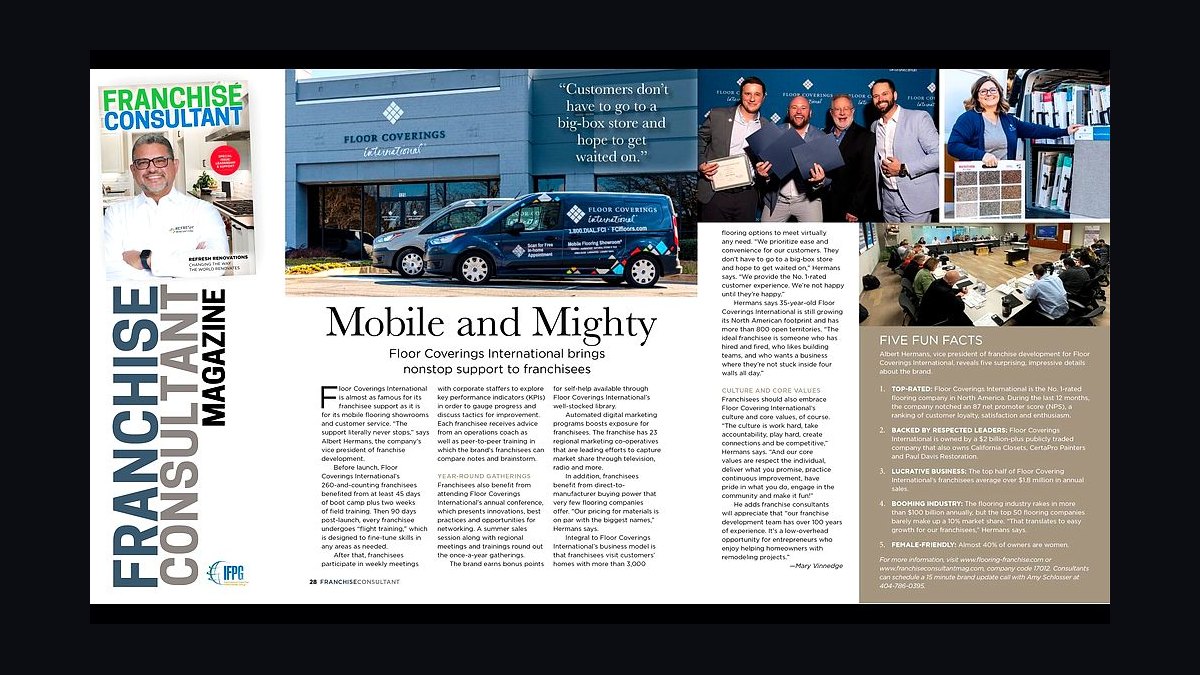
The project that gets signed that afternoon is rarely small. Floor Coverings International's average ticket runs $5,000-$20,000, because the model targets whole-room or whole-home replacements rather than single-aisle purchases. A homeowner replacing flooring across a great room, kitchen, and two bathrooms after a water leak, or refinishing an entire main floor before selling a house, is the typical project — not a single bedroom carpet swap. That ticket size is what separates this franchise's unit economics from a typical home-services business: fewer transactions, but each one worth multiples of a handyman job or a carpet-cleaning visit.
What the scenario doesn't show is everything that happens after the signature: scheduling a subcontracted crew, ordering materials from a regional distributor, managing a delivery window, and coordinating a homeowner who now has movers, furniture pads, and a dumpster showing up at their house for two to five days depending on square footage. The sales close is the easy, visible half of the business. The installation and crew-management half is where franchisees either build a referral engine or accumulate one-star reviews.
How The Mobile Shop-At-Home Model Actually Works
The mechanism has two halves that run on entirely different skill sets, and understanding the handoff between them is the key to understanding this franchise. Half one is lead generation and sales. Corporate-funded national marketing, Google Ads, home shows, and realtor partnerships generate the lead; the local franchisee drives the close. Franchisees who treat the appointment as "showing samples" rather than "running a consultative sales process" leave money on the table — corporate training teaches a structured needs-assessment-to-close sequence specifically because flooring is an emotional, high-ticket purchase that stalls without a confident guide.
Half two begins the moment ink hits paper: the franchisee becomes a project manager and quality-control supervisor overseeing people they don't directly employ. Most territories run with two to five subcontracted installation crews rather than W-2 installers, because flooring installation demand is lumpy — a franchisee doing $1.5M in annual volume might need four crews working simultaneously during the spring surge and one crew idle in January. The franchisee's software platform (the same CRM used for quoting) tracks job status, materials ordering, and crew scheduling in one system, which is the operational backbone that lets a single owner-operator run $1M+ in projects without a large back-office staff.
The friction point in this mechanism is material lead time colliding with customer expectations. Luxury vinyl plank in a specific color might ship from a regional warehouse in three to five days; a specialty hardwood species or an imported tile can take three to six weeks. Franchisees who set the installation date before confirming material availability create the single most common customer-complaint category in this business: "they promised my floor would be done by [date] and it wasn't." The experienced playbook is to build material confirmation into the sales process itself — never schedule a crew until the distributor confirms a ship date.
Real Numbers: Investment, Revenue, and Margin

| Line Item | Low | High | Notes |
|---|---|---|---|
| Franchise fee | $49,500 | $50,000 | Per 2026 FDD |
| Mobile showroom van (new or used) | $25,000 | $70,000 | Branded, stocked with samples |
| Flooring samples & displays | $8,000 | $25,000 | 200-300 core samples |
| Equipment & tools | $5,000 | $15,000 | Measuring, estimating hardware |
| Technology & CRM setup | $3,000 | $15,000 | Proprietary estimating platform |
| Insurance & licensing (year 1) | $4,000 | $18,000 | General liability + contractor license |
| Initial marketing & grand opening | $10,000 | $70,000 | Local lead generation launch |
| Working capital (3-6 months) | $30,000 | $90,000 | Covers payroll, royalty, lease during ramp |
| Total Item 7 investment | ~$153,500 | ~$300,000 | Home-based, no retail lease |
| Royalty | ~5% of gross | Paid to franchisor | |
| Marketing fee | ~2% of gross | Funds national campaigns |
A mature territory — typically year three or beyond — grosses $1,000,000 to $3,000,000+. Running the expense stack against a representative $1.5M-gross territory: cost of flooring materials runs 45-50% of gross ($675,000-$750,000), installation subcontractor labor runs 20-25% ($300,000-$375,000), the 5% royalty is $75,000, the 2% marketing fee is $30,000, franchisee and staff labor runs $120,000-$180,000, and vehicle/insurance/admin overhead adds another $35,000-$60,000. That leaves net profit before taxes in the range of $115,000-$235,000, a 7.7%-15.7% margin on gross — thin-looking as a percentage, but substantial in dollar terms because the revenue base is large.

Time to profitability matters more here than in many franchise categories because the ramp is sales-skill-dependent, not territory-dependent. Year one typically produces $400,000-$800,000 in gross revenue with a net loss of $20,000-$50,000, since startup costs, a learning curve on closing technique, and an unbuilt referral base all suppress margin. Year two commonly reaches $700,000-$1.2M with modest profit as crew relationships mature and repeat/referral business starts contributing leads that cost nothing to acquire. Most franchisees report recovering their full initial investment somewhere between 18 and 36 months, with sales-skilled operators on the faster end and operators still developing their in-home closing technique on the slower end.
On exit: the resale market for Floor Coverings International territories is active, with established territories selling for roughly 2-4x annual net profit — a franchise clearing $150,000/year might sell for $300,000-$600,000, subject to franchisor approval of the buyer. Multi-unit operators who acquire two to three territories over three to five years generally see the best enterprise-value growth, because marketing spend and crew-management overhead scale sub-linearly with revenue.
Trade-Offs: Is This Franchise Right For You, Or Is Something Else?
The core trade-off is this: Floor Coverings International trades the overhead and foot-traffic dependency of a retail flooring store for a sales-intensive, logistics-heavy mobile model. You save the six-figure buildout and ongoing lease of a showroom, but you take on the burden of generating every lead yourself (corporate marketing funds national brand awareness, not your local pipeline) and closing high-ticket sales face-to-face in a stranger's home, appointment after appointment. If in-home consultative selling makes you uncomfortable, no amount of operational excellence elsewhere in the business will compensate — this is the single disqualifying factor for otherwise well-capitalized candidates.

A second trade-off sits in the subcontractor-versus-employee decision baked into the model. Using subcontracted crews keeps fixed labor costs off your books during slow winter months, which matters because flooring demand is seasonal — 30-40% of annual revenue typically lands in the March-to-May and September-to-November renovation windows. But subcontractors are harder to control for quality and schedule reliability than employees, and a franchisee's local reputation lives or dies on install quality that happens largely out of their direct sight. Franchisees who invest early in building a stable of two to three trusted crews (rather than constantly sourcing new ones through classified ads) consistently outperform those who treat installation as an interchangeable commodity.
If the sales-intensity or crew-management burden is the deal-breaker, several adjacent models solve different pieces of the same problem. Footprints Floors runs a labor-focused, lower-capital flooring franchise that leans harder into installation and less into a branded mobile showroom experience — a reasonable alternative for someone stronger in trades management than in-home sales. N-Hance specializes narrowly in wood-floor refinishing, a lower-ticket, faster-cycle service that avoids the full-replacement sales conversation entirely. Traditional retail flooring franchises or independent stores (competing against Floor & Decor, Lowe's, and Home Depot's flooring desks) trade the mobile convenience advantage for a fixed location, employed sales staff, and a different cost structure built around rent instead of a van. None of these alternatives is strictly better — they simply weight the sales/installation/capital trade-off differently.

Geography is also a trade-off worth naming explicitly. This model performs best in suburban, higher-income homeowner markets with active renovation demand and real estate turnover — think growing Sun Belt metros in Texas, Florida, and Arizona — and performs worse in markets with low homeownership rates, low renovation spend, or dense urban cores where driveway-based van appointments are impractical. Territory selection within the FDD's available map should weight renovation-spend data and housing-turnover rate as heavily as raw population.
Common Pitfalls And How To Avoid Them
The single most expensive mistake new franchisees make is overinvesting in the van and sample inventory before the first sale closes. A new, fully custom-wrapped van loaded with 400+ samples can easily run $70,000, but a used panel van (budgeted $25,000-$40,000) stocked with 200-250 carefully chosen core samples performs the same sales function. Every dollar spent on an oversized rolling showroom is a dollar not available as working capital during the slow winter months, when royalty payments, insurance, and van financing still come due regardless of how many appointments you ran that week.
The second pitfall is underpricing installation to win a competitive bid. In saturated metro territories, franchisees sometimes shave labor margin to beat a rival quote, only to discover after paying the subcontractor crew that the job barely broke even — or lost money once a change order (unexpected subfloor repair, asbestos tile removal, furniture-moving overage) ate the thin remaining margin. The fix taught in franchisor training, and echoed by veteran owners, is to build a 20-30% buffer into every installation quote specifically to absorb the change orders that appear on a meaningful share of whole-home flooring jobs.

The third pitfall is neglecting online reputation management, which matters disproportionately in a referral- and review-driven local business. A single unresolved complaint about installation debris, a missed timeline, or a damaged piece of furniture — left to fester on Google rather than addressed within 24 hours — can cost a franchisee five to ten leads a month in a market where prospective customers compare star ratings across three or four flooring companies before ever picking up the phone. Proactively soliciting reviews from satisfied customers at the final walkthrough, while the positive experience is fresh, is the cheapest marketing a franchisee has.
A fourth, less obvious pitfall is scheduling installation before material delivery is confirmed, discussed above in the mechanism section — it is worth repeating here because it is the single largest driver of negative reviews in this category. And a fifth is under-capitalizing for the ramp period: franchisees who open with less than three months of operating-expense reserve frequently find themselves cutting marketing spend right when they need lead flow most, creating a revenue dip that compounds the very cash shortage they were trying to avoid.
Related questions
How much does a Floor Coverings International franchise really cost to open?
Total Item 7 investment runs roughly $153,500-$300,000, including a ~$50,000 franchise fee, the mobile showroom van, samples, technology setup, and working capital — no retail lease is required since the model is home-based.
Do I need flooring industry experience to buy this franchise?

No specific flooring background is required, but strong in-home consultative sales skills are essential, since franchisees close $5,000-$20,000 projects face-to-face in customers' homes rather than through retail foot traffic.
What's the biggest operational challenge for a Floor Coverings International owner?
Managing subcontracted installation crews for consistent quality and scheduling reliability — the sales close is often easier than ensuring the crew that executes the job protects the franchisee's local reputation.
How does Floor Coverings International compare to Footprints Floors?
Footprints Floors is a lower-capital, labor-focused flooring franchise with less emphasis on a branded mobile showroom experience, making it a better fit for operators stronger in trades management than in-home sales.
How long until a new franchisee becomes profitable?
Most franchisees recover their initial investment in 18-36 months, with year one often producing a modest net loss due to startup costs and sales-technique ramp-up, and year three typically reaching $1M+ in gross revenue.
FAQ
What are the realistic earnings for a Floor Coverings International franchisee? Owner earnings typically range from $120,000 to $350,000 annually, depending on territory maturity, sales skill, and crew-management quality. Mature territories can gross $1,000,000 to $3,000,000, but net profit varies with material costs and overhead control.
How much capital do I need to start?

Total initial investment runs roughly $153,500 to $300,000, including a franchise fee near $50,000, the mobile showroom van, samples, insurance, and working capital. Liquid capital requirements are typically $70,000-$130,000, with the remainder financeable.
Is prior flooring or sales experience required? No specific flooring background is needed, but confident in-home sales skills are critical. Franchisees must be comfortable closing high-ticket projects, often $5,000-$20,000, and overseeing subcontracted installation crews for quality control.
How does the mobile showroom model actually work? A branded van stocked with 200-300 flooring samples travels to the customer's home for a measurement, sample selection, and on-site quote, eliminating the retail-store overhead and letting the franchisee close the sale where the flooring will actually live.
What are the main challenges Floor Coverings International franchisees face? Mastering in-home sales execution and ensuring consistent installation quality from subcontracted crews are the two biggest hurdles, compounded by seasonal demand swings that require careful cash-flow planning through slower winter and summer months.
How long does it take to become profitable, and what does the resale market look like? Most franchisees reach profitability in 18-36 months. On exit, mature territories typically sell for 2-4x annual net profit, subject to franchisor approval of the buyer, making multi-unit expansion an attractive path for strong operators.
Sources
- https://www.franchise.org
- https://www.entrepreneur.com/franchises
- https://www.franchisebusinessreview.com
- https://www.ibisworld.com
- https://www.statista.com
- https://www.jchs.harvard.edu
- https://www.grandviewresearch.com
- https://www.census.gov
- https://www.floorcoveringsinternational.com
- https://www.ftc.gov/business-guidance/resources/franchise-rule-compliance-guide
Related on PULSE
This page will be disappearing soon. Save it to your device for $1 — or read it free while it is here.
@Kory-White- · if Venmo asks, the last 4 of my number are 2012
This page is gone.
This one is off the shelf now. $1 keeps it on your phone for good — the whole page, pictures and diagrams included.
 franchiseShould I open or buy a Hand and Stone Massage franchise in 2027?
 franchiseShould I open or buy a Servpro franchise in 2027?
 franchiseShould I open or buy a Jeremiah's Italian Ice franchise in 2027?
 frShould I open or buy a McDonald's franchise in 2027?
 franchiseShould I open or buy a Dairy Queen franchise in 2027?
 franchiseShould I open or buy a Jiffy Lube franchise in 2027?
 franchiseShould I open or buy a Pizza Hut franchise in 2027?
 franchiseShould I open or buy a Wingstop franchise in 2027?
 franchiseShould I open or buy a Meineke franchise in 2027?
 franchiseShould I open or buy a FACE FOUNDRIÉ franchise in 2027?