


Should I open or buy a Batteries Plus Bulbs franchise in 2027?
Quality
Certified
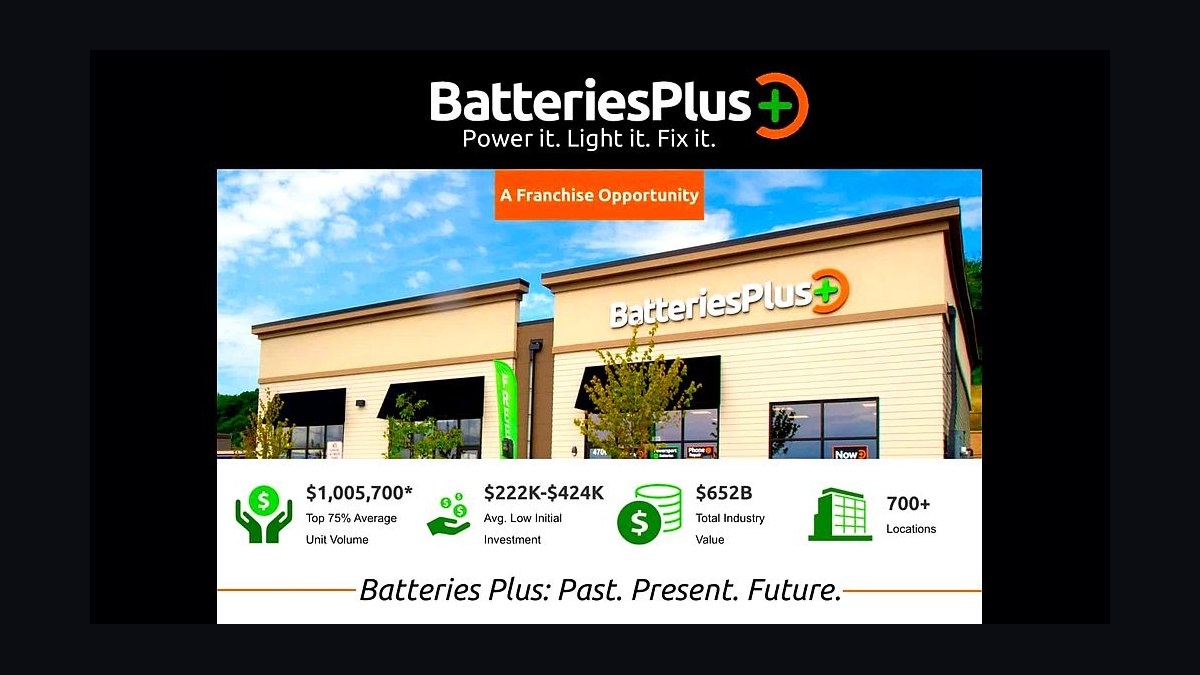
Only if you can fund $200,000–$450,000 and will personally sell commercial accounts. Batteries Plus Bulbs works as a diversified retail, repair, and B2B business with durable demand and a modest royalty, but retail walk-in traffic alone will not carry it. Owners who build a commercial book clear six figures; passive retail operators struggle.
The outcome you should expect if you sign in 2027
Set your expectations against a three-year arc, not a launch-day fantasy. A new Batteries Plus Bulbs store opened from scratch in a suburban trade area typically spends the first six to eighteen months climbing toward positive cash flow, and two to four years recovering the full initial outlay including the franchise fee and buildout. That is a normal retail-franchise curve, not a warning sign — but it means your working capital reserve is not a formality. If you open with $30,000 of cushion in a market where rent runs $8,000 a month, you are one slow quarter from personally funding payroll.
The revenue picture at maturity spreads wide. Small-format stores in secondary markets and small towns tend to land in the $500,000–$800,000 gross range, producing owner earnings somewhere around $80,000–$150,000 once every expense including your own replacement labor is accounted for. Standard suburban stores in the 2,000–2,800 square foot range more commonly run $800,000–$1,300,000 gross with owner earnings of roughly $120,000–$220,000. Larger metro locations with a genuinely developed commercial base can push past $1,500,000 and produce $180,000–$280,000 or more. The spread between the bottom and top of that range is not luck. It is almost entirely a function of how much commercial volume the owner personally generated.
What you are actually buying is three businesses sharing one lease. There is the retail counter — consumers walking in for a watch battery, a key fob, a specialty bulb, a car battery on a Saturday morning. There is the repair bench — phone screens, tablet glass, laptop batteries, occasionally a game console. And there is the commercial desk — fleet batteries for a plumbing contractor, emergency exit lighting for a property manager, backup power for a small telecom shed, medical device batteries for a clinic. Each has a different margin profile, a different sales motion, and a different rhythm. Retail is high-frequency and low-ticket. Repair is labor-margin and technician-dependent. Commercial is relationship-driven, higher-ticket, and the closest thing in this model to recurring revenue.

The trap is assuming those three legs balance themselves. They do not. Retail happens to you; commercial only happens if you go get it. Franchisees who treat the store as a place to stand behind a counter tend to plateau near the bottom of the revenue band and conclude the brand underperformed. Franchisees who spend two mornings a week out of the building — walking into fleet yards, school district facilities offices, and property management companies — tend to land in the upper band within three years. That is the single most predictive behavioral variable in this system, and it is worth deciding honestly, before you sign anything, whether you are the kind of operator who will do it.
One more expectation to set: this is a full-time, hands-on job for at least the first two years. Many owners work fifty to sixty hours a week early on, partly because that is what launching a retail operation demands and partly because owner labor is the cheapest way to hold payroll down while volume builds. If your plan is to hire a manager on day one and check in weekly, model the extra $50,000–$70,000 of salary and accept that it comes straight out of your owner earnings. Semi-absentee ownership is achievable here, but it is a year-three outcome, not a year-one structure.
What actually drives the outcome
The economics of this franchise are unusually legible once you break the P&L into its moving parts, and almost every meaningful decision you make as an owner pulls one of five levers.

Cost of goods sold is the biggest single line and the least flexible. Expect roughly 55%–65% of revenue depending on mix. Commodity batteries — the standard automotive and consumer chemistries — carry the thinnest margins because customers can price-check them against Walmart and Amazon in three seconds. Specialty and industrial batteries, custom assemblies, and repair labor carry materially better margins. So mix is a margin lever, not just a revenue lever. A store doing $900,000 with 40% specialty and repair revenue is meaningfully more profitable than a store doing $900,000 selling mostly AA packs and car batteries.
Labor typically runs 15%–22% of revenue and swings hard on two variables: your local minimum wage environment and how many hours you personally work. Repair capability complicates this — a competent bench technician commands more than a retail clerk, and technician turnover is a real operational tax because the training investment walks out the door with them. Cross-training your counter staff to handle basic repair intake and simple jobs is one of the few ways to blunt that.
Rent is where markets diverge most violently. A standard store might run $3,000 a month in a secondary-market strip center or $12,000 in an urban corridor. Because commercial revenue is driven by relationships rather than foot traffic, there is a real strategic case for taking a slightly less prominent, cheaper location in a market with a dense industrial or institutional base. You give up some walk-in volume and buy back margin plus proximity to the customers who actually anchor the business. That trade only works if you commit to the commercial motion — otherwise you have bought a low-traffic store with no compensating channel.
Royalty and marketing fees together land around 5%–7% of gross, split between a royalty near 4%–5% and a marketing contribution of roughly 1%–2%. That royalty is genuinely low for the retail franchise category, and it is one of the more honest arguments in favor of the brand. On $1,000,000 of gross, the difference between a 5% royalty and a 8% royalty is $30,000 a year straight to your bottom line.

Channel mix is the lever that compounds. Commercial accounts typically represent 30%–50% of revenue at mature locations, and they carry better gross margins than commodity retail while requiring far less square footage and shelf investment. They also churn slowly. A property manager who trusts you with emergency lighting compliance across twelve buildings does not shop that contract annually.
The diagram simplifies one thing worth naming: these levers interact. Pushing commercial share up also tends to pull COGS down as a percentage, because commercial mix skews toward specialty and industrial product. It also tends to pull labor up slightly, because someone has to be out selling. The net is still strongly positive, but the model is not a simple additive stack.
Benchmarks, ranges, and what to verify before you sign
Treat every number in this section as a starting hypothesis you will confirm against the actual current Franchise Disclosure Document and against franchisees you find yourself.
Initial investment. The franchise fee sits around $40,000. Total Item 7 investment commonly runs $200,000–$450,000, broken roughly into buildout and leasehold improvements ($80,000–$200,000), equipment and fixtures including shelving and repair tooling ($40,000–$100,000), signage and brand-prescribed decor ($15,000–$45,000), opening inventory ($60,000–$140,000), grand-opening marketing ($12,000–$35,000), training and travel ($8,000–$22,000), and working capital ($30,000–$80,000). Expect to need $80,000–$150,000 genuinely liquid before an SBA lender takes you seriously.
Opening inventory deserves special attention because it is the line most first-time retail owners underestimate operationally. Batteries alone span hundreds of chemistries, sizes, and form factors; add bulbs and repair parts and you are managing thousands of SKUs from day one. The dollar figure is manageable. The cognitive load of stocking the right mix, and the cash silently trapped in slow-moving SKUs, is where new owners bleed. Plan for a deliberate ninety-day SKU review where you cut what has not moved and reinvest in what has.

Buying an existing store versus opening a new one. This is the fork most candidates underweight. An existing store comes with a trailing P&L, an established commercial book, a trained staff, and immediate cash flow — you skip the eighteen-month ramp entirely. You pay for that in the multiple, typically a function of adjusted owner earnings, and you inherit whatever the previous owner neglected: a stale commercial list, a technician who is leaving, a lease with three years left and no renewal option. A resale where commercial revenue is already 40% of the mix and the accounts are documented in the CRM is often the better risk-adjusted buy even at a premium. A resale where the seller is "retiring" but revenue has declined three years running is a distressed asset dressed as an opportunity — verify the trend, not just the trailing twelve months.
How to validate the numbers. Request the most recent FDD and read Items 5, 6, 7, 19, and 20 carefully. Item 19 tells you what financial performance the franchisor is willing to state on the record; Item 20 gives you the store counts, openings, closures, and transfers, and the closure and transfer trend is often more informative than the revenue averages. Then use the franchisee contact list in Item 20 to call eight to ten owners you selected yourself — not the reference list the development team hands you. Ask specifically: what percentage of your revenue is commercial, what did you actually take home last year after paying yourself a market wage, how long did it take to hit positive cash flow, what would you do differently, and would you buy a second one.
Where support helps and where it doesn't. New franchisees complete a multi-week training program covering product knowledge, point-of-sale, inventory management, and commercial sales, followed by on-site support during grand opening. Ongoing, expect periodic field consultant visits, a help desk, an intranet with marketing and product resources, and annual conventions. There is also a national accounts function that can route institutional and chain business to local stores. The honest read from operators is that this support amplifies your own effort rather than substituting for it — national accounts sends volume to stores that are already executing, and inventory and repair training tends to be a floor rather than a ceiling. If you have no retail or technical background, budget real self-study time on inventory discipline and repair quality.
Risks, edge cases, and the ways this goes wrong

Online and big-box price competition is permanent. Amazon and home-improvement retailers will always be cheaper on commodity batteries and standard bulbs. If your value proposition is price on those items, you lose. The defensible ground is immediacy (someone needs it today), expertise (someone does not know which battery their scooter takes), specialty inventory (obscure chemistries and form factors nobody stocks), and service (installation, testing, custom assembly). Structure your merchandising and your pitch around those four, and treat commodity items as traffic drivers rather than profit centers.
The EV transition cuts both ways. As electric vehicles displace internal-combustion cars, the replacement market for traditional twelve-volt automotive starter batteries softens over time. That is a real headwind on a fifteen-year horizon, though the effect in any single market through 2027 is modest — the installed base of gas vehicles turns over slowly. Meanwhile the same electrification wave is pushing demand up elsewhere: electric forklifts and warehouse equipment, solar and residential storage systems, backup power, e-bikes and scooters, and an expanding population of battery-powered medical and monitoring devices. The store that is over-indexed on automotive retail is exposed. The store with a broad commercial and industrial book is arguably better positioned in 2027 than it was in 2017.

Repair is a genuinely different business inside your business. Device repair carries attractive labor margins, but it depends on a skilled technician, parts sourcing that has to stay current with device generations, and a quality bar set by independent repair shops in your market who do nothing else. Right-to-repair developments have generally improved parts and documentation availability, which helps. But if your technician leaves and you cannot backfill, that revenue line collapses in a week. Treat technician retention as a real risk, cross-train more than one person, and be honest about whether you can compete on repair quality in a market with three established independent shops.
Location mistakes are close to unrecoverable. You are signing a multi-year lease on a retail box. If the trade area lacks either consumer density or commercial density, no amount of operational excellence fixes it. The specific failure pattern is a site chosen for cheap rent in a market that also has no industrial base, no institutional customers, and thin population — cheap for a reason. Validate both sides: population and traffic counts for retail, and a real count of the fleets, schools, hospitals, clinics, property managers, and light manufacturers within a reasonable service radius for commercial.
Owner-skill mismatch is the most common quiet failure. The people who struggle here are not lazy. They are usually competent retail operators who are uncomfortable with outbound business development and therefore never build the commercial leg. If cold-walking into a facilities manager's office to offer a free emergency-lighting audit sounds unbearable, you have two options: hire a commercial salesperson and model that cost from the beginning, or buy an existing store where the commercial book is already established and your job is retention rather than acquisition. What does not work is signing up hoping the discomfort resolves itself.
Inventory drag and shrink. Thousands of SKUs across chemistries with real shelf-life characteristics means capital sits still and some of it expires. Batteries degrade in storage. Set a quarterly discipline for aging inventory, use the point-of-sale data rather than intuition, and resist the urge to stock deep on anything you sell fewer than a handful of times a month.
Multi-unit math changes the calculus. Single-unit ownership caps your earnings at whatever one store produces minus your own labor. Operators who intend to scale to three or more units get real leverage — shared commercial sales resources, a district manager spread across locations, better freight and inventory rebalancing between stores. If your ambition is a portfolio rather than a job, negotiate development rights up front and choose your first market for its expansion room, not just its immediate fit.
A practical rollout plan
Give yourself ninety days of diligence before you commit and another ninety of disciplined execution after you open. Rushing either half is how people buy the wrong store in the wrong market.
Days 1–15 — Read the documents. Get the current FDD and work through Items 5, 6, 7, 19, and 20 with a highlighter. Build your own spreadsheet of the investment range applied to your actual market's rent and wage levels rather than the franchisor's national midpoints. Note every fee, transfer restriction, renewal term, and territorial provision. If anything in the territory language is vague, get clarity in writing before you go further.
Days 16–30 — Call owners you chose. Use the Item 20 list, pick eight to ten across different market types and tenure lengths, and call them yourself. Include at least two who left the system if you can reach them; departed franchisees tell you what the FDD cannot. Push past pleasantries to the specific questions: commercial percentage, real take-home, ramp timeline, biggest surprise.
Days 31–45 — Validate the market on both axes. Map consumer density and traffic patterns for the retail side. Then physically inventory the commercial opportunity: drive the industrial parks, count the fleets, list the school districts, hospitals, clinics, hotels, and property management firms in your radius. If that list is thin, this is the wrong market regardless of what the retail demographics say.

Days 46–65 — Site, lease, and financing. Negotiate the lease with renewal options that outlast your franchise term, and get a tenant improvement allowance if the space needs work. Line up SBA financing with your liquidity documented. Finalize the opening inventory plan with your field support contact and push back on anything that looks like deep stock on slow SKUs.
Days 66–85 — Build out, train, and pre-sell. Complete training and buildout, hire and cross-train staff, and — critically — start the commercial motion before the doors open. Twenty pre-opening conversations with local businesses turn into a handful of accounts in your first month and change the entire shape of year one.
Days 86 onward — Run the commercial engine deliberately. Block two mornings a week for outbound. Offer free battery and emergency-lighting testing at commercial buildings and quote the replacements. Join the chamber and any local B2B networking group — most franchisees report relationships, not cold calls, produce the bulk of commercial revenue. Use the CRM to log every account's replacement cycle so a three-to-five-year emergency lighting refresh surfaces as a task, not a lost opportunity.
The loop at the end is the point. Commercial revenue is not a launch project you complete; it is a weekly habit you maintain. The owners who treat that block on the calendar as immovable are the ones sitting in the top revenue quartile three years out.
Related questions
Is it better to buy an existing store or open a new one?
Buying skips the six-to-eighteen-month ramp and delivers an existing commercial book, staff, and cash flow, but costs a multiple of earnings. Opening is cheaper up front and lets you pick your own site. If you are weak at outbound sales, buying an established commercial book is the safer path.
How much of the business is really B2B?
At mature locations, commercial accounts commonly represent roughly 30%–50% of total revenue, and some franchisees in industrial-heavy markets report more. That share is largely a function of owner effort, not market luck. Stores that never build it tend to sit at the bottom of the revenue range.
Do I need battery or electronics experience?
No. The franchisor provides product, operations, and sales training. What matters far more is retail management capability and genuine willingness to do outbound commercial selling. Technical knowledge is teachable; the temperament for walking into a facilities office to ask for business is much harder to install.
Can this be run semi-absentee?
Eventually, not immediately. Plan on fifty to sixty hours a week for the first year or two while you build volume and the commercial book. Once a competent manager and a stable technician are in place, reduced involvement is realistic — but model the $50,000–$70,000 manager salary against your owner earnings first.
How exposed is this model to electric vehicles?
Traditional automotive starter battery replacement softens over a long horizon as gas vehicles retire, but the installed base turns over slowly. Meanwhile electric forklifts, solar storage, backup power, e-bikes, and medical devices are growing battery demand. Diversified commercial stores are better hedged than automotive-heavy retail ones.
FAQ
How much does it cost to open a Batteries Plus Bulbs franchise?
The franchise fee is roughly $40,000, and total initial investment typically runs $200,000–$450,000 depending on store size, market, and how much buildout the space requires. Expect to have $80,000–$150,000 in genuinely liquid funds before an SBA lender will move. Verify the current figures in Item 7 of the most recent FDD rather than relying on any published summary, including this one.
What are the ongoing fees?
Royalty runs approximately 4%–5% of gross sales, with a marketing contribution generally around 1%–2% on top, putting the combined burden near 5%–7%. That royalty is on the lower end for retail franchising, which is a real economic advantage — on a million-dollar store, a few percentage points of royalty is tens of thousands of dollars a year in owner earnings.
What can an owner realistically earn?
Mature stores commonly gross between $700,000 and $1,800,000, with owner earnings typically in the $100,000–$280,000 range. Where you land depends heavily on store format, market, and above all how much commercial revenue you build. Small-format stores in thin markets sit near the bottom; metro stores with a developed commercial book sit at the top.
How long until the store is profitable?
Most franchisees reach positive cash flow somewhere in the six-to-eighteen-month window, with full payback of the initial investment usually landing at two to four years. Stores that open with commercial accounts already in hand — because the owner sold before the doors opened — consistently compress that timeline.
What is the single biggest reason franchisees underperform here?
Failure to build the commercial book. Retail walk-in traffic is real but capped, and it is the part of the business most exposed to online and big-box price competition. Owners who wait for customers to come in plateau. Owners who spend two mornings a week calling on fleets, schools, property managers, and clinics do not.
How does device repair fit into the economics?
Repair carries better labor margins than commodity battery retail, but it depends entirely on having a competent technician and current parts sourcing. It is a meaningful third revenue leg in markets without strong independent repair competition, and a difficult one where three established shops already own the category. Cross-train more than one employee so the line does not vanish when someone quits.
Sources
- https://www.sba.gov/business-guide/plan-your-business/buy-existing-business-or-franchise
- https://www.ftc.gov/business-guidance/resources/consumers-guide-buying-franchise
- https://www.ftc.gov/legal-library/browse/rules/franchise-rule
- https://www.franchise.org/
- https://www.entrepreneur.com/franchises/franchise500
- https://www.franchisebusinessreview.com/
- https://www.census.gov/programs-surveys/cbp.html
- https://www.bls.gov/oes/
- https://www.energy.gov/eere/vehicles/batteries
- https://www.eia.gov/todayinenergy/
Related on PULSE
- Should I open or buy a Tires Plus franchise in 2027?
- Should I open or buy a Pet Supplies Plus franchise in 2027?
- How do I evaluate a Franchise Disclosure Document before signing?
- Should I buy an existing franchise resale or open a new location?
- How do I build a B2B account book for a local retail business?
This page will be disappearing soon. Save it to your device for $1 — or read it free while it is here.
@Kory-White- · if Venmo asks, the last 4 of my number are 2012
This page is gone.
This one is off the shelf now. $1 keeps it on your phone for good — the whole page, pictures and diagrams included.
 franchiseShould I open or buy a Jimmy John's franchise in 2027?
 franchiseShould I open or buy a Papa John's franchise in 2027?
 franchiseShould I open or buy a Big O Tires franchise in 2027?
 franchiseShould I open or buy a Chipotle franchise in 2027?
 franchiseShould I open or buy a Bruster's Real Ice Cream franchise in 2027?
 franchiseShould I open or buy a UPS Store franchise in 2027?
 franchiseShould I open or buy a Whataburger franchise in 2027?
 franchiseShould I open or buy a Pizza Hut franchise in 2027?
 franchiseShould I open or buy a Drybar franchise in 2027?
 franchiseShould I open or buy a Crumbl Cookies franchise in 2027?