


How do you prevent data silos between CRM, billing, and support platforms in 2027?
Quality
Certified
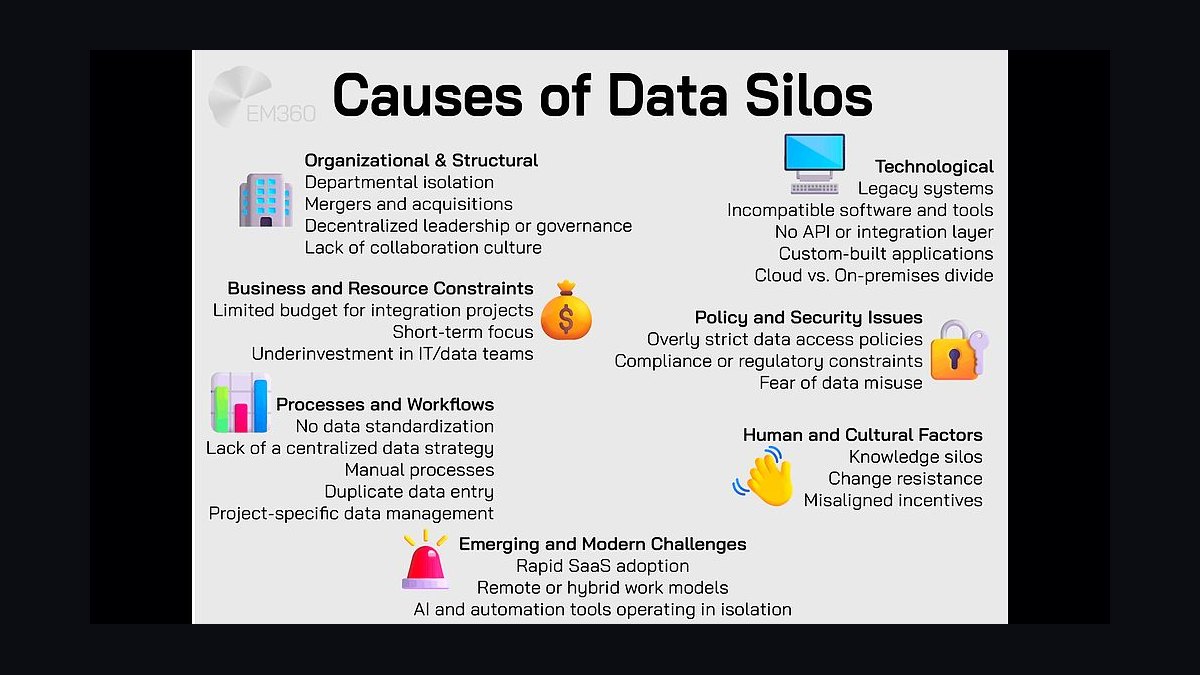
Prevent data silos by making one system the authoritative owner of each entity — customer, subscription, ticket — and syncing the rest through an event-driven middle layer keyed to a shared customer ID. Enforce that ID at account creation, reconcile nightly, and alert on drift. Governance, not tooling, is what actually holds.
The three-record problem nobody notices until renewal
Picture a mid-market SaaS company running a CRM for pipeline, a billing platform for subscriptions and invoices, and a support desk for tickets. Each system was bought by a different team in a different year, and each one has its own idea of what a "customer" is. The CRM has an Account object created by a sales rep who typed the company name by hand. Billing has a Customer object created by the checkout flow, keyed to whatever the buyer typed into the billing form — often a legal entity name that doesn't match the CRM's trade name. Support has an Organization created automatically the first time someone emailed help@, keyed to email domain.
Nothing breaks visibly for a long time. Sales closes deals, finance sends invoices, support answers tickets. The silo only surfaces at a specific moment: renewal. The account executive opens the CRM to prepare a renewal conversation and sees a healthy account — closed-won, expansion opportunity flagged, last activity a positive QBR. What the CRM does not show is that this customer opened forty-one support tickets in the last ninety days, eleven of them tagged as P1, and that their last two invoices went thirty and forty-five days past due before payment. That information exists. It lives in two other platforms, in two other schemas, under two other names for the same company.
The concrete failure mode is worse than an uninformed conversation. Consider what happens when the customer downgrades from a fifty-seat plan to a twenty-seat plan mid-term. Billing knows immediately — the subscription object changes and the next invoice reflects it. The CRM does not, because nobody built that sync, so the renewal opportunity still carries the original annual contract value. The forecast the CFO sees is overstated by the difference. Support does not know either, so entitlement checks still route this customer to the premium queue with a one-hour SLA they no longer pay for. Three systems, three versions of the truth, one customer who is quietly becoming a churn risk while every dashboard says otherwise.

The same pattern shows up in the reverse direction. A customer expands — adds a second business unit, signs a second contract. Sales creates a new CRM account because the buying entity is different. Billing puts both contracts under one customer record because the payment method is shared. Support sees two organizations because the email domains differ. Now the total revenue attached to that relationship is impossible to compute from any single system, and the account team is negotiating a renewal without knowing what the customer actually pays in aggregate.
What makes this hard is that none of the three systems is wrong. Each is internally consistent and correct for its own purpose. Billing genuinely needs the legal entity, because that's what goes on an invoice and what a court would recognize. Support genuinely needs the email domain, because that's how inbound tickets get routed with zero human input. Sales genuinely needs the account the rep can find by typing a trade name into a search bar. The silo is not a data quality problem inside any one platform. It is the absence of a layer above all three that says "these three records refer to the same commercial relationship" — and, critically, keeps saying it as records get created, merged, renamed, and split over the following years.
How the integration layer actually works
The mechanism that prevents silos has three parts: a canonical identifier, an event bus, and a reconciliation loop. Skip any one and the architecture degrades back into point-to-point spaghetti within a year.

The canonical identifier. Pick one system to mint the ID that every other system stores. In most B2B SaaS companies the CRM is the right choice, because that's where the commercial relationship starts and where the account hierarchy lives. The ID is not the CRM's internal record ID — use a stable, opaque string you control, so you can survive a CRM migration without reissuing every key. Every downstream platform stores this value in a custom field: pulse_account_id on the billing customer, the same on the support organization. That field is indexed, required, and validated. The rule that makes this work is boring and absolute: no billing customer or support organization may be created without one. That means the checkout flow calls the CRM (or the identity service) to resolve or create the account before it creates a subscription, and the support desk's auto-organization-creation feature gets disabled in favor of a lookup against the same service.
The event bus. Once records share a key, the systems need to tell each other when something changes. Do this with events, not with nightly full-table syncs. Each platform emits domain events — subscription.updated, invoice.payment_failed, ticket.escalated, account.merged — into a message broker or an iPaaS with a queue. A small set of consumers subscribes and writes derived fields back into the systems that need them. The direction matters: billing writes contract value and payment status *to* the CRM; support writes open ticket count, P1 count, and CSAT *to* the CRM; the CRM writes account name, owner, tier, and lifecycle stage *out* to both. Nothing writes a field it does not own. That single rule — one writer per field — eliminates the sync loops where two systems overwrite each other every four minutes forever.
The reconciliation loop. Events get dropped. Webhooks time out, retries exhaust, a schema change silently breaks a consumer, someone bulk-imports records through the UI and bypasses the API entirely. So you run a scheduled job — nightly is standard, hourly for high-volume — that pulls the full set of identifiers from each platform and compares them. It answers three questions: which billing customers have no matching CRM account, which CRM accounts flagged as customers have no billing subscription, and which linked records disagree on a field that should match. The output is a work queue, not an auto-fix. Auto-merging on a fuzzy name match is how you end up merging two genuinely different subsidiaries and spending a week untangling it.

A practical note on where the middle layer lives. There are three viable homes, and the choice is mostly about team shape rather than technology. An iPaaS product handles the plumbing and gives non-engineers a visual builder, which matters when the RevOps team owns the integration and no engineer is assigned to it. A customer data platform or reverse-ETL tool sitting on top of the warehouse works well when the warehouse is already the analytical source of truth and you want the same joins powering both dashboards and operational syncs. Custom services on a message broker give the most control and the lowest per-record cost at volume, and cost the most in engineering time to build and maintain. All three implement the same three parts above; they differ in who can change them at 4pm on a Friday.
Numbers, ranges, and what good looks like
Silos are usually argued about qualitatively and funded quantitatively, so it helps to have measurable targets. The following are the metrics worth instrumenting, with the ranges that separate a healthy integration from one that is quietly rotting.
Match rate. The percentage of billing customers with a valid, resolvable CRM account ID. Anything under 95% means the creation-path enforcement is not actually enforced — there's a UI, an import, or an admin bypassing it. Mature implementations sit at 99%+ and treat every miss as an incident with a root cause, because each miss is a customer whose revenue is invisible to the account team. Track the same figure for support organizations; it is usually the worse of the two, because support tools default to auto-creating organizations from email domains and that default has to be deliberately turned off.
Sync latency. Time from a change in the source system to the field being correct in the destination. Event-driven pipelines should land in under sixty seconds for the p50 and under five minutes for the p99. Batch syncs on a fifteen-minute or hourly cadence are acceptable for low-stakes fields like ticket counts, but not for entitlement. If support's entitlement check reads a plan tier that is four hours stale, a downgraded customer keeps premium SLA for four hours and an upgraded customer gets told they don't have access to something they just paid for — the second one generates an angry ticket within minutes.

Drift rate. The share of linked record pairs where a field that should match does not, measured by the reconciliation job. New implementations often start at 5-15% on names and addresses. The realistic steady state is under 1% for owned fields, and the number to actually watch is the trend: a drift rate that climbs week over week means a consumer broke or an integration credential expired, and it will usually show up in that metric two or three weeks before anyone reports a symptom.
Exception queue depth and age. Reconciliation output that nobody works is just a slower silo. A useful target is a queue that clears within one business day and holds fewer than fifty open items steady-state for a company with a few thousand accounts. When queue age crosses a week, the practical result is that people stop trusting the queue and start fixing things by hand in whichever system they happen to have open, which recreates the drift you were measuring.
Effort and cost, honestly stated. A first implementation covering CRM, billing, and support — canonical ID, four to six event types, one reconciliation job, and a backfill of existing records — is typically a six-to-twelve-week project, and the backfill is usually the largest single chunk. Deduplicating and linking several thousand pre-existing account records is mostly human review work; automated matching on domain and normalized name will resolve the majority, and the remainder requires someone who knows the book of business to make judgment calls. Ongoing maintenance is real and continuous, not zero: schema changes, API version deprecations, and new field requests arrive steadily, and an integration with no named owner degrades within a couple of quarters. Vendor pricing for iPaaS and CDP tools varies enough by volume and contract that any specific figure would be misleading — get quotes based on your actual monthly record volume, and model the three-year cost, since these tools are very hard to rip out once operational processes depend on them.
Volume assumptions matter for architecture choice. A company with two thousand accounts and a few hundred subscription changes a month can run this on almost anything, including scheduled batch jobs. A company with two hundred thousand self-serve customers and continuous plan changes needs real queueing, idempotent consumers, and dead-letter handling, because at that volume a 0.1% failure rate is hundreds of broken records a month and manual cleanup stops being viable.
Trade-offs, and the alternatives that also work

The canonical-ID-plus-event-bus pattern is the default recommendation, but it is not the only shape, and the honest trade-offs are worth stating before committing engineering time.
Point-to-point integrations — CRM syncs directly to billing, billing directly to support — are fast to build and genuinely correct for two systems. The cost curve is the problem: connections grow quadratically, so three systems need three integrations, five systems need ten, and each new tool triggers a round of retrofitting. The failure mode is not that any single connection is bad; it's that after two years nobody can answer "if I change this field, what breaks?" without reading every integration. Point-to-point is a reasonable choice when you are confident the stack will stay at two or three systems, and a trap when the company is still adding tools.
Warehouse-first (ELT plus reverse ETL) loads everything into a warehouse, resolves identity there with SQL, and pushes derived fields back out. The advantages are substantial: identity logic lives in version-controlled SQL that analysts can read and modify, the same models power both dashboards and operational syncs so reporting and operations cannot disagree, and adding a fourth or fifth platform is a new source connector rather than a new integration project. The cost is latency — most warehouse pipelines run on fifteen-minute to hourly schedules, which is fine for revenue reporting and health scores, and too slow for entitlement checks or anything a customer experiences in real time. Many teams run this as a hybrid: warehouse for analytical and slow-moving fields, direct events for the handful of fields that need to be fresh in seconds.

Consolidating platforms — replacing three vendors with one suite — genuinely eliminates the sync problem for the entities that move into the suite. It also introduces a different set of costs: migration is expensive and disruptive, the suite's individual modules are frequently weaker than the best-of-breed tools they replace, and negotiating leverage drops once one vendor holds the entire revenue stack. Consolidation is most defensible when the existing tools are genuinely under-used or when a renewal cliff forces the decision anyway. It is least defensible as a response to an integration problem you have not yet tried to solve, because the same silo will reappear the moment the company buys its next specialized tool — and it always buys another one.
Read-time federation — leaving data in place and joining it at query time via APIs or an embedded widget that surfaces billing and support data inside the CRM interface — avoids copying data entirely, so there is nothing to drift. It works well for human-facing views: a rep opening an account sees live ticket and invoice data without any sync existing. It does not work for automation, reporting, or anything that needs to filter or aggregate across systems, because you cannot build a segment like "all accounts with a failed payment and an open P1" out of read-time API calls at reasonable speed. Federation is a good complement to a sync architecture and a poor replacement for one.
One trade-off cuts across all four options and is usually decided badly: how much to enforce at creation time versus clean up afterward. Hard enforcement — refusing to create a billing customer without a resolvable account ID — produces clean data and occasionally blocks a sale at the worst possible moment, which generates real organizational pressure to add a bypass. Soft enforcement flags the record and lets it through, which never blocks revenue and guarantees a permanent backlog of unlinked records. The workable middle is hard enforcement on the automated paths, where a lookup is cheap and reliable, plus a deliberate, logged, time-boxed manual override for humans that creates an exception-queue item due within twenty-four hours. The override must be visible; a silent bypass is how the 95% match rate happens.
Pitfalls that break integrations after they ship

Most silo-prevention projects succeed at launch and decay afterward. The failures are predictable and worth designing against explicitly.
Two systems that both own the same field. The classic case is account name. Sales updates it in the CRM, finance updates it in billing to match the legal entity, and both sync bidirectionally. The result is a write loop that flips the value back and forth, burning API quota and producing an audit log nobody can read. The fix is a written field-ownership matrix — one row per field, one column naming exactly one owning system — reviewed whenever anyone requests a new sync. If two teams both insist they own a field, that usually means it is actually two fields (trade name and legal name) that were collapsed into one, and splitting them resolves the argument permanently.
No owner for the integration. The project is built by whoever had capacity, ships, and then that person changes teams. Six months later a vendor deprecates an API version, the sync fails silently, and nobody notices until a rep complains that renewal dates look wrong. Every integration needs a named owner, a monitored alert channel, and a documented runbook covering credential rotation, replaying failed events, and what to do when the exception queue spikes. Alerting on error rate alone is insufficient — alert on *absence* of expected volume too, because the most damaging failures are the ones where a consumer stops receiving events entirely and therefore reports zero errors.
Backfilling badly, or not at all. A new architecture applies cleanly to records created after launch and leaves years of historical records unlinked. Because the new-record path works, the metrics look fine, and the old records quietly form the silo you were trying to eliminate. Budget explicitly for the backfill, run it as a supervised project with human review of ambiguous matches, and do not auto-merge on name similarity — two records named "Acme Northeast" and "Acme North East" may be a typo or may be two real entities with separate contracts, and getting that wrong creates an invoice dispute.

Syncing everything. The instinct is to mirror every field into every system so nobody ever has to switch tabs. This multiplies the surface area for drift, inflates API costs, and buries the fields people actually need. Start from the decisions each team makes: an account executive needs open P1 count, payment status, and current contract value in the CRM — roughly a handful of fields, not the full ticket history. Support needs plan tier and account owner, not pipeline stage. Fewer synced fields means fewer things to reconcile and a much clearer signal when something drifts.
Treating deletes and merges as edge cases. Merging two duplicate CRM accounts is routine, and it detonates a naive integration: the losing record's ID disappears while billing and support still reference it. Any account merge must emit an account.merged event carrying both the surviving and retired identifiers, and consumers must re-key their records rather than orphan them. The same applies to hard deletes, which is one reason soft-delete-plus-tombstone is the safer default in the system that mints identifiers. Test the merge path before launch, because it will happen in week one.
Assuming the tooling is the hard part. Connectors are commodity; the durable work is governance. Someone must decide what a customer is when a parent company has four subsidiaries on three contracts with one shared support queue, and that decision has to be written down, applied consistently across all three platforms, and re-applied when the company acquires someone. Teams that buy an iPaaS and skip that decision get their silos back within a year, with a monthly bill attached. The governance layer — a field-ownership matrix, a documented account hierarchy model, a named owner, and a worked exception queue — is what actually prevents data silos. The technology just implements it.
Related questions
Which system should own the canonical customer ID?
Usually the CRM, since the commercial relationship starts there and account hierarchy lives there. In heavy self-serve businesses where signup precedes any sales contact, billing or a dedicated identity service is the better mint point. What matters more than the choice is that exactly one system owns it and every other stores it.
How often should reconciliation run?

Nightly is the standard baseline for most B2B companies. Move to hourly when subscription changes are frequent enough that a day of drift affects entitlement or invoicing. Running more often than the exception queue is actually worked adds noise without value — match the cadence to the team's capacity to resolve findings.
Do you still need a data warehouse if you have an event bus?
Yes, for different jobs. The event bus keeps operational fields fresh in seconds; the warehouse answers historical and cross-system analytical questions the bus cannot, like cohort retention by support volume. Many teams resolve identity in the warehouse and let the bus handle only latency-sensitive fields.
What breaks first when an integration is left unmaintained?
Credential expiry and API version deprecation, typically within two to four quarters. Both fail quietly — the sync stops, no user-facing error appears, and drift accumulates until someone notices wrong data in a renewal conversation. Alerting on missing expected volume catches this weeks earlier than error-rate alerting.
FAQ
Can you prevent data silos without engineering resources?
Partly. An iPaaS with a visual builder lets a RevOps team configure syncs, and most CRM, billing, and support platforms ship native connectors that cover the common field mappings. What a non-engineering team cannot easily build is idempotent event handling, a reconciliation job with an exception queue, and the enforcement hook that blocks record creation without a canonical ID. Expect to need some engineering time for those three, even if the day-to-day syncs are configured in a UI.
Is bidirectional sync always a bad idea?
Bidirectional sync between systems is fine; bidirectional sync of the *same field* is the problem. Structure it so each field flows one direction only — billing writes payment status to the CRM, the CRM writes account owner to billing — and the overall relationship is bidirectional without any field having two writers. Tools that offer "two-way sync" as a checkbox usually resolve conflicts by last-write-wins, which is a silent data-loss mechanism.

How do you handle customers who exist in billing but never in the CRM?
Self-serve signups create this constantly. The clean answer is that the checkout flow resolves or creates a CRM account before creating the billing customer, so the record never exists unlinked. If that is not feasible immediately, run a scheduled job that creates lightweight CRM accounts for unlinked billing customers with a distinct record type, so the revenue is visible without polluting the sales pipeline with records reps never touch.
What is the minimum viable version of this?
One canonical ID field, populated on the automated creation paths in all three platforms, plus a nightly job that reports unmatched records to a channel someone reads. No event bus, no iPaaS, no warehouse. That alone surfaces the silo and makes it measurable, which is the prerequisite for justifying anything larger. Teams that start here typically discover their real match rate is far lower than assumed.
Does consolidating onto one vendor's suite actually solve this?
It solves it for the entities inside that suite, and only until the next specialized tool is purchased — which happens, because product-led growth tools, revenue intelligence, and CPQ rarely all come from one vendor. Consolidation is a legitimate strategy when driven by cost or renewal timing, but treating it as the answer to integration debt tends to mean paying migration costs and then rebuilding the same integration layer eighteen months later.
How do you keep support entitlement accurate when plans change mid-cycle?
Entitlement is the field that most needs real-time treatment. Have billing emit a subscription-change event that a consumer writes directly to the support platform's tier field, and have the support tool read entitlement from that field rather than from a manually maintained list. Add a reconciliation check specifically on tier mismatches and alert on any that persist past a short window, since a stale tier either gives away premium support or denies it to someone who just paid for it.
Sources
- https://martinfowler.com/articles/patterns-of-distributed-systems/
- https://microservices.io/patterns/data/saga.html
- https://learn.microsoft.com/en-us/azure/architecture/best-practices/api-design
- https://cloud.google.com/architecture/data-lifecycle-cloud-platform
- https://aws.amazon.com/event-driven-architecture/
- https://kafka.apache.org/documentation/
- https://www.dama.org/cpages/body-of-knowledge
- https://docs.getdbt.com/docs/build/models
- https://stripe.com/docs/billing/customer
- https://developer.salesforce.com/docs/atlas.en-us.api.meta/api/sforce_api_objects_account.htm
Related on PULSE
This page will be disappearing soon. Save it to your device for $1 — or read it free while it is here.
@Kory-White- · if Venmo asks, the last 4 of my number are 2012
This page is gone.
This one is off the shelf now. $1 keeps it on your phone for good — the whole page, pictures and diagrams included.
 revopsWhat is the best way to structure a RevOps team for a mid-market B2B company in 2027?
 revopsWhat KPIs should a RevOps leader track across the full customer lifecycle in 2027?
 revopsHow do you handle lead scoring disagreements between sales and marketing in 2027?
 revopsWhat is the ideal reporting cadence for RevOps dashboards in 2027?
 revopsWhat are the biggest pitfalls when implementing a revenue operations platform in 2027?
 pulse-toolsHow do I find a fractional CRO who can also cover interim VP of Sales duties in 2027?
 pulse-sales-enablementDoes a higher LinkedIn SSI score actually generate more pipeline in 2027?
 revopsHow do you calculate customer acquisition cost when running multi-channel campaigns in 2027?
 revopsWhat made Casablanca a classic when it was considered a routine studio picture at the time in 2027?
 snowflakeSnowflake vs Clari — which should you buy?