


How do you build the GTM playbook for a barbershop and men's grooming chain in 2027?
Quality
Certified
Build the barbershop and men's grooming chain GTM playbook around premium positioning: charge $58–$95 for cuts versus $24–$32 commodity chains, anchor a signature hot-towel-shave ritual, run subscription memberships at 18–32% of revenue, dominate the local Google map pack, and merchandise grooming retail at a 22–38% attach rate.
The revenue problem being solved
The core revenue problem in 2027 barbershop economics is that the commodity haircut is a race to the bottom. Great Clips, Supercuts, and Cost Cutters have trained a segment of male consumers to expect a $22–$26 cut in 20 minutes, and a shop that competes on that plane is structurally capped: labor eats 38–52% of revenue, rent takes another 10–16%, and a single-location independent stalls around $280K–$680K in annual unit volume with net margins squeezed into the low teens. The playbook has to break that ceiling, because on the commodity plane there is no room to absorb a rent increase, a labor shortage, or a slow winter quarter — one bad variable and the unit runs at a loss.
The escape is a deliberate repositioning from "haircut vendor" to premium men's grooming destination. The 2027 U.S. category sits near $5.8B in revenue and grows at roughly 6–9% annually — among the fastest-growing personal-service subcategories — because Millennial and Gen Z men treat grooming as routine self-care rather than a chore. That demand shift is the opening. A premium cut at $58–$95 is 2–3x the commodity ticket, and once a client is paying that, the marginal upsell into beard grooming, hot-towel shaves, and take-home product is easy. The revenue problem, restated, is capacity monetization: the same chair, the same barber-hour, must produce a far higher average ticket and far stickier repeat cadence, or the unit never clears its fixed costs with room to reinvest. A chair that turns eight $28 heads a day grosses roughly $224; the same chair turning six $75 tickets grosses $450 while doing less physical volume — that is the entire thesis of the premium play in one line.

The second dimension of the problem is retention. Barbers own relationships, and when a barber leaves they take their book. A shop with no membership layer, no booking-system CRM, and no brand loyalty beyond an individual chair is one resignation away from a revenue hole — and in a labor market where skilled barbers field constant poaching offers, that risk is not hypothetical. So the playbook solves two things at once: raising the ticket and locking the client to the brand rather than only to a person who can walk out the door. Get both right and the unit compounds; get only one right and it either stays cheap or stays fragile.
Root-cause map: why the average ticket stays low
When a barbershop underperforms on revenue, the symptom is a thin average ticket and a low rebooking rate, but the causes chain backward through positioning, service design, technology, and retail discipline. Map the root causes before you touch price. A shop competing on the commodity plane has no permission to upsell; a shop with no online booking bleeds 22–38% of new-client acquisition to friction; a shop with no membership caps its own recurring revenue; and a shop with weak atmosphere generates reviews that complain about "no vibe" instead of raving about the experience. Each of these is fixable, but they compound — fixing one without the others leaves money on the table, because the levers reinforce each other rather than add up independently.
The map points to a single conclusion: revenue does not rise from one lever. You reposition the brand to earn premium pricing, engineer a service ladder that gives every visit an upsell path, remove booking friction so demand converts, install a membership that converts one-time cutters into monthly subscribers, and merchandise grooming product so each loyal client contributes $180–$580 a year in retail. Pull all five and the average ticket moves from the commodity $24–$32 into the premium $48–$140 band, and the unit's AUV climbs toward the $480K–$1.8M ceiling that well-run 2027 operators actually hit. The sequencing matters as much as the levers: you cannot merchandise $28 pomade to a client who resents paying $30 for the cut, so positioning and the service ladder come first, then booking and CRM, then membership, then retail — each rung earns the permission for the next.
Benchmarks and ranges practitioners should hold
Numbers are the spine of this playbook, so hold the ranges. On capital: a single-location independent barbershop runs $80K–$340K to open, driven by $80–$180 per square foot of build-out across 1,200–3,800 square feet, $40K–$140K of equipment (barber chairs alone run $1,800–$4,200 each, times 4–12 stations, plus mirrors, TVs, sound, sanitation, and beverage service), and $15K–$45K of opening inventory and supplies. Add a working-capital cushion of three to six months of fixed costs so the unit can survive the ramp before rebooking rates stabilize. A franchise route — Sport Clips, Floyd's 99, Roosters, V's, Hammer & Nails — layers a $30K–$80K franchise fee, 6–8% royalty, and 4–6% ad-fund contribution on top of a $180K–$540K total investment.
On unit economics: barbershop AUV spans $480K–$1.8M per location, gross margin runs 58–72%, and net margin lands at 14–32% for a well-run shop. Labor is the swing cost at 38–52% of revenue — commission barbers typically take 45–60% of the service revenue they generate, while booth-rental barbers pay the shop a flat $220–$540 per week and keep their own take. Rent should hold at 10–16% of revenue; anything above 18% and the model gets fragile, because there is no slack to absorb a soft month.
On the operating KPIs that actually predict revenue: active client base of 1,200–3,800; revenue per barber of $95K–$220K annually; rebooking (client retention) rate above 72%; average ticket of $35–$140, which decomposes into $35–$58 for a classic cut, $58–$95 for a cut plus beard, and $95–$140 for a premium cut-shave-grooming package. Aim for booking lead time of 1–4 weeks (a genuine signal of brand strength), review discipline of 4.7-plus stars on 80-plus reviews, and subscription penetration of 18–32%. Retail attach should sit at 22–38%, with retail gross margins of 38–58%.
On the channel mix that a healthy shop produces: roughly 58% of revenue from classic and premium cuts, 22% from beard and shave services, 8% from color and styling, 6% from membership and subscription, 4% from grooming retail, and 2% from specialty and events. First-year targets are more modest — 600–2,200 active clients by month 12, 4–10 barbers, a 65%-plus rebooking rate, a $48–$95 average ticket, and 60-plus Google and Yelp reviews at 4.7-plus stars. Hold barber turnover under 22% annually; above that, the client-attrition math starts eating your growth, because every departed barber at a 72% rebooking rate strands a book that took months to build. Track these numbers weekly, not quarterly — the leading indicators (rebooking rate, booking lead time, attach) turn before revenue does, which gives you time to correct.
Trade-offs and alternatives to weigh
The first real fork is franchise versus independent. Franchising with Floyd's 99, Roosters, Sport Clips, or V's buys a proven atmosphere template, operational systems, national marketing, and a recognizable brand — valuable if you have never operated a shop. The cost is the 6–8% royalty plus 4–6% ad fund and restricted operations, and, subtly, a ceiling on your pricing freedom: a franchise brand's positioning may not let you charge the full $58–$95 premium your local market would bear. Independent operators keep full margin and creative control and can position exactly where the neighborhood pays best, but they carry all the brand-building and systems risk themselves. There is no universally correct answer; it hinges on your operating experience and whether your local market rewards a national name or a distinctive local identity.

The second trade-off is barber compensation: commission versus booth rental. Commission at 45–60% aligns well for newer barbers still building a book — the shop supplies the clients and shares the upside, and keeps control of service standards, pricing, and the upsell script. Booth rental at $220–$540 per week suits established barbers who bring their own loyal following; the shop trades revenue-share for predictable rent and lower management overhead, but also cedes control over service standards and pricing, and weakens the brand-owns-the-client defense that protects you against departures. Many mature shops run a hybrid: commission for the bench, booth rental for the veterans, with a written non-solicit and a shop-owned booking system so the client relationship stays with the brand regardless of comp model.
The third is the atmosphere-and-amenity bet. Premium shops differentiate on whiskey, beer, or coffee service, masculine design, and sports TVs — Floyd's leans alternative-rock and tattoo art, Roosters runs vintage premium, V's plays 1920s Americana, Hammer & Nails builds a men's clubhouse with beverage service and adds nail care. Atmosphere is the 2027 moat against commodity competitors, but it is capital and execution risk: bad beverage service actively destroys the premium position and produces "no vibe" reviews. The alternative — a clean, no-frills, efficient shop — is legitimate, but it competes closer to the commodity plane and forfeits the premium ticket. Choose deliberately; do not half-build a clubhouse, because a half-finished premium experience reads as pretension at premium prices, which is worse than an honest cheap cut.
The fourth is technology and booking. Squire is the barbershop-specialized platform in 2027, with built-in CRM and commission management across thousands of U.S. shops; Booksy, Vagaro, GlossGenius, and Schedulicity are viable general alternatives. Staying on phone-only booking is the one option that is simply wrong — it forfeits 22–38% of new-client acquisition and the CRM backbone your membership program needs. The right pick is less about features than about the data spine: whatever platform you choose has to own the client record, the rebooking prompt, the membership billing, and the retail attach tracking in one place, or you are stitching revenue systems together by hand.
Rollout plan: from lease to full revenue mix
Sequence the launch so revenue-building systems are live before the doors open, then layer the premium and retention machinery through year one. Months 1–3 are lease and build-out, working through state barber and cosmetology licensing and sanitation approvals in parallel so nothing blocks the opening. Months 4–5 are barber recruitment, equipment install, and — critically — standing up the booking system and CRM before launch, not after. Month 6 is soft open into grand opening, with charity-cut and community events seeding the first review velocity. From there, the job is to walk the channel mix from cuts-only toward the full 58/22/8/6/4/2 split by installing the beard and shave ladder, then the membership, then retail merchandising.
Through months 7–9, drive the premium service ladder and launch memberships at $29–$89 per month for unlimited cuts plus perks — a monthly cut, a free beard trim, a 10–22% retail discount, and early booking access — which is what converts one-time cutters into the 18–32% recurring-revenue base with 75–85% retention. Months 10–12 are about compounding: push retail attach past 22%, harvest Google and Instagram reviews toward 4.7-plus stars on 80-plus, and build each barber's Instagram portfolio (fade-cut transformation reels are the viral surface; top barbers run 8K–180K followers) into a personal client pipeline that feeds the shop's chairs. The operating cadence that sustains it: daily booking and beverage management and retail merchandising; weekly social calendar and staff scheduling; monthly P&L, barber productivity, and retail-attach review; quarterly brand campaigns and barber training (fade workshops, beard masterclasses); annual license renewals and industry events like Premiere Orlando and IBS Las Vegas. Once one unit holds these numbers for two or three quarters, the same playbook clones into unit two — and multi-unit is where the grooming chain economics and the eventual exit multiple actually live.
Related questions
How is a barbershop GTM playbook different from a hair salon playbook?

Barbershops skew male, lean on shorter 3–5 week visit cadence, and monetize beard and shave services plus atmosphere (beverage service, sports, masculine design). Salons carry higher color and chemical-service revenue. The barbershop playbook weights subscription memberships and grooming-product retail more heavily to offset lower per-visit tickets.
Do I need a signature service, and what should it be?
Yes. The hot-towel straight-razor shave at $48–$95 is the canonical signature — it is Instagram-shareable, anchors the premium narrative, and justifies your pricing tier. Floyd's, V's, and Hammer & Nails all use a signature ritual as the experiential proof that a customer is buying more than a haircut.
What is the fastest lever to raise revenue in an existing shop?
Install online booking, then launch a membership. Booking recovers the 22–38% of new clients lost to phone friction and feeds the CRM; the membership then converts those clients into 18–32% recurring revenue at 75–85% retention. Both can go live in weeks without new build-out or new barbers.
How do I keep barbers from taking clients when they leave?
Bind the client to the brand, not only the chair: run memberships through the shop's CRM, own the booking relationship, and build brand loyalty via atmosphere and reviews. Keep annual turnover under 22% with fair commission or booth-rental terms and continuing-education investment.
What is the exit value of a barbershop chain?
Single owner-operator shops sell for roughly 2x–4x seller's discretionary earnings; multi-location chains trade at 5x–8x EBITDA. Premium chains with private-equity backing actively roll up existing shops as conversions, so a well-branded multi-unit operator has a real strategic-buyer exit path.
FAQ
How much capital do I need to launch a barbershop in 2027? Plan for $80K–$340K as a single-location independent, driven by build-out ($80–$180 per square foot), equipment ($40K–$140K), and opening inventory ($15K–$45K). A franchise route runs $180K–$540K total plus a $30K–$80K franchise fee, 6–8% royalty, and 4–6% ad-fund contribution. Add three to six months of fixed-cost working capital.
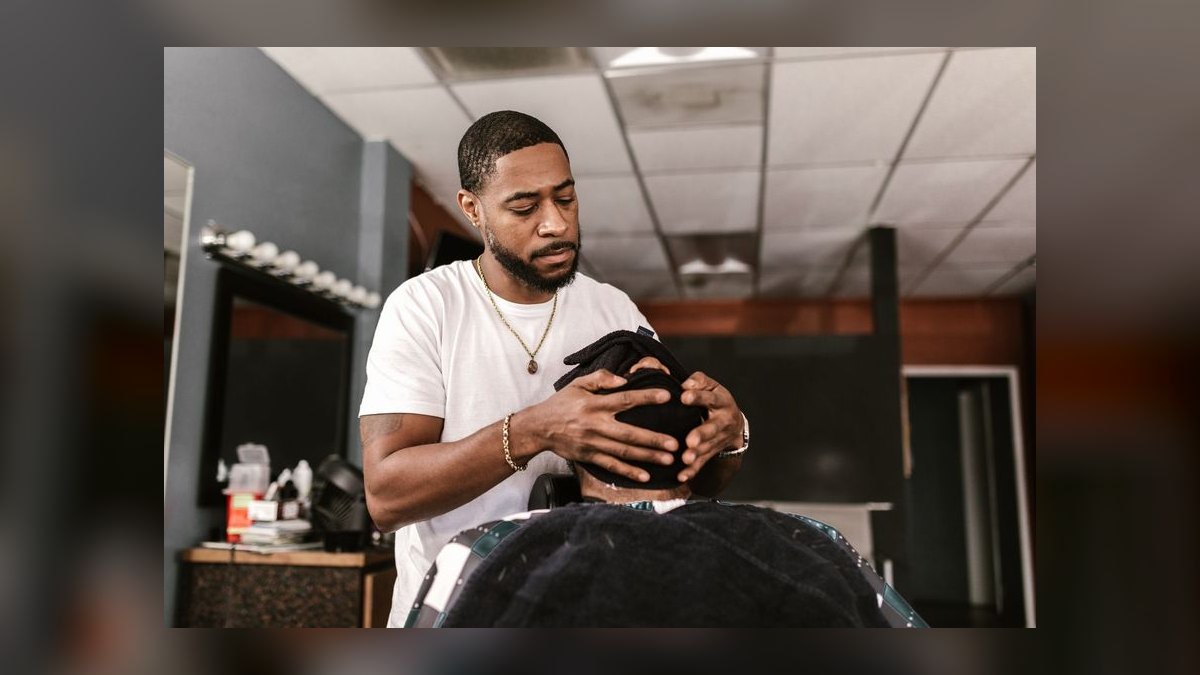
Should I franchise or stay independent? Franchise if you lack operating experience and want a proven brand, atmosphere template, and systems — accepting the royalty, ad fund, and pricing constraints. Go independent to keep full margin, creative control, and the freedom to charge the full $58–$95 premium your local market supports. It depends on your experience and market.
Commission or booth rental for barbers? Both work. Use commission at 45–60% for newer barbers still building a book, since the shop supplies clients and shares upside. Use booth rental at $220–$540 per week for established barbers with a personal following. Mature shops often run a hybrid across the bench, backed by a shop-owned booking system.
How important is atmosphere to the premium play? It is the central moat. Whiskey, beer, or coffee service, masculine design, and sports TVs are what justify premium pricing — Floyd's, Roosters, V's, and Hammer & Nails all compete on distinctive vibe. But execution matters: poor beverage service destroys the position and generates "no atmosphere" complaints.
What membership pricing and perks actually work? Price at $29–$89 per month for unlimited cuts plus perks: a monthly cut, a free beard trim, a 10–22% retail discount, and early booking access. Done right, membership drives 18–32% of revenue at 75–85% retention and is the single most durable lever against barber-departure attrition.
How much does grooming retail contribute? A healthy attach rate is 22–38%, at 38–58% retail gross margin, with loyal clients spending $180–$580 a year on product. Stock recognized men's grooming brands — pomade, beard oil, aftershave, and styling products — and merchandise them at the chair and reception, not in a back corner.
Sources
- https://www.ibisworld.com/united-states/industry/hair-cuts-services/1670/
- https://www.statista.com/topics/4671/mens-grooming/
- https://www.bls.gov/ooh/personal-care-and-service/barbers-hairstylists-and-cosmetologists.htm
- https://www.mintel.com/industries/beauty-personal-care/
- https://www.mckinsey.com/industries/consumer-packaged-goods/our-insights
- https://www.getsquire.com/
- https://booksy.com/
- https://www.grandviewresearch.com/industry-analysis/mens-personal-care-market
Related on PULSE
- GTM Playbook for Pet Grooming Services in 2027
- How do you build the GTM playbook for a quick-lube and oil change chain in 2027?
- Thrift Store Chain GTM Playbook 2027
- Frozen Yogurt Chain GTM Playbook 2027
- How do you build a cold chain logistics software go-to-market motion in 2027?
- How do you build a supply chain planning (SCP) software go-to-market motion in 2027?
This page will be disappearing soon. Save it to your device for $1 — or read it free while it is here.
@Kory-White- · if Venmo asks, the last 4 of my number are 2012
This page is gone.
This one is off the shelf now. $1 keeps it on your phone for good — the whole page, pictures and diagrams included.
 gtm-playbookHow do you build a court and case management software go-to-market motion in 2027?
 gtm-playbookWhat is the go-to-market playbook for launching a new product line in 2027?
 gtm-playbookGTM Playbook for Title Insurance Companies in 2027
 gtm-playbookGTM Playbook for DJ Services in 2027
 gtm-playbookGTM Playbook for Tax Attorneys in 2027
 pulse-recentWhat go-to-market playbook works best for Cleaning & Facilities in 2027?
 gtm-playbookNotary Services / Mobile Notary GTM Playbook 2027 — RON + Loan Signing Agent and the 85M Notarize Operator Path
 gtm-playbookGTM Playbook for Mobile Notary Services in 2027
 gtm-playbookWhat is the go-to-market playbook for verticalizing in 2027?
 gtm-playbookWhat is the go-to-market playbook for category creation in 2027?