


“DO THE REPS” — Sales Floor Print
Quality
Certified
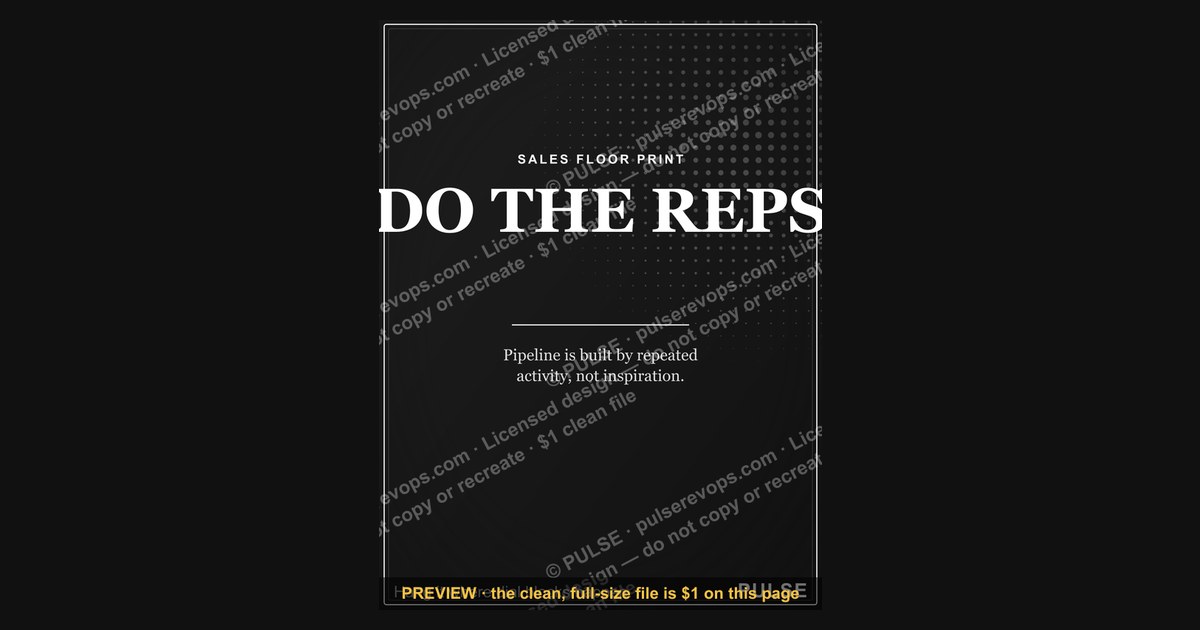
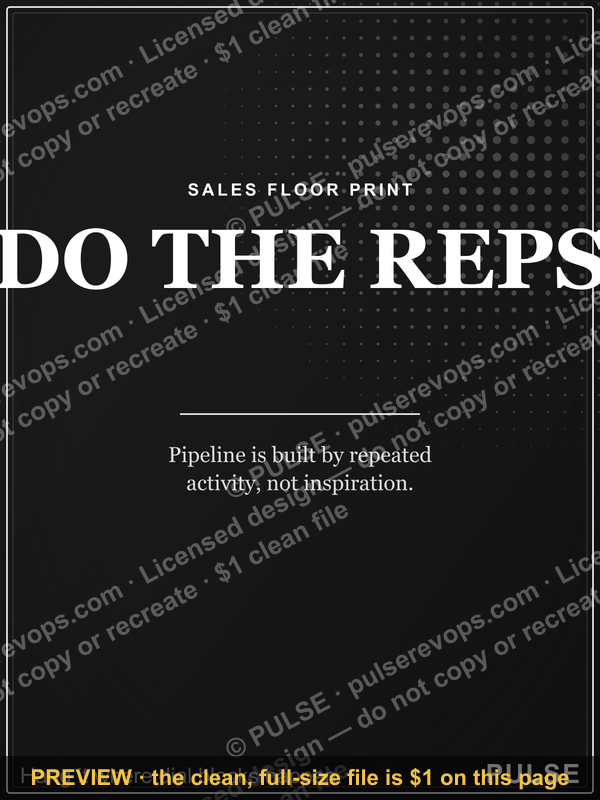
"DO THE REPS" is a sales floor print — a bold typographic poster reminding a revenue team that pipeline is built by repeated activity, not inspiration. Teams hang it where reps see it during dial blocks. Free SVG downloads exist; printed versions typically run roughly $15–$50 depending on size, paper, and framing.
What a sales floor print actually is, and why teams still hang them
A sales floor print is a large-format piece of wall art carrying a single operating instruction. It is not decoration in the hotel-lobby sense, and it is not a mission statement plaque. The good ones carry a verb. "DO THE REPS" carries a verb, an object, and an implied schedule, which is why it survives on walls where "Excellence Through Integrity" gets covered by a whiteboard within a quarter.
The mechanism is environmental cueing. A rep sitting in a bullpen makes dozens of small go/no-go decisions a day: send this follow-up or save it for tomorrow, dial the last five numbers on the list or start prepping tomorrow's list, leave a voicemail or hang up on the third ring. Each of those decisions is low-stakes on its own and enormously consequential in aggregate. A print in the sightline doesn't make the decision, but it tilts it. That is a small effect applied hundreds of times per person per week, which is the only kind of small effect worth engineering.
The reason "reps" specifically works is that it borrows a frame from a domain where the connection between volume and skill is uncontroversial. Nobody argues that a lifter should wait for motivation before the second set. Nobody thinks the fourth set is less legitimate than the first because it felt harder. Importing that frame into sales does something useful: it separates the input from the outcome. A rep who has made 40 calls and booked nothing has still done the work. Under an outcome-only frame, that day is a failure. Under a rep frame, that day is a completed set, and the outcome is a lagging indicator you'll see in three weeks.
There is a secondary function that sales leaders underrate. The print is a *permission structure* for managers. Coaching on activity is uncomfortable — it sounds like micromanagement, and reps hear "you're not working hard enough." When the wall has already said it, the manager is referencing shared context rather than issuing a personal criticism. "Are we doing the reps on this account?" lands differently than "I looked at your call log." Same question, much lower defensiveness. Cheap infrastructure for a hard conversation.
Adjacent formats do similar work with different mechanics. Whiteboards with live dial counts create peer visibility and work best in high-volume SDR rooms; they can also curdle into shame if the numbers are the only thing on the wall. A gong creates a shared celebration moment but only fires on wins, which means it goes quiet exactly when a floor most needs energy. Leaderboard TVs update continuously and are excellent for contests and terrible as a permanent fixture, because the bottom third of the board reads it every hour. The static activity print is the low-variance member of that family — it never shames anyone, never goes quiet, and never needs a data feed. Most floors that get this right run one print plus one dynamic surface, not four competing ones.
Remote and hybrid teams have not made these obsolete; they have relocated them. The print becomes a Zoom virtual background, a Slack channel banner, a header image on the team's activity dashboard, a physical copy mailed in the onboarding box. The SVG format matters here specifically because it scales from a 1500×500 LinkedIn banner to a 24×36 wall piece with no quality loss and no re-export.
From download to wall: the step-by-step process
Getting a print onto a wall is a small project, but it's a project people routinely botch by starting with the printer instead of the file. Work in this order.
Pick the file format before anything else. Vector (SVG) is the correct source for a typographic print, because the letterforms stay razor-sharp at any output size. Raster (PNG/JPG) is fine only if you already have it at the final print resolution. The working rule for raster: 300 DPI at final size. An 18×24 inch print at 300 DPI needs roughly 5400×7200 pixels. A 2400×3000 px file is genuinely fine at 8×10 (300 DPI) and acceptable at 11×14 (~215 DPI, which for large flat type is still clean), but stretching it to 24×36 will produce visibly soft edges on the letter strokes. If you have the SVG, none of this arithmetic applies — export at whatever the printer asks for.
Recolor before you export. Brand-matching a print costs nothing at the SVG stage and costs a reprint later. Swap the accent to your team color, decide on the background (a transparent background is the right export for anything you'll composite onto a slide or banner; a solid background is the right export for physical printing), then export once you're settled.
Choose the physical spec against the room, not the catalog. Reading distance drives size. A print meant to be legible from across a 30-foot bullpen wants a 24×36 or larger with type occupying most of the height. A print for the wall behind one desk works at 11×14. Matte paper is the safe default for an office with overhead fluorescents or windows — semi-gloss and glass will throw glare and turn the poster into a mirror at exactly the angle people sit at. If you frame it, non-glare acrylic solves this and is lighter and safer than glass in a room where people move chairs quickly.

Decide print channel. An office multifunction printer maxes out around 11×17 and will band large flat color fields; it's fine for a desk-side copy. A local print shop or an online poster service handles large format properly. Ask for the file spec up front (most want PDF or high-res PNG with a small bleed) rather than sending an SVG and hoping.
Hang it in the sightline that matters. The wall a rep faces while on the phone, not the wall behind them and not the hallway to the kitchen. Eye level when seated, roughly 55–60 inches to center for a standing-height room, lower if the floor is desk-heavy. Command strips over nails in leased space.
Costs, timelines, and what to actually budget
The file itself can cost nothing. Free downloadable SVG posters are common, and a designer-made custom piece from a freelance marketplace typically lands in the low hundreds if you want something bespoke to your brand. Most teams do not need bespoke — a good free typographic file recolored to your accent is indistinguishable from a commissioned one at 20 feet.
Physical output is where the money goes, and the ranges are wide because "print" spans a laser-printed sheet and a museum-mounted piece. Broadly: unframed poster paper in standard sizes is the cheap tier, framed or canvas versions run several times that, and large-format mounted work runs higher still. The commonly cited $15–$50 band covers most unframed-to-lightly-framed retail options in standard sizes; large format, custom framing, or mounted acrylic will exceed it. Budget per print, then multiply by the number of walls, then add one spare — you will want a second copy for the manager's office or a new-hire desk within the month.

Timelines are short and predictable. In-house printing is same-day for small sizes. A local shop turns large format in one to three business days. Online poster services typically run in the range of a few days to about a week including shipping, longer if you're ordering framed. If you are timing this to a kickoff, an SKO, or a new quarter, order two weeks out — the failure mode is not the printer, it's the person who has to approve the color.
The cost that nobody budgets is the replacement cycle. A print that stays on a wall for four years stops registering. The mere-exposure effect that makes a slogan feel familiar and trustworthy in month two makes it invisible in year two. Budget to rotate the wall annually — same message, new treatment, or a different message from the same family. This is a small recurring line item and it's the difference between a working cue and beige.
If you want a defensible ROI frame: this is one of the cheapest interventions available to a sales leader, and its cost should be compared not against zero but against the alternatives competing for the same "improve floor consistency" budget. A contest with cash prizes, a sales enablement tool subscription, or an outside trainer all cost multiples more per rep per quarter. That doesn't make a poster equivalent to training. It makes it the correct thing to do *in addition*, because it costs roughly one hour of a manager's time and a small print bill.
Where teams get this wrong
Treating the print as the program. This is the big one. A poster does not create activity discipline; it reinforces activity discipline that already exists somewhere in the operating cadence. If there is no activity metric anyone looks at, no daily huddle, and no manager who asks about touch counts, the print is wallpaper with a verb on it. Sequence matters: define what a rep *is* for your motion first — is it a dial, a connect, a multi-channel touch on a named account, a personalized email — then hang the sign that refers to it.
Defining "rep" as volume only. The literal reading of "do the reps" produces spray-and-pray dialing, and a floor that optimizes raw dial count will hit dial count while pipeline flatlines. The fix is to define the rep at the level of quality you actually want: a rep is a researched touch on an ICP-fit account, not a number dialed. Pair the print with a definition, in writing, in the same place the activity is tracked. Teams that skip this get exactly what they measured and then blame the poster.
Hanging it and never referencing it. Objects on walls decay into background within days unless someone reactivates them. The reactivation is cheap — a manager pointing at it in a huddle, a rep explaining in thirty seconds what it means to them this week, a recognition moment tied to it — but it has to happen. A print referenced once a week stays live for years. A print referenced never is dead in eleven days.
Rewarding only outcomes while preaching inputs. If the wall says "do the reps" and every celebration on the floor is a closed deal, reps will read the contradiction correctly and ignore the wall. The correction is to build at least one recognition mechanism around effort — most consistent activity week, most disciplined follow-up sequence, most accounts genuinely worked — and give it real airtime, not a token mention after the revenue awards. This matters disproportionately for new hires who are 60 days in with nothing closed, which is exactly the population most likely to quit.
Using it as a cudgel. The moment a manager points at the print while criticizing an individual in front of the floor, the print becomes a symbol of surveillance. It is very hard to recover a wall object's meaning after that. Activity conversations belong in one-on-ones.
Bad physical execution. Glare-mirrored glass under a window. Hung behind everyone's heads. Printed at 150 DPI so the type edges are fuzzy. Sized for a hallway and hung in a bullpen. These are trivial to avoid and they cost the piece its credibility — a print that looks cheap makes the message look cheap, and reps are professionally calibrated to notice when something is low-effort.
Ignoring the remote half of the team. A physical-only print in a hybrid org silently signals that the office half is the real team. Ship the digital version the same day: virtual background, Slack banner, and a mailed physical copy if the budget allows.
Choosing between the print and everything else on the wall
There is a real decision here, and it depends on what is actually broken. Diagnose before you decorate.
If the problem is inconsistent effort — reps who work in bursts, strong Mondays and dead Thursdays, activity that collapses the week after a big close — a static activity print is well matched. It addresses the go/no-go moment without adding measurement pressure.
If the problem is no visibility into who is doing what, a print won't touch it. You need a live activity surface: a dashboard on a TV, a daily digest, a whiteboard someone updates. Add the print alongside as the "why," but the dashboard is doing the work.
If the problem is skill, not effort — reps making plenty of calls and converting none — the wall is the wrong lever entirely. That's call review, objection handling drills, and a manager listening to recordings. Hanging an activity poster on a skill problem tells your best-effort reps that you misdiagnosed them, which is corrosive.
If the problem is morale after a bad quarter, be careful. An activity mandate on the wall during a demoralized stretch can read as "work harder" from management that hasn't fixed the underlying issue — bad territory, broken pricing, a product gap. Fix the visible thing first, then the wall lands as solidarity instead of blame.
If the problem is new-hire ramp, the print helps most as part of a ramp scaffold: a defined daily activity floor for the first 60 days, a manager checking in against it, and the wall as the ambient reminder. New reps are the population for whom "the rep itself is the win" is most true and most necessary.
Adjacent uses beyond the physical wall
The same file does more work than a single poster, and the marginal cost of each additional placement is essentially zero once the SVG is recolored.
Deck and slide furniture. Drop the vector into PowerPoint, Google Slides, Keynote, Canva, or Figma as a section divider in a QBR or a kickoff deck. It scales cleanly, it carries the brand accent, and it gives an activity-heavy slide a visual anchor that isn't a stock photo of a handshake.
Onboarding materials. A new SDR's welcome packet with a printed copy plus a one-page definition of what counts as a rep in your motion is a better first-day artifact than a mug. It connects a physical object to an operating standard on day one.
Internal comms surfaces. Slack channel banners, email signature blocks for the SDR team during a push, an intranet header. Consistency across surfaces is what turns a slogan into ambient environment rather than one framed thing in one room.

Contest and campaign branding. If you run a two-week activity sprint, the print becomes the sprint's visual identity — on the tracker, on the announcement, on the leaderboard header. This is also a natural rotation trigger: a new campaign is a legitimate reason to put up a variant without declaring the old one failed.
Field and distributed teams. Mail a copy to remote reps' home offices. This is the cheapest possible gesture that says the remote half of the floor is part of the floor. Include the digital versions so they can use it as a call background.
Adjacent teams that run on volume. Customer success teams doing renewal outreach, recruiters doing candidate sourcing, support teams working ticket queues, fundraising and development staff working donor lists — every one of these is an activity-driven motion where the same frame applies with no translation needed. If your CS org sits near sales, one print family across both floors is cheaper and reads as one company rather than two.
The unifying principle across all of these: the print is a carrier for an operating standard you have already defined. Where the standard exists, the print amplifies it everywhere it appears. Where the standard doesn't exist, no amount of placement makes it real. Define the rep, measure the rep, celebrate the rep — then put it on the wall, the deck, the banner, and the box.
Related questions
What size should a sales floor poster be?
Match reading distance. For a bullpen where people read it from across the room, 24×36 inches or larger with type filling most of the height. For a single desk or a manager's office, 11×14 or 8×10 is right. Oversized in a small room reads as shouting.
Does motivational wall art actually improve sales performance?
Not on its own. It functions as an environmental cue that nudges repeated small decisions, and it gives managers a shared reference for activity conversations. Any measurable effect comes from the operating cadence it reinforces — huddles, activity tracking, effort recognition — not the paper.
Can I recolor a downloadable print to my company's brand?
If it's an SVG, yes — swap the accent color and background in any vector editor or a browser-based color picker, then export as SVG or PNG. Vector files carry no quality penalty when recolored or resized, which is why SVG is the preferred source format.
What counts as one "rep" in a sales context?
Whatever your team defines it as, in writing. Common definitions: one dial, one connected conversation, one researched multi-channel touch on a target account, or one completed follow-up sequence step. Leaving it undefined is what produces meaningless volume.
How often should sales floor wall art be replaced?
Roughly annually. Repeated exposure builds familiarity for a few months, then the piece stops registering entirely. Rotating the treatment or the message — while keeping the underlying standard constant — restores the cue without changing what you're asking of the team.
FAQ
What does "DO THE REPS" mean?
It's a call to focus on the fundamental, repeated activity that builds pipeline: dials, emails, follow-ups, demos, and proposals. The phrase borrows a training frame from athletics to separate effort from outcome. A rep who completes the day's activity has done the job, regardless of whether a deal closed that day — the outcome shows up weeks later.
Is this print only for salespeople?
No. Any function that runs on repeated outreach benefits: SDRs and AEs obviously, but also customer success teams working renewals, recruiters sourcing candidates, support staff clearing queues, and founders doing early-stage prospecting. The frame translates without modification wherever consistent volume of a defined action drives results.
What size and material options are typical?
Common retail sizes are 8×10, 11×14, 16×20, 18×24, and 24×36 inches, printed on matte or semi-gloss poster paper. Framed and canvas options are widely available at higher price points. Matte is the safer default in offices with overhead lighting or windows, since gloss finishes and glass glazing produce glare at seated viewing angles.
Can I hang this in a shared office or team space?
Yes — that's the intended context. Put it in the sightline reps face while working the phone, at seated eye level, not behind them or in a hallway. Command strips are the sensible mounting choice in leased space. Pair it with a visible activity tracker so the message connects to something measurable.
Is there a digital version for remote teams?
Free SVG downloads are common and are the most flexible option — they export to any size for print, video call backgrounds, Slack banners, or slide decks without quality loss. For paid physical prints, digital versions depend entirely on the seller; check the listing before assuming one is included.
How do I keep a paper print looking good?
Keep it out of direct sunlight, which fades ink over months. Dust unframed prints with a dry microfiber cloth. If framed, clean the glazing only, with a lightly dampened cloth — never spray cleaner directly at the frame, since liquid wicks behind the glass and marks the paper permanently.
Sources
- https://jamesclear.com/atomic-habits — identity-based habits and cue-driven behavior change
- https://www.apa.org/topics/behavioral-health/habit-formation — American Psychological Association on habit formation and environmental cues
- https://hbr.org/topic/subject/sales — Harvard Business Review sales management coverage
- https://www.gartner.com/en/sales — Gartner research on sales performance and enablement
- https://www.osha.gov/wall-ceiling-openings — OSHA guidance relevant to safe fixture and wall mounting in workplaces
- https://developer.mozilla.org/en-US/docs/Web/SVG — MDN reference on SVG as a scalable vector format
- https://www.adobe.com/creativecloud/file-types/image/vector/svg-file.html — Adobe explainer on SVG vs. raster formats and print resolution
- https://www.printful.com/blog/poster-printing-guide — practical poster resolution and sizing guidance
- https://www.saleshacker.com/ — practitioner community coverage of sales activity cadence and coaching
Related on PULSE
This page will be disappearing soon. Save it to your device for $1 — or read it free while it is here.
@Kory-White- · if Venmo asks, the last 4 of my number are 2012
This page is gone.
This one is off the shelf now. $1 keeps it on your phone for good — the whole page, pictures and diagrams included.
 graphic“EARN THE RIGHT” — Sales Floor Print
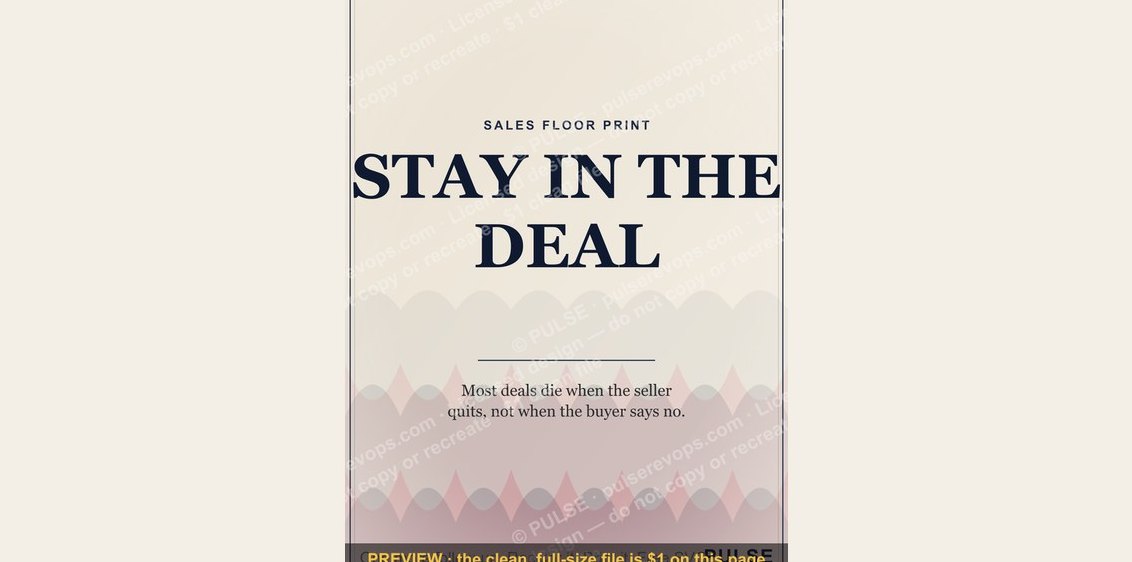 graphic“STAY IN THE DEAL” — Sales Floor Print
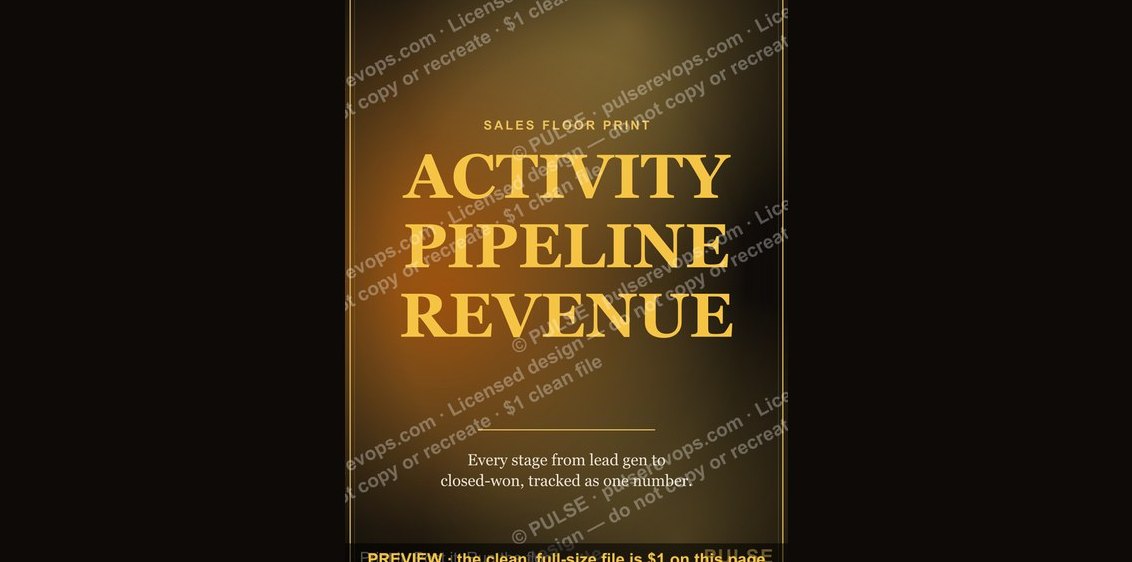 graphic“ACTIVITY PIPELINE REVENUE” — Sales Floor Print
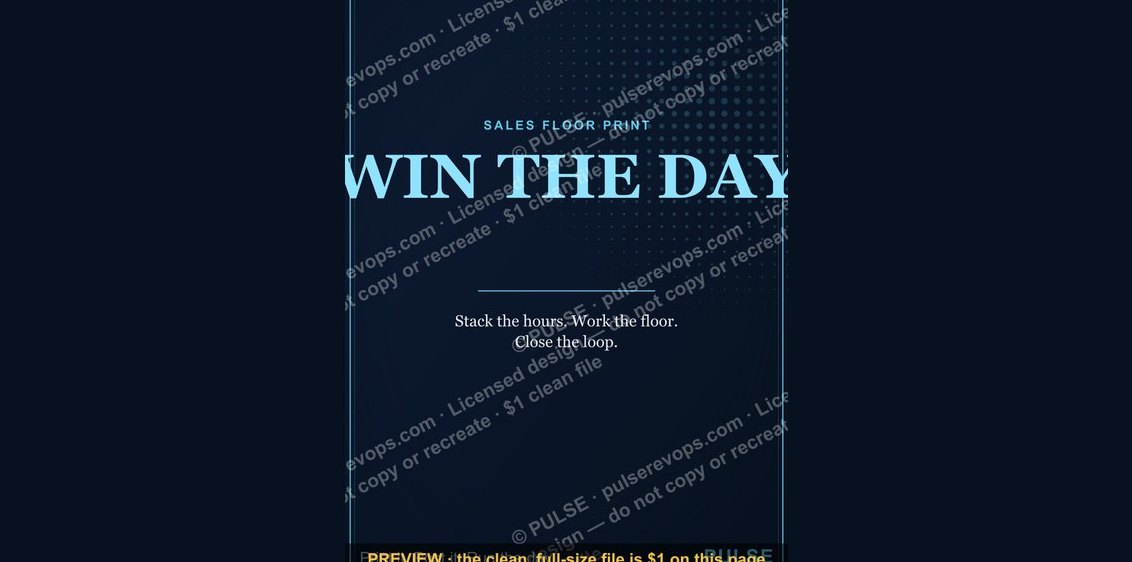 graphic“WIN THE DAY” — Sales Floor Print
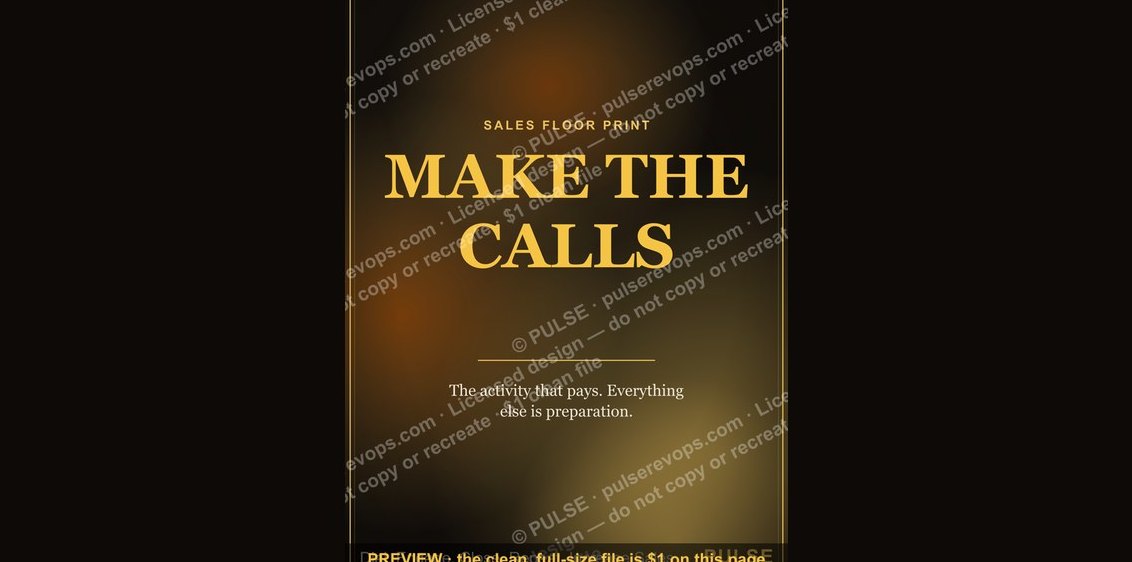 graphic“MAKE THE CALLS” — Sales Floor Print
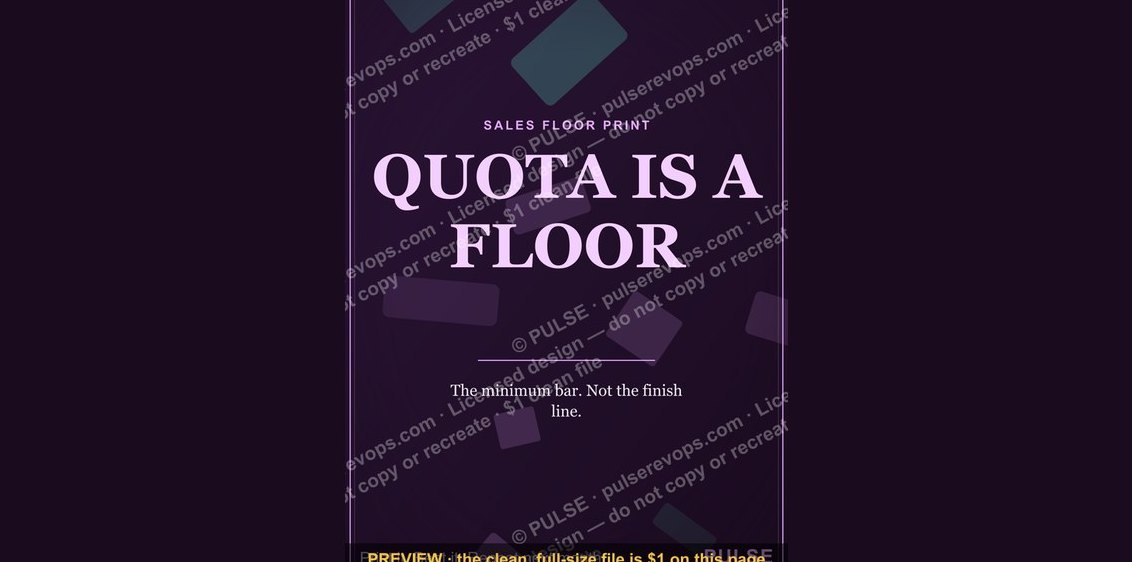 graphic“QUOTA IS A FLOOR” — Sales Floor Print
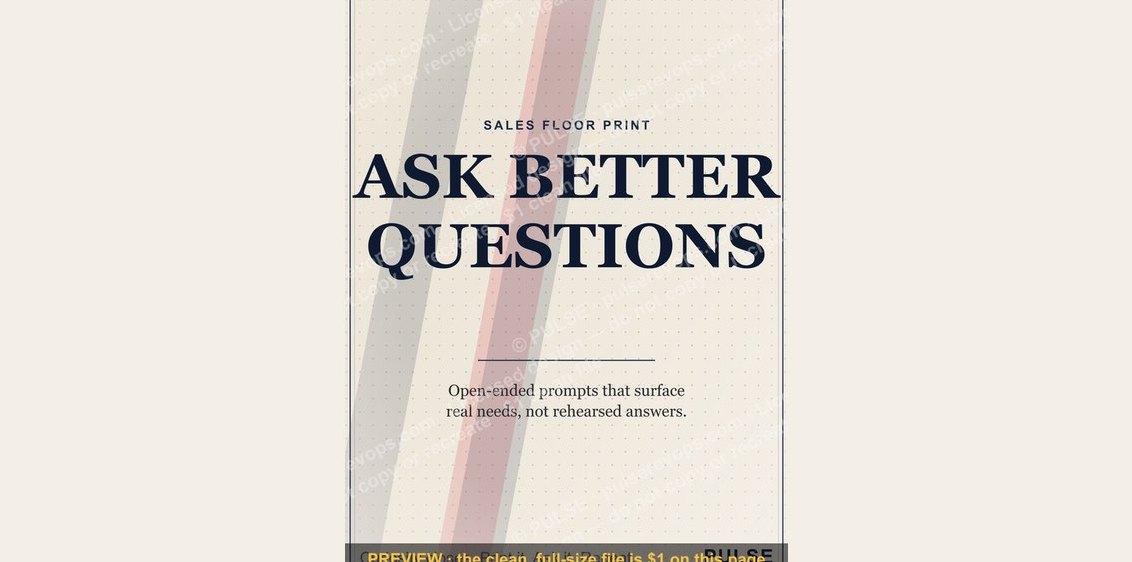 graphic“ASK BETTER QUESTIONS” — Sales Floor Print
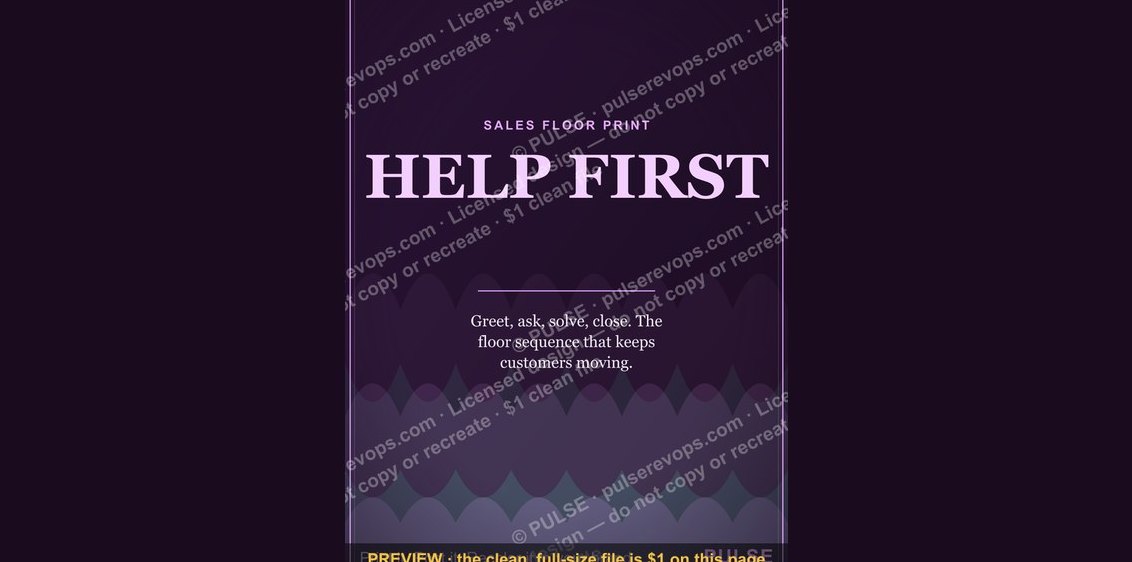 graphic“HELP FIRST” — Sales Floor Print
 graphic“FOLLOW UP AGAIN” — Sales Floor Print
 graphic“CHASE THE NO” — Sales Floor Print