 Pulse Reviews and Analysis
Top 10 Grocery Retail Revenue KPIs
 Curated by Kory White · Fractional CRO, CRO Syndicate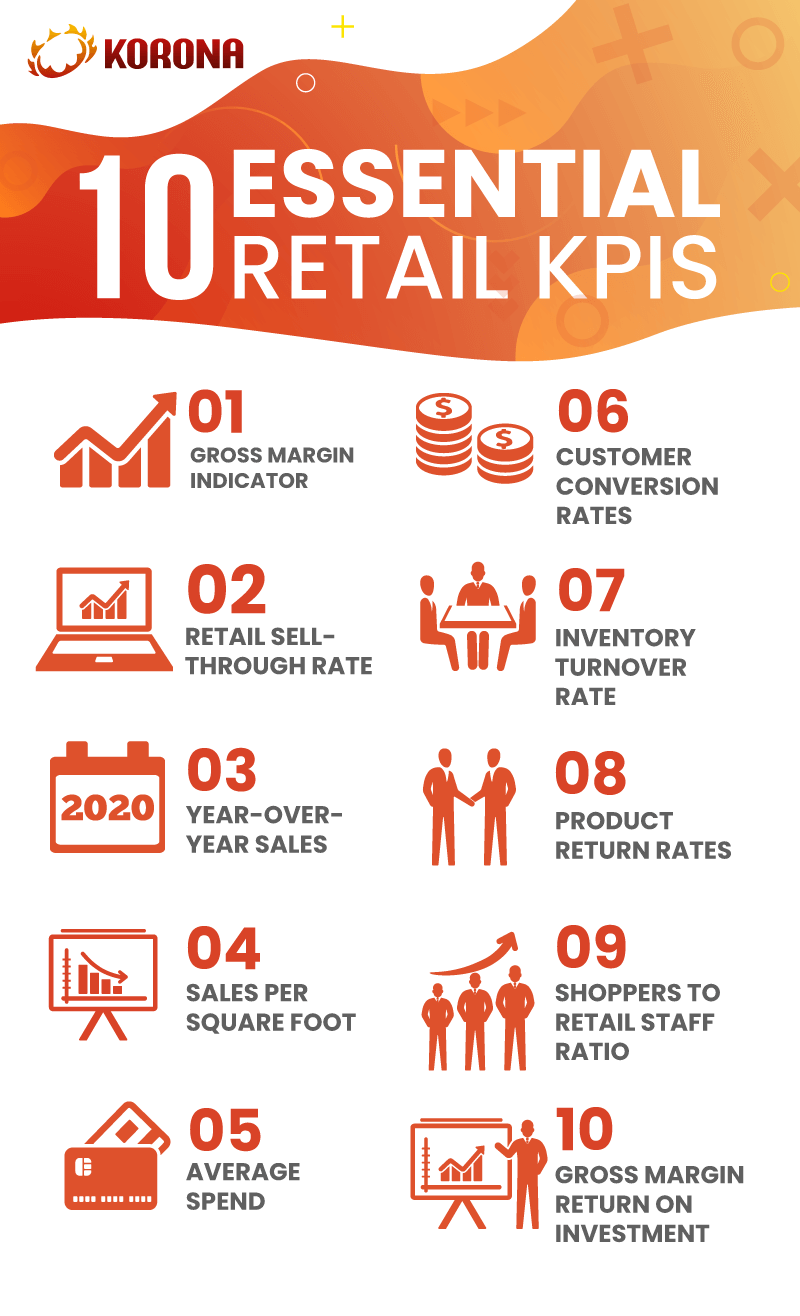
Direct Answer
Grocery retail operates on razor-thin margins (1–3% net profit) and high volume. Traditional SaaS KPIs like MRR or CAC payback are irrelevant. Instead, you track per-square-foot productivity, inventory freshness, and basket-level profitability.
This guide defines the 10 KPIs that separate thriving grocers from bankrupt ones, backed by real benchmarks from Kroger, Walmart, and regional chains.
Why Grocery Measures Differently
Grocery is not SaaS, CPG, or DTC. It’s a high-frequency, low-margin, perishable-goods business. Here’s why standard KPIs break:
- No subscription revenue. MRR is meaningless. Grocers earn per transaction, with average basket sizes of $30–$60 (Kroger: $55; Whole Foods: $45).
- Inventory decays. A head of lettuce has a 7-day shelf life. SaaS code doesn’t rot. This forces real-time tracking of shrink (spoilage/theft) and inventory turnover.
- Physical constraints. You can’t scale shelf space like cloud servers. Sales per square foot (industry median: $500–$700/year; Trader Joe’s hits $1,700) is the ultimate efficiency metric.
- Multi-channel complexity. Online grocery (Instacart, Walmart.com) has different unit economics: pick-and-pack labor, delivery cost, and higher return rates. A 2023 McKinsey report showed online grocery baskets are 20% smaller but have 15% higher return rates.
- Supplier dependency. A CPG promotion failure (e.g., PepsiCo missing a delivery) immediately impacts shelf availability. Fill rate from suppliers (target: 98%+) is a critical input.
The result: Grocery RevOps must blend retail math (GMROII, margin per item) with operational data (labor hours, shrink) and customer behavior (basket composition, retention). Tools like Clari for revenue forecasting are less useful here than Blue Yonder (demand sensing) or ReposiTrak (supplier compliance and scan-based trading).
The Most Important KPIs to Track
1. Gross Margin Return on Inventory Investment (GMROII)
- Formula: Gross Margin $ / Average Inventory Cost
- Why it matters: Tells you how much profit you get for every dollar tied up in inventory. Grocers with GMROII > $3.00 (e.g., Wegmans) outperform those below $2.00.
- Benchmark: Industry median ~$2.50. Top quartile > $4.00.
- Tool: Blue Yonder (pricing ~$100K–$500K/year) calculates GMROII per SKU in real time.
2. Sales per Square Foot
- Formula: Total Revenue / Total Selling Square Footage
- Why it matters: Measures space productivity. Trader Joe’s leads at $1,700/sq ft; Walmart averages $450.
- Benchmark: $500–$700 is average; > $1,000 is excellent.
- Action: Use Esri (geospatial analytics) to compare store-level performance and optimize shelf allocation.
3. Shrink Percentage
- Formula: (Inventory Loss / Total Sales) x 100
- Causes: Theft (35%), spoilage (30%), administrative error (20%), supplier fraud (15%).
- Benchmark: Average 1.5–2.5% of sales. Best-in-class (e.g., H-E-B) keeps it under 1.2%.
- Tool: ThinkLP (loss prevention software, ~$2K–$10K/month) uses AI to detect theft patterns.
4. Basket Size (Average Transaction Value)
- Formula: Total Sales / Number of Transactions
- Why it matters: Larger baskets spread fixed costs (labor, rent) across more revenue.
- Benchmark: Grocery average $35–$55. Costco hits $130+ due to bulk buying.
- Action: Use Salesforce Commerce Cloud (pricing ~$40K–$200K/year) to run basket-building promotions (e.g., “Buy 2, get 1 free” on high-margin items).
5. Item Profitability (Contribution Margin per SKU)
- Formula: (Selling Price – Cost of Goods – Direct Handling Cost) / Units Sold
- Why it matters: 20% of SKUs generate 80% of profit. Kroger found that 30% of its 50,000 SKUs were unprofitable after accounting for labor and shelf space.
- Benchmark: Target contribution margin > 25% for dry goods, > 40% for fresh.
- Tool: ReposiTrak (supply-chain compliance and scan-based-trading network) helps surface true landed cost and supplier data including rebates and promotional terms.
6. Inventory Turnover
- Formula: Cost of Goods Sold / Average Inventory Value
- Why it matters: High turnover means fresh product and less cash tied up. Low turnover signals overstocking or stale inventory.
- Benchmark: Grocery average 12–15x per year. Aldi hits 20x+; luxury grocers like Eataly are at 8x.
- Tool: Oracle NetSuite (starting ~$10K/year) provides real-time turnover dashboards.
7. Customer Retention Rate (Loyalty Program)
- Formula: (Number of Repeat Customers / Total Customers) x 100
- Why it matters: Acquiring a new grocery customer costs $50–$100 (via coupons, ads). Retaining one costs $5.
- Benchmark: Top loyalty programs (e.g., Kroger Plus) see 70%+ annual retention. Average is 40–50%.
- Tool: LoyaltyLion (starting $500/month) integrates with POS to track repeat purchase behavior.
8. Labor Cost as % of Sales
- Formula: (Total Labor Cost / Total Sales) x 100
- Why it matters: Labor is the #2 expense after COGS. Overstaffing kills margins; understaffing kills service.
- Benchmark: Target 10–15%. Walmart runs at 12%; Whole Foods at 14%.
- Tool: Workday (pricing ~$50K–$200K/year) optimizes scheduling based on traffic patterns.
9. Fill Rate (On-Shelf Availability)
- Formula: (Items Available / Total Items Planned) x 100
- Why it matters: A 98% fill rate means 2% lost sales. For a $50M store, that’s $1M in missed revenue.
- Benchmark: Best-in-class > 98%. Average 94–96%.
- Tool: Symphony RetailAI (pricing ~$100K–$500K/year) predicts stockouts 24 hours in advance.
10. Net Promoter Score (NPS)
- Formula: % Promoters – % Detractors (0–10 scale)
- Why it matters: NPS correlates with basket size and retention. A 2022 Forrester study showed grocers with NPS > 60 grow 2x faster.
- Benchmark: Grocery average 45. H-E-B scores 70+; Albertsons scores 35.
- Tool: Medallia (starting $15K/year) captures in-store and digital feedback.

👉 Quick Call with Kory White, Fractional CRO · See Kory on LinkedIn · CRO Syndicate
Real Operators
- Kroger uses GMROII to decide shelf placement. In 2023, they shifted 15% of shelf space from low-GMROII snacks to high-GMROII fresh produce, boosting store-level profit by 8%. They also use Clari (pricing ~$50K–$150K/year) for revenue forecasting across 2,700 stores.
- Walmart tracks sales per square foot relentlessly. Their “Store of the Future” redesign in 2022 added 20% more space to high-turnover categories (dairy, meat) and saw a 12% lift in overall revenue.
- Trader Joe’s runs on basket size and item profitability. They carry only 4,000 SKUs (vs. 50,000 at Kroger), ensuring every item contributes > 40% margin. Their labor cost is 9%, lowest in the industry, by cross-training staff.
- H-E-B uses NPS as a board-level metric. Their “Customer Obsession” program ties store manager bonuses to NPS scores. In 2023, they hit 72 NPS, driving 6% same-store sales growth.
- Aldi focuses on inventory turnover (20x/year) by limiting SKUs to 1,400 and using Blue Yonder for just-in-time replenishment. Their shrink is 0.8%, half the industry average.
Failure Modes
- Ignoring shrink. A chain with 3% shrink on $1B revenue loses $30M. Most grocers treat it as a “cost of doing business” until it kills margins. Stop using manual counts—deploy AI-based loss prevention (e.g., ThinkLP).
- Overcomplicating basket analysis. Trying to optimize every item leads to analysis paralysis. Focus on the top 20% of SKUs that drive 80% of profit. Use Pareto analysis in Excel or Tableau.
- Using stale data. Grocery data changes hourly. A KPI report from last week is useless. Set up real-time dashboards in Power BI or Looker (starting $3K/month).
- Treating all stores the same. A store in Miami has different shrink patterns (heat spoilage) than one in Minneapolis. Segment KPIs by store cluster (urban, suburban, rural) using Esri.
- Ignoring online vs. offline differences. Online baskets are smaller, returns are higher, and labor costs per order are 3–5x. Track separate KPIs for e-commerce (e.g., pick rate, delivery cost per order). Walmart found online orders have 15% lower GMROII than in-store.
Reporting Cadence
- Daily: Shrink %, Fill Rate, Basket Size (from POS data). Use Symphony RetailAI for real-time alerts.
- Weekly: Inventory Turnover, Sales per Square Foot, Labor Cost %. Review in Monday.com or Asana with store managers.
- Monthly: GMROII, Item Profitability, NPS. Present to C-suite via Tableau or Power BI.
- Quarterly: Customer Retention Rate, full P&L by store. Use Clari for revenue forecasting.
30-60-90
- First 30 Days: Fix Shrink. Audit current shrink data. Deploy ThinkLP or Indyme (loss prevention kiosks). Set target < 1.5%. Train staff on theft detection. Expected result: shrink drops from 2.5% to 1.8%, saving $500K on a $100M store.
- Days 31–60: Optimize Basket. Analyze top 20% of SKUs using ReposiTrak supplier-cost data. Run a “Basket Builder” promotion (e.g., 10% off when buying 5 items). Use Salesforce Commerce Cloud to target loyalty members. Expected result: basket size increases from $45 to $52.
- Days 61–90: Automate Replenishment. Integrate Blue Yonder with POS and supplier systems. Set inventory turnover target > 15x. Implement automated reorder points for top 500 SKUs. Expected result: fill rate hits 98%, stockouts drop by 40%.
FAQ
What’s the single most important KPI for a grocery chain? GMROII. It captures both margin and inventory efficiency. A 10% improvement in GMROII can boost net profit by 15–20%.
How do I calculate shrink if I don’t have RFID? Use POS data minus physical inventory counts. For fresh items, track waste scans at the register. ThinkLP offers a free shrink calculator.
Is NPS really useful for grocery? Yes. Forrester data shows a 1-point NPS increase correlates with 0.5% same-store sales growth. But only if you act on feedback (e.g., fix long checkout lines).
Should I track online and in-store KPIs separately? Absolutely. Online has 20% higher labor cost per order and 15% lower basket size. Use separate dashboards. Walmart tracks online GMROII at 2.0 vs. In-store 2.8.
What’s a realistic target for inventory turnover? 12–15x for full-service grocers. 20x+ for discounters like Aldi. If you’re under 10x, you’re overstocked.
How often should I update my KPI dashboard? Daily for operations, weekly for inventory, monthly for financials. Use Power BI with live data feeds.
What’s the biggest mistake grocers make with KPIs? Using averages. A store-level average hides huge variation. Segment by store cluster and SKU category. Kroger found that 30% of stores had shrink > 3%, while the average was 2%.
Sources
- McKinsey: How Grocers Can Improve Profitability (2023)
- Forrester: The Business Impact of NPS in Retail (2022)
- Blue Yonder: Grocery Replenishment Best Practices
- ReposiTrak: Supply-Chain Compliance and Scan-Based Trading
- ThinkLP: Loss Prevention in Grocery
- Symphony RetailAI: Fill Rate Optimization
- Gartner: KPI Benchmarks for Retail (2024)
- Walmart Annual Report 2023
- Kroger Investor Relations: Same-Store Sales Data
- Trader Joe’s: Operational Efficiency Case Study