 Pulse Reviews and Analysis
Top 10 Cannabis Dispensary Revenue KPIs
 Curated by Kory White · Fractional CRO, CRO Syndicate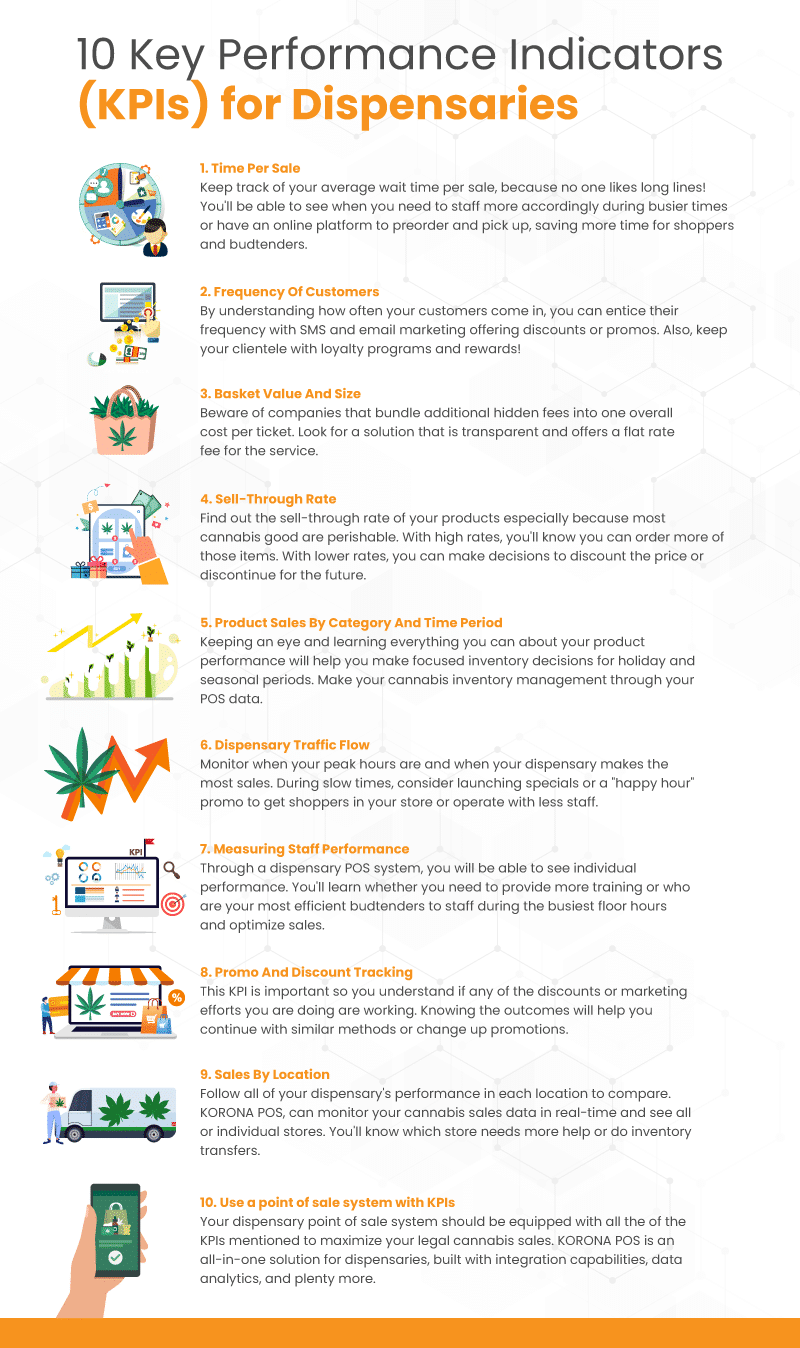
Direct Answer
The top 10 cannabis dispensary revenue KPIs are: Average Transaction Value (ATV), Customer Acquisition Cost (CAC), Customer Lifetime Value (CLV), Conversion Rate, Retail Foot Traffic, Online Order Percentage, Inventory Turnover Ratio, Gross Margin per Product Category, Repeat Purchase Rate, and Revenue per Square Foot.
These metrics are critical because cannabis dispensaries operate under strict regulatory constraints (cash-heavy, limited marketing channels, state-specific compliance) that make traditional retail KPIs insufficient. Tracking these allows operators to optimize pricing, inventory, and marketing spend in a highly fragmented market.
Why Cannabis Dispensaries Measure Differently
Cannabis retail is unlike any other consumer goods vertical. Three structural factors force a different KPI framework:
- Cash and compliance burden. Over 60% of U.S. Dispensaries still operate primarily in cash (per 2023 data from the U.S. Treasury’s FinCEN). This makes Revenue per Square Foot a more reliable metric than digital sales attribution, because cash transactions are harder to track at the customer level. Most point-of-sale (POS) systems—like Flowhub, Treez, or Green Bits—offer inventory tracking but often lack built-in CRM. You must manually sync with Mailchimp or HubSpot to get CAC.
- Product category volatility. In 2023, the average dispensary saw flower sales drop 12% year-over-year while vape sales grew 18% (per BDSA market data). A KPI like Gross Margin per Product Category is essential because margins vary wildly: flower averages 45-55% margin, edibles 35-45%, and pre-rolls 50-60%. If you only track total revenue, you'll miss the shift toward lower-margin products.
- Regulated marketing. You cannot run Google Ads or Facebook Ads for cannabis in most states. Dispensaries rely on Leafly, Weedmaps, local SEO, and loyalty programs. This makes Customer Acquisition Cost harder to calculate—you have to attribute traffic from these platforms manually. A typical dispensary spends $50-150 per new customer via Weedmaps, compared to $10-20 via local SEO (per Cannabiz Media benchmarks).
The Most Important KPIs to Track
1. Average Transaction Value (ATV)
Formula: Total Revenue ÷ Total Number of Transactions Target: $45–$75 per transaction (varies by state; higher in medical-only markets like Pennsylvania, lower in adult-use states like Oregon). Why it matters: ATV directly impacts revenue without requiring more foot traffic.
A $5 increase in ATV for a store doing 200 transactions/day adds $365,000/year in revenue. Tactics to raise ATV: bundle deals (e.g., "buy an eighth, get a lighter for $1"), upselling premium flower (e.g., Cookies or Stiiizy strains), and adding accessories (papers, grinders).
2. Customer Acquisition Cost (CAC)
Formula: Total Marketing Spend ÷ Number of New Customers Target: Under $50 for organic/local, under $100 for paid (Weedmaps, Leafly). Why it matters: With limited digital ad channels, CAC is the single biggest driver of profitability. A dispensary spending $20,000/month on Weedmaps with only 200 new customers has a CAC of $100—which may be too high if CLV is only $300.
Use HubSpot's Marketing Hub ($800/month for the Professional plan) to track source attribution, but note that cash transactions often break attribution links.
3. Customer Lifetime Value (CLV)
Formula: Average Transaction Value × Purchase Frequency per Year × Average Customer Lifespan (years) Target: $1,200–$3,000 per customer (adult-use markets with high frequency). Why it matters: CLV tells you how much you can spend on CAC. In mature markets (Colorado, Washington), the average customer visits 2-3 times per month and stays loyal for 12-18 months.
Use Loyalty programs (e.g., SpringBig, Cannaloyalty) to increase frequency. A 10% increase in repeat visits can boost CLV by 25%+.
4. Conversion Rate
Formula: (Number of Transactions ÷ Number of Visitors) × 100 Target: 30-50% for in-store, 2-5% for online (pre-order). Why it matters: In-store conversion is high because customers often arrive with intent. But online conversion is low because many states require age verification before browsing menus.
A low conversion rate on Leafly or Weedmaps usually means your menu is outdated or pricing is uncompetitive. Use Gong (if you have a call center for medical orders) to analyze why prospects drop off.
5. Retail Foot Traffic
Source: Physical counters or POS system logs Target: 100-300 visitors/day for a single-store dispensary in a mid-size city. Why it matters: Foot traffic is the leading indicator of revenue. If traffic drops 10%, revenue will follow within 2 weeks.
Track by day of week and hour. Use Clari (or a simple Google Sheets tracker) to correlate traffic with local events, weather, and holidays. In Denver, for example, traffic spikes 40% on 4/20 and 20% on concert nights.
6. Online Order Percentage
Formula: (Online Orders ÷ Total Orders) × 100 Target: 15-30% of total orders (higher in states with delivery, like California). Why it matters: Online orders have higher ATV (customers spend 15-20% more when ordering ahead) and lower labor costs (less budtender time per transaction).
If your online percentage is below 10%, you're leaving money on the table. Use Salesforce Commerce Cloud (or Shopify for smaller operators) to streamline pre-orders.
7. Inventory Turnover Ratio
Formula: Cost of Goods Sold ÷ Average Inventory Value Target: 4-8 turns per year (for flower; 6-12 for vapes). Why it matters: Cannabis flower expires (dries out) in 6-12 months, and vape cartridges lose potency. Slow turnover means write-offs.
A dispensary with $500,000 in inventory and $2M in COGS has a turnover of 4—which is marginal. Use Treez or Flowhub to track batch-level age and flag products older than 90 days.
8. Gross Margin per Product Category
Formula: (Revenue - COGS) ÷ Revenue × 100, broken down by flower, vapes, edibles, concentrates, etc. Target: Flower 45-55%, Vapes 40-50%, Edibles 35-45%, Pre-rolls 50-60%. Why it matters: Margins vary 20+ points across categories.
A dispensary that sells 60% flower may have a 50% overall margin, while one that sells 60% edibles may have only 38%. Use Benchmark (a cannabis analytics tool) to compare your category mix to local averages. If your edible margin is below 35%, renegotiate with suppliers or drop low-margin SKUs.
9. Repeat Purchase Rate
Formula: (Number of Customers with 2+ Purchases in 90 Days ÷ Total Customers) × 100 Target: 40-60% (higher in medical markets). Why it matters: Acquiring a new customer costs 5-7x more than retaining an existing one. A repeat purchase rate below 30% means your loyalty program or product quality is failing.
Use Mailchimp (free tier up to 500 contacts) to send SMS/email reminders for loyalty points expiring.
10. Revenue per Square Foot
Formula: Total Annual Revenue ÷ Total Retail Square Footage Target: $800–$1,500/sq ft (benchmark from Winning by Design retail studies). Why it matters: This is the ultimate efficiency metric. A 1,000 sq ft store doing $1.2M/year has $1,200/sq ft—good.
But if you have 2,000 sq ft and only $1.2M, that's $600/sq ft, indicating wasted space. Use Clari to model how adding a drive-through or delivery-only window could boost this.
Real Operators
Verilife (a multi-state operator with 30+ dispensaries) tracks ATV and Inventory Turnover weekly. In 2022, they reported a 15% increase in ATV after implementing a "budtender upsell" training program focused on premium flower strains. Their average ATV rose from $52 to $60 in six months.
They use Treez for inventory and Salesforce for CRM.
The Apothecarium (a California chain) focuses on Online Order Percentage. In 2023, they hit 28% online orders after integrating Shopify with their POS. They also use Mailchimp to send personalized offers based on past purchases, which increased repeat purchase rate by 12%.
A small independent dispensary in Portland, Oregon (name withheld) tracked CAC and found they were spending $120 per customer via Weedmaps. They shifted 30% of that budget to local SEO (Google Business Profile optimization) and saw CAC drop to $45. Their CLV was $1,800, so the ROI improved dramatically.

👉 Quick Call with Kory White, Fractional CRO · See Kory on LinkedIn · CRO Syndicate
Failure Modes
- Ignoring category mix. A dispensary that only tracks total revenue might see growth but actually be losing margin. Example: If flower sales drop but vape sales rise, total revenue may stay flat, but margin could fall 5 points. Always track Gross Margin per Product Category.
- Over-reliance on Weedmaps. Many dispensaries spend 50-60% of their marketing budget on Weedmaps without calculating CAC. Weedmaps charges $500–$2,000/month per listing, but if your CAC exceeds CLV, you're burning cash. Diversify into local SEO and loyalty programs.
- Using "same-store sales" incorrectly. Cannabis dispensaries often have varying product mixes and local tax rates (e.g., Washington has 37% excise tax, Oregon has 17%). Comparing same-store sales year-over-year without adjusting for tax changes is misleading. Use Revenue per Transaction instead.
- Not accounting for cash discounts. Some dispensaries offer 10% discounts for cash to avoid credit card fees. This artificially lowers ATV and Gross Margin if not tracked separately. Always record the "pre-discount" revenue for KPI calculations.
Reporting Cadence
| KPI | Frequency | Tool |
|---|---|---|
| ATV | Daily | POS (Treez, Flowhub) |
| CAC | Weekly | HubSpot + POS |
| CLV | Monthly | CRM (Salesforce, HubSpot) |
| Conversion Rate | Weekly | POS + Leafly/Weedmaps |
| Foot Traffic | Daily | Physical counter or POS |
| Online Order % | Weekly | POS + Shopify |
| Inventory Turnover | Monthly | Treez, Flowhub |
| Gross Margin per Category | Monthly | POS + accounting software (QuickBooks) |
| Repeat Purchase Rate | Monthly | Mailchimp, SpringBig |
| Revenue per Sq Ft | Quarterly | POS + floor plan |
Use Clari to create a weekly dashboard that surfaces the top 3 KPIs (ATV, CAC, Repeat Purchase Rate). For monthly reviews, add Gross Margin per Category and Inventory Turnover.
30-60-90
First 30 days: Implement tracking for ATV, CAC, and Repeat Purchase Rate. Use your POS system (e.g., Treez) to export daily transaction data into a Google Sheet. Set up HubSpot (free tier) to log customer sources. Run a one-week audit of Online Order Percentage by manually counting orders.
Days 31-60: Build a weekly dashboard in Clari or Google Data Studio (free). Include ATV, CAC, and foot traffic. Train budtenders on upselling (e.g., "Would you like to add a pre-roll for $10?"). Test a loyalty program via Mailchimp (send a "10% off next visit" email to 100 customers). Measure the impact on Repeat Purchase Rate.
Days 61-90: Analyze Gross Margin per Product Category. Identify the top 5 low-margin SKUs (under 35% margin) and either renegotiate with suppliers or discontinue them. Run a Revenue per Square Foot calculation—if below $800/sq ft, consider reducing floor space or adding a delivery-only window.
Set up a monthly review with your team using the 10 KPIs above.
Mermaid Diagrams
FAQ
How do I calculate CAC if I use cash and can't track customers? Use a proxy: divide total marketing spend by the number of new loyalty program sign-ups. If you don't have a loyalty program, start one with SpringBig ($99/month) or Cannaloyalty (free tier). Without it, CAC is a guess.
What's a good ATV for a new dispensary? Expect $35–$45 in the first 3 months. It will rise as you build a loyal customer base and train budtenders. In mature markets, $60+ is standard.
Should I track revenue before or after discounts? Track both. Use "pre-discount" for ATV and "post-discount" for Gross Margin. This helps you see if discounts are actually driving volume or just eating margin.
How often should I update my menu on Leafly/Weedmaps? Daily. Stale menus (more than 24 hours old) lower conversion rate by 15-20% because customers see "out of stock" items. Use Treez or Flowhub to auto-sync inventory to these platforms.
What's the biggest KPI mistake dispensaries make? Tracking only total revenue. It hides category mix shifts, margin erosion, and customer churn. Always break down revenue by product category and customer cohort.
Can I use Google Analytics for cannabis websites? Yes, but only for informational pages (not transactions). Google's terms of service prohibit using Analytics for cannabis sales. Use HubSpot or Matomo (self-hosted) instead.
What's the best tool for inventory turnover tracking? Treez is the most popular (starts at $199/month). Flowhub is a close second ($299/month). Both offer batch-level tracking and auto-alerts for aging inventory.