
Top 10 Retail Grocery Revenue KPIs
 Curated by Kory White · Fractional CRO, CRO Syndicate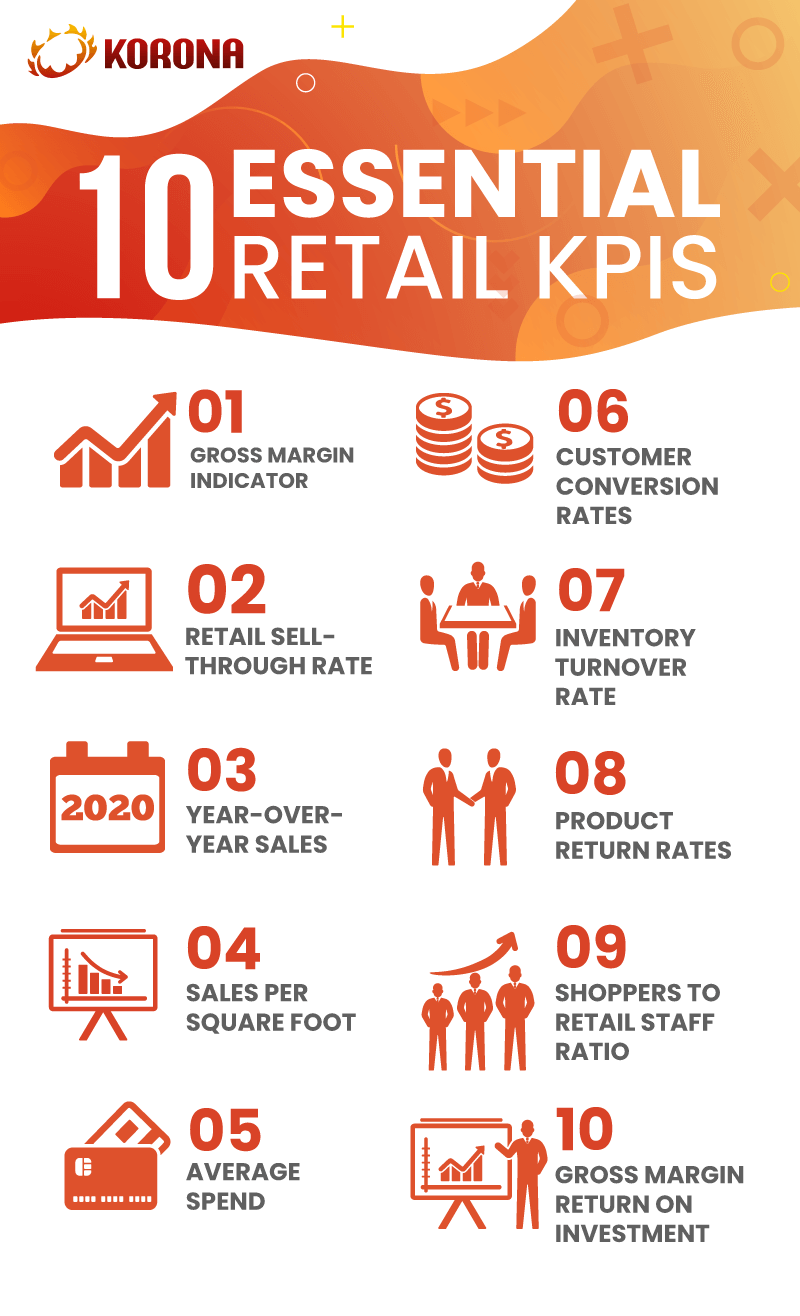
Direct Answer
For retail grocery operators, Gross Profit Margin per Store is the #1 revenue KPI because it directly captures the combined effect of pricing, shrink, and category mix at the store level. The runner-up is Revenue per Transaction (RPT) , which provides a clear signal of basket-building effectiveness and is especially useful for merchandising teams.
This ranking is designed for grocery VPs of Operations, Revenue Operations leaders, and category managers who need to prioritize metrics that actually move P&L.
How We Ranked These
We evaluated each KPI against four criteria: actionability (can a store manager or category lead directly influence it within a week?), predictive power (does it correlate with future revenue or margin?), benchmarkability (can it be compared across stores, banners, or industry averages?), and data availability (is it readily generated by standard POS and ERP systems like Oracle Retail or SAP S/4HANA?).
Each KPI scored 1–10 on these dimensions, and we weighted actionability and predictive power at 35% each. The top 10 represent the highest-weighted composite scores for a typical $500M–$5B grocery chain.
1. Gross Profit Margin per Store 🏆 BEST OVERALL
What it is: Gross Profit Margin per Store measures total store revenue minus the cost of goods sold (COGS), expressed as a percentage of revenue. For grocery, COGS includes vendor cost, inbound freight, and direct store labor for perishable prep. This KPI is the single most reliable indicator of a store's pricing power and operational discipline.
How/when to use: Track it weekly by store and by department. A store with a 32% margin but a 28% chain average likely has strong local pricing or better shrink control. Pair it with shrink reports from Blue Yonder or RELEX to isolate whether margin erosion comes from theft, spoilage, or markdowns.
Use it in monthly business reviews to flag stores that need pricing audits or category resets. The industry benchmark for U.S. Grocery gross margin is 28–33%, with natural/organic chains often hitting 35–38%.
Real tool/framework ref: Walmart uses a variant called "Segment Margin" in its Retail Link system, which subtracts direct store expenses from gross profit. For mid-market chains, Oracle Retail Merchandising can generate this KPI at the store-day level.
2. Revenue per Transaction (RPT)
What it is: RPT divides total store revenue by the number of transactions. It directly measures basket depth and is the most actionable top-line metric for front-line teams. A rising RPT indicates successful cross-selling or upselling, while a falling RPT suggests customers are buying fewer items per visit.
How/when to use: Monitor RPT daily in high-traffic stores and weekly in low-volume locations. Use it to evaluate promotional effectiveness: if a BOGO on soda lifts transactions by 15% but RPT drops 8%, the promotion may be attracting cherry-pickers. Real-time RPT dashboards are available in Salesforce Commerce Cloud for e-grocery and NCR Counterpoint for brick-and-mortar.
Target RPT of $35–$55 for conventional grocery, $55–$80 for premium banners.
3. Same-Store Sales Growth (SSSG)
What it is: SSSG compares current-period revenue from stores open at least 12 months to the same period last year. It strips out the noise of new store openings and closures, giving a pure measure of organic demand. This is the metric most analysts and boards use to judge a grocer's health.
How/when to use: Report SSSG monthly and quarterly. A 2–4% SSSG is healthy for a mature chain; anything below 1% signals share loss or traffic decline. Use Clari or Anaplan to forecast SSSG based on promotional calendars and macroeconomic indicators like CPI for Food at Home.
When SSSG dips, investigate traffic counts (from ShopperTrak or Density) and average basket size separately to pinpoint the driver.
4. Inventory Turnover (Days on Hand)
What it is: Inventory turnover (or its inverse, Days on Hand) measures how quickly a grocer sells through its stock. For perishable-heavy grocery, this is a direct proxy for freshness, waste, and working capital efficiency. A low turnover (high days on hand) means cash is tied up in unsold goods that may spoil.
How/when to use: Calculate it as COGS ÷ Average Inventory. Target 12–20 turns per year for dry grocery, 40–60 for dairy, and 80–100 for fresh produce. Use RELEX or SymphonyAI to set dynamic reorder points that balance service level with turnover.
A sudden drop in turnover in one category (e.g., deli meats) should trigger a markdown event or a vendor quality review. Real example: Kroger has publicly targeted inventory turnover improvement of 5–10% annually through its Restock Kroger initiative.
5. Customer Acquisition Cost (CAC) by Channel
What it is: CAC in grocery is the total marketing and sales spend (loyalty program costs, digital ads, in-store sampling) divided by the number of new customers acquired in a period. Unlike SaaS, grocery CAC is low ($5–$20 per customer) but churn is high, making retention equally critical.
How/when to use: Segment CAC by channel: Instacart vs. in-store vs. loyalty app downloads.
Use HubSpot or Salesforce Marketing Cloud to track attribution. If CAC for digital channels exceeds $30, consider shifting budget to in-store signage or local event sponsorships. Pair CAC with Lifetime Value (LTV) to ensure payback period is under 6 months.
A 3:1 LTV-to-CAC ratio is the minimum healthy threshold.
6. Average Basket Size (ABS) by Department
What it is: ABS is the average number of items per transaction, often broken down by department (produce, deli, center store). This KPI reveals cross-department purchasing patterns and is more granular than RPT. For example, a high RPT but low ABS means customers are buying expensive items but few of them.
How/when to use: Track ABS weekly in your business intelligence tool (e.g., Tableau or Microsoft Power BI). Use it to design end-cap displays that encourage multi-department trips. If produce ABS is 1.2 and deli ABS is 0.8, consider placing a deli sample station near the produce section.
Industry median ABS for grocery is 10–14 items per trip.
7. Shrink Percentage
What it is: Shrink is the difference between recorded inventory and actual inventory, expressed as a percentage of sales. It includes theft, spoilage, administrative errors, and vendor fraud. For grocery, shrink is the #1 profit killer, often eating 2–5% of revenue.
How/when to use: Measure shrink weekly by department and store. Use RFID-based inventory systems from Checkpoint Systems or Zebra Technologies for real-time tracking. If produce shrink exceeds 8%, audit receiving procedures and temperature logs. Use the mermaid flowchart below to decide when to escalate a shrink issue.
8. Revenue per Labor Hour (RPLH)
What it is: RPLH divides total store revenue by the number of paid labor hours. It measures workforce productivity and is a direct lever for margin improvement. Grocery is labor-intensive (12–18% of revenue), so small RPLH gains compound significantly.
How/when to use: Calculate RPLH daily for each store and shift. Use Workday or Kronos for labor data. Target $150–$250 per labor hour for conventional grocery.
If RPLH drops below $120, review scheduling: are too many cashiers scheduled during slow periods? Use Safeway as a benchmark: they target a 2–3% annual improvement in RPLH through labor optimization algorithms.
9. Customer Retention Rate (by Loyalty Cohort)
What it is: The percentage of customers who made at least one purchase in a given period and then made another in the next period. For grocery, 30-day and 90-day retention are the standard windows. This KPI is more predictive of revenue than raw traffic because repeat customers spend 2–3x per year more than new ones.
How/when to use: Segment by loyalty tier (e.g., Plenti, Kroger Plus, Target Circle). Use Gong or Salesforce to analyze call transcripts from customer service for churn signals. If 90-day retention for digital-only customers is under 40%, invest in personalized offers via Bluecore or Dynamic Yield.
Industry average 90-day retention for grocery is 55–70%.
10. Gross Merchandise Value (GMV) per Digital Order 💎 BEST VALUE
What it is: GMV per digital order is the total value of items sold through e-commerce (pickup and delivery) divided by the number of digital orders. It is the best KPI for measuring the profitability of online grocery, where fulfillment costs (picking, packing, last-mile) are high.
How/when to use: Track GMV per digital order weekly. If it falls below $45, the order may not cover fulfillment costs (typically $10–$15 per order). Use Ordergroove or Blue Yonder to set minimum order thresholds.
For example, Walmart requires a $35 minimum for delivery to ensure GMV per order covers its Spark Driver costs. This KPI is a "best value" pick because it is cheap to track (native to most e-commerce platforms) and directly impacts the bottom line of any digital channel.
FAQ
What is the single most important revenue KPI for a new grocery store? Gross Profit Margin per Store. It tells you immediately if your pricing and shrink controls are working. Wait until you have 3 months of data before making major changes.
How often should I review these KPIs? Gross margin and shrink weekly; RPT, ABS, and SSSG monthly; CAC and retention quarterly. Daily review of RPLH is recommended for high-volume stores.
Can these KPIs be used for both physical and online grocery? Most apply to both, but GMV per Digital Order and CAC by Channel are digital-specific. For physical stores, add Foot Traffic Conversion Rate as a supplementary KPI.
What tool can I use to track all 10 KPIs in one dashboard? Tableau or Microsoft Power BI connected to your ERP (e.g., SAP S/4HANA) and POS (e.g., NCR). Pre-built grocery templates are available from Domo.
How do I benchmark these against competitors? Use IBISWorld industry reports for U.S. Grocery averages, or subscribe to FMI (Food Marketing Institute) data. For private benchmarks, participate in Winning by Design peer groups.
What is a realistic shrink target for a grocery chain? 1.5–2.5% of revenue for dry grocery, 3–5% for produce and meat. Chains with strong RFID and training programs achieve under 2% overall.
How does inflation affect these KPIs? RPT and ABS may rise due to price increases, masking unit volume declines. Always report RPT in both dollar and unit terms during inflationary periods.
Sources
- FMI – The Food Retailing Industry Speaks 2025
- Oracle Retail – Grocery KPI Benchmarks
- McKinsey – The State of Grocery Retail 2024
- RELEX – Inventory Optimization for Grocery
- Walmart – Retail Link Analytics Overview
- ShopperTrak – Retail Traffic Analytics
- IBISWorld – Supermarkets & Grocery Stores in the US
Bottom Line
The top 10 retail grocery revenue KPIs—led by Gross Profit Margin per Store and Revenue per Transaction—form a practical framework for any operator who wants to move beyond vanity metrics. Focus on the four that directly affect your P&L: gross margin, shrink, RPT, and RPLH. Use the decision tree for shrink escalation, and benchmark against FMI data.
The rest of the list fills in the gaps for digital growth and customer retention.
*Top 10 Retail Grocery Revenue KPIs for operators: Gross Profit Margin per Store, Revenue per Transaction, Same-Store Sales Growth, Inventory Turnover, Customer Acquisition Cost, Average Basket Size, Shrink Percentage, Revenue per Labor Hour, Customer Retention Rate, and GMV per Digital Order.*