
How Do I Budget an Indoor Golf or Golf-Simulator Buildout?
 Curated byKory White · Fractional CRO · Maryland
 PULSEKNOWLEDGE LIBRARY
Budget roughly $40–$90 per square foot for an indoor golf buildout, with simulator bays the dominant cost at $25,000–$75,000 each depending on launch-monitor tier. A six-bay venue in 4,000–7,000 square feet runs $350,000–$900,000 all-in with a bar. Clear ceiling height of 10–12 feet is non-negotiable, and it filters your site list before anything else.
What actually drives the number
The single line that defines an indoor golf project is the simulator bay, and each complete bay lands between $25,000 and $75,000. Break one bay down and the launch monitor is the swing factor: the monitor itself runs $2,000 to $25,000, a short-throw or ceiling projector $1,500 to $4,000, the impact screen $800 to $2,500, a commercial hitting mat $1,500 to $4,000, enclosure framing and turf $3,000 to $8,000, and the gaming PC plus software $2,000 to $5,000 with an ongoing $500 to $3,000 per year subscription. Multiply that across six bays and hardware alone is $150,000 to $450,000, before you have poured a foundation or hung a single light.
Around the bays sit the costs that quietly balloon the total. A bar and lounge adds $40,000 to $150,000, and it is not optional — indoor golf lives on food-and-beverage attachment, where a bay rents for $40 to $60 an hour but the group ordering behind it drops $80 to $200 on drinks and food. HVAC runs $8 to $14 per square foot because projectors, PCs, and swinging bodies all throw heat, and humidity control protects screens and turf from warping and mildew. Electrical and low-voltage add $6 to $12 per square foot for dedicated circuits and structured cabling to every bay. Flooring, lounge, and seating add $5 to $12 per square foot, and booking/POS, sound isolation, and lighting together run $20,000 to $60,000 — bay-to-bay sound bleed and stray light wreck both the guest experience and launch-monitor accuracy, so neither is a place to cut.
Bay geometry and why clear height is non-negotiable
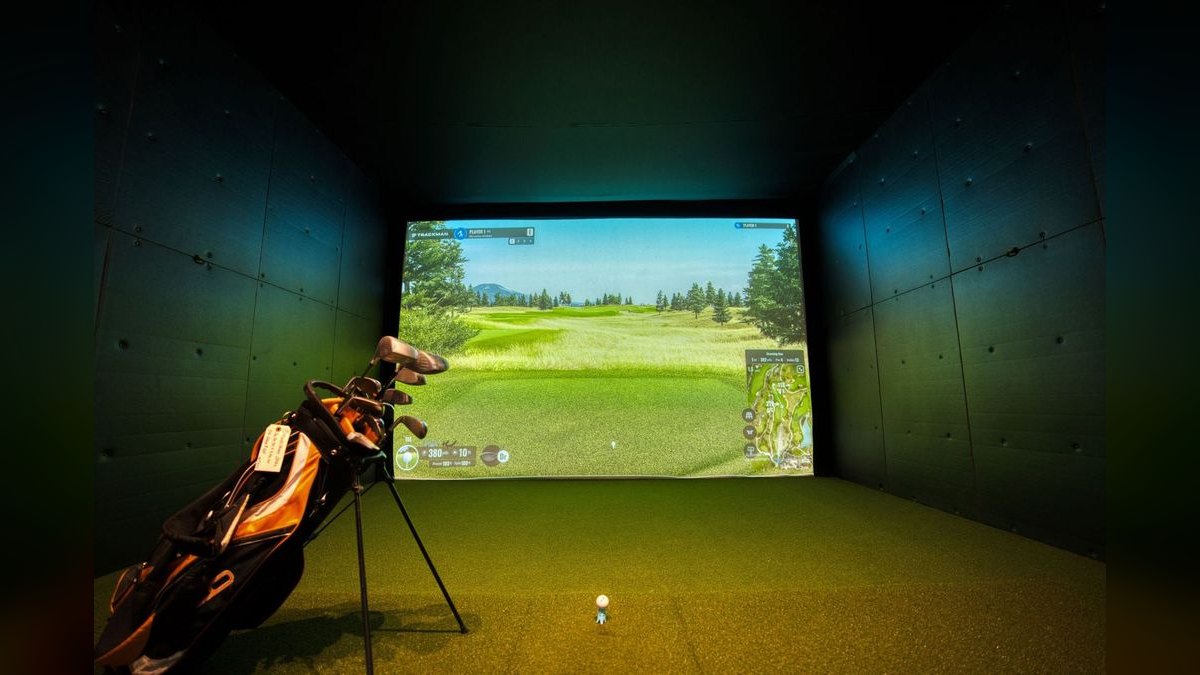
A proper bay needs a minimum of 10 feet of clear ceiling height, 12 to 15 feet of depth from tee to screen, and 12 to 16 feet of width so a right-handed and a left-handed player both fit without repositioning the enclosure. Squeeze those dimensions and you lose accuracy, comfort, and the sense of space that justifies premium pricing. Plan roughly 350 to 500 square feet per bay once you include circulation and setback, which is exactly why a six-bay venue settles around 4,000 to 7,000 square feet total.
Clear height is the constraint that quietly disqualifies most spaces. A golf simulator needs 10 to 12 feet of genuinely clear ceiling so a tall player can swing a driver without catching joists or ductwork — 10 feet is the bare minimum and 11 to 12 feet is the safe target. The trap is that "clear" means clear to the lowest obstruction, not to the structural deck. A landlord who advertises a 12-foot ceiling may be measuring to the deck while sprinkler heads, ducts, conduit, and joists hang down to leave you only 9.5 feet of usable swing height. Measure to the obstructions at every planned bay location before you sign anything, because you cannot add height later without cutting the roof. This one requirement pushes you out of low-ceiling retail strip space and toward industrial flex or high-bay warehouse conversions, typically at $10 to $18 per square foot triple-net — often cheaper per foot than retail, which partly offsets the extra square footage golf demands.
Choosing a launch-monitor tier to match your market
The launch-monitor decision drives both what you spend and what you can charge, so make it deliberately rather than defaulting to the most expensive box on the wall. Premium monitors carry brand cachet that supports $50 to $65 per hour pricing and attracts serious-golfer leagues, and a top-tier bay runs $55,000 to $75,000. Value-tier monitors deliver strong accuracy at a much lower cost, support $35 to $50 per hour casual play, and bring a bay in at $25,000 to $40,000. Both tiers produce data good enough for the vast majority of players; the difference buyers actually feel is the room, the screen quality, and the beverage program, not the last decimal of spin-rate measurement.
The counterintuitive money move is that fewer premium bays often lose to more value bays plus a strong bar. Six value-tier bays at $30,000 each is $180,000 and, paired with a real beverage program, will out-earn three premium bays at $70,000 each ($210,000) with no bar — because revenue follows bay-hours sold and F&B attachment, not brand prestige. Reserve premium monitors for markets that genuinely have serious golfers willing to pay $55-plus an hour and join structured leagues. In a casual or suburban entertainment market, the premium tier is capital you could have spent on two more bays or a better lounge, and the average birthday-party or after-work group cannot tell the difference at the screen.
The revenue math per bay
Run the economics before you commit to a bay count. A single bay open 60 hours a week at 50% utilization and $45 an hour grosses roughly $70,000 a year before any food or beverage — and F&B often doubles that take, which is why the bar is a revenue engine rather than a hospitality nicety. That math rewards building fewer, better bays anchored by a strong beverage program over a room full of cheap bays with nothing to sell between swings. It also means the marginal profitability of bay number six depends entirely on whether you can actually keep it booked.
Utilization is the number to stress-test, because it swings the entire model. Winter evenings and weekends carry the calendar in most markets, so peak demand is concentrated into a narrow band of hours while weekday mornings sit nearly empty. If you underwrite at 50% utilization but only hit 35% because your market is seasonal or your marketing is thin, per-bay gross drops from roughly $70,000 to under $50,000 and the extra bays you built sit dark and depreciating. Model a conservative and an aggressive utilization case, size your day-one bay count to the conservative one, and treat league bookings, corporate events, and lesson programs as the upside that pushes you toward the aggressive case rather than the base you depend on to cover rent and debt service.

Negotiating the lease and TI allowance
Indoor golf is a quiet, clean, high-clear-height tenant, and its unusual height requirement is both a filter and a negotiating lever. First, make clear height a written lease condition: get the landlord to certify minimum clear height to the lowest obstruction, not the deck, so a measurement dispute after signing becomes their problem, not yours. Second, demand tenant-improvement dollars for the permanent work — bay framing, electrical upgrades, HVAC, and the bar all stay with the building — so push for $15 to $35 per square foot in TI, or as high as $20 to $60 on a strong multi-year deal, disbursed against pay applications during construction rather than reimbursed after you open.
Get the fine print right too. Confirm the use clause explicitly permits "indoor golf, simulator, entertainment, and bar/restaurant service" so you can add a liquor license and league play without a second landlord approval. Cap CAM at 3 to 5% and exclude capital items like roof, structure, and parking-lot resurfacing. Negotiate 3 to 6 months of free rent and tie rent commencement to your certificate of occupancy — and to the liquor license if you are serving. Lock in evening and weekend parking, since that is precisely when you operate. Finally, negotiate the personal guaranty to burn off after 24 to 36 months of on-time payments or convert it to a good-guy clause. Because a golf buildout is expensive and hard for a landlord to re-lease to the next tenant, that difficulty is leverage: it makes them more willing to fund improvements to keep you in the space.

Vetting the contractor and the install
Simulator buildouts look simple but carry precise tolerances — the screen, projector, and launch monitor have to be positioned exactly or the projected image ghosts and the ball data goes wrong. Hire a general contractor who has built simulators before, or coordinate tightly with your simulator vendor's published install specification. Projector throw distance, screen tension, and ceiling-mount placement all have tight windows, and a generalist who guesses leaves you with ghosting, ball-tracking errors, and warranty disputes that nobody wants to own after the doors open.
Structure the contract to protect yourself. Keep the actual bay installation with the specialist vendor or a certified turnkey integrator so the GC cannot mark up the technology package 15 to 25%. Use a guaranteed-maximum-price contract and hold 10% retainage until the certificate of occupancy and a calibrated accuracy test of every single bay. Hand the electrician a bay-by-bay electrical and AV schedule up front so dedicated circuits and structured cabling get bid correctly the first time rather than change-ordered later at a premium. Carry a 10 to 15% contingency, because older shells routinely reveal undersized power, low clear-height pockets, and HVAC shortfalls once demolition opens the ceiling — an existing panel often needs a $3,000 to $15,000 upgrade to feed the bays. And if you are serving, remember the bar needs restaurant-grade plumbing: bar drains, a walk-in cooler, and grease or floor drains all to code, which the GC must scope from day one rather than discover mid-build.
Where budgets blow up and where to protect cash
The bay hardware is the line everyone budgets for; the building itself is what wrecks the number. Three site constraints decide whether a space even works — true 10-to-12-foot clear height, adequate electrical capacity for each bay's PC, projector, and monitor, and HVAC sized for the heat load of players swinging clubs under hot projectors. Add soundproofing between bays and to neighboring tenants, impact-rated wall backing behind the screens, and flooring that survives spikes and rolling equipment, and you should budget a realistic $15 to $30 per square foot for these soft and site costs alone, entirely separate from the bays themselves. Get a contractor walkthrough before you sign the lease, not after.
Phasing is the cleanest way to de-risk all of it. Build the full shell, electrical, and HVAC up front because that work is expensive and disruptive to redo, then install bays in two waves — open with three or four bays plus the bar, prove demand on a live booking calendar, and fund bays five and six from operating cash. That approach cuts day-one capital by 30 to 40%, roughly $50,000 to $150,000, and lets you confirm the right launch-monitor tier before committing to it across the whole room. When you trim, trim the right things: cut lounge luxury, oversized signage, and day-one bay count. Never trim clear height, launch-monitor accuracy, screen quality, or HVAC and humidity control — those are the experience itself and the lifespan of the equipment, and none of them can be retrofitted cheaply once you are open and operating.
FAQ
How much does a single simulator bay actually cost? A complete bay — launch monitor, projector, impact screen, hitting mat, enclosure, turf, and PC — runs $25,000 to $75,000, and the launch-monitor tier is the dominant swing. Spec one bay fully with itemized quotes before you multiply, because small per-bay differences compound fast across a multi-bay room.
Is the per-square-foot number the construction cost or everything? Treat $40 to $90 per square foot as the buildout itself: framing, electrical, lighting, flooring, and the bays. It generally excludes lease costs, permits, and the working capital you need to open the doors. Build a separate soft-cost line so the headline figure does not lead you to underfund the project.
What ceiling height do I actually need? Ten feet of clear height is the bare minimum and 11 to 12 feet is the safe target, measured to the lowest obstruction — sprinklers, ducts, joists — not the structural deck. You cannot add height after signing, so this is the first thing to verify at every planned bay location before committing to a space.
Should I negotiate a tenant-improvement allowance into the lease? Yes. A buildout this construction-heavy is exactly where TI dollars matter most, and permanent improvements like framing, HVAC, and a bar stay with the building. Push for $15 to $35 per square foot, disbursed against pay applications during construction, and get the TI, CAM, and buildout scope in writing before signing.
How do I keep the contractor from wrecking the install? Hire a GC who has built simulators or make them follow the vendor's install spec, keep the actual bay installation with the specialist vendor to avoid a 15 to 25% markup, use a guaranteed-maximum-price contract, and hold 10% retainage until every bay passes a calibrated accuracy test at certificate of occupancy.
Can I phase the buildout to reduce opening capital? Yes, and it is usually the smart move. Build the full shell, electrical, and HVAC up front, then install bays in two waves — open with three or four bays plus the bar, prove demand, and fund the rest from cash flow. That cuts day-one capital by roughly 30 to 40%.
What are the most common hidden costs? Soundproofing between bays, impact-rated wall backing behind screens, HVAC upgrades for heat load, electrical panel upgrades, and bar-specific plumbing (grease traps, floor drains, walk-in cooler electrical). These often add $15–$30 per square foot beyond the bay hardware.
How many bays should I open with? Most operators start lean — open three or four bays plus the bar to validate demand, and design the room so adding bays later is a straightforward install rather than a rebuild. Size your day-one count to conservative utilization projections.
Sources
- https://www.ngf.org/golf-industry-research/
- https://www.sba.gov/business-guide/manage-your-business/lease-commercial-space
- https://www.cbre.com/insights/views/retail
- https://www.us.jll.com/en/trends-and-insights/workplace/commercial-lease-negotiation
- https://www.naiop.org/research-and-publications/
- https://www.boma.org/standards
- https://golf.com/gear/simulators/best-golf-simulators/
- https://www.golfdigest.com/story/golf-simulator-buying-guide
Related on PULSE
- [How Do I Budget a Vertical Farm or Indoor Ag Buildout?](/knowledge/bo0198)
- [How Do I Budget a Funeral Home Buildout?](/knowledge/bo0220)
- [How Do I Budget an Ambulatory Surgery Center Buildout?](/knowledge/bo0219)
- [How Do I Budget an Imaging Center (MRI/CT) Buildout?](/knowledge/bo0218)
- [How Do I Budget a Dialysis or Infusion Center Buildout?](/knowledge/bo0217)
- [How Do I Budget a Physical Therapy Clinic Buildout?](/knowledge/bo0216)
This page will be disappearing soon. Save it to your device for $1 — or read it free while it is here.
@Kory-White- · if Venmo asks, the last 4 of my number are 2012
 buildoutsHow Do I Budget a Gym or Fitness Studio Buildout?
 buildoutsHow Do I Budget an Ice Cream or Gelato Shop Buildout?
 buildoutsHow Do I Budget a Dance Studio Buildout?
 buildoutsHow Do I Get a Right of First Refusal on the Space Next Door?
 buildoutsHow Do I Budget an Optometry Office With an On-Site Lab?
 buildoutsHow Do I Budget an Orthodontics or Oral-Surgery Office Buildout?
 buildoutsHow Do I Budget an Escape Room Buildout?
 buildoutsHow Do I Budget a Car Wash Site Buildout?
 buildoutsHow Do I Budget a Coffee Roastery Buildout?
 buildoutsHow Do I Budget a Micro-Cinema or Screening-Room Buildout?