
What are the key lessons from *Never Split the Difference* for negotiating a raise in 2027?
 Curated byKory White · Fractional CRO · Maryland
 PULSEKNOWLEDGE LIBRARY
*Never Split the Difference* by Chris Voss offers a set of negotiating lessons built on tactical empathy rather than horse-trading: label your manager's likely objections before they voice them, mirror their words to draw out real constraints, ask calibrated "how" and "what" questions so they solve your raise for you, and refuse to settle at a midpoint. For a 2027 raise, the core strategy is to make your manager an ally who defines fairness, not an opponent you split a number with.
The two negotiating strategies compared
Most employees walk into a raise conversation with one of two strategies, and Voss's book is essentially an argument for abandoning the first in favor of the second.
Strategy one: the logical anchor-and-compromise approach. This is the default most people learn without ever reading a negotiation book. You gather market data, decide on a target number, ask for slightly more than you want, and expect to land somewhere in the middle after your manager counters. The entire approach assumes both sides are rational actors optimizing for the same spreadsheet. It treats the conversation as a math problem: two numbers converge, the gap closes, everyone shakes hands. The weakness Voss identifies is that this approach ignores the emotional and political reality your manager is operating inside — budget approvals, precedent-setting fears, and their own standing with their boss. When you push a number and they push back, "splitting the difference" satisfies no one; you feel shorted, and they feel you engineered a discount off an inflated ask.
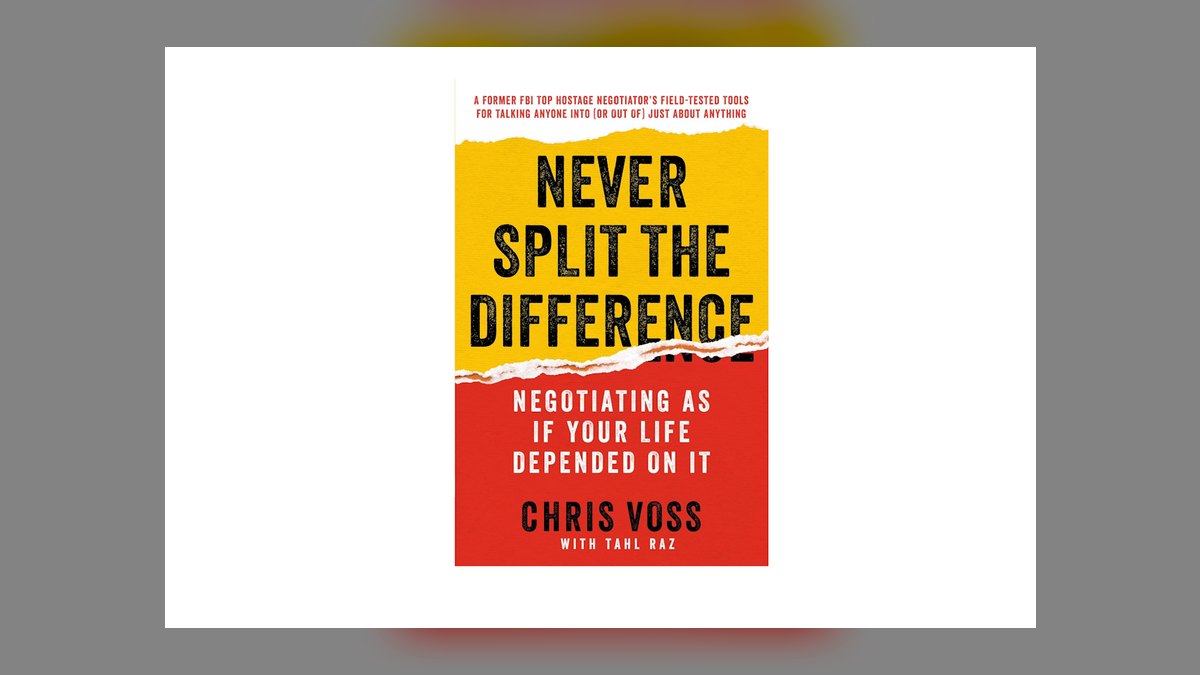
Strategy two: Voss's tactical empathy approach. Here, the number is not the first move — the relationship dynamic is. You open with an accusation audit, naming the objections your manager is silently rehearsing ("you're probably worried this sets a precedent, or that the budget's already locked"). You use labels ("it sounds like timing is the real issue here") to surface hidden constraints without confrontation. You mirror their last few words to invite elaboration instead of shutting the conversation down. And instead of stating what you deserve, you ask calibrated questions — "how would you approach getting this approved?" — that hand your manager the job of solving your raise. Under this strategy, you never propose splitting a gap; you either hold your anchor while reframing what's fair, or you restructure the ask entirely (timing, non-salary levers, milestones) so no one has to lose face.
The practical difference between these two negotiating strategies in 2027 is leverage type. Strategy one relies on external leverage — data from compensation sites, competing offers, market rates — and if that leverage is weak or your manager disputes the data, the conversation stalls. Strategy two relies on relational leverage — trust, framing, and your manager's own words — which works even when your market data is thin or your company genuinely has a frozen budget, because it shifts the goal from "prove I deserve X" to "help me find a path to X."

How to decide between them
Choosing between the two strategies isn't about which one is "better" in the abstract — it depends on your relationship with your manager, how rigid the budget cycle is, and how much documented impact you're bringing into the room.
Use the logical anchor-and-compromise approach only when you have unusually strong, undisputed leverage: a written competing offer at a specific number, a formal compensation-band review already underway, or a manager who has explicitly invited you to "just tell me the number." In those narrow cases, the emotional groundwork Voss prescribes is less necessary because the outcome is close to a formality.

In every other case — which is most raise conversations — the tactical empathy strategy is the safer default, because it degrades gracefully. If your manager truly has no budget, the accusation audit and calibrated questions still surface real information ("what would need to be true for this to become possible next quarter") instead of a flat no. If your manager has full discretion, the same techniques still work, just faster.
Concrete numbers behind each option
Voss doesn't provide raise-specific dollar figures, but he does describe a specific bidding structure — the Ackerman model — that translates directly into a raise negotiation, and it's worth knowing the actual percentages rather than a vague "start high."

The Ackerman model moves in four steps toward a target number, using decreasing increments so the final offer looks precise and researched rather than arbitrary: your first anchor lands around 65% of your actual target, your second offer moves to about 85% of target, your third to about 95% of target, and your final offer sits at 100% of target, ideally expressed as a specific, slightly odd figure (a target of $8,000 more per year becomes an ask like $8,250, not a round $8,000 or $10,000). The odd number signals that you calculated it rather than picked it out of the air. Applied to a raise, if your researched target increase is a $10,000 bump, you might open the conversation anchored around a $16,000-$17,000 increase (well above target, priming the room), then step down through roughly $13,500, then $11,000, then land your real ask near $10,250 — each step delivered with a label ("I want this to work for both of us") rather than a bare number.
Compare that to the typical anchor-and-compromise pattern: standard annual merit increases in most organizations cluster in a narrow single-digit-percent band, while a market-correction or promotion-driven raise typically runs into the double digits as a percentage of current base. Under the anchor-and-compromise strategy, if your target is a 10% increase, you'd commonly open around 15% and expect to settle near 12-13% — a genuine midpoint. Under the Ackerman-based tactical empathy approach, the stepped-down anchors serve a different purpose: they're not concessions you expect to be met halfway on, they're a sequence designed to make your final, unmoved number feel like the reasonable one by comparison. The numeric difference matters less than the structural one — one strategy plans for a midpoint, the other plans to hold its real number while appearing to move.

Implementation details and sequencing
Running this in an actual 2027 conversation — likely over video, given how much comp discussion now happens remote-first — requires sequencing the techniques in a specific order, because using them out of order weakens each one.
Start the meeting by requesting time specifically for compensation, not folding it into a general check-in; this signals seriousness without demanding anything yet. Open with the accusation audit in the first two minutes: name the budget worry, the precedent worry, and the "is this really deserved" worry, delivered flat and unhurried — the "late-night FM DJ voice" Voss describes, a slow, downward-inflected tone that reads as calm confidence rather than nerves. Pause after each accusation; let your manager respond, and expect them to soften ("no, it's not that bad, we do value you") — that response is the opening you needed, not just politeness.

Next, state your case briefly using specific, recent impact — not a general resume of achievements, but the two or three concrete outcomes from the current review period. Then pivot immediately to a calibrated question rather than a number: "how do you think we should approach getting this in line with that impact?" Let the silence sit. Voss treats silence as a tool, not a gap to fill — the person who talks next often concedes information.
If your manager offers a number, don't accept or reject it immediately. Mirror the key phrase back ("that number feels tight given this year") and ask what's driving it. If they cite a budget freeze or cycle timing, label it ("it sounds like the real constraint is timing, not my case") and ask the calibrated question that reopens the door: "what would need to be true for this to happen next quarter instead?" This is where the Ackerman-style stepped anchors come in if you do state a number yourself — deliver your first anchor high, then step down through the sequence described above, labeling your own movement each time so it reads as flexibility, not weakness.

Close by summarizing whatever was agreed in your own words and asking a final calibrated question — "is there anything about this plan that doesn't work for you?" — which invites any hidden objection to surface now rather than after the meeting, when it's harder to renegotiate.
Related questions
Does the accusation audit work if my manager is not emotionally expressive?
Yes — the technique targets unspoken concerns regardless of how visibly your manager reacts. Even a flat "that's not really an issue" response confirms you've cleared the objection and can move forward.
Should I ever just state my number directly instead of using calibrated questions?
Only when you have unusually strong, undisputed leverage, such as a written competing offer. Otherwise, opening with a number invites a yes/no response that ends the conversation instead of building toward one.
How is this different from just asking for feedback before asking for a raise?
Feedback requests are informational; calibrated questions in a raise conversation are structured to make your manager articulate the case for paying you more, using their own reasoning rather than yours.
What if my manager tries to split the difference anyway?
Ask a calibrated question rather than accepting: "how does that number feel fair given the impact we just discussed?" This forces them to justify the midpoint, which often reveals they don't believe it's fair either.
FAQ
What is the single most important lesson from Never Split the Difference for a raise negotiation? Never treat the conversation as two numbers converging toward a midpoint. Voss's central lesson is that a forced compromise satisfies no one; the goal is a number or package both sides can defend as fair, reached through labeling and calibrated questions rather than trading concessions.
What is tactical empathy, in practice, during a raise conversation? It's naming your manager's likely fears and constraints before they have to state them — not to be nice, but strategically, because unspoken objections are what quietly kill raise requests. Once named, those objections lose much of their power to derail the conversation.
What is a calibrated question and why does it matter here? It's an open-ended question starting with "how" or "what" that requires your manager to think through the logic of your raise rather than simply approve or deny it. Because they generate the reasoning themselves, they become invested in making it work.
Is the Ackerman model just aggressive lowballing in reverse? No — it's a structured anchoring sequence (roughly 65%, 85%, 95%, then your true target) designed to make your final number look calculated and reasonable by comparison to your own earlier anchors, not to manipulate the other side into overpaying.
Why does Voss say "no" is a good outcome early in a negotiation? A "no" often means "I'm not ready yet" rather than a final rejection. It gives your manager a sense of control and frequently prompts them to explain the actual constraint, which is more useful information than a pressured "yes."
Can these lessons apply to negotiating something other than base salary, like remote days or title? Yes — the labeling, mirroring, and calibrated-question techniques apply to any negotiable term. Ask "how could we structure two remote days into this role?" the same way you'd ask about a salary number.
Sources
- https://www.blackswanltd.com
- https://www.penguinrandomhouse.com/books/236925/never-split-the-difference-by-chris-voss-with-tahl-raz/
- https://hbr.org
- https://www.shrm.org
- https://www.themuse.com
- https://www.glassdoor.com
- https://www.levels.fyi
Related on PULSE
- [Never Split the Difference by Chris Voss: Summary, Key Lessons, and RevOps Takeaways](/knowledge/bs297)
- [How does *Never Split the Difference* teach you to handle a "we need to think about it" objection in 2027?](/knowledge/bs0411)
- [What's the best way to use *Never Split the Difference* to build rapport with a hostile stakeholder?](/knowledge/bs0404)
- [How do you apply *Never Split the Difference* to a pricing negotiation with a long-time customer in 2027?](/knowledge/bs0391)
- [How do you use *Never Split the Difference* to handle difficult conversations with customers in 2027?](/knowledge/bs0351)
- [How does *Never Split the Difference* apply to salary negotiations in 2027?](/knowledge/bs0348)
@Kory-White- · if Venmo asks, the last 4 of my number are 2012
 bsHow do you apply *Fanatical Prospecting* to LinkedIn outreach in 2027?
 bsHow does *Gap Selling* help you close more deals in a recession in 2027?
 bsWhat sales script does *New Sales. Simplified.* recommend for cold calls in 2027?
 bsDoes *The Psychology of Selling* still hold up for modern sales techniques in 2027?
 bsWhat’s the most actionable principle from *How to Win Friends and Influence People* for remote work in 2027?
 bsWhat’s the biggest mistake *SPIN Selling* warns against in complex B2B sales?
 bsHow does *Fanatical Prospecting* change your daily routine for outbound sales?
 bsWhat’s the most persuasive technique from *Pitch Anything* for investor pitches?
 bsWhat’s the key insight from *The Challenger Sale* for leading a sales team in 2027?
 bsHow do you use *Never Split the Difference* to handle difficult conversations with customers in 2027?