
What sales script does *New Sales. Simplified.* recommend for cold calls in 2027?
 Curated byKory White · Fractional CRO · Maryland
 PULSEKNOWLEDGE LIBRARY
*New Sales. Simplified.* by Mike Weinberg does not recommend a memorized word-for-word script. It recommends a structured sales opening: identify yourself, state a specific reason for calling tied to the prospect's business, and immediately ask a low-risk, open-ended question. This value-driven strategy replaces feature-dump pitches — in 2027, cold callers who follow this approach still outperform reps using generic, pitch-first scripts.
The two approaches compared
Cold callers in 2027 generally fall into one of two camps, and Weinberg's book is written as a direct rebuttal of the first one.
Approach A — the pitch-first script. This is the traditional cold call format most reps were trained on for decades: open with a pleasantry ("How are you today?" or "Did I catch you at a bad time?"), then launch into a rehearsed rundown of the product — features, differentiators, and a close attempt, all inside the first 60-90 seconds. The logic behind this approach is that the rep needs to "get the pitch out" before the prospect hangs up. In practice, this script front-loads risk: the opening question invites a one-word rejection, and the pitch that follows gives the prospect nothing to react to except "not interested." Weinberg calls this style of opening a script built by someone who has never had to use it — it optimizes for what the rep wants to say, not for what makes the prospect want to keep listening.
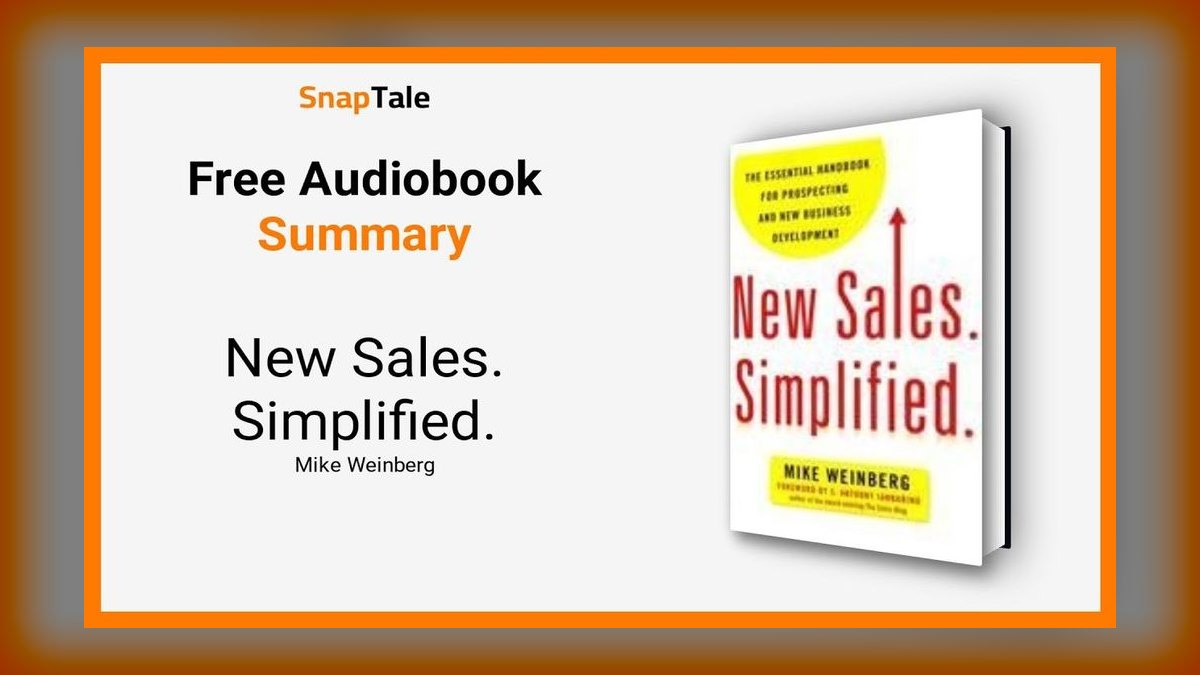
Approach B — the value-driven, curiosity-based opening. This is what *New Sales. Simplified.* actually recommends, and it inverts the pitch-first sequence. The rep still identifies themselves and their company in the first sentence, but the second beat is a credibility statement — a specific, researched observation about the prospect's company, role, or industry — not a product claim. The third beat is a question, and it's engineered to be low-risk (it doesn't ask for a meeting, a budget, or a decision) while still being specific enough that a generic non-answer would feel awkward. The prospect is doing the talking within the first 20-30 seconds, which is the opposite of Approach A.
The practical difference between the two shows up in three places. First, who talks first and how much: Approach A has the rep talking for 60+ uninterrupted seconds; Approach B has the rep talking for roughly 15-20 seconds before handing the conversation back. Second, the type of question asked: Approach A frequently opens or closes with a yes/no question ("Is now a bad time?" or "Would you be interested in learning more?"), both of which hand the prospect an easy exit. Approach B's question is open-ended and requires a real answer, which is harder to brush off with a single syllable. Third, the preparation required: Approach A can technically be delivered with zero research — it's the same script for every prospect on the list. Approach B is not deliverable without prospect-specific homework, because the credibility statement has nothing to say if you don't know something specific about the account.

Weinberg's argument, and the reason this matters more in 2027 than it did in 2012 when the book published, is that Approach A has gotten measurably worse as a strategy over time. AI tools now let low-effort reps generate personalized-sounding pitch scripts at scale, which means prospects have gotten faster at pattern-matching "this is a script" within the first sentence. A generic pitch-first opener increasingly reads as machine-written even when a human is speaking it live. Approach B is harder to fake at scale because the credibility statement has to be true and specific — which is exactly why it still lands.
How to decide between them
For most B2B sellers making outbound calls in 2027, the decision isn't really a coin flip — Weinberg's book argues, and most modern sales training built on top of it agrees, that the value-driven opening (Approach B) should be the default for any call where the rep has more than about two minutes to prepare. The decision tree below is how reps and sales managers typically triage which approach to use call-by-call, because there are edge cases (extremely high-volume, low-context dials) where a lighter-touch opener is a defensible tradeoff.

The deciding factor Weinberg emphasizes is not the rep's personal comfort with either script — it's whether the call is a "cold" first touch to a named, targetable account or a low-context number pulled from a raw list. For named-account, higher-value prospecting (the majority of complex B2B sales), the two-minute research investment pays for itself almost every time, because the credibility statement is what earns the extra 20-30 seconds needed to get to a real answer instead of a brush-off. For high-volume, low-context dialing (SDR teams working thousands of records with minimal firmographic detail), a full research-backed opening isn't operationally realistic call-by-call — but Weinberg's position is that the fallback here should still avoid the pitch-first structure. A shorter, still-curiosity-based opener beats a full feature pitch even without deep research, because the core mechanism (question over pitch) doesn't require account-specific detail to work.
Concrete numbers behind each option
The two approaches diverge on measurable call mechanics, and these numbers are what reps and managers actually coach to.

Talk-time ratio. In Approach A (pitch-first), the rep typically talks for 70-85% of the first minute of the call — a long uninterrupted run before the prospect gets a real chance to speak. In Approach B (value-driven), the rep's opening is designed to run 15-20 seconds before yielding to the prospect, which flips the ratio: the goal is for the prospect to be talking for the majority of the first 60-90 seconds once the question lands.
Opening statement length. Weinberg is specific that the credibility statement should be one sentence — roughly 10-15 seconds spoken aloud, not a paragraph. Reps who let this stretch past 20 seconds start to sound like they've reverted to a pitch, even if the content is still "research-based." The discipline here is brevity, not volume of detail.

Objection and rejection handling. With Approach A, because the opener frequently contains a yes/no question, a meaningful share of calls end in an immediate one-word "no" before the rep has said anything of substance. With Approach B, because the question is open-ended and specific, prospects are less able to close the conversation with a single word — they either have to answer the question or explicitly say they don't want to engage, which is a higher-friction exit than a reflexive "no."
Follow-up cadence. Regardless of which opening is used, Weinberg's broader prospecting framework calls for a disciplined four-touch sequence per prospect before moving them to a nurture track: the initial call, a follow-up email within 24 hours, a second call several days later with a new hook, and a final email or call that creates urgency or offers a low-risk next step (a short audit, a case study, a calendar link). Reps following Approach B tend to have materially more content to draw on for those follow-up touches, because each research pass that fed the credibility statement also generates additional hooks for touches two through four. Reps running Approach A on a generic script often run out of new material after the first attempt, which is a large part of why pitch-first cadences tend to collapse after one or two touches.
Preparation time per dial. Approach A requires effectively zero prep time — that's its main appeal for high-volume dialing. Approach B requires roughly 2-5 minutes of account research per named prospect: identifying the specific person and role, finding one current hook (a funding announcement, an executive move, an industry shift, a competitor's public move), and drafting the one-sentence credibility statement. Weinberg's position, echoed by most modern sales-enablement teams, is that this investment is worth it for any account above a minimum deal-size threshold, and not worth it below that threshold — which is exactly why the decision tree above splits on call volume and context.
Implementation details and sequencing
Rolling out the value-driven opening across a sales team — or adopting it individually — follows a fairly consistent build sequence in 2027, because the script itself is only the visible layer on top of a research and follow-up process that has to exist for the opening to work.

Step 1: Build the pre-call research checklist. Before any script gets used, reps need a repeatable, time-boxed research routine: identify the specific named contact and their role in the buying process, scan for one recent, relevant hook (a news item, a leadership change, a funding round, an earnings call mention, a competitor's public loss or win), and confirm the prospect's company still matches the ideal customer profile. This step is capped deliberately at a few minutes — Weinberg's strategy fails if research turns into an open-ended rabbit hole that reps use as an excuse to avoid dialing.
Step 2: Draft the credibility statement and the question, separately. The credibility statement is written first and tested against one rule: would a stranger reading it know it's about *this* company specifically, not a generic industry statement that could apply to anyone? The question is drafted second, and tested against a different rule: can it be answered with a single word? If yes, it gets rewritten until it can't.
Step 3: Rehearse aloud, not from memory. Weinberg is explicit that the goal isn't memorization — a memorized script sounds memorized, and prospects can hear the difference immediately. Reps rehearse the shape of the opening (identify, credibility, question) enough times that the wording comes out naturally and adapts in real time to how the prospect responds, rather than being read verbatim off a card.
Step 4: Deliver, listen, and follow the prospect's answer — not the script. Once the question lands, the rep's job shifts from "execute the script" to "actively listen and ask one more specific follow-up question." This is where most of the value in the approach actually gets captured; the opening only exists to earn this moment.

Step 5: Log the call outcome and trigger the follow-up sequence immediately. Whether the call converts to a next step or ends in a soft or hard no, the outcome gets logged the same day so the follow-up cadence (email within 24 hours, second call with a new hook days later, and so on) starts on schedule rather than drifting.
Step 6: Review and iterate on hit rate by hook type, not by rep intuition. Sales managers coaching this approach in 2027 track which categories of hooks (funding news, leadership changes, competitor moves, industry trend commentary) produce the strongest response rates for their specific market, and adjust the research checklist in Step 1 accordingly.

The sequencing matters because skipping steps is where most teams fail to get results from the book. Reps who skip Step 1 (research) end up delivering Approach A with Approach B's wording — a generic "I noticed you're in the software industry" statement that reads as hollow because it isn't specific. Reps who skip Step 6 (review by hook type) never learn which categories of research actually move response rates in their market, so the whole team's research time stays inefficient indefinitely instead of converging on what works.
Related questions
Does *New Sales. Simplified.* provide an exact word-for-word script to memorize?
No. Weinberg deliberately avoids a verbatim script, instead teaching a repeatable structure — identify, credibility statement, open question — that reps adapt per prospect rather than recite from memory.
How is Weinberg's cold call approach different from a typical elevator pitch?
An elevator pitch is rep-centered and monologue-heavy; Weinberg's opening is prospect-centered, hands the conversation back within 15-20 seconds, and is built around a question rather than a feature list.
Can this cold call strategy work over LinkedIn voice notes or video instead of the phone?
Yes. The identify-credibility-question structure is medium-agnostic and adapts well to LinkedIn voice notes, short video messages, and even SMS, as long as the opening stays brief and specific.
What's the biggest reason cold calls using this approach still fail?
Skipping or rushing the pre-call research step. Without a specific, true hook, the credibility statement reads as generic, and the whole approach collapses back into a pitch-first call.
FAQ
**What is the core sales script *New Sales. Simplified.* recommends for cold calls?** It's not a fixed script but a three-part structure: a quick self-introduction, a one-sentence credibility statement specific to the prospect, and an open-ended, low-risk question that invites a real response instead of a yes/no answer.
Why does Weinberg reject scripts that open with "How are you today?" Because that kind of opener is generic, signals the rep hasn't done any preparation, and burns the first few seconds of the call — the highest-attention window — without giving the prospect any reason to keep listening.
How long should the credibility statement be? Roughly one sentence, spoken in about 10-15 seconds. Longer than that and it starts to sound like a pitch rather than a researched observation.
Is memorizing the script recommended? No — Weinberg recommends internalizing the structure and rehearsing it aloud so it sounds natural, rather than memorizing and reciting fixed wording, which tends to sound scripted to the prospect.
Does this approach still work in 2027 given how much outreach is AI-generated? Yes, and arguably more than before — AI-generated outreach tends to be generic at scale, so a specific, well-researched human opening stands out more, not less, in a crowded inbox or call queue.
What happens if the prospect says "not interested" right away? The recommended strategy is to acknowledge it without arguing, then move to the follow-up cadence — an email recap, a second call with a new hook days later, and a final low-risk offer — rather than pushing harder on the same call.
Sources
- https://www.mikeweinberg.com/
- https://www.goodreads.com/book/show/13152864-new-sales-simplified
- https://www.linkedin.com/in/mikeweinbergnewsalescoach/
- https://www.salesgravy.com/
- https://blog.hubspot.com/sales
- https://www.gong.io/
- https://www.forbes.com/sales/
- https://www.saleshacker.com/
Related on PULSE
- [What's the best cold-calling template from *New Sales. Simplified.* for 2027?](/knowledge/bs0360)
- [What's the most practical technique from *New Sales. Simplified.* for handling a "send me info" objection?](/knowledge/bs0400)
- [How can *New Sales. Simplified.* help you win back a prospect who ghosted you after the first meeting in 2027?](/knowledge/bs0387)
- [What's the main takeaway from *New Sales. Simplified.* for overcoming call reluctance in 2027?](/knowledge/bs0374)
- [How do you use *New Sales. Simplified.* to overcome the "no decision" stall?](/knowledge/bs0346)
- [New Sales. Simplified. by Mike Weinberg — Cliff Notes Summary for AEs](/knowledge/bs0230)
@Kory-White- · if Venmo asks, the last 4 of my number are 2012
 bsWhat are the key lessons from *Never Split the Difference* for negotiating a raise in 2027?
 bsHow do you apply *Fanatical Prospecting* to LinkedIn outreach in 2027?
 bsHow does *Gap Selling* help you close more deals in a recession in 2027?
 bsDoes *The Psychology of Selling* still hold up for modern sales techniques in 2027?
 bsWhat’s the most actionable principle from *How to Win Friends and Influence People* for remote work in 2027?
 bsWhat’s the biggest mistake *SPIN Selling* warns against in complex B2B sales?
 bsHow does *Fanatical Prospecting* change your daily routine for outbound sales?
 bsWhat’s the most persuasive technique from *Pitch Anything* for investor pitches?
 bsWhat’s the key insight from *The Challenger Sale* for leading a sales team in 2027?
 bsHow do you use *Never Split the Difference* to handle difficult conversations with customers in 2027?