


How does Thinking, Fast and Slow by Daniel Kahneman help you avoid bias when forecasting pipeline in 2027?
Quality
Certified
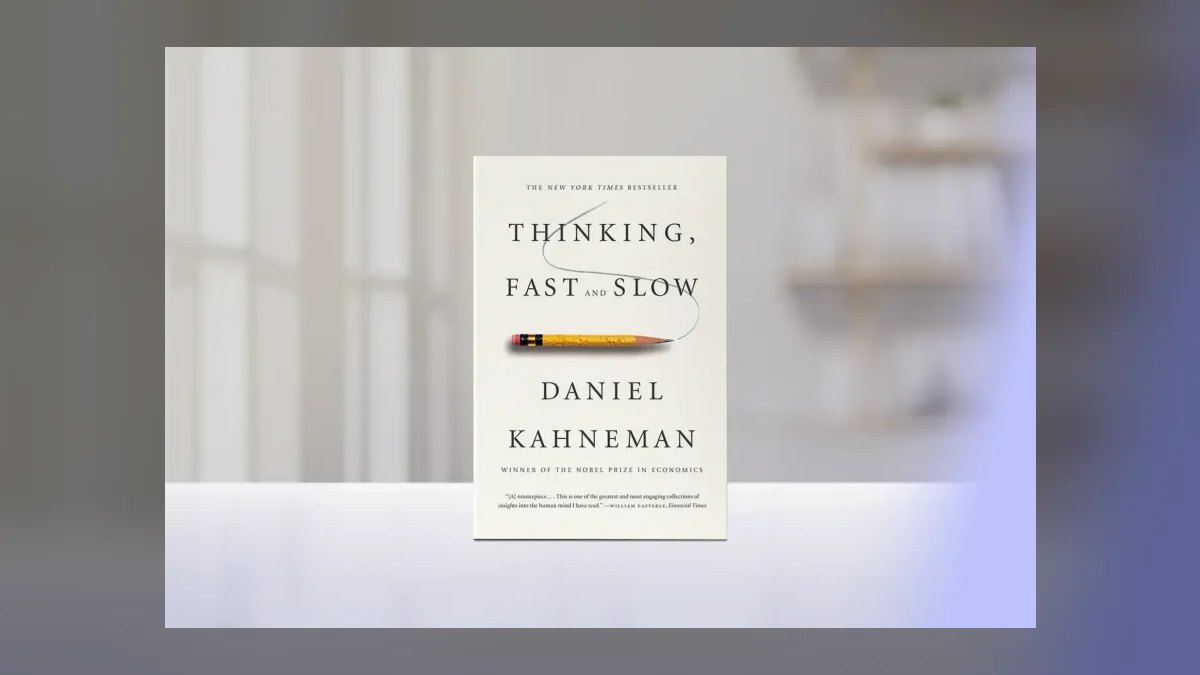
Kahneman's two-system model gives forecasting a diagnostic vocabulary: System 1 produces fast, confident pipeline calls anchored on the first number seen, while System 2 must be forced on through structured process. Applying base rates, reference-class comparison, and premortems converts intuitive deal-by-deal optimism into calibrated, evidence-weighted probability — the core of a defensible 2027 forecast.
The two competing approaches: clinical judgment versus statistical baselines
Every pipeline forecast is built one of two ways, and *Thinking, Fast and Slow* is essentially a 400-page argument about which one wins. Kahneman calls them clinical prediction and statistical prediction, borrowing the framing from Paul Meehl's work on prediction in psychology. Understanding the difference is what turns the book from an interesting read into an operating manual for your forecast call.
Approach one: clinical judgment (the rep-and-manager forecast). This is what almost every revenue org actually does. A rep looks at an opportunity — the champion is engaged, the demo went well, the CFO joined the last call — and assigns a stage and a commit status. The manager sits with the rep, asks probing questions, applies their own read on the account, and either sandbags the number down or lets it ride. The forecast rolls up through the org, each layer applying its own judgment haircut. The output is a single number that feels *known* because a chain of experienced humans looked at each deal individually.
Kahneman's critique is not that these people are stupid. It is that they are substituting an easy question for a hard one. The hard question is "what is the probability this specific opportunity closes for this amount inside this quarter?" The easy question their brain actually answers is "how good does this deal feel right now?" He calls this *attribute substitution*, and it operates below conscious awareness. The rep experiences the substituted answer as a genuine probability judgment. That is why forecast calls feel productive even when they are systematically wrong.
Approach two: statistical baselines (the reference-class forecast). Here you ignore the narrative of the individual deal at first and ask a purely mechanical question: of all opportunities that historically looked like this one on measurable dimensions — segment, deal size band, source, stage, age, number of stakeholders engaged — what fraction actually closed within the quarter? That fraction is your starting probability. Only *then* do you adjust for deal-specific information, and you adjust modestly.

Kahneman's evidence, drawn heavily from Meehl and later from his own work with Amos Tversky, is consistent and uncomfortable: simple statistical rules match or beat expert clinical judgment across a wide range of prediction domains. Experts add value in generating the *inputs* to the model — they can see that a champion left the company, which no historical dataset captures — but they systematically destroy value when they override the model's output based on holistic impression.
The trade-off is real, not one-sided. Statistical baselines fail on genuinely novel situations. If you launched a new product line in Q3 2026 and are forecasting it in 2027, there is no reference class of prior closes to draw from. They also fail when the underlying process shifts — a pricing change, a new competitor, an economic contraction — because the historical base rate encodes the old world. And they are politically hard: telling a VP their $2M commit deal has a 34% base-rate probability because deals in that band with that stakeholder count close 34% of the time invites the response "but this one is different."
The answer Kahneman points toward is not to pick one. It is to use the statistical baseline as the anchor and clinical judgment as a bounded adjustment. In *Thinking, Fast and Slow* he describes his own work designing evaluation interviews for the Israeli Defense Forces: score six independent traits mechanically, sum them, and only then allow an intuitive overall impression — and give that impression a small, defined weight. The mechanical scores did the work. The intuition was allowed in, but on a leash. That is exactly the architecture a good 2027 forecast wants.
How to decide which method governs a given deal
The decision is not "which method do we use as a company." It is "which method governs *this* opportunity, this week." The right split depends on how much reference-class data you have and how unusual the deal is relative to that class.

Start with data sufficiency. If a segment has produced fewer than roughly 30 closed opportunities in the last 18 months, your historical win rate for it is statistically noisy — a couple of unusual outcomes swing it 10+ points. Below that threshold you widen the class: roll the segment up to its parent, or pool across two adjacent deal-size bands, and accept a blunter but more stable base rate. Above roughly 100 closed opportunities in the class, the base rate is usually stable enough to hold as a hard anchor that reps must argue *against* with evidence rather than vibes.
Then assess novelty. Kahneman's inside view/outside view distinction is the operative test. The inside view looks at the specifics of this plan, this deal, this team — and it is where the planning fallacy lives. The outside view looks at how similar efforts have historically gone. His canonical illustration is a textbook-writing team that estimated 18 months to completion, then, when asked how long comparable teams had actually taken, produced an outside-view range of seven to ten years with a 40% failure rate. The team knew the outside view and proceeded on the inside view anyway. The book took roughly eight years.
Pipeline is full of textbook-writing teams. A rep with a Q1 close date on a deal that entered pipeline three weeks ago is doing the same thing: reasoning from the plan rather than from the record of how deals like this actually move.
The practical decision rule is a hierarchy. Where reference-class data is thick and the deal is typical, the base rate governs and reps may adjust it by a bounded amount — a common ceiling is ±15 percentage points, and any adjustment beyond that requires named, checkable evidence logged in the record. Where data is thin but the deal is typical, use the widened class and allow a wider band. Where the deal is genuinely atypical — new product, unprecedented size, novel buying committee — you are in inside-view territory by necessity, so the discipline shifts from base rates to premortems and explicit assumption logging.
The hierarchy matters because it makes the *default* statistical and the *exception* clinical. In most forecast processes the polarity is reversed: judgment is the default and data is what you cite when you happen to have it. Flipping the default is most of the value.
The specific biases that distort a pipeline number

Kahneman catalogs dozens of biases. A handful do nearly all the damage to a forecast, and each has a measurable signature you can look for in your own CRM.
Anchoring. The first number in the room sets the range for everything after it. Kahneman and Tversky demonstrated this with a rigged wheel of fortune that landed on 10 or 65 before subjects estimated the percentage of African nations in the UN — the wheel, an obviously irrelevant number, moved median estimates substantially. In forecasting, the anchor is usually last quarter's number, the annual target divided by four, or whatever the first person on the call says out loud. The diagnostic: if your quarterly commit lands within a few percent of quota quarter after quarter while actual attainment scatters widely, you are anchoring on the target, not forecasting. The countermeasure is sequencing — every forecast participant writes and submits their number *before* any group number is stated.
Overconfidence and the illusion of validity. Kahneman's account of his own experience as a young army psychologist assessing officer candidates is the sharpest version of this. He and his colleagues watched candidates in a group exercise, formed confident impressions of who would lead well, and were told repeatedly by feedback data that their predictions were near worthless. The confidence did not budge. He named the effect the illusion of validity: the subjective sense of certainty is produced by the *coherence* of the story you have built, not by the *evidence* behind it. A rep who can tell you a tidy narrative about why a deal will close in March feels more certain than a rep with a messier read — and coherence is not correlated with accuracy.
The planning fallacy. Deals take longer than anyone forecasts, systematically and in one direction. In most pipelines, slip is the dominant forecast error — deals that push a quarter, not deals that die. The correction is empirical: measure your actual median days-in-stage from your own CRM by segment, and hold close dates to that distribution rather than to what the rep hopes. If median stage-4-to-close is 40 days and the rep set a close date 14 days out, the date is a wish.
WYSIATI — what you see is all there is. System 1 builds the best story it can from available information and does not represent what is missing. In pipeline terms: the champion is enthusiastic, so the deal looks strong, and no one asks whether procurement has ever seen the contract or whether the economic buyer has been in a single conversation. Missing stakeholders do not generate a feeling of doubt because absence produces no sensation. This is why stage-gate checklists work — they force the missing item to become visible.

The availability heuristic. Whatever is vivid and recent dominates probability judgment. One spectacular loss to a specific competitor makes every subsequent deal against that competitor feel doomed. One giant deal that closed against the odds makes the whole team believe hero deals are normal. The countermeasure is boring: pull the actual counts, not the memorable stories.
Loss aversion and sandbagging. Losses loom roughly twice as large as equivalent gains in Kahneman and Tversky's prospect theory work. For a rep, missing a commit is a much sharper loss than the gain of beating it — so the rational play is to under-commit and overdeliver. Chronic sandbagging is not dishonesty; it is a predictable response to an asymmetric penalty. Fixing it means changing the payoff, not lecturing about integrity: score reps on calibration (did your 70% deals close about 70% of the time?) rather than on beating commit.
Regression to the mean. Kahneman's flight-instructor example — praise appeared to hurt performance, criticism appeared to help, when both were just regression around a noisy mean — maps directly to how orgs read a rep's blowout quarter. A rep who hits 180% of quota is very likely to come in lower next quarter regardless of what coaching happens in between. Forecasting off their last quarter rather than their multi-quarter average bakes in an error you could have predicted.
The numbers behind each approach
Concrete thresholds turn the theory into a process someone can actually run. These are structural rules of thumb, not universal constants — calibrate every one against your own historical data before enforcing it.
Base-rate stability thresholds. Under 30 closed opportunities in a reference class, treat the win rate as directional only and widen the class. From 30 to 100, treat it as a soft anchor with a wide permitted adjustment band. Above 100, treat it as a hard anchor requiring documented evidence to override. These bands exist because small samples swing wildly: in a 20-deal class, three unusual outcomes move the win rate 15 points.

Adjustment ceilings. A workable default is ±15 percentage points of rep adjustment off the base rate without escalation, and ±30 with a named, checkable piece of evidence — a signed order form, a verified budget approval, a departed champion. Beyond that, the deal is not really a member of its reference class and should be reclassified as inside-view. The point of the ceiling is not that 15 is magic; it is that an unbounded adjustment is not an adjustment at all, it is a replacement.
Calibration scoring. The only honest measure of forecast quality is whether stated probabilities match observed frequencies. Bucket every forecasted deal by its committed probability — 0-20%, 21-40%, 41-60%, 61-80%, 81-100% — and at quarter end compute the actual close rate in each bucket. A well-calibrated team's 61-80% bucket closes roughly 70% of the time. A typical uncalibrated team's 81-100% bucket closes far below 90%, and the gap between stated and actual is your overconfidence tax, measured in points. Track it quarterly; the trend matters more than any single reading.
Slip measurement. Compute, per segment, the median and 75th-percentile days from each stage to close over the trailing 12 months. Any deal whose close date implies faster-than-median movement from its current stage gets flagged automatically. If 30%+ of your committed deals fail that test, your commit is a plan, not a forecast.
Aggregation weighting. Where you have both a mechanical model output and a human forecast, a defensible starting weight is 70/30 in favor of the mechanical number, reviewed against outcomes each quarter and re-weighted based on which side actually predicted better. The empirical claim from the book is not that humans add nothing — it is that unstructured holistic override adds less than practitioners believe. Let the data on your own team settle the weight.
Independent-estimate spread. Collect forecasts from rep, manager, and any mechanical model *before* anyone shares. When the spread between the high and low independent estimate exceeds roughly 25% of the deal value, that deal gets a mandatory review — the disagreement is information, and it disappears the moment the group converges socially. Kahneman's point about independent judgments is that averaging them only helps if the errors are uncorrelated, and a group discussion correlates them instantly.
Premortem yield. A premortem takes 15-20 minutes per major deal. The instruction is specific: "It is the last day of the quarter. This deal did not close. Write down why." Kahneman credits Gary Klein with the technique, and its value is that it legitimizes dissent — it converts "I have a bad feeling" into a sanctioned analytical contribution. Run it on every deal above a value threshold that makes the time worth it, typically anything in the top decile of your deal sizes.
Implementation and sequencing across a forecast cycle

Order of operations is most of the mechanism. Kahneman's practical prescriptions almost all concern *when* information enters the process, because once an anchor lands or a group converges, the bias is already priced in and no amount of downstream rigor removes it.
Phase one — build the reference classes (one-time, then quarterly refresh). Pull trailing 12-18 months of closed-won and closed-lost opportunities. Define classes on dimensions that are known at forecast time and not themselves judgment calls: segment, ARR band, source, product line, stage, deal age, distinct stakeholders engaged. Compute win rate and median days-to-close per class. Flag any class under 30 deals as thin. This artifact is the spine of everything else — without it, "use the base rate" is advice with no referent.
Phase two — independent estimates before any group contact. Each rep submits per-deal probability and expected close date in writing. The mechanical model runs and produces its own number. Managers submit theirs without seeing the reps'. Nobody sees anyone else's until all are locked. This is the single highest-leverage change most teams can make, and it is nearly free. Kahneman is explicit that the first opinion voiced in a meeting contaminates every one after it; the fix is to make the first opinion arrive in writing, simultaneously, from everyone.
Phase three — mechanical scoring, then bounded judgment. Score each deal against a fixed checklist of independently assessed factors: economic buyer engaged (yes/no), procurement or legal contacted, technical validation complete, budget confirmed for the period, competitor status, champion tenure. Score each independently — resist forming an overall impression until all items are scored, which is precisely the discipline Kahneman describes from his IDF interview redesign. Only after the checklist is complete does the rep apply their holistic adjustment, within the ceiling.
Phase four — premortem on the deals that carry the quarter. Take the deals that represent the top slice of committed value. Run the 15-minute prospective hindsight exercise. Log every failure mode named, and for each, write the observable signal that would confirm it is happening. Those signals become the following week's checklist.

Phase five — roll up without re-anchoring. The rollup is where a well-built bottom-up number gets quietly overwritten by a top-down target. If the sum of calibrated deal probabilities produces $4.1M and the number the org wants is $5M, the honest output is $4.1M plus an explicitly labeled gap. Merging the two into a single "commit" of $4.6M destroys the information content of both. Report the calibrated number, the target, and the gap as three separate figures.
Phase six — score calibration and feed it back. At quarter close, compute bucket-level calibration by rep, by manager, and for the mechanical model. Publish it. This is the only feedback loop that touches the actual failure mode. Kahneman's discussion of expert intuition with Gary Klein establishes the conditions under which intuition becomes trustworthy: a sufficiently regular environment, and prolonged practice with rapid, unambiguous feedback. Sales has a reasonably regular environment but usually terrible feedback — quarterly, noisy, and rarely tied back to the specific judgment that was made. Calibration scoring is how you manufacture the missing feedback so that intuition can actually improve rather than just harden.
What breaks in practice. Three things, predictably. First, the independent-estimate step erodes — someone shares a number early "just to save time," and within two quarters the process is a group call again. Second, the adjustment ceiling gets treated as a suggestion, usually for the largest deals, which are exactly the ones where it matters most. Third, calibration scoring gets published once, embarrasses someone senior, and quietly disappears. Each failure is a bias defeating its own countermeasure, which is what Kahneman warns about directly: knowing about a bias does not inoculate you against it. He is candid that decades of studying these effects did not make him meaningfully better at avoiding them in his own thinking — the improvement comes from changing the process, not from trying harder to be unbiased.
What the book does not solve

Honesty about the limits keeps this from becoming cargo-cult rigor.
*Thinking, Fast and Slow* is a book about individual cognition. Much of what corrupts a pipeline forecast is organizational: comp plans that reward sandbagging, board pressure that makes an honest low number career-limiting, a CRO who needs a specific figure for a fundraise. No debiasing technique survives an incentive structure pointed the other way. If a rep is punished for an accurate 40% call and rewarded for an optimistic 80% call that misses, they will keep giving you 80%. Fix the payoff first.
The replication crisis also touched parts of the book. Kahneman himself publicly acknowledged that the chapter drawing on social priming research relied on studies that have not held up, and wrote that he had placed too much faith in underpowered findings. The core work on judgment under uncertainty — anchoring, availability, prospect theory, the planning fallacy, base-rate neglect — remains far better supported than the priming material, but the honest position is to treat the framework as a useful lens rather than settled physics. Read the specific claim you are relying on, and check whether it is one of the well-replicated ones.
Base rates also go stale. A 2027 forecast built on 2025 reference classes assumes the buying environment did not change. If your pricing model shifted, a major competitor entered, buying committees grew, or macro conditions moved, the historical class describes a world that no longer exists. Refresh classes quarterly and watch for structural breaks — a sustained shift in win rate or cycle length that persists across two or more quarters is a signal that the reference class needs rebuilding, not that the current quarter is an anomaly.
Finally, there is a real cost. Independent estimates, mechanical checklists, premortems, and calibration scoring add meaningful process time per cycle. On a small team with a handful of deals, that overhead may exceed the value of the accuracy gained. Scale the ceremony to the stakes: full protocol on the deals that determine whether the quarter lands, lightweight base-rate anchoring on everything else. A forecasting strategy nobody follows is worth less than a crude one everybody does.
Related questions
Does knowing about a bias help you avoid it?
Barely, on its own. Kahneman is explicit that awareness does not confer immunity — he reports that his own judgment did not improve much despite decades of study. What works is changing the process: independent written estimates, mechanical checklists, forced base rates, and calibration feedback that operates whether or not anyone is paying attention.
What is the fastest single change to reduce forecast bias?

Collect every forecast independently and in writing before anyone speaks. It costs almost nothing, requires no new tooling, and removes the anchoring and social-conformity effects that contaminate group forecast calls. The spread between independent estimates is also free diagnostic information about which deals are genuinely uncertain.
How do you set a base rate when you have almost no historical data?
Widen the reference class until you have enough deals — roll up to the parent segment, pool adjacent size bands, or borrow from a structurally similar product line. A blunt base rate from 60 loosely comparable deals beats a precise one from 8. Label it as thin and re-derive it as data accumulates.
Is a mechanical model always better than an experienced sales manager?
No. The book's claim is narrower: simple statistical rules typically beat unstructured holistic judgment, while experts remain essential for supplying inputs the model cannot see. The best result comes from combining them — the model anchors, the human adjusts within bounds, and outcome data settles the weighting over time.
How long before calibration scoring changes behavior?
Expect two to four quarters. The first cycle establishes a baseline and usually produces defensiveness. The second shows movement in the extreme buckets. Sustained improvement requires that calibration, not commit-beating, is what actually gets recognized — otherwise the scores become a report nobody acts on.
FAQ
Which specific chapters matter most for pipeline forecasting?
The material on the inside view versus the outside view and the planning fallacy maps most directly onto close-date accuracy. The chapters on anchoring explain why forecast calls converge on the first number spoken. The discussion of the illusion of validity explains why confident reps are not more accurate reps. The Kahneman-Klein material on when expert intuition can be trusted sets the conditions under which you should weight judgment at all.
Doesn't this just replace rep judgment with a spreadsheet?
No — it sequences them. The checklist and base rate come first because they are hard to corrupt; holistic judgment comes second because it is powerful but easily hijacked by narrative coherence. Reps still supply the information no dataset contains: a champion who resigned, a budget that quietly moved. What changes is that this information must be named and logged rather than absorbed into a general feeling about the deal.
How does this apply to a 2027 forecast specifically?
Two forces make it more relevant, not less. Reference classes built on 2025-2026 data may describe a different buying environment, so the discipline of refreshing classes and watching for structural breaks matters more. And as more forecasting tooling produces confident-looking probability outputs, the illusion of validity gets a new vector — a number generated by a model feels more objective than a rep's guess even when it rests on the same thin, stale data. Ask what reference class any automated forecast is actually using.
What is the single most common implementation mistake?
Letting the adjustment ceiling become a suggestion on the biggest deals. Large opportunities generate the strongest narratives, attract the most executive attention, and carry the most career risk — which is exactly why they draw the largest unjustified overrides. If the ceiling only binds on deals nobody cares about, it is decoration.
Can you run this without a data team?
Yes, at reduced fidelity. A trailing-12-month export of closed opportunities into a spreadsheet, pivoted by segment and size band, gets you usable base rates in an afternoon. Independent written estimates need only a shared form. Premortems need a timer. Calibration scoring needs one column recording the committed probability and one recording the outcome. The tooling is not the constraint — the discipline is.
How do you handle a leader who overrides the calibrated number?
Report both figures and keep them separate. The calibrated bottom-up number, the target, and the gap are three distinct facts, and collapsing them into one commit destroys the information in all three. If the override is a business decision — a stretch goal, a board commitment — label it as such rather than laundering it through the forecast, and record it so that next quarter's calibration review can measure whether the override was right.
Sources
- https://us.macmillan.com/books/9780374533557/thinkingfastandslow
- https://www.nobelprize.org/prizes/economic-sciences/2002/kahneman/facts/
- https://www.science.org/doi/10.1126/science.185.4157.1124
- https://hbr.org/2007/09/performing-a-project-premortem
- https://hbr.org/2011/06/before-you-make-that-big-decision
- https://www.apa.org/pubs/journals/features/pas-a0029046
- https://www.jstor.org/stable/1914185
- https://en.wikipedia.org/wiki/Reference_class_forecasting
- https://www.nature.com/articles/nature.2017.21895
Related on PULSE
- Thinking Fast and Slow by Daniel Kahneman — Cliff Notes Summary for Salespeople
- How can *Fanatical Prospecting* help you maintain a full pipeline without burning out in 2027?
- What’s the biggest mistake *Fanatical Prospecting* warns against when following up with a warm lead in 2027?
- How can *The Sales Acceleration Formula* help you forecast revenue more accurately for a new product launch in 2027?
This page will be disappearing soon. Save it to your device for $1 — or read it free while it is here.
@Kory-White- · if Venmo asks, the last 4 of my number are 2012
This page is gone.
This one is off the shelf now. $1 keeps it on your phone for good — the whole page, pictures and diagrams included.
 pulse-booksWhat is the single most useful chapter in The Innovator's Dilemma by Clayton Christensen for a RevOps leader in 2027?
 pulse-booksHow does Measure What Matters by John Doerr help you set quarterly OKRs for a RevOps team in 2027?
 pulse-booksWhat is the key takeaway from The Lean Startup by Eric Ries for reducing churn in a SaaS business in 2027?
 pulse-booksWhat is the biggest lesson from The Power of Habit by Charles Duhigg for changing your team's reporting behaviors in 2027?
 pulse-booksWhat is the most actionable framework from Hooked by Nir Eyal for increasing product adoption in 2027?
 pulse-booksWhat is the core insight from Radical Candor by Kim Scott for giving feedback to a senior stakeholder in 2027?
 pulse-booksHow does Start with Why by Simon Sinek apply to building a sales team culture in 2027?
 pulse-booksHow does The Hard Thing About Hard Things by Ben Horowitz help you decide when to pivot your go-to-market strategy in 2027?
 pulse-booksHow does The Art of War by Sun Tzu translate to competitive positioning in enterprise sales in 2027?
 pulse-booksTop 10 best Book Summaries options in 2027