

What is the step-by-step process for Strategic Selling by Miller Heiman in 2027?
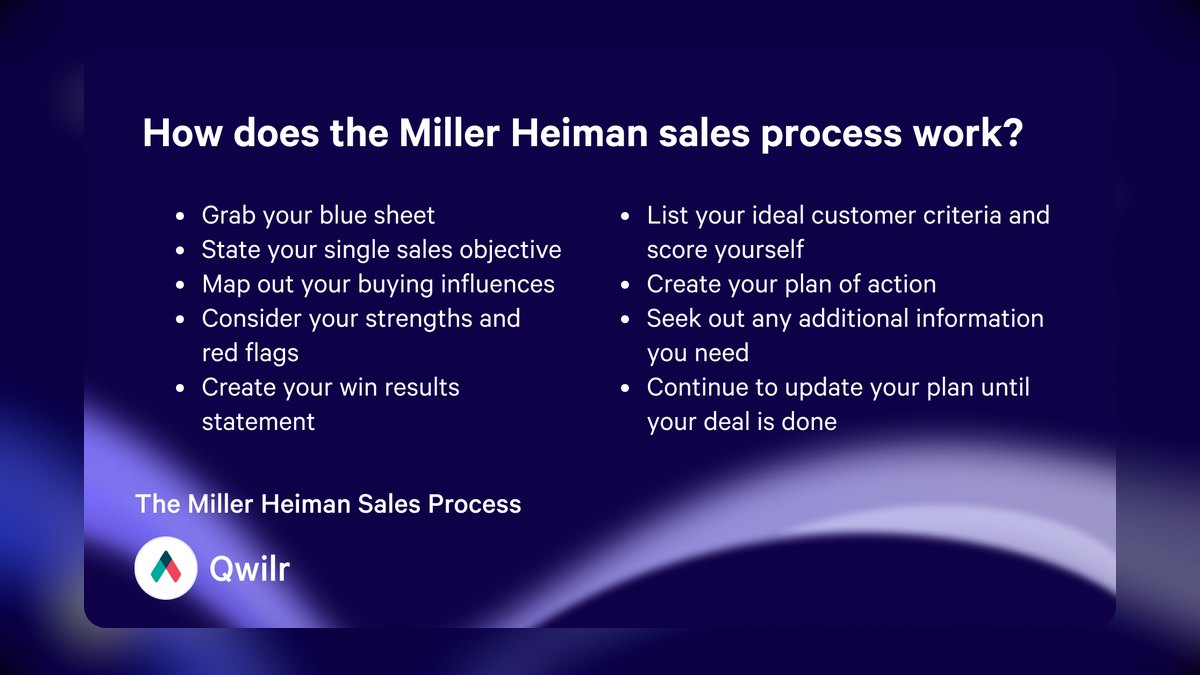
Strategic Selling by Miller Heiman is a six-step complex-sale process: map every buying influence (Economic, User, Technical, Coach), classify each one's response mode and rating, define Win-Results per person, run a red-flag/strength analysis on the Blue Sheet, choose an entry and selling strategy, then execute the single best action that moves the weakest position forward.
What Strategic Selling actually is versus what teams think it is
The most common failure with Strategic Selling is treating it as a stage model. It is not. It is a *position assessment* framework that sits on top of whatever pipeline stages your CRM already enforces. Your CRM says the deal is in "Proposal." Strategic Selling asks a different question entirely: given the four buying influences on this deal, do you actually have a position that survives contact with a procurement committee, or are you single-threaded into a User Buyer who cannot sign?
That distinction matters because the two artifacts get confused constantly. A pipeline stage is a *forecasting* construct — it tells revenue leadership when money is likely to land. A Blue Sheet is a *diagnostic* construct — it tells the seller what is currently broken about their coverage of the account. A deal can sit in "Negotiation" with a perfect stage-exit checklist and still have a red flag on the Economic Buyer, because nobody has spoken to the person who releases the funds. The stage model will not catch that. The Blue Sheet is designed to catch exactly that.
The other framing error is confusing Strategic Selling with Conceptual Selling, which is the companion Miller Heiman methodology. Strategic Selling operates at the *opportunity* level — the whole deal, all the people, the full competitive picture. Conceptual Selling operates at the *single call* level — how you structure one conversation with one buying influence to surface their concept of the solution. The Green Sheet is the call-planning artifact; the Blue Sheet is the opportunity-planning artifact. Large Account Management Process (LAMP, the Gold Sheet) is the third layer, covering long-term account strategy across many opportunities. Teams that adopt "Miller Heiman" and only roll out one sheet usually pick the wrong one for the problem they have.
The methodology originated with Robert B. Miller and Stephen E. Heiman and their 1985 book. The intellectual property now sits with Korn Ferry, which acquired the Miller Heiman Group in 2020 and folded the content into its sales-effectiveness practice. That ownership history matters practically: if you are sourcing training in 2027, you are buying from Korn Ferry or from a licensed partner, not from an independent "Miller Heiman Group." Anything marketed as the original standalone brand deserves a provenance question.

What has genuinely changed by 2027 is not the framework but the environment it operates in. Buying committees have grown. Research consistently shows enterprise software purchases involving somewhere in the range of six to eleven stakeholders, and the practitioner reality is often worse — a mid-six-figure platform deal can touch security review, procurement, legal, IT architecture, the budget holder, and two or three functional user groups. Strategic Selling was built for exactly this shape of problem, which is why a forty-year-old framework keeps getting re-adopted. The buying-influence taxonomy was ahead of its time; the committee finally caught up to it.
The two ways teams run it: full Blue Sheet versus lightweight buying-influence mapping
Before walking the steps, it is worth being honest that there are two distinct implementations, and picking the wrong one is how rollouts die.
Option A: the full Blue Sheet. Every qualifying opportunity gets a complete worksheet — all buying influences named with role, response mode, rating, and Win-Results; a full red-flag inventory; strengths to leverage; a competitive position read; a defined selling strategy; and a single best action with an owner and a date. This is the canonical implementation. It takes a trained rep roughly 30 to 60 minutes to build the first version of a sheet and 10 to 15 minutes to update it before each deal review. It is genuinely rigorous and genuinely heavy.
Option B: lightweight buying-influence mapping. You extract only the highest-yield part of the framework — the four-role map plus red flags — and embed it directly in the CRM as required fields on opportunities above a dollar threshold. No worksheet, no formal strategy section. A rep fills in "who is the Economic Buyer, have we met them, who is our Coach, what is unknown" in about five minutes. This is what most modern teams actually sustain.

The trade-off is precision versus adoption. Option A produces a materially better plan on the deals where it gets done, and produces nothing at all on the deals where the rep quietly skips it. Option B produces a mediocre-but-real plan on nearly every deal. In my experience the failure curve is steep: mandate full Blue Sheets on all opportunities and compliance tends to collapse within two quarters to the deals a manager personally inspects. Mandate the lightweight map on everything and full sheets only on the top-tier deals, and both survive.
A third pattern worth naming: hybrid by deal tier. Deals under some threshold — pick a number that reflects your actual ACV distribution, often the top quartile boundary — get the lightweight map. Deals above it, plus every renewal of a strategic account and every deal that has slipped a quarter, get the full sheet with a mandatory manager review. This is the implementation that tends to hold, because the heaviness is proportional to the stakes, and reps can see that logic rather than experiencing the process as tax.
There is also a build-versus-buy dimension. You can license official Korn Ferry training and the Blue Sheet artifact, which gets you certified facilitators, a common vocabulary, and legally clean materials. Or you can implement the *concepts* — buying influences, red flags, Win-Results — natively in your CRM without licensed materials. The concepts are widely published; the specific worksheet and trademarks are not yours to copy. Teams that go the native route should build their own fields and their own language rather than reproducing the licensed artifact, and should be clear-eyed that they are trading facilitated behavior change for a schema.
How to decide which implementation fits your motion
The decision hinges on four variables: average deal size, committee size, sales-cycle length, and rep tenure. Long cycles with big committees justify the heavy artifact because the cost of a blind spot compounds over months. Short transactional cycles do not — a 21-day deal with two stakeholders does not need a strategy worksheet, it needs a good discovery call.
Rep tenure is the variable teams underweight. Strategic Selling is a thinking framework, and a rep in their first two quarters does not have enough pattern recognition to fill a Blue Sheet honestly — they will write what they wish were true. For new reps, the sheet works best as a *manager-led interview*: the manager asks the questions in sequence and the rep answers out loud. The artifact gets filled either way, but the learning happens in the conversation, not the form. Experienced reps can self-serve and should be reviewed by exception.
One more decision input: whether your CRM can actually hold the data. If contact roles, relationship hierarchies, and opportunity-contact mappings are already clean in your system, the lightweight option becomes much stronger because the map is queryable — you can report on "opportunities over $100K with no Economic Buyer contact in the last 30 days" and turn the methodology into a pipeline-hygiene alert rather than a worksheet. If your contact data is a mess, the worksheet is a workaround for bad CRM hygiene, and you should probably fix the hygiene problem in parallel rather than papering over it.
The six steps in order, with what each one concretely requires
Here is the actual process. The steps are sequential the first time you run them on a deal and iterative thereafter.

Step one: define the single sales objective. Write one sentence stating what you are selling, to whom, by when, for how much. It must be specific and dated — "close a 250-seat platform expansion at the regional operations division by end of Q3 for approximately $340K" rather than "grow the account." This sounds trivial and is not. A large share of stalled complex deals are stalled because the seller and the buyer are pursuing different objectives, or because the objective quietly expanded mid-cycle without anyone re-baselining the plan. The single sales objective is the thing every other element of the sheet is evaluated against. If the objective changes, the whole sheet is stale.
Step two: identify every buying influence. Four roles, and every role is filled on every complex deal whether or not you have found the person.
- The *Economic Buyer* gives final approval and releases funds. There is exactly one per decision, and it is a role, not a title — on a departmental purchase it may be a director; on an enterprise platform it may be a CFO or a committee acting as one. This role can say yes when everyone else says no, and no when everyone else says yes.
- *User Buyers* judge the impact on their own job performance. There are usually several. They cannot approve the purchase but they can absolutely kill it, and they are the population most likely to sandbag an implementation after signature.
- *Technical Buyers* screen out. Security, IT architecture, procurement, legal, compliance. Their job is to disqualify on specifications. They cannot give a final yes; they can give an absolute no, and increasingly in 2027 they gate earlier — security review has moved from post-selection diligence to pre-shortlist filter at many enterprises.
- The *Coach* is developed, not found. A Coach wants you to win, is credible to the other buying influences, and will give you information about the decision process you could not otherwise get. A Coach can be inside the customer, inside your own company, or a third party. Having no Coach is a red flag on its own.
Name actual humans against each role. "Probably someone in IT" is not an identification, it is an admission.

Step three: assess each influence's response mode. Four modes describe how each person feels about *change*, not about you.
- *Growth* — they see a gap between results and desired results and want more. Receptive.
- *Trouble* — something is broken and they need it fixed. Most receptive, and usually the fastest-moving segment of the committee.
- *Even Keel* — results match expectations, no perceived gap. Not hostile, just uninterested. You cannot sell to Even Keel without first establishing a discrepancy they believe in.
- *Overconfident* — results are perceived as exceeding expectations, often on bad data. The hardest mode. Direct challenge tends to entrench them.
The practical use: your selling effort should concentrate where Growth and Trouble live, and your risk register should track everyone in Even Keel or Overconfident who has veto power. A Technical Buyer in Overconfident mode about the incumbent system is a specific, nameable threat, not a vague worry.
Step four: rate each influence and define their Win-Results. Rate the relationship on a simple scale — commonly a five-point range from strong advocate to active opponent — and, critically, separate the *Result* from the *Win*. A Result is a measurable business outcome the solution delivers: cycle time drops 30%, ticket backlog clears, audit findings go to zero. A Win is what that outcome does for the individual personally: the VP gets the promotion case, the ops manager stops working Saturdays, the security lead stops being the department that says no. Results are organizational and shared. Wins are personal and different for every person on the committee.
The reason this step exists is that people approve purchases for personal reasons and justify them with organizational ones. If you can only articulate the Result, you have a business case. If you can articulate both, you have a champion. A useful discipline: for each named influence, write the Win in the first person, as they would say it. If you cannot, you have not had a deep enough conversation with them.
Step five: run the red-flag and strength analysis. Red flags are the honest inventory of what is missing or wrong. The canonical categories: missing information, uncontacted buying influence, any buying influence who is new to their role or whose role is in flux, and reorganization or other instability in the account. To that list, most modern practitioners add: no Coach, no confirmed budget source, no access to the Economic Buyer, a competitor with an incumbent relationship you have not mapped, and a compelling event you cannot verify independently.
Then, for each red flag, name the strength that offsets it or the action that removes it. This is the step that converts anxiety into a plan. A red flag with no offsetting strength and no assigned action is not a red flag, it is a forecast problem, and it should be visible to the manager before the deal is committed.
Step six: choose the selling strategy and the single best action. Consider your alternate positions — including the option of not pursuing this deal on this timeline — pick the strategy, then name the *one* action that most improves your weakest position, with an owner and a date. Not five actions. One. The discipline of choosing one is what makes the sheet a plan rather than a wish list. Reps who list eight next steps typically do none of them well; reps who commit to one usually do it.

Concrete numbers, timelines, and what implementation actually costs
Rollout economics are where most of the honest planning happens, so here are the ranges practitioners should budget against, stated as ranges because they vary enormously by vendor, geography, and headcount.
Training time. Classic Strategic Selling delivery is typically a two-day workshop, sometimes split into shorter virtual modules across two to three weeks in modern delivery. Add reinforcement sessions — the single strongest predictor of whether methodology survives is whether it is reinforced in the manager's regular deal-review cadence, not whether the initial workshop was good.
Time per sheet. First full Blue Sheet on an unfamiliar deal: 30 to 60 minutes for a trained rep, longer if they have to go find information they do not have — which is itself the point of the exercise. Steady-state updates before a deal review: 10 to 15 minutes. Lightweight CRM map: about five minutes to fill, near-zero to update. Manager review of a full sheet: 20 to 30 minutes per deal, which is the real cost constraint. A manager with eight reps and three strategic deals each cannot review 24 sheets monthly at 30 minutes apiece on top of everything else; do the arithmetic before you set the mandate.
Coverage thresholds worth instrumenting. Set an explicit bar for what "covered" means and report on it: every buying influence role filled with a named person; Economic Buyer contacted within the last 30 days on any deal forecast to close this quarter; at least one Coach identified and validated; zero unaddressed red flags at the final stage gate. These are queryable if your CRM data is clean, and they convert methodology adherence from a subjective coaching topic into a dashboard.

Committee size. Plan for six to eleven stakeholders on enterprise software purchases, and treat anything under four discovered influences on a large deal as a discovery gap rather than a simple deal. If your rep has mapped two people on a $400K purchase, the deal is not simple — the map is incomplete.
What you should not expect. Be skeptical of any vendor claiming a specific percentage win-rate lift from methodology adoption. Those figures are almost always self-reported, drawn from customers who both adopted the methodology and invested in management discipline, sales hiring, and enablement at the same time. The honest claim is narrower and still valuable: teams that consistently map buying influences find missing stakeholders earlier, and deals with an identified and engaged Economic Buyer slip less than deals without one. That is a mechanism you can verify in your own data within two quarters — run the cohort analysis on your own closed-won and closed-lost sets before you believe anyone else's number.
Slippage diagnostics. The single most useful report to build alongside a Strategic Selling rollout is a slipped-deal post-mortem tagged by red-flag category. After 30 to 50 slipped deals you will have your own empirical answer to "what actually kills our deals," and it is usually one or two categories dominating — most often no verified Economic Buyer access, or a compelling event that was assumed rather than confirmed. That report justifies the process more persuasively than any vendor case study.

Sequencing the rollout, and wiring it into the systems around it
The order of operations matters more than the content of any single training day.
Train managers first. This is the step teams skip and the one that determines survival. If a rep builds a Blue Sheet and their manager asks stage-based questions in the deal review, the sheet becomes homework with no consumer, and homework with no consumer stops getting done. Managers need to run the review *from* the sheet — walking the buying influences, asking where the red flags are, challenging the Win statements — before reps will believe the artifact matters.
Use live deals in training, never case studies. Case-study exercises produce comfortable competence that evaporates. Reps who leave the workshop with three real sheets on their three biggest open deals leave with something they will use on Monday, and the workshop pays for itself in the found blind spots alone.
Wire it to the CRM rather than beside it. Contact roles on opportunities, a red-flag multi-select, a last-Economic-Buyer-touch date field. Once those exist you can build the alerts that make the methodology self-enforcing: flag any opportunity forecast this quarter with no Economic Buyer contact in 30 days, flag any large opportunity with fewer than four mapped influences, flag any deal that slipped with no updated sheet. Methodology that lives only in a document decays; methodology expressed as pipeline-hygiene alerts persists.
Connect upstream to marketing and demand gen. Buying-influence mapping has an obvious upstream consequence that most teams never exploit: if Technical Buyers gate earlier every year, then security documentation, architecture diagrams, and compliance artifacts are top-of-funnel content, not late-stage collateral. If User Buyers kill deals post-selection, then adoption evidence and peer references belong earlier in the cycle than most sequences place them. A sales methodology that maps who must be satisfied is also, read sideways, a content strategy.
Connect downstream to customer success. The Win-Results you documented during the sale are the exact success criteria the CS team should inherit at handoff. Most handoff processes transfer the contract and the technical requirements and drop the personal Wins entirely — which is why the champion who bought the platform often goes quiet six months later. Carrying the Win statements into the CS account plan is a cheap, high-leverage integration that almost nobody does.
Adjacent frameworks and how they coexist. MEDDIC and its variants overlap substantially with Strategic Selling on economic buyer, champion, and decision process, but MEDDIC is fundamentally a *qualification* checklist while Strategic Selling is a *strategy* framework. Command of the Message and similar value-messaging frameworks address what you say; Strategic Selling addresses who you say it to and in what order. Challenger addresses the teaching posture within a conversation. These are complementary layers, not competitors — but running three of them simultaneously with three vocabularies produces reps who use none. Pick one primary vocabulary, borrow specific instruments from the others, and be explicit about which is primary.
When to abandon the sheet on a specific deal. If the deal is genuinely simple — one decision-maker, short cycle, known budget — the sheet adds cost with no return. Say so out loud in the rollout, because a methodology that claims universal applicability loses credibility with the reps whose judgment is good. Explicitly carving out simple deals is what buys you compliance on the complex ones.
Related questions
How is Strategic Selling different from MEDDIC?
MEDDIC is a qualification checklist — metrics, economic buyer, decision criteria, decision process, identify pain, champion — used to score whether a deal is real. Strategic Selling is a position-assessment and strategy framework used to decide what to do next. They overlap on economic buyer and champion but answer different questions.
Who owns the Miller Heiman methodology now?
Korn Ferry acquired the Miller Heiman Group in 2020 and now owns and licenses the Strategic Selling content, the Blue Sheet, and the related programs. Training in 2027 comes from Korn Ferry or its licensed partners rather than an independent Miller Heiman entity.
What is the difference between the Blue Sheet, Green Sheet, and Gold Sheet?
The Blue Sheet is opportunity-level strategy for a single complex deal. The Green Sheet plans one specific sales call under Conceptual Selling. The Gold Sheet is long-term account strategy under the Large Account Management Process, covering many opportunities across a strategic account over years.
Does Strategic Selling work for shorter transactional sales cycles?
Poorly. The framework's value comes from mapping multiple buying influences over a long cycle. On a two-stakeholder, three-week deal the overhead exceeds the insight. Use the buying-influence concept as a mental check, skip the worksheet, and reserve the full process for complex committee purchases.
What is the single most common red flag in practice?
No verified access to the Economic Buyer. Reps routinely assume their senior-most contact holds budget authority when that person is actually a User or Technical Buyer relaying decisions upward. Verifying who releases funds — by name, directly — resolves more forecast error than any other single check.
FAQ
How long does it take to fill out a Blue Sheet?
A trained rep needs roughly 30 to 60 minutes for a first full sheet on an unfamiliar opportunity, and 10 to 15 minutes to refresh it before each deal review. If it takes dramatically longer, the bottleneck is usually missing information about the account rather than the form itself — which is a useful signal in its own right, because it means the rep has gaps they had not noticed.
Can we implement the concepts without buying licensed training?
You can implement the underlying concepts — mapping buying influences, distinguishing Results from Wins, maintaining a red-flag inventory — since these are widely published and discussed. The specific Blue Sheet artifact, trademarks, and course materials are Korn Ferry's intellectual property. Build your own fields and your own language rather than reproducing licensed materials, and accept that you are trading facilitated behavior change for a data schema.
What is the difference between a Result and a Win?
A Result is an objective business outcome the solution produces — reduced cycle time, lower cost per ticket, cleared audit findings. A Win is what that outcome means personally to one individual: credibility, a promotion case, fewer weekends at work, no longer being the department that blocks everything. Results are shared across the organization; Wins differ for every person on the committee.
How many buying influences should we expect on an enterprise deal?
Research on enterprise software buying consistently points to roughly six to eleven stakeholders, and complex platform purchases can exceed that once security, legal, procurement, and multiple user groups are counted. If a rep has mapped only two or three people on a large opportunity, treat that as an incomplete map rather than evidence of a simple deal.
Why does the process insist on only one "single best action"?
Because a list of eight next steps is a wish list, not a plan. Forcing the choice of the one action that most improves the weakest position makes the rep decide where the real risk sits, and makes the commitment inspectable in a deal review. Reps who commit to one action generally complete it; reps who list many generally complete none.
What kills a Strategic Selling rollout fastest?
Managers who do not run deal reviews from the sheet. If the artifact has no consumer, it becomes paperwork and compliance collapses within about two quarters. Train managers before reps, make the sheet the agenda of the review rather than an attachment to it, and inspect coverage metrics rather than sheet completion.
Sources
- https://www.kornferry.com/capabilities/sales-effectiveness
- https://www.gartner.com/en/sales/insights/b2b-buying-journey
- https://hbr.org/2015/03/making-the-consensus-sale
- https://hbr.org/2017/03/the-new-sales-imperative
- https://www.salesforce.com/resources/research-reports/state-of-sales/
- https://www.forrester.com/blogs/category/b2b-sales/
- https://www.mheducation.com/
- https://www.rainsalestraining.com/blog
Related on PULSE
- How to build a buying-committee map inside your CRM
- MEDDIC vs MEDDPICC: what the extra letters actually add
- Deal review cadence: what a good weekly pipeline inspection looks like
- Champion development: how to tell a coach from a cheerleader
- Sales methodology rollout: why most fail in the second quarter
- Forecast accuracy: the red flags that predict slipped deals
 pulse-recentHow to Apply Strategic Selling — Step-by-Step Playbook in 2027
 book-summaryThe Art of the Start 2.0 by Guy Kawasaki — Cliff Notes Summary
 pulse-booksHow does Daring Greatly by Brené Brown change how you handle criticism at work in 2027?
 book-summaryProActive Selling by William Miller — Cliff Notes Summary
 book-summaryEmpowered by Marty Cagan — Cliff Notes Summary for Sellers
 book-summaryNever Split the Difference by Chris Voss: Summary, Key Lessons, and RevOps Takeaways
 book-summaryPositioning: The Battle for Your Mind by Al Ries and Jack Trout: Summary, Key Lessons, and RevOps Takeaways
 book-summaryThe 22 Immutable Laws of Marketing by Ries and Trout — Cliff Notes Summary
 book-summaryHow to Become a Rainmaker by Jeffrey Fox — Cliff Notes Summary
 book-summaryThe Inner Game of Tennis by Tim Gallwey — Cliff Notes Summary for Sellers