


How to Become a Rainmaker by Jeffrey Fox — Cliff Notes Summary
Quality
Certified
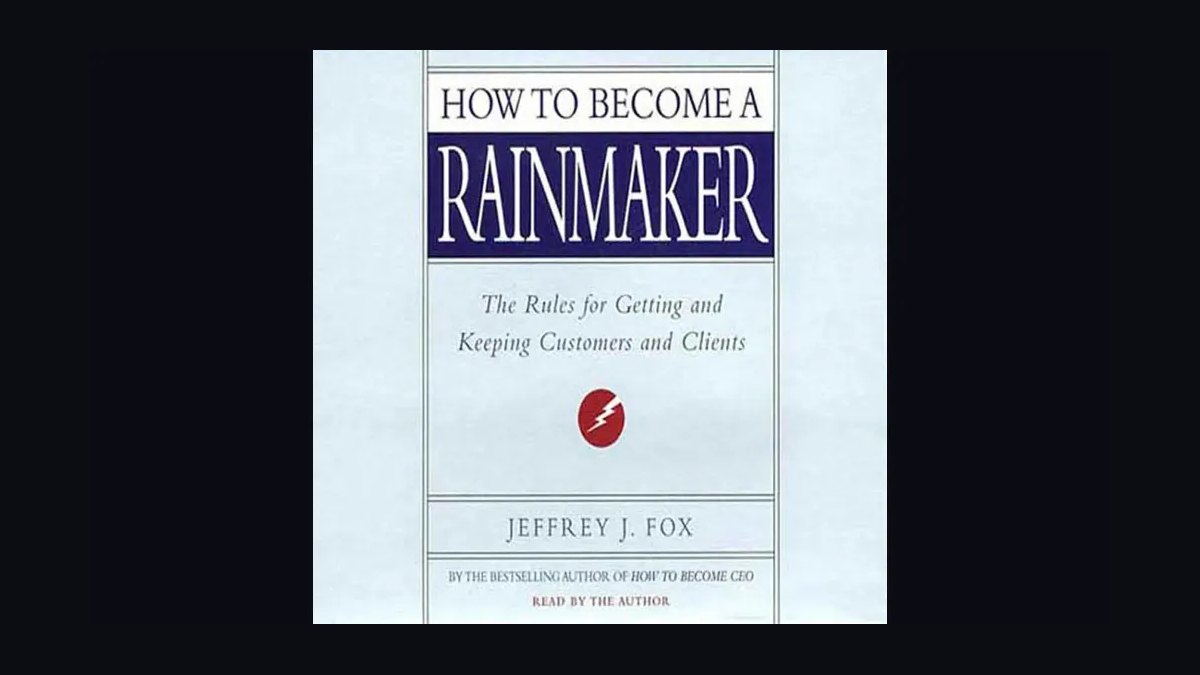
*How to Become a Rainmaker* by Jeffrey J. Fox is a short sales book built as 50 brief chapters, each carrying one rule a top producer follows and most reps ignore. Its core discipline: always answer "Why should I do business with you?" in dollar terms, ask what the buyer would change about their current vendor, and sell only the next commitment.
The outcome you should expect from working the book
The honest promise of this book is narrow and worth stating plainly, because most summaries oversell it. Reading Fox will not fix a broken territory, a mispriced product, or a comp plan that pays reps to discount. What it reliably does is raise the floor on individual seller behavior — the dozens of small decisions made between Monday morning and Friday afternoon that no CRM field captures and no manager watches.
The mechanism is simple. Fox writes rules, not theory. A chapter runs one to three pages, states a single behavior, gives a short illustration, and stops. That format has two practical consequences. First, a rep can read the whole thing in two evenings, which means the book actually gets finished — a real advantage over the 300-page methodology titles that sit half-read on desks. Second, any single rule can be re-read in under two minutes before a call. The book functions less like a course and more like a reference card you keep in a drawer.
What changes first, in most reps who genuinely apply it, is pre-call preparation. Fox's insistence that every touch carry a specific, customer-centric reason kills the "just checking in" email outright. That one substitution — a reason instead of a check-in — tends to show up in reply rates within a few weeks, because the message stops being about the seller's pipeline and starts being about something the buyer might actually care to read.

What changes second is discovery. The signature question — if you could change one thing about your current vendor, what would it be? — does four jobs in one sentence: it surfaces the incumbent's weakness, gives the buyer permission to complain, hints at whether there's budget intent behind the complaint, and tells you which stakeholder feels the pain. Reps who add it to a standard discovery call usually report longer, more candid first meetings.
What changes third, and slowest, is deal structure. "Show the chain, sell the first link" asks a seller to stop trying to close the entire engagement on call one and instead map the sequence visibly for the buyer — discovery, scoping, pilot, procurement, deployment, expansion — then sell only the next step. This is the hardest habit to install because it fights quota pressure. It's also the one with the largest effect on close rates in complex deals, since it converts an intimidating yes-or-no into a series of small, low-risk agreements.
Set expectations accordingly. If you are a new SDR, the pre-call and outreach chapters are worth more to you than everything after chapter 30. If you are a full-cycle AE, the discovery, chain-selling, and price-discipline chapters are the ones to work. If you run a team, the value is mostly as shared vocabulary in deal reviews — "did we dehorn the rhino on price?" is a faster question than a paragraph of coaching. And if your problem is that marketing hands you unqualified leads, no book fixes that; that's a pipeline architecture problem, and Fox has nothing to say about it.
What actually drives the results

Strip away the anecdotes and the book's fifty rules resolve into four stages that reinforce each other. The reason the sequence matters is that skipping a stage makes the next one harder, and most struggling reps are failing upstream of where they think they are.
Stage one is preparation. Fox is unsparing about cold calling — he treats it as the lazy substitute for research. A warm call starts from something real: a referral, a trigger event, a named person, a public disclosure. The rep who opens with a specific, verifiable observation about the buyer's business is starting a different conversation than the rep working a purchased list. Note that Fox wrote this before LinkedIn Sales Navigator, ZoomInfo, or Apollo existed, and the rule describes exactly what those tools are for. The tools don't create the discipline; they lower its cost.
Stage two is the perpetual pitch. Every email, voicemail, slide, and lunch implicitly answers one question: why should I do business with you? Fox's complaint is that reps answer with features — we have 24/7 support — instead of economic outcome. The answer he wants is one sentence with a number in it, and the number belongs to the customer's P&L, not the vendor's feature list. This is the ancestor of every value-selling framework and of the "M" in MEDDPICC.
Stage three is discovery that gets written down. Fox's "Cassandra memo" is a notebook rule: capture the buyer's exact phrasing, exact figures, exact stakeholder names, then repeat them back verbatim in the next meeting. Opening a second call by quoting what the buyer said in the first is disproportionately effective, because it proves attention in a way no amount of rapport-building can fake. Chris Voss's mirroring in *Never Split the Difference* is a close cousin.
Stage four is advancing rather than closing. Show the chain, sell the first link. Pre-empt objections before the buyer raises them — Fox's "dehorned rhino," where you name the price gap yourself and hand over the justification before it becomes an ambush. And hold price, on the theory that discounting is what a rep does after failing to do the work in the preceding thirty chapters.
The four stages compound. A warm call earns a real discovery conversation; a real discovery conversation produces the specifics that make the dollarized answer credible; a credible dollarized answer makes the first link easy to sell; and a delivered first link makes the second one nearly automatic. Reps who complain that "closing techniques don't work on my deals" are usually failing at stage one or three and trying to fix it at stage four.
There's a fifth element that sits underneath all of them and is easy to skip: the retention chapters. Fox argues you should treat a tiny account with the attention you'd give the largest one, because you cannot reliably predict which small account grows, gets acquired, or whose champion turns up three years later as a VP somewhere else. The modern parallel is a product-led company obsessing over single-seat self-serve users. The logic is the same — the cost of over-serving a small account is bounded, and the option value is not.
Benchmarks and realistic ranges
Be careful with numbers here, because most "results" claims attached to sales books are marketing. What can be stated with confidence is structural, not statistical.
On the artifact itself: the book is short — a couple hundred pages at most, fifty chapters, one to three pages each. That density is the point. Budget two evenings for a first read and roughly ninety seconds per chapter for re-reads. Paperback copies sit in ordinary trade-paperback territory, and used copies are cheap and plentiful, which makes it a reasonable book to buy in bulk for a team.
On adoption, use a behavioral benchmark rather than a revenue one. A realistic target for a rep working the book deliberately: replace every "just checking in" touch with a reasoned one within two weeks; add the vendor-change question to every discovery call within one week; produce a written Cassandra memo for every meeting within thirty days; and map a visible chain on at least one live deal within a quarter. Those are all observable in a CRM or a call recording, which means a manager can actually coach them. "Read the book" is not coachable; "did you quote their exact words back in the second call" is.
On sequencing against other books, a defensible reading order for someone building a sales library: Fox first because it's short and behavioral, then *SPIN Selling* by Neil Rackham for the research-backed question structure, then *The Challenger Sale* by Dixon and Adamson for the macro argument about what kind of seller wins in complex B2B. Fox is inductive — start from the habit and build outward. Challenger is deductive — it starts from a large study of reps, sorts them into profiles, and argues one profile outperforms. They don't conflict; they operate at different altitudes.
On what to expect by role, the ranges are honest guesses about attention allocation rather than performance promises. An SDR will get most of the value from perhaps a dozen chapters. An AE will use maybe half the book routinely. A sales manager will use fewer chapters directly but will get more mileage from the shared vocabulary. A founder selling their own product will find the price-discipline chapters the most immediately useful, because founders discount out of anxiety more often than out of strategy.
One benchmark worth flagging as a caution: the book assumes a single, findable decision-maker. Contemporary B2B research consistently shows buying groups rather than individual buyers, with committees of several people or more on meaningful purchases. That doesn't invalidate any rule, but it does mean that "answer why should I do business with you" now has to be answered several times, in different economic languages, for different people in the same account. Budget for that. A single perfect champion conversation no longer carries a deal.
Risks, edge cases, and failure modes
The most common failure is mechanical application. The vendor-change question is powerful because it is genuinely curious; delivered as a scripted line in the first ninety seconds of a cold discovery call, it reads as an attack on the incumbent and buyers close up. Earn the question. Ask it after you've established that you understand their operation well enough to have a useful opinion about it.
The second failure is misreading "hold your price" as "never negotiate." Fox's argument is that price objections are usually symptoms of upstream failure — you never established the economic case, so the buyer has nothing to weigh cost against. That's often true. It is not always true. Sometimes a buyer genuinely has a fixed budget, sometimes procurement has a mandate, and sometimes you are simply not the right fit at your price point. A rep who treats every price conversation as a coaching failure will burn winnable deals defending a number that was never the real issue. The useful version of the rule: never discount before you've made the value case, and never discount without getting something back — scope reduction, a longer term, a reference commitment.
The third failure is the lunch rule. Fox's claim is that lunch buys you an uninterrupted hour, which was true when buyers sat in offices and vendors visited them. In distributed, remote-first selling that hour is much harder to buy, and a video call is not a substitute — the interruption pattern is completely different. The translation that actually works: on-site workshops, a scheduled working session with a defined deliverable, or the dinner at an industry conference where you already both are. The underlying principle — buy uninterrupted attention — survives. The specific tactic doesn't always.
The fourth failure is context mismatch. The book's examples come from industrial distribution and the mid-market industrial world Fox consulted in. If you sell developer tooling with a self-serve motion and a product-qualified lead flow, several chapters simply don't map, and forcing them wastes effort. The high-touch chapters assume a seller-led deal. In a PLG motion, the equivalent of the warm call is the in-product signal, and the equivalent of the perpetual pitch is onboarding copy. Translate rather than transplant.
The fifth failure is treating the hand-written note as a hack. Fox's argument that a note is the highest-return five minutes a rep can spend has aged well precisely because notes are rarer now — scarcity restored the signal. But the signal only holds while the note means something. Batch-produced, outsourced, or sent after every trivial interaction, it degrades into just another automated touch and buyers notice fast. Send few, send specific, and reference something the person actually said.
The sixth failure, and the one most likely to bite a manager: mandating the book without changing the system around it. If comp pays on booked revenue with no clawback, reps will discount regardless of what chapter 31 says. If the CRM has no field for the buyer's own words, the Cassandra memo dies in a notebook nobody reads. If pipeline coverage targets force forty touches a week, "always have a reason for calling" becomes impossible arithmetic. Behavior books fail against incentive structures every time. Fix the structure first, or at least fix it alongside.

A final edge case worth naming: the book is written for individual contributors and largely ignores the operational layer — territory design, routing, forecasting hygiene, data quality. Nothing in it addresses why your pipeline is thin or why your forecast is wrong at the aggregate level. That's not a flaw, it's a scope boundary. Just don't hand a rep this book as the answer to a RevOps problem.
A practical rollout plan
If you're deploying this across a team rather than reading it alone, treat it as a behavior-change program with a small number of observable checkpoints, not as assigned reading.
Week one: everyone reads it. Two evenings, no book club, no discussion questions. Ask each rep to pick the three rules they are currently violating most and write them down. Self-selection matters here — the rule someone identifies themselves is the one they'll actually work on.
Week two: install the reason-for-calling discipline. The concrete change is that no outbound touch goes out without a one-sentence reason a buyer would recognize as being about their business. Audit this by sampling sent emails, not by asking. It's the easiest rule to verify and the fastest to show movement.
Weeks three and four: install the discovery question and the memo. Every discovery call includes the vendor-change question, and every call produces written notes that capture at least three verbatim phrases from the buyer. Put a field in the CRM for it — if there's nowhere to store it, it won't get stored.
Month two: work chain-selling on live deals. Pick five open opportunities and have the rep draw the actual chain for each — every step between now and a signed deal — then identify which single link they're currently selling. Most reps discover they've been trying to sell link six while the buyer is standing at link two. This exercise is where the biggest deal-cycle improvements come from.

Month three: price discipline and objection pre-emption in deal reviews. Change the deal review script to ask two questions before any discount is approved: what economic case did we make, in the buyer's numbers, and which objections did we raise ourselves before the buyer did. Reps who can't answer the first question don't get the discount approved yet.
Two implementation notes. First, do not run all five phases at once — the failure mode of behavior programs is asking for six changes simultaneously and getting none. Sequence them. Second, measure the behavior, not the revenue, for at least a quarter. Revenue attribution across a quarter with normal deal-size variance will tell you nothing about whether the program worked, and if you tie the program's survival to a revenue number you'll kill something that was working.
For an individual rather than a team, compress the same sequence: one rule per week for five weeks, working on live deals, with a Friday review of what actually changed in the conversations. Then re-read the book annually. The reason experienced reps keep recommending it is that the rules read differently at year one, year five, and year fifteen — you notice the chapters that describe mistakes you have recently made.
Related questions
Is this book still relevant for SaaS selling?
Mostly. The preparation, discovery, and chain-selling rules translate directly. The high-touch relationship chapters — lunch, drop-bys, physical premiums — need translation for remote and product-led motions. Roughly the large majority of the rules work unmodified; a handful need rethinking for distributed, multi-stakeholder deals.
How does it compare to SPIN Selling?

Rackham's *SPIN Selling* is research-driven and structural: it derives a question sequence from analysis of thousands of sales calls. Fox is aphoristic and behavioral. Read SPIN for why questions work in a particular order; read Fox for the daily habits around them. They complement rather than compete.
Should sales managers buy it for the whole team?
Yes, if you pair it with a behavior program. Cheap, short, and it creates shared vocabulary that makes deal reviews faster. Handed out without follow-through, it becomes another unread desk book. The value is in the coaching structure you build around it.
What's the single most useful rule for a new rep?
Have a specific reason for every touch. It's the easiest to apply, the fastest to show results in reply rates, and it forces the research habit that makes every later rule work. "Just checking in" is the phrase to eliminate first.
FAQ
Who is Jeffrey Fox?
Jeffrey J. Fox is a marketing and sales consultant and the founder of Fox & Company, a management consultancy. He is the author of a series of short, rule-based business books under the "How to" banner, including titles on becoming a CEO, landing a job, and becoming a great boss. The books share a format: many very short chapters, one idea each, minimal theory.
Why is it organized as fifty tiny chapters?
The format is the argument. Fox is writing for working salespeople who don't have time for a methodology course, so each rule is self-contained and re-readable in a minute or two before a call. It also makes the book easy to use as a reference — you can look up the price chapter the morning of a pricing conversation without re-reading anything else.
What is the "killer" discovery question?
Asking the buyer what one thing they would change about their current vendor. It works because it's easy to answer, it doesn't require the buyer to criticize you, and the answer usually contains the pain, the political dynamics, and a hint about whether anyone is willing to spend money to fix it.
Does "show the chain, sell the first link" conflict with modern mutual action plans?
No — a mutual action plan is essentially the formalized, shared version of the same idea. Fox's contribution was the sequencing insight: make the whole path visible so it doesn't feel infinite, then ask for one step. Modern tooling just moved the chain from a whiteboard into a shared document both sides can edit.
Is it useful for people who aren't in sales?
Reasonably. Anyone who has to persuade someone with a budget — founders, consultants, freelancers, agency owners — will find the preparation and pricing chapters directly applicable. The specifically B2B field-sales chapters will be less relevant, but the underlying discipline of leading with the other side's economics travels well.
What should I read after it?
*SPIN Selling* for question structure, *The Challenger Sale* for the argument about which seller profile wins complex deals, and *Never Split the Difference* for negotiation and mirroring technique. Fox is a good first book precisely because it's short enough to finish, which makes the longer ones more likely to get read.
Sources
- https://www.harpercollins.com/
- https://en.wikipedia.org/wiki/SPIN_selling
- https://www.gartner.com/en/sales/insights/b2b-buying-journey
- https://hbr.org/2017/03/the-new-sales-imperative
- https://www.mheducation.com/
- https://www.penguinrandomhouse.com/
- https://www.goodreads.com/
- https://www.loc.gov/
Related on PULSE
- The Sales Bible by Jeffrey Gitomer — Cliff Notes Summary & Key Takeaways
- Little Red Book of Selling by Jeffrey Gitomer — Cliff Notes Summary & Key Takeaways
- The Charisma Myth by Olivia Fox Cabane — Cliff Notes Summary
- The Challenger Sale — Cliff Notes Summary & Key Takeaways
- How I Raised Myself from Failure to Success in Selling — Cliff Notes Summary
This page will be disappearing soon. Save it to your device for $1 — or read it free while it is here.
@Kory-White- · if Venmo asks, the last 4 of my number are 2012
This page is gone.
This one is off the shelf now. $1 keeps it on your phone for good — the whole page, pictures and diagrams included.
 pulse-recentWhat is the first concrete step in SPIN Selling by Neil Rackham for structuring a discovery call in 2027?
 pulse-recentThe Greatest Salesman in the World by Og Mandino — Top 10 Key Takeaways for Sales Leaders in 2027
 pulse-recentThe Sales Acceleration Formula by Mark Roberge — Top 10 Key Takeaways for Sales Leaders in 2027
 pulse-recentThe Collaborative Sale by Keith Eades — Top 10 Key Takeaways for Sales Leaders in 2027
 pulse-recentMonetizing Innovation by Madhavan Ramanujam — Top 10 Key Takeaways for Sales Leaders in 2027
 pulse-recentSelling Above and Below the Line by Skip Miller — Top 10 Key Takeaways for Sales Leaders in 2027
 pulse-recentWhat are the concrete steps to implement the Sandler Rules for Sales Leaders by David Mattson in 2027?
 pulse-booksRework by Jason Fried and David Heinemeier Hansson — Cliff Notes Summary
 pulse-recentHyper Sales Growth by Jack Daly — Top 10 Key Takeaways for Sales Leaders in 2027
 pulse-recentNever Split the Difference by Chris Voss — Top 10 Key Takeaways for Sales Leaders in 2027