
Selling Above and Below the Line by Skip Miller — Top 10 Key Takeaways for Sales Leaders in 2027
 Curated by Kory White · Fractional CRO · Maryland
 PULSEKNOWLEDGE LIBRARY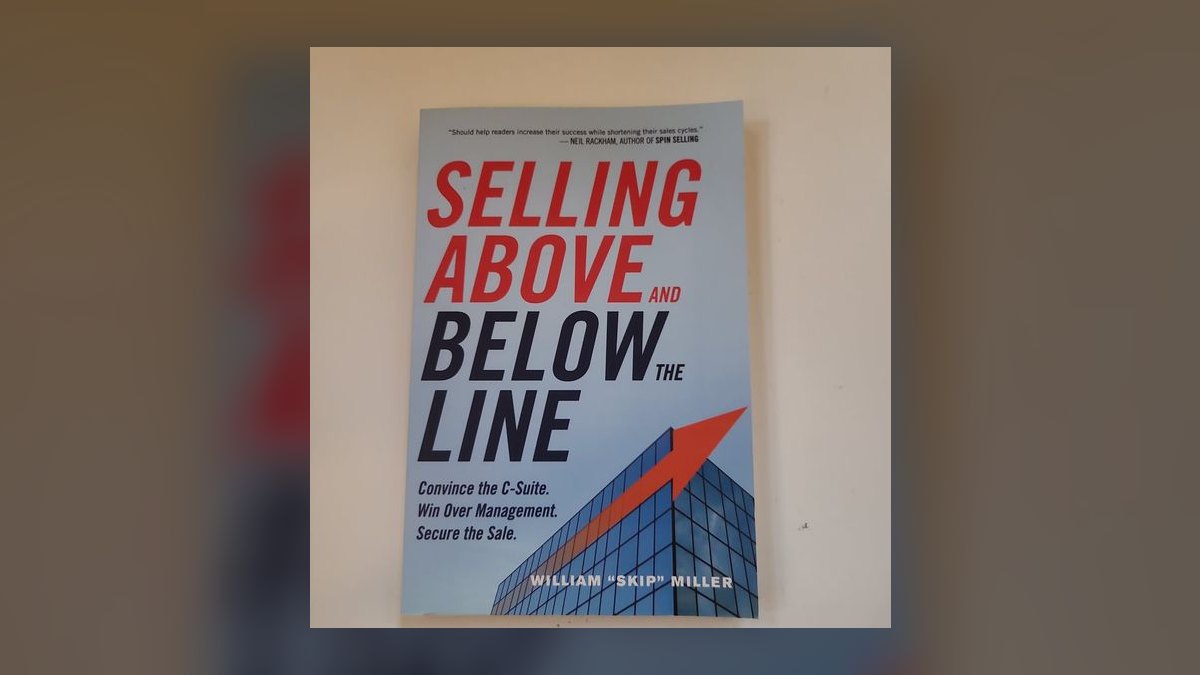
Skip Miller's *Selling Above and Below the Line* teaches sales leaders that Above the Line (ATL) executive buyers purchase strategic, financial, and reputational outcomes, while Below the Line (BTL) operational buyers purchase functional, day-to-day usability — and that the top takeaway for 2027 is building one strategy with two distinct value narratives, sequenced and coordinated, rather than a single generic pitch aimed at everyone in the buying committee.
The two options compared: Above the Line versus Below the Line
Skip Miller's core distinction in *Selling Above and Below the Line* is that every complex sale contains two separate buying populations who evaluate the same purchase through opposite lenses, and sales leaders who miss this split lose otherwise winnable deals. Above the Line buyers — CEOs, CFOs, COOs, and business unit presidents — care about strategy: market position, competitive advantage, shareholder value, risk to the business, and multi-year return on investment. They rarely touch the product day to day, so their compelling reason to buy is transformational: does this change the trajectory of the company, the P&L, or their own standing with the board. Below the Line buyers — directors, managers, and individual contributors who will actually operate the tool — care about functionality: does it fit their workflow, will it slow them down during onboarding, does it integrate with what they already use, and will it make their specific job easier or harder next quarter. Their compelling reason to buy is incremental and tactical, not visionary.
Miller argues that most sales reps default to a single message and drag it into every meeting, which flatters neither audience. An ATL executive bored by a feature-by-feature walkthrough disengages and delegates the decision downward, which strips the deal of executive sponsorship and budget authority. A BTL manager overwhelmed by a strategy deck full of market trends and board-level language can't map the pitch to their actual pain, and quietly becomes an internal blocker. The takeaway for sales leaders is to treat the two conversations as genuinely different sales cycles that happen to close on the same contract: separate discovery questions, separate proof points, separate champions, and separate success metrics, unified only at the final approval stage. Coaching reps to ask "who else needs to say yes, and what does winning look like for each of them personally" surfaces this split early, often in the first or second call, rather than discovering it painfully in a stalled procurement review three months in.
How to decide which approach a given deal needs
Deciding how much weight to put on the Above the Line strategy versus the Below the Line strategy depends on deal size, organizational structure, and who initiated the evaluation. A deal that starts as a grassroots request from an individual contributor typically needs a deliberate escalation motion to manufacture Above the Line air cover, because the buyer who found the tool has no budget authority. A deal that starts with a CFO mandate to cut costs across a business unit needs the opposite motion: sales must proactively pull in the operational owners who will be forced to adopt the change, or the executive's mandate meets silent resistance during rollout and the champion loses political capital. Sales leaders can build a simple triage: ask where the deal originated, ask who signs the check, and ask who logs in every day; if those are three different people, both the Above the Line and Below the Line strategies are mandatory and must be run in parallel, not sequentially.
The decision tree matters because reps left to their own judgment tend to over-invest in whichever buyer type feels more comfortable to them personally — social, confident reps gravitate to executives and neglect the operational champion who will actually determine renewal; technically minded reps gravitate to the practitioner and never get in front of the economic buyer at all. Sales leaders should coach explicitly against this bias in deal reviews by asking, for every opportunity above a threshold size, "show me your Above the Line champion and your Below the Line champion by name," and treating a missing name as an open risk on the forecast, not a detail to fill in later.

Concrete numbers and thresholds behind each approach
While Miller's framework is qualitative, sales leaders in 2027 apply it with concrete internal thresholds so reps know when to invoke which motion rather than debating it deal by deal. A common practical rule is to require an identified Above the Line sponsor on any opportunity above roughly 15-20% of average deal size for the segment, since deals of that size almost always need budget approval that a Below the Line manager cannot grant alone. Below that threshold, a strong Below the Line champion with delegated purchasing authority can often close the deal without ever involving a C-level executive, and forcing an executive meeting onto a small deal can actually slow it down by adding an unnecessary approval layer.
On sales cycle length, deals that engage only the Below the Line buyer tend to move faster to a demo and pilot — often within two to three weeks of first contact — but stall longer at final signature because the practitioner has no authority to approve spend and must build an internal case upward, which can add four to six weeks of delay while they search for a sponsor. Deals that engage only the Above the Line buyer move faster through signature, since an executive mandate compresses procurement, but face higher first-year churn risk because the operational team was never consulted and treats the rollout as something done to them rather than chosen by them; renewal risk in these top-down deals is meaningfully elevated in the first twelve months compared to deals where both buyer types were engaged from the start. The numbers argue for running both tracks concurrently rather than sequentially: sales leaders should expect roughly a 30-40% longer initial sales cycle when both tracks are opened together, but a materially higher win rate and first-year retention rate, because the deal closes with both authority and adoption secured at the same time instead of one being retrofitted after signature.

Commission and quota design should reflect this too — some sales leaders build a modest kicker into compensation plans for reps who document both an Above the Line and a Below the Line champion on deals over a set size, because the behavior the framework asks for (dual-track selling) is more effort than the path of least resistance (chasing whichever buyer answers the phone first), and comp plans that don't reward the harder, correct behavior will see reps quietly revert to single-track selling within a quarter or two.
Implementation details and sequencing for sales teams
Rolling out the Above and Below the Line framework across a sales organization works best as a staged implementation rather than a single training day, because the skill is diagnostic (recognizing which buyer type is in the room) as much as it is tactical (adjusting the pitch). Stage one is discovery-call redesign: rewrite the standard discovery question set so that every call, regardless of who answers it, surfaces both the strategic stakeholder and the operational stakeholder by name within the first thirty minutes — questions like "if this goes well, whose numbers does it move at the executive level" and "who's going to be living in this tool every day" belong in the standard script, not left to rep improvisation. Stage two is message-mapping: sales enablement builds two one-page value narratives per product line, one written in ATL language (market position, cost avoidance, competitive risk, board-level metrics) and one in BTL language (time saved per task, reduction in manual steps, integration with existing tools), so reps aren't inventing the framing live in a meeting. Stage three is deal-review instrumentation: CRM fields are added to tag each open opportunity with an identified ATL contact and BTL contact, and pipeline review meetings flag any deal above the size threshold missing either tag as at-risk, regardless of stage.

Sequencing matters because a strategy rolled out all at once tends to be treated as a slogan rather than a process change; sales leaders who introduce the language ("who's our ATL, who's our BTL") in week one, then add the CRM tagging in week three or four once reps are comfortable with the vocabulary, and only then tie it to compensation in the following quarter, see much higher adoption than teams that mandate all four changes simultaneously. Ongoing reinforcement happens in weekly forecast calls, where a manager simply asking "what does the Below the Line buyer think of this deal" on every ATL-heavy opportunity, and vice versa, keeps the framework alive long after the initial training fades from memory. The other implementation detail worth calling out: this is a leadership-driven habit change, not a rep-driven one — if sales leaders don't ask the diagnostic questions consistently in every deal review, reps stop asking them on calls within a month, because the framework only survives as long as it's visibly rewarded and inspected from above.
Related questions
What is Skip Miller best known for in sales training?
Skip Miller, founder of M3 Learning, is best known for practical, buyer-psychology-driven sales frameworks, with *Selling Above and Below the Line* and *ProActive Selling* among his most widely used training programs for B2B sales organizations.
How is Above the Line selling different from consultative selling?
Consultative selling is a broader discovery methodology usable with any buyer; Above the Line selling is a narrower audience-targeting skill — it tells a rep which consultative questions and value language to lead with once they know they're facing an executive rather than a practitioner.
Can one salesperson effectively run both ATL and BTL conversations alone?
Yes, but it requires deliberately switching vocabulary and proof points between meetings; many organizations pair an account executive with a solutions engineer or customer success resource specifically so the BTL technical conversation doesn't fall entirely on the closing rep.
Does this framework apply to smaller, transactional deals?
It applies with reduced formality — even a small deal usually has a decision-maker and a day-to-day user, so the diagnostic questions still help, though the dual-track sequencing and CRM tagging are typically reserved for larger, multi-stakeholder deals.
FAQ
What book introduced the Above the Line and Below the Line sales framework? The framework comes from Skip Miller's book *Selling Above and Below the Line*, which distinguishes executive strategic buyers from operational functional buyers within the same purchasing organization.
Why do sales leaders need a Top 10 takeaways list for this book in 2027? Because sales organizations rotate reps and onboard new hires constantly, a condensed takeaways list keeps the core Above the Line and Below the Line diagnostic alive as standing operating practice rather than something learned once in a single training session and forgotten.
What is the single biggest mistake reps make with this framework? Pitching every stakeholder the same message regardless of whether they sit Above or Below the Line, which either bores the executive with operational detail or loses the practitioner in strategic language they can't act on.
How do sales leaders coach reps who default to only one buyer type? By making the missing champion visible in deal reviews — asking by name who the Above the Line and Below the Line contacts are on every opportunity — and treating a missing name as a flagged risk rather than a minor gap to fill in later.
Does the framework change how compensation plans should be structured? Many sales leaders add a modest kicker for reps who document both an executive and an operational champion on larger deals, since the correct dual-track behavior is more effortful than chasing whichever buyer responds first and won't persist without being rewarded.
Is this framework only relevant to enterprise software sales? No — any sale involving both a budget-holder and a day-to-day user, from manufacturing equipment to professional services, benefits from separating the strategic and operational value narratives, though the formality of the process usually scales with deal size.
Sources
- https://www.m3learning.com
- https://www.amazon.com/Selling-Above-Below-Line-Strategies/dp/1626343162
- https://www.forbes.com/sites/forbesbusinesscouncil/
- https://hbr.org/topic/subject/sales
- https://www.gartner.com/en/sales
- https://www.salesforce.com/resources/articles/sales-strategy/
- https://www.linkedin.com/pulse/
- https://www.mckinsey.com/capabilities/growth-marketing-and-sales/our-insights
Related on PULSE
- How do sales leaders identify the real economic buyer in a complex deal?
- What is a compelling event and why does it accelerate enterprise sales cycles?
- How should sales comp plans reward multi-threaded deal strategies?
- What separates a champion from a coach in enterprise sales?
- How do you build a mutual close plan for a multi-stakeholder deal?
- What is executive sponsorship and how do reps earn it mid-cycle?
 pulse-recentThe Little Red Book of Selling by Jeffrey Gitomer — Top 10 Key Takeaways for Sales Leaders in 2027
 pulse-recentThe Closer’s Survival Guide by Grant Cardone — Top 10 Key Takeaways for Sales Leaders in 2027
 pulse-recentSecrets of Closing the Sale by Zig Ziglar — Top 10 Key Takeaways for Sales Leaders in 2027
 pulse-recentSell or Be Sold by Grant Cardone — Top 10 Key Takeaways for Sales Leaders in 2027
 pulse-recentAgile Selling by Jill Konrath — Top 10 Key Takeaways for Sales Leaders in 2027
 pulse-recentThe Sales Bible by Jeffrey Gitomer — Top 10 Key Takeaways for Sales Leaders in 2027
 pulse-recentProActive Selling by Skip Miller — Top 10 Key Takeaways for Sales Leaders in 2027
 pulse-recentRainmaking Conversations by Mike Schultz — Top 10 Key Takeaways for Sales Leaders in 2027
 pulse-recentLet’s Get Real or Let’s Not Play by Mahan Khalsa — Top 10 Key Takeaways for Sales Leaders in 2027
 pulse-recentQuestion Based Selling by Thomas Freese — Top 10 Key Takeaways for Sales Leaders in 2027