 Pulse Reviews and Analysis
How do you structure a weekly sales coaching 1:1?
 Curated by Kory White · Fractional CRO, CRO Syndicate
Direct Answer
Structure a weekly sales coaching 1:1 as a fixed 30-minute, rep-led, skill-focused block — not a deal-status interrogation. The proven shape is 5 minutes connect → 5 minutes rep self-review → 10 minutes one coached skill → 5 minutes one deal applied to that skill → 5 minutes commitments.
Open with the rep's own read, anchor every session to a single coaching focus pulled from a recorded call (Gong or Chorus), and close with one written, measurable commitment you both check next week. The core move: make the 1:1 a recurring loop on one named skill at a time rather than a forecast meeting in disguise.
This is the manager's playbook, built for 2027 hybrid teams and AI-assisted call review.
Why This Happens — Diagnose Before You Coach
Most weekly 1:1s fail for a structural reason, not a relationship one. When a manager says "my 1:1s aren't working," the cause is almost always one of four things, and the fix is different for each. Before you redesign the meeting, root-cause why the current one is flat.
- Skill — The rep doesn't know *how* to do the behavior (discovery, multithreading, closing). Coaching is the right tool; structure the 1:1 around reps and role-play.
- Will — The rep knows how but isn't motivated. No 1:1 template fixes this; you need a motivation and accountability conversation, possibly comp or career path.
- Knowledge — The rep lacks product, market, or process information. This is an enablement gap, not a coaching gap — send content, don't drill.
- System/territory — The rep is fine but the territory, ICP, or pipeline math is broken. Coaching a rep harder on a dead patch is malpractice; escalate the system problem instead.
A 1:1 that has become a status update usually means the manager defaulted to talking about deals (which feels productive) instead of behaviors (which compounds). The diagnosis tree below routes you from the symptom to the real cause before you touch the agenda.
The Coaching Conversation
Run the 1:1 with the GROW model — Goal, Reality, Options, Will — so the rep does the thinking and you do the questioning. The manager who talks 70% of the time is consulting, not coaching. Below are verbatim openers and questions you can copy into your next session. Bold lines are the words to say almost exactly.
Open (Connect, ~5 min): *"Before we get into anything tactical — how's your week actually going? What's one thing that's working and one thing that's grinding on you?"* Listen first. This is rapport and signal, not filler.
Hand the wheel to the rep (Reality, ~5 min): *"Pull up the call we agreed to review. Before I say anything — where do you think it went well, and where did you lose control?"* Letting the rep self-assess first is the single highest-leverage habit; it builds the self-coaching muscle Sandler and Winning by Design both push.
Coach one skill (Goal + Options, ~10 min): *"Let's stay on one thing this week: discovery. Play me the 90 seconds where the buyer told you their priority — what did you do with it?"* Then: *"What's one different question you could have asked right there?"* and *"What would that have changed about where the deal is now?"* Notice you are asking, not telling.
If the rep stalls, offer two options and let them choose: *"You could either layer a 'why now' question or quantify the cost of inaction — which feels more natural to you?"*
Apply it to a live deal (~5 min): *"Take the Acme deal. Where in that deal is the exact gap we just practiced? What will you do on the next call to close it?"* This is where coaching-the-skill meets coaching-the-deal — the deal is the practice field for the skill, not the agenda itself.
Lock the commitment (Will, ~5 min): *"So your commitment for this week is: run that 'cost of inaction' question on your three top deals and bring me the recordings. Say it back to me so I know we're aligned."* Write it down where you both see it. No commitment, no coaching — you just had a chat.
The Coaching Plan / Cadence
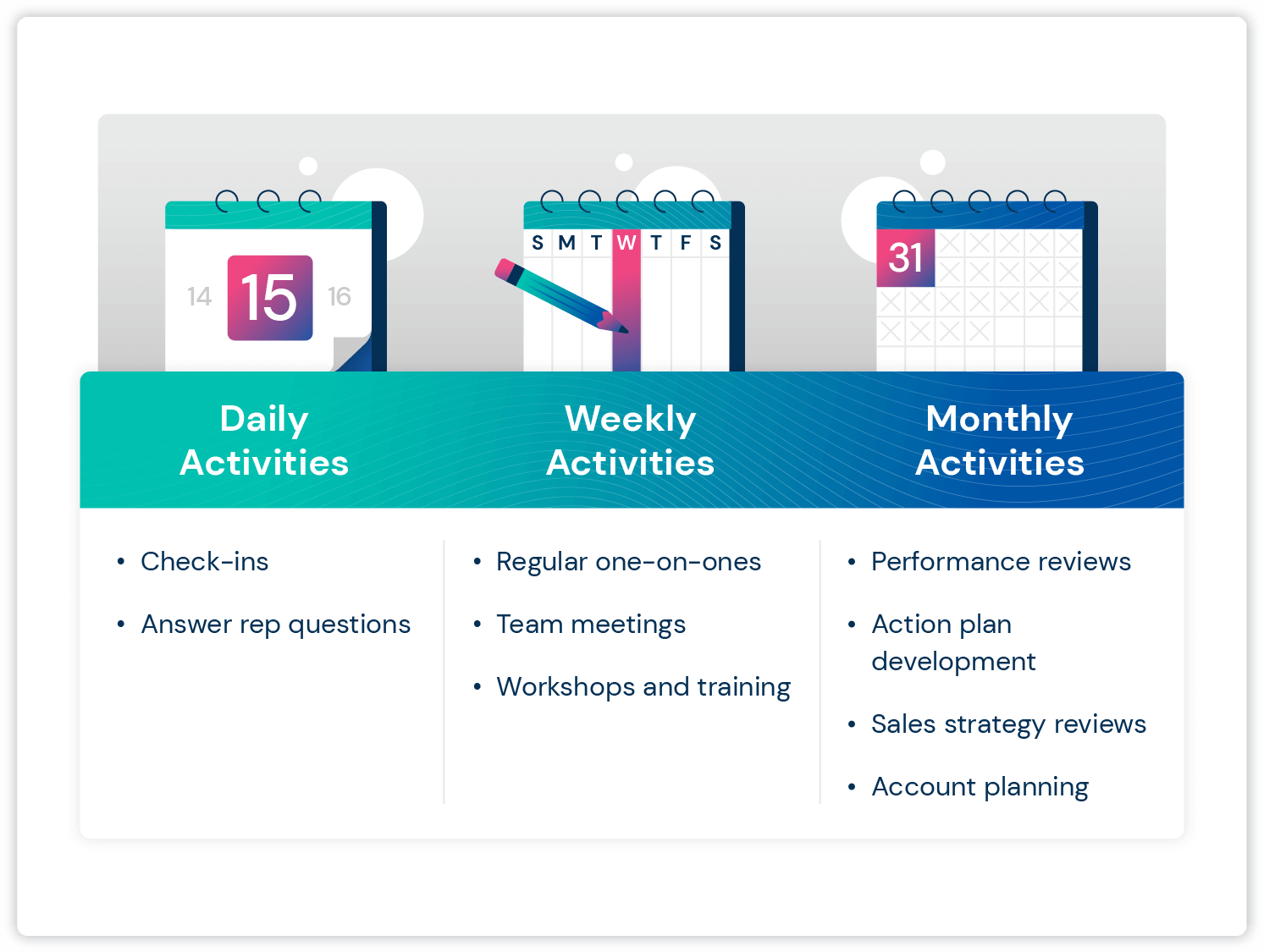
The weekly 1:1 is one turn of a loop, not a standalone event. The loop is: observe a real call → diagnose the one gap → coach it in the 1:1 → rep practices in the field → measure the behavior → repeat on the same or next skill. Hold the same skill for two or three weeks until it sticks; jumping to a new focus every week guarantees nothing compounds.
Here is the concrete weekly 30-minute template with time blocks:
| Block | Time | Manager move |
|---|---|---|
| Connect | 0:00–0:05 | Human check-in; surface blockers |
| Rep self-review | 0:05–0:10 | Rep grades their own recorded call first |
| Coach one skill | 0:10–0:20 | GROW questioning on a single named skill |
| Apply to a live deal | 0:20–0:25 | Map the skill gap onto one real opportunity |
| Commit | 0:25–0:30 | One written, measurable commitment + recordings to bring |
On a monthly rhythm, zoom out: review the rep's leading indicators, reset the skill focus, and tie it to their 30/60/90 development plan so the weekly work ladders to a quarter-level goal.
Drills & Role-Play
The 1:1 is where you *practice*, not just *discuss*. Specific reps to run:
- Call-review scorecard. Use Gong or Chorus to clip one call. Score it on 3–5 behaviors only (e.g. Talk-ratio, question count, next-step set). More than five and the rep tunes out.
- Two-minute role-play. You play the buyer's hardest objection; the rep responds live, then again after one tweak. Repetition under mild pressure is what transfers the skill.
- Reverse role-play. Have the rep coach *you* through the skill — teaching back is the fastest way to confirm they own it.
- Deal-gap drill. Take a real stuck deal and run a 5-minute MEDDIC or MEDDPICC gap check: which letter is missing? Coach the rep to fill it before the next call.
What to Measure
Quota is a lagging indicator; by the time it moves, the coaching window has closed. Measure leading indicators that prove the behavior is changing:
- Behavior change — did the coached skill show up on this week's calls? (Gong makes this measurable: question rate, talk-ratio, next-step rate.)
- Activity quality — not just call volume, but multithreading and meetings booked with the economic buyer.
- Conversion by stage — is the rep advancing stage-to-stage better since coaching started?
- Ramp time — for new reps, weeks-to-first-deal and weeks-to-quota.
- Commitment follow-through — what % of last week's written commitments did the rep actually do? This single number predicts everything else.
Common Mistakes Managers Make
- Turning the 1:1 into a forecast review. If you spend 25 minutes on deal status, you coached nothing. Move the pipeline review to a separate meeting.
- Rescuing the rep. Jumping in with the answer feels helpful and kills learning. Ask the next question instead.
- Coaching the deal, not the skill. Closing one deal *for* a rep doesn't make them better. Coach the transferable behavior the deal exposes.
- No follow-through. Setting a commitment and never checking it teaches the rep that commitments are optional.
- Coaching everyone the same. A ramping SDR and a senior AE need different focuses; one template, individualized content.
- Skipping the 1:1 when busy. Canceling coaching to chase a deal signals coaching is the first thing to cut. Protect the recurring slot.
FAQ
How long should a weekly sales coaching 1:1 be? Thirty minutes is the sweet spot for a weekly cadence — long enough to coach one skill and apply it, short enough to protect and never cancel. Senior reps can run bi-weekly at 45 minutes; ramping reps may need two shorter touches a week.
The duration matters less than the consistency and the single-skill focus.
Should the 1:1 cover deal status or skills? Skills. Keep forecast and pipeline status in a separate meeting. Deals appear in the 1:1 only as the practice field for the skill you're coaching — "where in this deal does that gap show up?" — not as a status sweep.
Who should drive the agenda, the manager or the rep? The rep should drive 60–70% of the talking, starting with their own call self-review. The manager owns the structure and the questions; the rep owns the thinking. This is the core of the GROW model and what separates coaching from telling.
How do I coach reps on a remote or hybrid team in 2027? Lean on recorded calls and AI call-coaching from Gong or Chorus so you're reviewing real evidence, not memory. Keep the video on for role-play, share a live commitment doc, and hold the same fixed weekly slot — remote teams drift fastest when the cadence is loose.
What if coaching the same skill every week isn't working? Re-run the diagnosis. If a rep can't improve a skill after three focused weeks of coaching and practice, the issue may be will, fit, or a system problem — not skill. That's a different conversation, and sometimes a performance plan, not more drills.
How many skills should I coach at once? One. Pick a single behavior, hold it for two to three weeks until it shows up reliably on calls, then move on. Coaching three things at once means the rep changes none of them.
Bottom Line
A weekly sales coaching 1:1 works when it is a fixed 30-minute, rep-led loop focused on one skill at a time, anchored to a real recorded call, and closed with a written commitment you check next week. Keep deals out of the driver's seat, ask more than you tell, and measure the behavior — not just the quota.
Structure plus consistency is the whole game.
Sources
- HBR: The Best Sales Leaders Are Coaches, Not Closers
- Gong Labs: What the Best Sales Managers Do in 1:1s
- RAIN Group: Sales Coaching Best Practices
- Sandler: A Framework for Effective Sales Coaching
- Winning by Design: The Sales Coaching Framework
- Salesforce Blog: How to Run Effective Sales 1:1 Meetings
- Sales Hacker: The GROW Coaching Model for Sales Managers
*Sales coaching for weekly 1:1s — how to structure a sales coaching 1:1, sales manager coaching guide, rep coaching framework, weekly 1:1 template, and a coaching playbook for 2027.*