
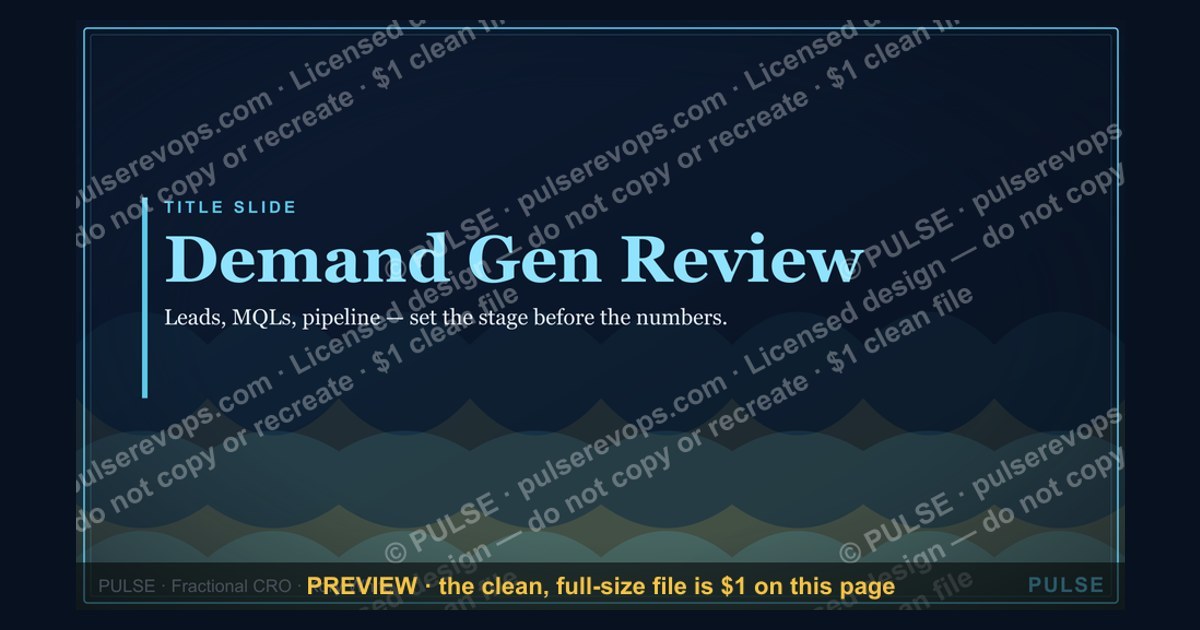
Demand Gen Review — Title Slide
 Curated byKory White · Fractional CRO · Maryland
 PULSEKNOWLEDGE LIBRARY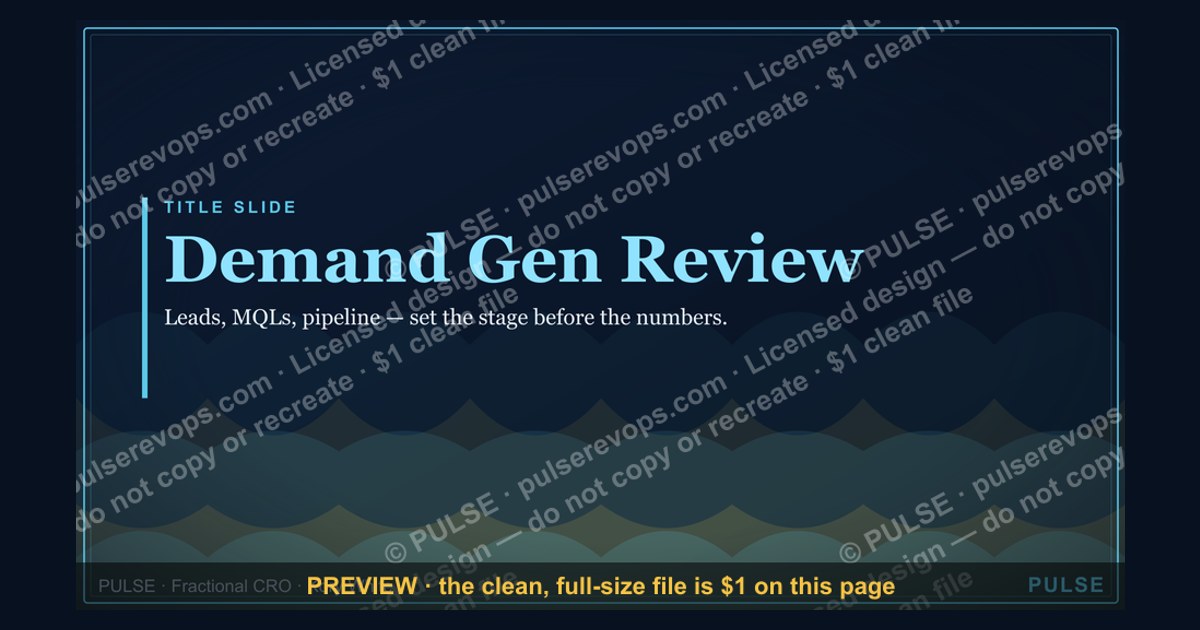

Demand Gen Review is a strategic framework for evaluating demand generation campaigns, not a specific software tool or product. It typically assesses key metrics like lead volume, conversion rates, and pipeline contribution across channels such as paid ads, content marketing, and events. The review's title slide usually sets the stage by naming the campaign period, key stakeholders, and high-level objectives.
Demand Gen Review — Title Slide

A clean 16:9 title slide — "Demand Gen Review" with a "Leads MQLs Pipeline" sub-line and pulse accent. Open your demand gen review on a polished, on-brand note.
Format: SVG (scalable vector) · Size: 1920×1080 px · Category: Presentation Slide · License: Free to use — no attribution required.
[⬇ Download this graphic](/graphics/assets/gb0079.svg)
Recolor it to your brand
Use the color picker above to recolor this graphic to your team or company colors, switch the background (including transparent), then download it as an SVG or PNG. No sign-up, no watermark.
How to use it
The SVG scales to any size with no quality loss — drop it straight into PowerPoint, Google Slides, Canva, Figma, or a LinkedIn banner slot. The PNG export is ready to upload anywhere that wants a raster image.
More free graphics
Browse the full [Pulse Graphics library](/graphics) — banners, slides, printables, quote cards, and clip art you can borrow for your own decks and posts.
Related on PULSE
- [Demand Gen Leader — LinkedIn Banner](/knowledge/gb0031)
- [The Demand Waterfall — Infographic](/knowledge/gb0099)
- [Demand Generation Lead — LinkedIn Banner](/knowledge/gb0242)
- [Sales Kickoff 2027 — Title Slide](/knowledge/gb0007)
- [Quarterly Business Review — Title Slide](/knowledge/gb0005)
- [RevOps Review — Title Slide](/knowledge/gb0080)
Anatomy of a High-Impact Demand Gen Title Slide
The title slide of a demand generation review isn't just a decorative cover—it's a strategic anchor that sets the tone, frames the narrative, and primes stakeholders for the data-driven insights to follow. In practice, the most effective title slides accomplish three distinct objectives within the first 5–10 seconds of presentation.
First, they establish credibility and context by clearly naming the initiative, time period, and owner. A well-constructed title slide might read: "Q3 2024 Demand Generation Review — Pipeline Acceleration Initiative | Owner: Marketing Ops." This immediately signals to executives and team members exactly what they're about to evaluate, reducing cognitive friction and aligning expectations.
Second, they visually communicate the current state through a single, high-level metric or visual cue. Leading B2B organizations often place a "North Star" metric—such as "Marketing-Sourced Pipeline: $4.2M (112% of Target)"—prominently on the title slide. This gives viewers an instant snapshot of performance before diving into granular details. The metric should be honest: if the number is below target, use a contrasting color (e.g., amber or red) rather than hiding it. Transparency builds trust during reviews.
Third, they provide a navigation roadmap for the presentation. A simple agenda or section list—such as "1. Lead Generation Performance → 2. Channel Attribution → 3. Conversion Funnel → 4. Recommendations"—tells the audience what to expect and allows them to mentally prepare for the depth of analysis. This is especially critical when presenting to C-suite stakeholders who may only have 15–20 minutes for the entire review.
Avoid common pitfalls: overly cluttered title slides with too many logos, stock photography that doesn't relate to the content, or vague titles like "Demand Gen Review" without a specific time frame or initiative name. The best title slides feel intentional, minimal, and immediately informative—they're the opening statement of your data story.
Strategic Use of Visual Hierarchy on the Title Slide
Visual hierarchy on a demand gen review title slide directly influences how quickly stakeholders grasp the most important information. Based on eye-tracking studies in presentation design, viewers naturally scan from top-left to bottom-right, spending roughly 80% of their attention on the upper-left quadrant. Savvy demand gen leaders exploit this pattern by placing the most critical elements in that prime real estate.
The primary headline (typically the initiative name and time period) should be the largest text element, using a bold, sans-serif font at 36–48pt. Below it, a subheadline at 18–24pt can clarify the review's purpose—e.g., "Performance Analysis & Optimization Recommendations." This creates a clear visual hierarchy that guides the eye downward.
The key metric or KPI callout deserves the second-most prominent placement, usually centered or right-aligned in the upper half of the slide. Use a large, contrasting number (48–60pt) with a concise label beneath it. For example:
$3.8M Pipeline Generated (108% of Q3 Target)
Color psychology matters here: green for exceeding targets, amber for near-target (90–99%), and red for below 90%. This instant visual cue allows executives to assess health at a glance without reading any text.
The sponsor/additional context area (such as the fractional CRO sponsorship shown in the original slide) should be visually separated but not distracting. A subtle background color shift or thin divider line creates separation without competing with the main content. Keep this area to 15–20% of the slide's vertical space, typically at the bottom or right side.
Avoid using more than three distinct font sizes on a single title slide—this prevents visual noise and maintains clarity. Also, limit color usage to two brand colors plus one accent color for the metric callout. Overusing colors dilutes the impact of the key performance indicator.
In practice, a well-executed visual hierarchy means a VP of Marketing can glance at your title slide for 3 seconds and immediately know: (1) what initiative is being reviewed, (2) whether performance is on track, and (3) who is responsible. That's the power of intentional design—it respects the audience's time while delivering maximum signal.
Integrating the Title Slide into the Broader Review Narrative
The title slide shouldn't exist in isolation—it should serve as the narrative springboard for the entire demand generation review. Experienced demand gen leaders use the title slide to establish a thematic hook that carries through every subsequent section. This narrative continuity transforms a data dump into a compelling story about performance, learning, and forward strategy.
One effective approach is to use the title slide to pose a central question that the review will answer. For example: "Q3 Demand Gen Review — Did Our ABM Expansion Deliver ROI?" This immediately frames the entire presentation around a specific hypothesis or decision point. Every subsequent slide then builds evidence toward answering that question, creating a logical flow that keeps stakeholders engaged.
Another technique is to use the title slide to set contrast or tension that the review will resolve. A title like "Q3 Demand Gen Review — Record Pipeline Volume, But Conversion Rates Dropped. Why?" creates curiosity and primes the audience for a deeper analysis. This is particularly effective when presenting to cross-functional teams (sales, product, finance) who may have different perspectives on what "success" means.
The title slide also serves as a memory anchor for action items. After the review, when stakeholders reference "the Q3 review," they'll mentally return to the title slide's framing. If you've clearly stated the review's purpose and key finding on the title slide, it becomes easier to align on next steps. For instance, if the title slide states "Focus: Improving MQL-to-SQL Conversion by 15%," then the entire team knows the primary objective of the upcoming quarter's efforts.
Finally, consider adding a call-to-action or decision point on the title slide itself. A simple line like "Decision Needed: Approve $50K budget for LinkedIn ABM pilot" at the bottom of the slide signals to executives that this review isn't just informational—it requires action. This transforms the title slide from a passive cover into an active leadership tool.
When done correctly, the title slide becomes the first and last thing stakeholders remember about your review. It's not just a starting point—it's the thesis statement for your entire demand generation narrative.
Key Components of a Demand Gen Review Title Slide
A well-constructed title slide typically includes four essential elements: the campaign name or period (e.g., "Q3 2024 Demand Gen Review"), the primary reviewer or team (e.g., "Marketing Operations"), the core objective statement (e.g., "Evaluating Pipeline Acceleration"), and a high-level metric snapshot (e.g., "Target: 20% MQL-to-SQL conversion"). Avoid cluttering the slide—limit text to 10–15 words per element for clarity. Many teams also add a company logo, date, and confidentiality notice (e.g., "Internal Use Only") to set context.
Common Mistakes When Designing the Title Slide
Overloading the title slide with data is a frequent error—it should preview, not summarize. Avoid using vague phrases like "Campaign Performance" without specifying the time frame or audience. Another pitfall is inconsistent branding: use the same font, color palette, and logo placement as the rest of the deck. Finally, don't skip the call to action—even a simple "Review Purpose: Identify Wins & Gaps" helps align stakeholders before the first data slide appears.
How to Tailor the Title Slide for Different Audiences
For executive reviews, emphasize strategic outcomes (e.g., "Revenue Contribution by Channel") and keep metrics high-level. For team reviews, include process details (e.g., "A/B Test Results from LinkedIn Ads"). For investor or board presentations, add a one-line summary of ROI (e.g., "3.2x Pipeline Return on Ad Spend"). Adjust the tone accordingly—formal for external stakeholders, conversational for internal teams.
Best Practices for Your Demand Gen Review Title Slide
Keep your title slide focused on three essentials: the review period (e.g., "Q3 2024"), the primary goal (e.g., "Increase MQL-to-SQL conversion by 15%"), and the team or stakeholder names. Avoid cluttering it with metrics or charts — those belong on later slides. A clean, branded title slide sets a professional tone and helps your audience immediately understand the scope of the review.
Common Mistakes to Avoid
Many presenters overload the title slide with too much text or outdated data. Stick to the campaign name, time frame, and one high-level objective. Another frequent error is using low-resolution images or mismatched brand colors — always export your SVG at 1920×1080 px and recolor it to match your company palette before presenting. Finally, don't skip the date; a title slide without a clear time reference can confuse stakeholders reviewing the deck weeks later.
How to Customize the SVG for Your Brand
The provided SVG graphic is fully editable in vector tools like Figma, Illustrator, or even PowerPoint (after ungrouping). To recolor it, select the pulse accent shape and the "Demand Gen Review" text, then apply your brand's primary color using the fill or color picker. For a transparent background, delete the white rectangle behind the graphic before exporting. This ensures the slide integrates seamlessly with your existing deck template.
Sources
- Gartner — Market trends and forecasts for demand generation and B2B marketing.
- Forrester Research — Buyer behavior and demand generation strategies.
- HubSpot Blog — Inbound marketing and demand generation best practices.
- Content Marketing Institute — Content-driven demand generation tactics.
- LinkedIn Marketing Solutions — B2B demand generation and audience targeting insights.
- MarketingProfs — Educational resources on demand generation and lead nurturing.
FAQ
What exactly is a demand gen review? A demand gen review is a structured analysis of your full funnel—from top-of-funnel awareness campaigns to conversion tactics. It typically examines channels, messaging, lead scoring, and sales handoff, helping you identify gaps and prioritize quick wins.
Who should lead a demand gen review? Ideally, a cross-functional team including marketing, sales, and revenue operations, sometimes with an external fractional CRO for an unbiased view. The review works best when someone with both strategic and operational experience facilitates it.
How long does a typical demand gen review take? Most reviews span 2–4 weeks, depending on data availability and team bandwidth. The actual analysis phase might be 1–2 weeks, with another week for recommendations and presentation prep.
What are the most common findings in a demand gen review? Frequent findings include misaligned lead definitions between marketing and sales, underutilized channels, and weak conversion points in the middle of the funnel. Many teams also discover they’re over-investing in low-intent tactics without proper attribution.
How much does a professional demand gen review cost? Costs vary widely based on scope and provider—ranging from a few thousand dollars for a focused audit to $15,000–$30,000 for a comprehensive review with ongoing recommendations. Fractional CROs or specialized consultancies often offer fixed-price packages.
What should I prepare before a demand gen review? Gather your last 6–12 months of campaign performance data, CRM pipeline reports, lead scoring criteria, and any existing attribution models. Also prepare a list of your top 3–5 growth questions or pain points to ensure the review addresses your specific needs.
This page will be disappearing soon. Save it to your device for $1 — or read it free while it is here.
@Kory-White- · if Venmo asks, the last 4 of my number are 2012
 graphicRevOps Review — Title Slide
 graphicQuarterly Business Review — Title Slide
 graphicDiscovery Call — Title Slide
 graphicThe Plan — Section Divider Slide
 graphicWhat Changed — Section Divider Slide
 graphicAccount Plan — Title Slide
 graphicTerritory & Quota Planning — Title Slide
 graphicQuestions — Section Divider Slide
 graphicPipeline — Section Divider Slide
 graphicPipeline Review — Title Slide