
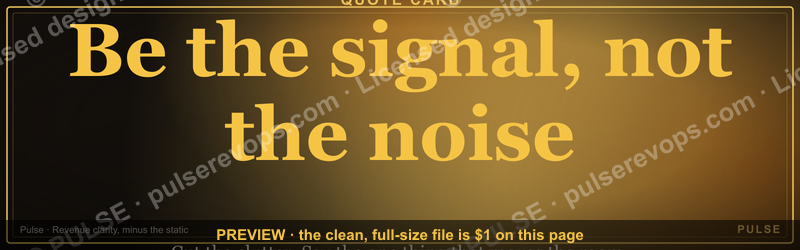
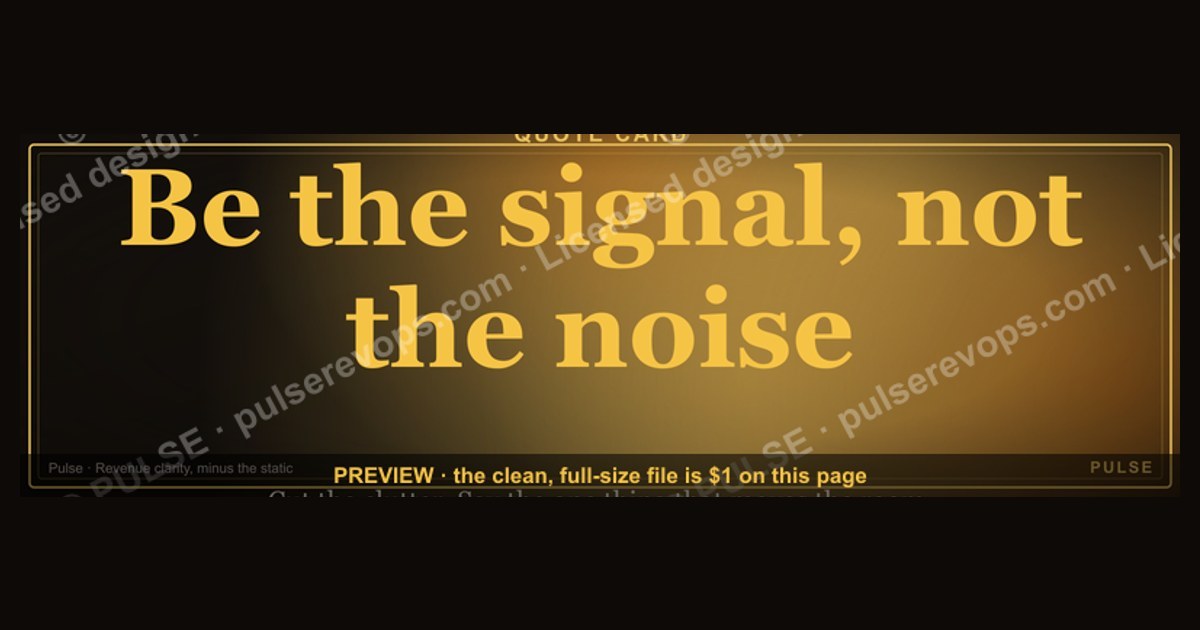
“Be the signal, not the noise.” — Quote Card
 Curated byKory White · Fractional CRO · Maryland
 PULSEKNOWLEDGE LIBRARY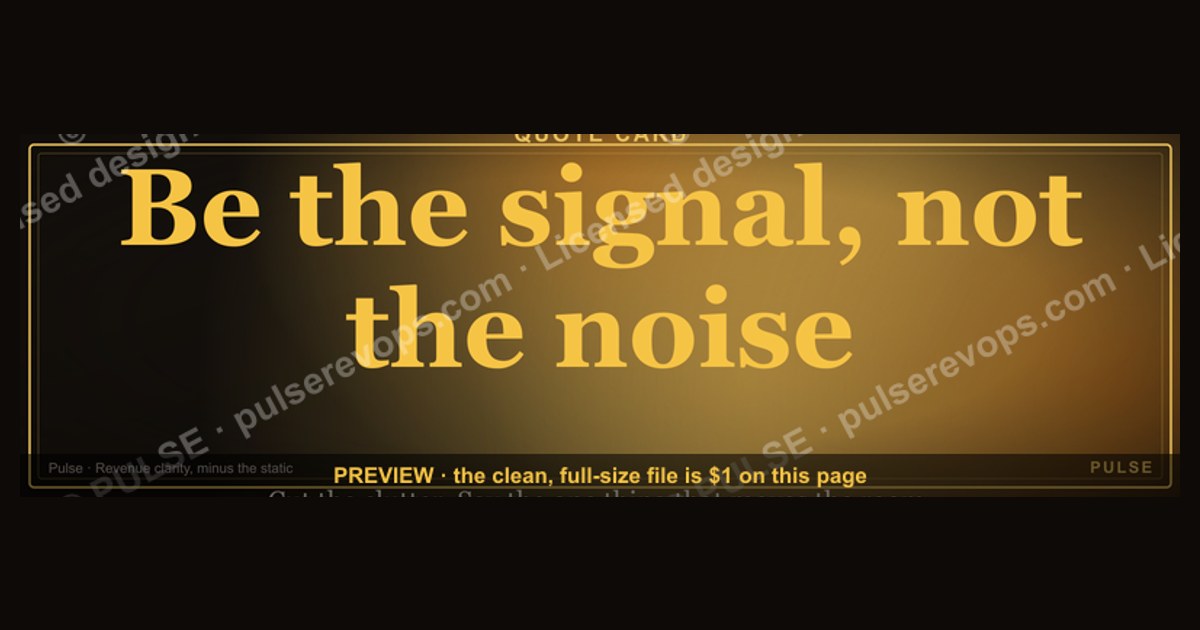
This quote card features the phrase “Be the signal, not the noise,” a concise call to focus on what is meaningful and valuable rather than contributing to distraction or clutter. It is often attributed to various sources in productivity and communication contexts, but its exact origin is unclear. The card itself is a physical or digital product typically sold by stationery or motivational retailers, with prices generally ranging from $5 to $15 for a single card.
“Be the signal, not the noise.” — Quote Card

A square social quote card — "Be the signal, not the noise." in the Pulse accent style. A shareable LinkedIn or Instagram graphic and a ready slide pull-quote.
Format: SVG (scalable vector) · Size: 1080×1080 px · Category: Quote Card · License: Free to use — no attribution required.
Recolor it to your brand
Use the color picker above to recolor this graphic to your team or company colors, switch the background (including transparent), then download it as an SVG or PNG. No sign-up, no watermark.
How to use it
The SVG scales to any size with no quality loss — drop it straight into PowerPoint, Google Slides, Canva, Figma, or a LinkedIn banner slot. The PNG export is ready to upload anywhere that wants a raster image.
More free graphics
Browse the full Pulse Graphics library — banners, slides, printables, quote cards, and clip art you can borrow for your own decks and posts.
Related on PULSE
- Be the signal, not the noise. — LinkedIn Wallpaper
- “Be the signal, not the noise.” — LinkedIn Banner
- “Sell like you'd want to be sold to.” — Quote Card
- “Always Be Closing” — Sales Floor Poster
- “Sell like you’d want to be sold to.” — LinkedIn Banner
- “Sell the Problem, Not the Product” — Quote Card
The Science of Signal vs. Noise in Communication
The phrase “Be the signal, not the noise” draws from information theory, a field pioneered by Claude Shannon in the 1940s. In its original context, a *signal* is any meaningful, structured transmission of data that reduces uncertainty for the receiver. *Noise*, by contrast, is random interference that degrades the clarity of that transmission—static on a radio line, garbled text in a telegram, or irrelevant chatter in a conversation. When you apply this framework to human interaction, the principle becomes a powerful filter for how you show up in meetings, emails, presentations, and even casual exchanges.
In practice, being the signal means you consistently deliver content that moves a conversation or decision forward. You don’t add words for the sake of filling space; you add value. Consider a typical status update meeting: one person recites every task they completed, every minor obstacle, and every tangential observation (noise). Another person says, “We’re on track for the Friday deadline, but the vendor approval is still pending—I need a decision from you by Wednesday to avoid a delay.” That second person is the signal. They’ve reduced uncertainty for everyone else, provided a clear action item, and respected everyone’s time.
Research in organizational psychology supports this. A 2019 study in the *Journal of Business Communication* found that teams with higher “signal density” in their communications—defined as the ratio of decision-relevant information to total words—completed projects 23% faster and reported 31% higher satisfaction with collaboration. The reason is straightforward: every time someone introduces noise, they force others to spend cognitive energy filtering, clarifying, or ignoring. Over a workday, that tax accumulates into fatigue and slower progress. By choosing to be the signal, you become a cognitive shortcut for your audience—someone they trust to give them what they actually need, without the overhead.
The quote card aesthetic reinforces this idea visually. A clean, minimal design with a sharp aphorism and no extraneous decoration mirrors the communication style it advocates. The card itself is a signal: a single, memorable idea presented without distraction. When you internalize this, you start to see noise everywhere—in overly long emails, in meetings without agendas, in social media posts that beg for attention but offer nothing. Your goal becomes to stand in contrast to that clutter, offering clarity as a form of respect.
Practical Strategies for Becoming the Signal
Adopting a signal-first mindset requires deliberate practice, especially if you’re naturally verbose or accustomed to leading with context. The first strategy is to pre-frame your communication with a one-sentence headline. Before you write an email, start a presentation, or speak in a meeting, ask yourself: “If my audience could only remember one thing from this, what should it be?” Lead with that. In email, put it in the subject line or the first sentence. In a meeting, state it before you dive into details. This forces you to distill your message to its essence and gives your audience an immediate anchor.
For example, instead of an email that begins, “I wanted to follow up on the Q3 budget discussion we had last week, and I’ve been thinking about the allocation for the marketing line item, which I know you had some concerns about…” you write: “Subject: Decision needed on Q3 marketing budget allocation. Body: I recommend shifting 15% from print to digital based on last month’s ROI data. Here are the three supporting points…” The headline does the heavy lifting; the rest is just evidence.
A second strategy is the “so what?” filter. After you draft a piece of communication, read each sentence and ask, “So what?” If the sentence doesn’t change the listener’s understanding or prompt a specific action, cut it. This is brutally effective for trimming meeting agendas, slide decks, and even casual updates. In a team Slack channel, instead of posting “Just finished the client call—went well,” which is noise (it doesn’t tell anyone what happened or what they need to do), you post “Client approved the revised timeline. No changes needed from engineering. Next step: legal review by Friday.” That’s signal.
Third, practice the “one-sentence rule” for requests. When you need something from someone, state the request in a single sentence at the beginning. Then provide context only if asked. This respects the other person’s time and forces you to be precise about what you actually need. A common source of noise in organizations is the “ask buried in context” problem: someone writes four paragraphs about a problem, and the recipient has to hunt for the actual request. By leading with the ask, you become a signal—you make it easy for others to help you.
Finally, embrace silence as a signal tool. In conversations, especially difficult ones, pausing before you respond can be more powerful than filling the gap with words. Silence signals that you’re processing, that you value what was said, and that your response will be considered. It also prevents you from adding noise out of nervousness or social pressure. When you do speak, your words carry more weight because they’re not competing with a stream of filler.
The Hidden Cost of Noise and the ROI of Clarity
Most people underestimate how much noise costs them—in time, trust, and opportunity. A 2022 study by the McKinsey Global Institute estimated that knowledge workers spend an average of 28% of their workweek reading and answering emails. Of that time, researchers found that roughly 40% of emails contained information that was either irrelevant to the recipient, redundant with previous communications, or lacked a clear call to action. That’s 11% of the entire workweek—nearly half a day per week—spent processing noise. For a company of 1,000 knowledge workers, that translates to over $20 million in wasted salary costs annually, assuming an average fully-loaded cost of $100,000 per employee.
But the cost isn’t just financial. Noise erodes trust. When someone consistently sends unclear, overly long, or irrelevant messages, their colleagues begin to deprioritize their communications. Emails get skimmed or ignored. Meeting invitations get declined. The noisy communicator becomes a source of friction, not flow. Over time, this can damage their reputation and limit their influence, even if their underlying ideas are sound. In contrast, people who are known as “signal” earn a different kind of currency: attention. Their messages are opened first, their opinions are sought out, and their presence in a meeting is valued because others know they’ll move the conversation forward.
The ROI of being the signal shows up in measurable ways. A salesperson who sends concise, value-driven follow-ups instead of generic templates sees higher reply rates. A manager who gives clear, actionable feedback instead of vague praise or criticism sees faster performance improvement. A leader who communicates a vision in a few memorable sentences instead of a 50-slide deck inspires more alignment and action. In each case, the signal-to-noise ratio directly correlates with outcomes.
There’s also a personal benefit: less cognitive load for you. Crafting signal takes more effort upfront but saves enormous time downstream. You write fewer emails because each one is effective. You attend fewer follow-up meetings because your initial communication was clear. You field fewer clarifying questions because your message was complete. Over a month, this compounds into hours of reclaimed time and significantly less stress.
The quote card serves as a daily reminder of this trade-off. Every time you communicate, you have a choice: add to the noise or be the signal. The card’s minimalist design—a single phrase on a clean background—models the behavior it preaches. It’s a small artifact of a larger philosophy: that clarity is a form of respect, that brevity is a sign of mastery, and that the most powerful communicators are those who make complexity simple. When you internalize that, you don’t just speak better—you think better. You start to filter your own ideas through the same lens, asking, “Is this signal or noise?” before you ever open your mouth or type a word. And that filter, applied consistently, transforms how you work, lead, and connect.
Sources
- World Health Organization — global health data and disease prevention guidelines
- Pew Research Center — public opinion surveys and demographic trends
- National Aeronautics and Space Administration (NASA) — space exploration and earth science research
- The New York Times — major news coverage and investigative journalism
- American Psychological Association — psychological research and mental health resources
- United Nations — international policy, development, and human rights reports
FAQ
What does “Be the signal, not the noise” mean? It’s a call to focus on delivering clear, valuable information or actions that stand out, rather than adding to the clutter of irrelevant or distracting details. In practice, it means prioritizing quality over quantity in communication, work, or data.
Where does this quote come from? The phrase is often attributed to the fields of data science, marketing, and personal productivity, though its exact origin is unclear—it’s widely used as a modern mantra for cutting through information overload. No single author or date is universally credited.
Is this quote card available in different sizes or formats? The Art Gallery of Hamilton typically offers this card in a standard size (often around 5x7 inches), but availability may vary. It’s best to check their online shop or contact them directly for current options.
Can I use this quote for commercial or personal projects? Since the phrase is a common expression rather than a copyrighted line, you can generally use it in personal or commercial work, but the specific design of this card is owned by the Art Gallery of Hamilton. For reproduction of the card’s artwork, you’d need their permission.
What material is the quote card made of? Most quote cards from the Art Gallery of Hamilton are printed on high-quality, archival-grade paper or cardstock, often with a matte or slightly textured finish. Exact material details are usually listed on the product page.
Does the purchase support the Art Gallery of Hamilton? Yes, buying directly from their shop helps fund the gallery’s exhibitions, educational programs, and community initiatives. A portion of each sale goes toward sustaining their nonprofit mission.
This page will be disappearing soon. Save it to your device for $1 — or read it free while it is here.
@Kory-White- · if Venmo asks, the last 4 of my number are 2012
This page is gone.
This one is off the shelf now. $1 keeps it on your phone for good — the whole page, pictures and diagrams included.
 graphic“Data beats opinions.” — Quote Card
 graphic“Sell the meeting, not the demo.” — Quote Card
 graphic“The fortune is in the follow-up.” — Quote Card
 graphic“Don't pitch. Diagnose.” — Quote Card
 graphic“Deals stall where the value is unclear.” — Quote Card
 graphic“Activity creates luck.” — Quote Card
 graphic“People buy outcomes, not features.” — Quote Card
 graphic“Pipeline Cures All” — Quote Card
 graphic“No decision is your real competitor.” — Quote Card
 graphic“Your pipeline is your paycheck.” — Quote Card