
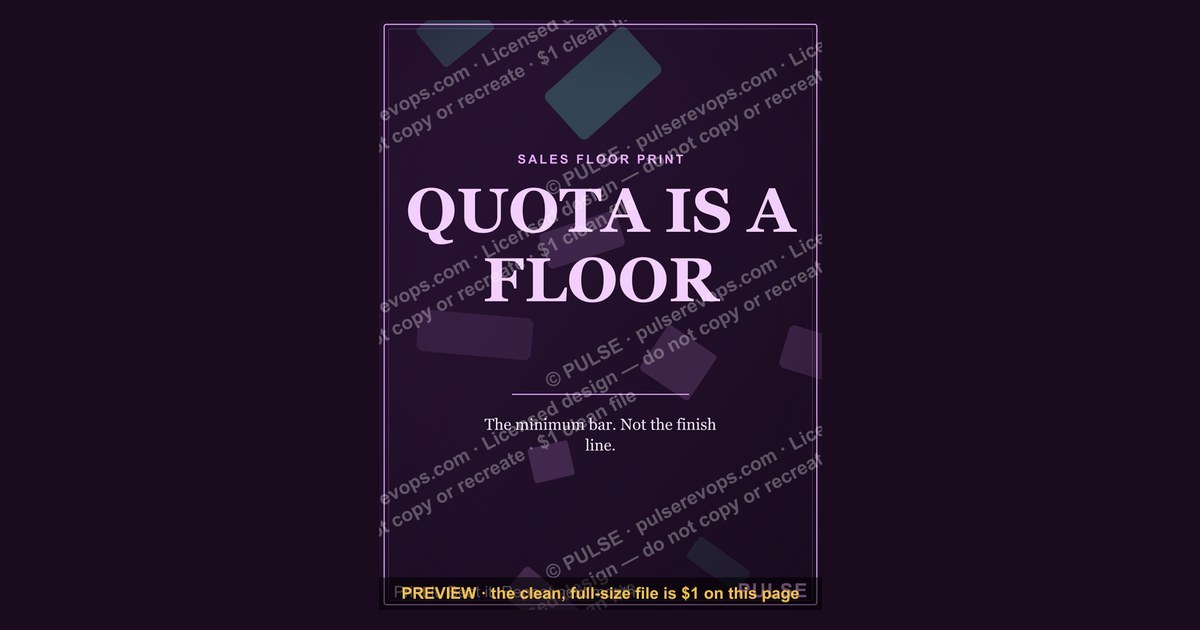
“QUOTA IS A FLOOR” — Sales Floor Print
 Curated byKory White · Fractional CRO · Maryland
 PULSEKNOWLEDGE LIBRARY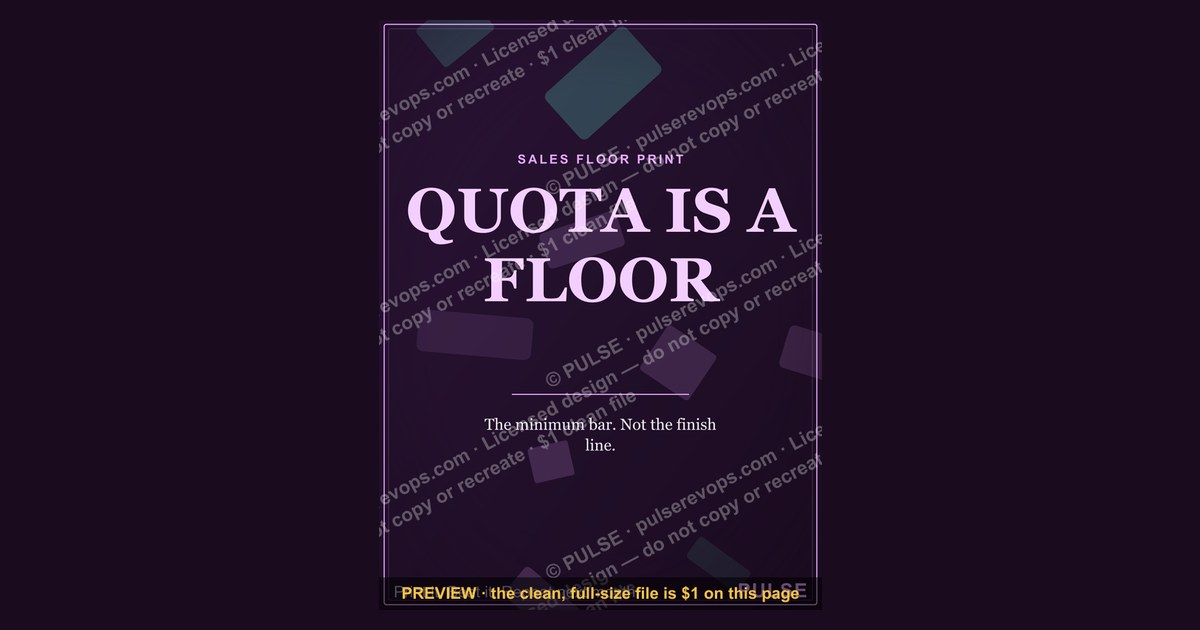

The phrase "quota is a floor" on a sales floor print means that the sales quota represents the minimum acceptable performance, not a target to stop at. It serves as a baseline that every salesperson must meet or exceed to avoid being below expectations. In practice, quotas are set based on historical data and market conditions, with top performers typically reaching 110–130% of their quota.
“QUOTA IS A FLOOR” — Sales Floor Print

A bold printable poster — "QUOTA IS A FLOOR" stacked in the Pulse accent gradient. Print it for the sales floor or your home office to keep energy up.
Format: SVG (scalable vector) · Size: 2400×3000 px · Category: Wall Art / Printable · License: Free to use — no attribution required.
Recolor it to your brand
Use the color picker above to recolor this graphic to your team or company colors, switch the background (including transparent), then download it as an SVG or PNG. No sign-up, no watermark.
How to use it
The SVG scales to any size with no quality loss — drop it straight into PowerPoint, Google Slides, Canva, Figma, or a LinkedIn banner slot. The PNG export is ready to upload anywhere that wants a raster image.
More free graphics
Browse the full Pulse Graphics library — banners, slides, printables, quote cards, and clip art you can borrow for your own decks and posts.
Related on PULSE
- "Quota is a floor." — LinkedIn Banner
- “Quota is a floor, not a ceiling.” — LinkedIn Banner
- Territory & Quota Planning — Title Slide
- “Looking for my next quota.” — LinkedIn Banner
- “HELP FIRST” — Sales Floor Print
- “NEXT CALL WINS” — Sales Floor Print
Why “Quota Is a Floor” Changes How You Manage Sales Teams
The phrase “quota is a floor” isn’t just a motivational slogan—it’s a fundamental shift in how you structure compensation, pipeline management, and performance reviews. When you treat quota as the minimum acceptable performance rather than a stretch target, you force a re-examination of what “good” actually means in your sales organization.
Most sales leaders set quotas based on historical averages, company revenue needs, or a blend of territory potential and past performance. But if quota is truly a floor, then hitting exactly 100% of quota means the rep is barely meeting expectations. In practice, this requires a compensation plan that heavily rewards overperformance—typically 150% to 200% accelerators once reps cross 100% of quota. Without that structure, the phrase rings hollow. Reps quickly learn that hitting quota is the goal, not the starting point.
The psychological impact is immediate. When reps internalize that 100% is the minimum, they stop coasting after hitting their number in month nine. Instead, they push for 120%, 140%, or more because the system rewards them disproportionately for doing so. This changes the entire sales culture from “survive and hit number” to “dominate and overachieve.”
For sales managers, this mindset forces a harder look at underperformers. If quota is a floor, then a rep consistently at 85% to 95% isn’t “almost there”—they’re failing. You either coach them up or move them out. It also changes how you allocate leads and territories. You stop giving the best leads to your top performers just to ensure they hit quota; instead, you distribute opportunities more evenly because you expect everyone to clear the floor.
How to Design a Compensation Plan That Makes Quota a Floor
Making “quota is a floor” operational requires a compensation plan that aligns incentives with overperformance. Here’s how to structure it effectively.
Start with a base salary that covers 60% to 70% of a rep’s on-target earnings (OTE). For example, if OTE is $150,000, base should be $90,000 to $105,000. This ensures reps aren’t desperate to hit quota just to pay rent—they can survive at 80% attainment, but they won’t thrive. The variable component should be heavily weighted toward accelerators.
Set the accelerator structure as follows:
- 0% to 80% of quota: 0.5x commission rate (or a reduced rate)
- 80% to 100% of quota: 1.0x commission rate (standard)
- 100% to 120% of quota: 1.5x to 2.0x commission rate
- 120%+ of quota: 2.0x to 3.0x commission rate
This creates a powerful incentive to blow past quota. A rep who hits 130% of quota might earn 1.8x to 2.5x their variable comp, effectively doubling their commission check. That’s the difference between earning $60,000 in variable comp vs. $120,000—a life-changing gap for most reps.
You also need to cap accelerators carefully. Some companies set no cap, which can create windfalls if a rep lands a massive deal in month one. Others cap at 200% or 300% of quota to manage risk. A reasonable middle ground is uncapped accelerators within the fiscal year, but reset quarterly or annually so reps don’t coast after a huge Q1.
Another critical design element: clawbacks and chargebacks. If quota is a floor, then deals that fall through or get refunded should hit the rep’s attainment immediately. Don’t let reps bank commission on deals that haven’t fully closed or that carry high refund risk. This keeps them focused on quality deals that actually stick.
Finally, communicate the plan clearly. Hold a quarterly compensation review meeting where you walk through the math. Show reps exactly how much more they earn at 110% vs. 100%. Use real examples from your team. When reps see that hitting 110% means an extra $15,000 to $25,000 in their pocket, the phrase “quota is a floor” becomes self-fulfilling.
The Psychological and Cultural Impact of Treating Quota as a Floor
Adopting “quota is a floor” isn’t just a compensation change—it’s a cultural transformation that affects hiring, training, and team dynamics.
First, it changes who you hire. You stop looking for reps who can “just get by” or who need constant motivation. Instead, you seek out competitive, self-driven individuals who thrive on exceeding expectations. During interviews, ask candidates: “What’s the highest percentage of quota you’ve ever hit?” and “How did you feel when you hit exactly 100%?” The answers reveal whether they see quota as a ceiling or a floor. Candidates who say they were disappointed with 100% are your ideal hires.
Second, it changes how you run your sales meetings. Stop celebrating reps who hit 100% of quota with a round of applause. Instead, celebrate those who hit 120% or 150%. Make it clear that 100% is expected, not exceptional. This might feel harsh at first, but it sets the right tone. You can still acknowledge progress—a rep moving from 80% to 95% deserves recognition for improvement—but the bar for public celebration should be well above 100%.
Third, it changes how you handle underperformance. If quota is a floor, then a rep at 85% for two consecutive quarters isn’t just “having a tough year”—they’re failing to meet the minimum. You need a performance improvement plan (PIP) that’s shorter and more aggressive than typical. A 30-day PIP with clear milestones, daily coaching, and weekly check-ins. If they can’t hit 100% within 60 days, it’s time to part ways. This might seem harsh, but it protects the team culture. One underperformer can drag down morale and create resentment among high achievers who carry the load.
Fourth, it changes how you allocate resources. Top performers who consistently hit 120%+ of quota should get first access to the best leads, most marketing support, and the highest-value accounts. This isn’t favoritism—it’s ROI optimization. Your best reps generate the most revenue per lead, so give them the best ammunition. Lower performers get coaching and smaller accounts until they prove they can clear the floor.
Finally, it changes how you think about your own role as a sales leader. If quota is a floor, then your job is to remove obstacles that prevent reps from exceeding it. That means fixing broken processes, improving lead quality, shortening sales cycles, and providing better training. You stop being a babysitter who chases reps to make calls and start being a strategist who builds systems that enable overperformance.
The cultural shift takes 6 to 12 months to fully embed. Expect some resistance from reps who are comfortable hitting 90% to 100% and coasting. They’ll either step up or self-select out. The ones who stay will become a high-performance team that consistently exceeds expectations—and that’s exactly what “quota is a floor” is designed to create.
Sources
- Salesforce — official documentation on sales performance metrics and quota management
- Harvard Business Review — articles on sales strategy, quota setting, and performance incentives
- Gartner — research reports on sales compensation and quota best practices
- SHRM (Society for Human Resource Management) — resources on sales team motivation and goal-setting
- McKinsey & Company — insights on sales effectiveness and quota design
- The Wall Street Journal — business news and analysis on sales trends and compensation practices
FAQ
What does “quota is a floor” mean in sales? It means your quota isn’t a ceiling or a target you barely hit—it’s the minimum acceptable performance. Top reps treat quota as the starting point, not the finish line, and aim to exceed it by a meaningful margin (often 20–50% or more).
Is this print just motivational, or does it reflect real sales strategy? It’s both. The phrase reinforces a mindset that drives behavior: when you view quota as a floor, you plan for overachievement, build pipeline buffers, and avoid the scramble to hit minimums. Many high-performing sales organizations explicitly coach this mentality.
Who is this print designed for—individual reps or sales leaders? It works for both. Individual contributors use it as a daily reminder to push past minimums, while leaders can display it in team spaces to set a cultural expectation that “just making quota” isn’t the goal. It’s common in sales floors, home offices, and team war rooms.
What size and material options are typically available for this print? Sizes usually range from 8x10 inches up to 24x36 inches, with common options being 11x14 or 18x24. Materials often include matte paper, semi-gloss poster stock, or framed prints on canvas—prices vary widely from around $15 to $60 depending on size and framing.
Can I customize the design or add my company’s logo? Some sellers offer customization for bulk orders, such as adding a company logo or tweaking colors to match brand guidelines. For single prints, customization is less common, but you can check with the specific seller—many print-on-demand services allow basic text or color changes.
How should I hang or display this print for maximum impact? Place it at eye level in a high-traffic area where reps see it daily—near a sales whiteboard, above a monitor, or in a shared team space. Avoid cluttered walls; let the bold message stand alone. Some teams pair it with other sales mindset prints for a cohesive “wall of standards.”
This page will be disappearing soon. Save it to your device for $1 — or read it free while it is here.
@Kory-White- · if Venmo asks, the last 4 of my number are 2012
This page is gone.
This one is off the shelf now. $1 keeps it on your phone for good — the whole page, pictures and diagrams included.
 graphic“STAY IN THE DEAL” — Sales Floor Print
 graphic“MORE PIPELINE LESS PANIC” — Sales Floor Print
 graphic“Always Be Closing” — Sales Floor Poster
 graphic“DO THE REPS” — Sales Floor Print
 graphic“SHOW UP FOLLOW UP CLOSE” — Sales Floor Print
 graphic“SELL THE VALUE” — Sales Floor Print
 graphic“CHASE THE NO” — Sales Floor Print
 graphic“FOLLOW UP AGAIN” — Sales Floor Print
 graphic“HELP FIRST” — Sales Floor Print
 graphic“EARN EVERY YES” — Sales Floor Print