
“No decision is the real competitor.” — LinkedIn Banner
 Curated byKory White · Fractional CRO · Maryland
 PULSEKNOWLEDGE LIBRARY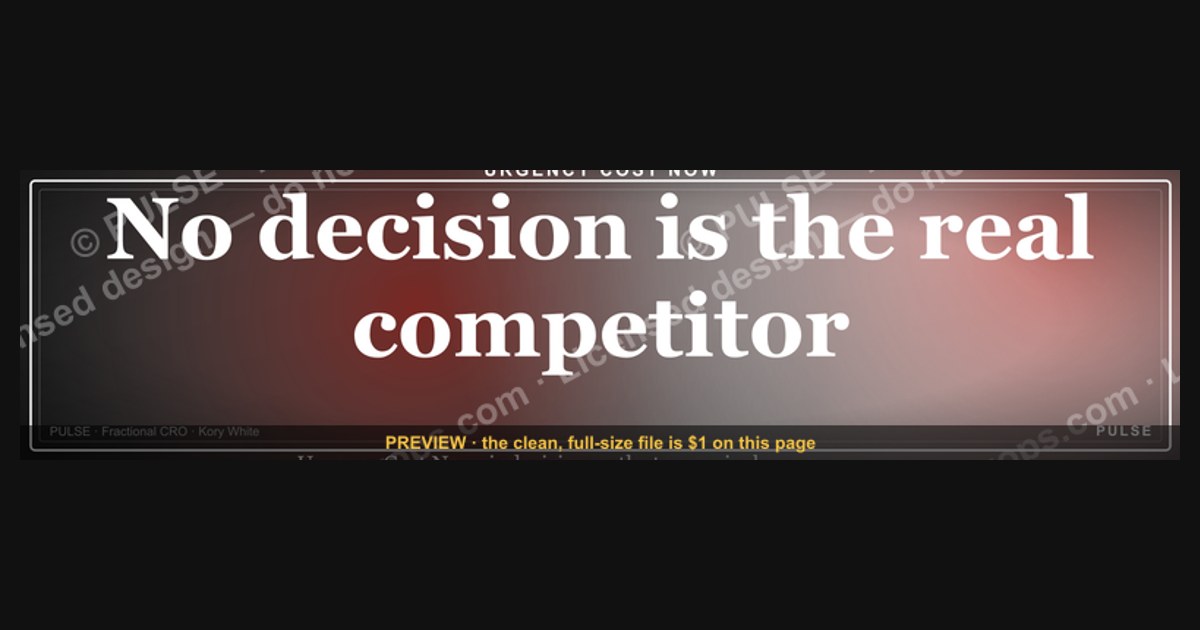
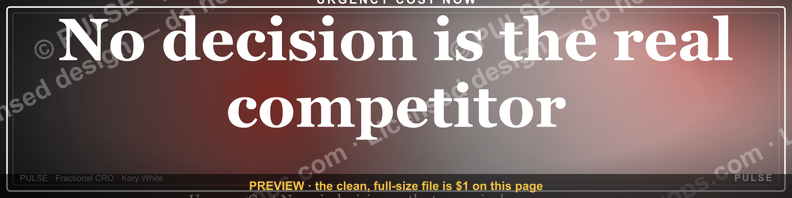
This banner quote suggests that indecision or inaction is often a greater obstacle than any external rival. It reframes competition as an internal struggle where failing to make a choice can hold you back more than a direct opponent. The message encourages decisive action, implying that moving forward with a decision—even an imperfect one—outpaces the paralysis of doing nothing.
“No decision is the real competitor.” — LinkedIn Banner

A dark, on-brand LinkedIn banner — "No decision is the real competitor." over a "Urgency Cost Now" line with a pulse motif. Put it on your profile to signal exactly what you do.
Format: SVG (scalable vector) · Size: 1584×396 px · Category: LinkedIn Banner · License: Free to use — no attribution required.
Recolor it to your brand
Use the color picker above to recolor this banner to your team or company colors, switch the background (including transparent), then download it as an SVG or PNG. No sign-up, no watermark.

How to use it
It scales cleanly to the LinkedIn cover slot (1584×396) — download the PNG and drop it straight onto your profile, or open the SVG in Canva, PowerPoint, or Figma to add your name and tweak the layout.
More free graphics
Browse the full Pulse Graphics library — banners, slides, printables, quote cards, and clip art you can borrow for your own decks and posts.
Related on PULSE
- “No decision is your real competitor.” — Quote Card
- “BOUGHT THE COMPETITOR” — Sales Meme
- Hire Decision Framework
- Renewal Risk Decision Tree
- Pricing Discount Decision Tree
- Real Estate CRO — LinkedIn Banner
The Psychology Behind Decision Paralysis in Sales
The quote “No decision is the real competitor” strikes at the heart of a psychological phenomenon that plagues B2B sales: decision paralysis. When prospects avoid choosing between your solution and doing nothing, they’re not being lazy—they’re often experiencing cognitive overload. Research in behavioral economics suggests that humans have a limited capacity for decision-making, typically handling between 3-5 significant choices per day before mental fatigue sets in. In a complex B2B buying process involving 6-10 stakeholders, each with competing priorities, the path of least resistance becomes no decision at all.
This inertia is amplified by what psychologists call the “status quo bias.” Your prospect’s current state—even if imperfect—feels safer than the unknown outcome of choosing your solution. They can justify maintaining the status quo to their boss, while a new vendor introduces risk. The salesperson who understands this dynamic doesn’t just pitch features; they actively dismantle the comfort of inaction. They reframe the cost of doing nothing as more expensive than the risk of moving forward. For example, a SaaS company selling workflow automation might calculate that every month of delay costs the prospect $12,000–$18,000 in lost productivity—a concrete number that transforms abstract hesitation into a tangible loss.
The key is to make the “no decision” outcome feel painful, not neutral. This requires shifting from a benefits-focused pitch to a “cost of inaction” narrative. Instead of saying, “Our software improves efficiency,” say, “Every week you delay, your team loses 40 hours of manual work that could be automated.” When prospects feel the weight of indecision, they’re more likely to choose action—even if imperfect.
Structuring Your Sales Process to Force Decisions
A sales process that leaves room for indefinite deliberation is a recipe for lost deals. The most effective sales organizations build decision points into every stage, creating natural moments where prospects must choose to advance, delay, or exit. This isn’t about being pushy; it’s about respecting the prospect’s time by making the path forward clear and the cost of waiting explicit.
Start by defining “decision milestones” in your sales cycle. For example, after the discovery call, require a commitment to a specific next step—like a demo with the economic buyer—within 48 hours. If the prospect hesitates, you’ve identified a potential “no decision” risk early. Use a scoring system to track engagement: prospects who miss two consecutive milestones without rescheduling are flagged for re-engagement or disqualification. This prevents your team from wasting weeks on deals that will never close.
Another tactic is to introduce a time-bound incentive tied to a decision, not just a purchase. For instance, offer a free implementation session if the prospect signs a mutual action plan within five business days. This rewards forward movement without discounting your product. The goal is to create a sense of momentum—once a prospect invests time in the process, they’re psychologically committed to seeing it through. Studies from the Harvard Business Review suggest that deals where prospects complete a structured evaluation process close 30-40% faster than those without clear milestones.
Finally, train your team to recognize and address “silent stalls.” When a prospect stops responding after a demo, it’s rarely because they’ve chosen a competitor—it’s usually because they’ve chosen indecision. A simple email like, “I noticed we haven’t connected in a while. Are you still evaluating options, or has the priority shifted?” forces a response. If they say they’re still deciding, ask directly: “What would need to be true for you to move forward this month?” This question surfaces hidden objections and gives you a chance to address them, turning a passive stall into an active conversation.
Building a Culture That Competes Against Inaction
The “no decision” competitor isn’t just an external force—it can also live inside your own organization. Sales teams that tolerate vague commitments, endless follow-ups, and “just thinking about it” prospects are inadvertently enabling the very inertia they should be fighting. Creating a culture that competes against inaction starts with how you define a qualified lead.
Move beyond surface-level criteria like company size or budget. Instead, qualify leads based on their willingness to make a decision within a defined timeframe. Ask prospects during the first call: “If we can show you a solution that meets your needs, what’s your timeline for making a decision?” If they say “3-6 months,” you’re likely facing a long, uncertain cycle. While not disqualifying, this signals the need for a different approach—like a pilot program or a limited-scope engagement—that reduces the commitment required.
Internally, reward progress over activity. Many sales organizations celebrate calls made or demos scheduled, but these metrics don’t reflect whether decisions are happening. Instead, track “decision velocity”—the average time from first contact to a yes or no. If your team’s average is 90 days, set a target to reduce it to 60 days by tightening qualification and adding decision-forcing steps. Celebrate reps who disqualify prospects quickly, because a fast “no” frees up time for better opportunities.
Finally, build a feedback loop between sales and marketing to address the root causes of indecision. If prospects consistently stall after seeing a pricing page, your pricing might be too complex or unclear. If they hesitate during demos, your messaging might focus too much on features and not enough on the cost of inaction. By analyzing where deals get stuck, you can refine your entire go-to-market strategy to compete more effectively against the silent enemy of no decision.
Why Indecision Paralysis Hurts More Than a Wrong Choice
The hidden cost of indecision isn't just lost time—it's compound opportunity loss. Every day you delay a strategic decision (hiring, pricing, product launch), your competitors who act gain data, customer feedback, and market position. A wrong decision typically costs you a few weeks or months to correct; no decision costs you the entire window of opportunity. Research on decision fatigue shows that even mediocre decisions executed consistently outperform perfect plans that never leave the whiteboard.
Practical Triggers to Break Decision Paralysis
Three concrete techniques help convert this banner's philosophy into action:
- The 10-10-10 Rule: Ask how your decision will feel in 10 minutes, 10 months, and 10 years. Most indecision dissolves when you realize the long-term cost of inaction dwarfs short-term discomfort.
- Set a Decision Deadline: Give yourself 48 hours maximum for decisions under $10,000 in impact, and one week for larger ones. Parkinson's Law applies here—decisions expand to fill the time available.
- Use a "Minimum Viable Decision": Instead of seeking the perfect choice, identify the smallest decision that moves you forward. A "good enough" decision today beats a perfect decision next quarter.
When Deliberation Actually Serves You
The banner's wisdom isn't absolute. Strategic indecision can be valuable when you're gathering critical market data, waiting for a known catalyst (regulatory ruling, funding round), or when the cost of a wrong move exceeds the cost of delay by 10x or more. The key distinction: are you actively gathering information to decide, or are you avoiding discomfort? If you can't articulate what specific data you're waiting for and when you'll have it, you're in decision paralysis, not strategic patience.
The Psychology Behind the Quote
This banner taps into a well-documented cognitive bias: decision paralysis. Research in behavioral economics shows that when faced with multiple options or high-stakes choices, the human brain often defaults to inaction as a self-protective mechanism. The quote reframes this natural hesitation as a competitive threat—one that is often more damaging than any external rival. In practice, this means that the entrepreneur who launches a "good enough" product beats the perfectionist who never ships. The salesperson who sends one more outreach email outperforms the one who waits for the "perfect" lead. The banner visually reinforces this with its "Urgency Cost Now" line, reminding viewers that every moment of indecision carries a real, compounding cost.
Practical Applications for Your Profile
Use this banner to signal a specific mindset to your network. It works best for:
- Founders and startup teams – Communicates a bias toward action and rapid iteration.
- Sales and business development professionals – Implies you value closing deals over endless deliberation.
- Project managers and operations leads – Suggests you cut through analysis paralysis to drive results.
Pair it with a profile headline that reinforces the message, such as "Turning decisions into momentum" or "Helping teams choose action over hesitation." The dark, minimalist design keeps the focus on the text, making it readable even in LinkedIn's small preview thumbnails. For maximum impact, update your banner quarterly to keep your profile feeling current and intentional.
Common Misinterpretations to Avoid
Some viewers may read the quote as advocating for reckless decision-making. Clarify your intent by adding a brief note in your "About" section: "Decisive doesn't mean careless—it means gathering enough data to act, then iterating." The quote is not about ignoring analysis or research; it's about recognizing that indefinite waiting is itself a choice—one that often leads to worse outcomes than a timely, imperfect decision. The banner's pulse motif reinforces this balance: a steady rhythm of action, not a chaotic sprint. Use it to start conversations about how you balance speed with quality in your own work.
Sources
- LinkedIn Help Center — official guidance on profile features and banner usage
- Harvard Business Review — articles on decision-making and leadership in business
- Forbes — coverage of professional development and career strategy insights
- American Psychological Association — research on decision-making psychology and cognitive biases
- The Wall Street Journal — business news and analysis on competitive strategy
- Society for Human Resource Management — resources on workplace behavior and professional branding
FAQ
What does “No decision is the real competitor” mean? It means that in sales, the biggest obstacle isn’t another vendor—it’s a prospect choosing to do nothing. When a buyer delays or avoids a decision, you lose the deal to inertia, not to a rival.
How do I overcome a prospect’s indecision? Focus on the cost of inaction by quantifying what they lose by not moving forward. Use specific, honest examples of missed revenue or unresolved pain points to make the status quo feel riskier than choosing a solution.
Is this banner only for LinkedIn? No, the same message works on any professional profile or sales page. It’s designed to spark a conversation about why prospects stall, so you can repurpose it on your website, email signatures, or slide decks.
Does this approach work for B2B and B2C sales? Yes, but it’s most powerful in B2B where buying cycles are long and multiple stakeholders are involved. In B2C, indecision often stems from price sensitivity or lack of urgency, so the principle still applies but the framing may shift.
What if my product has many real competitors? Even in crowded markets, the “no decision” problem can be larger than any single competitor. Your job is to make the choice to act feel safer and more urgent than the choice to wait—regardless of how many alternatives exist.
How do I measure if indecision is hurting my pipeline? Track the percentage of deals that stall in late stages or expire without a clear “no.” If that number is above 20–30% of your pipeline, indecision is likely a bigger drain than any competitor.
This page will be disappearing soon. Save it to your device for $1 — or read it free while it is here.
@Kory-White- · if Venmo asks, the last 4 of my number are 2012
This page is gone.
This one is off the shelf now. $1 keeps it on your phone for good — the whole page, pictures and diagrams included.
 graphicFaster deals, fewer leaks. — LinkedIn Wallpaper
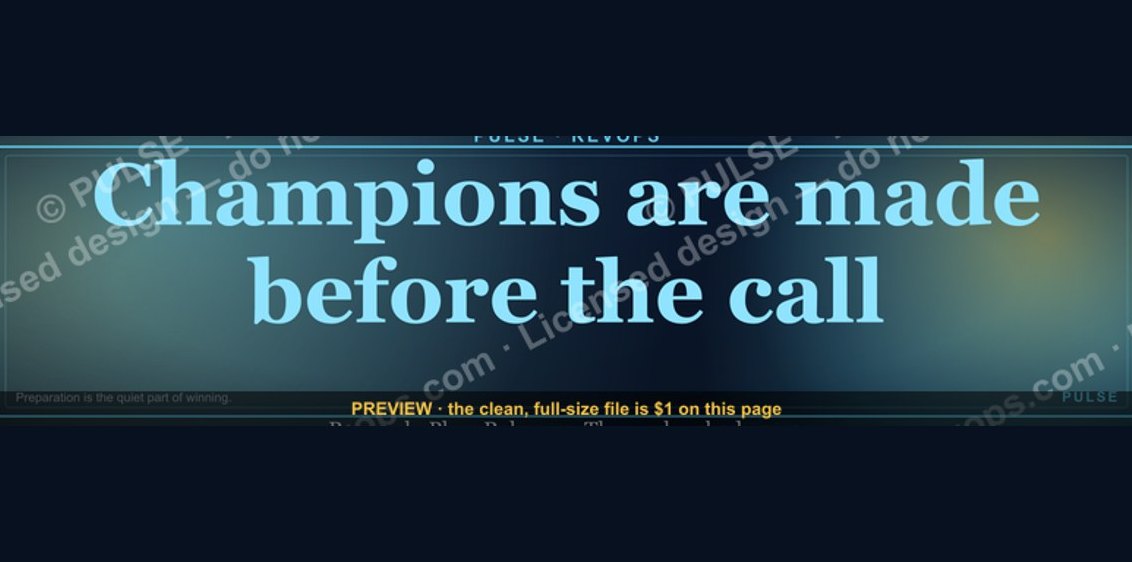 graphic“Champions are made before the call.” — LinkedIn Banner
 graphicOne team. One number. — LinkedIn Wallpaper
 graphicHow to build a champion seller playbook in 2027
 graphicSIEM and Data Lake CRO — LinkedIn Banner
 graphic“Hire slow. Ramp fast.” — LinkedIn Banner
 graphicSpeed to lead wins. — LinkedIn Wallpaper
 graphic“Looking for my next quota.” — LinkedIn Banner
 graphicAccount Executive — LinkedIn Banner
 graphic“More pipeline, less panic.” — LinkedIn Banner